

Summary
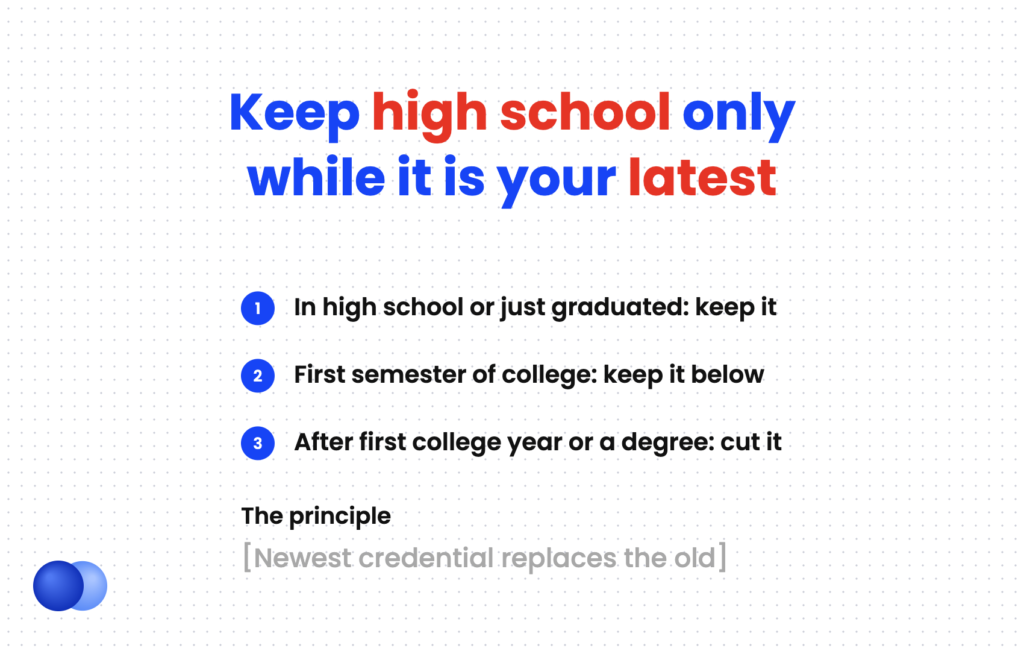
Put high school on your resume only while it is your most recent or highest education: as a high school student, a recent graduate, a first-semester college student, or an adult whose highest credential is a diploma. Remove it after your first year of college or once you have a degree. Keep it as one line with school, city and graduation year, and move any standout achievement into an awards line.
Should I put high school on my resume? Yes, if it is your highest or most recent education. No, once you have finished a year of college or earned any degree, because the newer credential replaces it.
The question sounds simple, yet the right answer changes as you move from student to graduate to professional. Most people ask it at one of three moments: applying for a first job, starting college, or rewriting a resume after years of work.
This guide gives you a stage-by-stage rule, the exact format, the details worth keeping, and the narrow exceptions where an old high school line still earns its space.
Should I put high school on my resume at every career stage?
No. Include high school on your resume while you are in high school, right after graduation, during your first semester or year of college, and whenever a diploma is your highest education. Remove it after your first year of college, once you earn a degree, or when work experience fills the page.
Use this table to find your stage. It is the fastest answer to "should I put high school on my resume" for your situation.
| Your stage | Keep high school? | Why |
|---|---|---|
| Still in high school | Yes, as main education | It is your only education |
| Graduated, not in college | Yes | It is your highest credential |
| First semester of college | Yes, below college | College record is still thin |
| After first year of college | No | College now carries the section |
| Associate or bachelor's degree | No | The degree implies a diploma |
| Diploma is highest, years of work | Yes, one line | Meets "diploma or equivalent" screens |
Career centers draw the line early. Georgia Tech's first-year seminar text tells students they need to remove any high school activities from the resume after the first year of college. Oklahoma State's engineering career services goes further: after the first semester of freshman year, remove all high school accolades.
Most students already follow that advice. In a text-matching analysis of 77,136 resumes on its platform that mention college, Simplify found that only 3.1% still carried a high school line. The company calls the figure directional, but the pattern is clear.
When does high school belong on a resume?
High school belongs on a resume when it is your highest or most recent education, when you are still in school, when a job requires a diploma or equivalent and you have no degree, or briefly in your first college semester. In each case it answers a real screening question rather than filling space.
Four situations justify the line.
You are still in high school. Education is your main credential. Our guide to the high school resume shows how to build the whole page around it.
You graduated and did not go to college. The diploma is your highest education, so it stays. That is also the case years later.
You are in your first college semester. A lone "enrolled" line looks thin. Keep high school below the college entry until you have grades and coursework to show.
The job asks for a diploma. BLS data shows occupations whose typical entry-level requirement is a high school diploma or equivalent made up 35.4% of US employment in 2025. Those postings screen for the credential, so make it easy to find.
A diploma or equivalent is also the formal bar for many federal jobs. OPM defines it as a high school diploma, a GED equivalency certificate, or a state proficiency certificate. If your credential is an equivalency, see today's guide on how to put a GED on a resume.
When should you take high school off your resume?
Take high school off your resume after your first year of college, as soon as you earn an associate or bachelor's degree, or when experience and skills fill the page. A higher degree already proves you finished high school, so the extra line only takes space from stronger evidence.
The logic is about recency and proof. Recruiters read the Education section to see your latest and highest training. A degree answers that. A high school line next to it adds nothing new.
Keeping it too long also sends a signal. It can suggest the resume has not been updated, or that the college record is thin.
Drop it in these cases:
- After your first full year of college. Replace it with relevant coursework, projects or campus roles. See how to list relevant coursework on a resume.
- Once you have a degree. An associate degree on a resume or a bachelor's makes the diploma redundant.
- When space is tight. If the line pushes useful content to a second page, cut it first.
Move the achievement, not the school
If you won something significant in high school, such as a state title or a national scholarship, you do not need the school line to keep it. Move it into an Awards or Honors section with the year. The achievement stays visible while the Education section reflects where you are now.
How should I list high school on my resume?
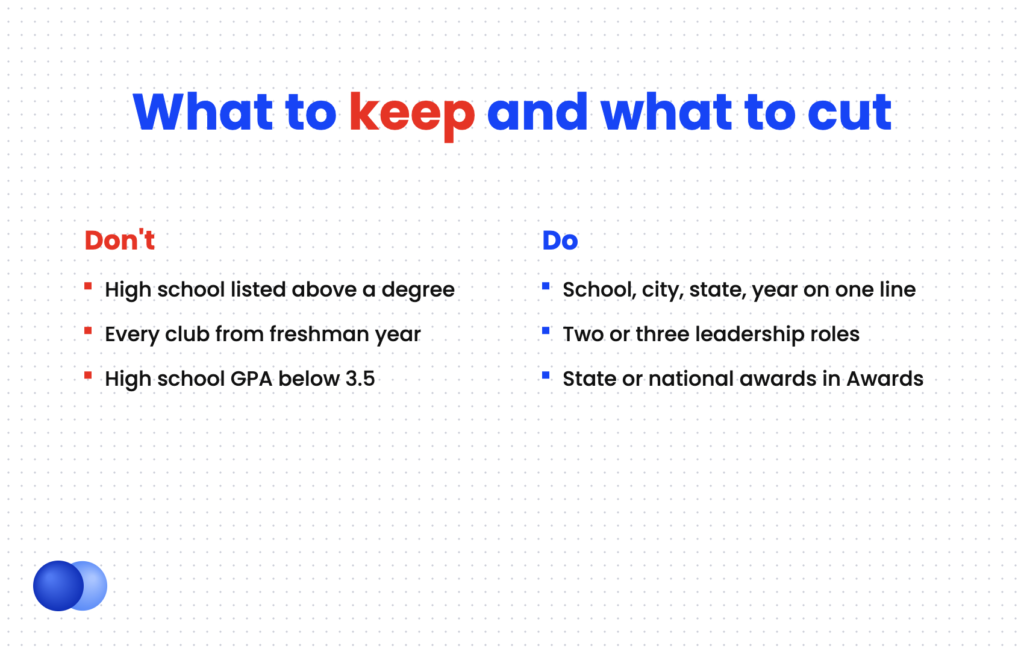
List the school name, city and state, and graduation year or expected graduation date on one or two lines. Add GPA only if it is 3.5 or higher, and add one line of honors or relevant coursework only if you have no college yet. Put the entry below any college education, never above it.
The format is short. Use one of these depending on your stage.
STILL IN HIGH SCHOOL EDUCATION Roosevelt High School, Des Moines, IA Expected graduation: June 2027 | GPA: 3.7 Relevant coursework: AP Computer Science A, Statistics
RECENT GRADUATE, NO COLLEGE EDUCATION Roosevelt High School, Des Moines, IA — High School Diploma, 2025
FIRST SEMESTER OF COLLEGE EDUCATION Iowa State University, Ames, IA B.S. in Mechanical Engineering, expected May 2030 Roosevelt High School, Des Moines, IA — Diploma, 2026
EXPERIENCED, DIPLOMA IS HIGHEST EDUCATION High School Diploma, Roosevelt High School, Des Moines, IA
Notice the last example drops the year. For experienced candidates, the graduation year adds little and can invite age assumptions. Our guide to how far back a resume should go covers that trade-off.
For GPA rules, see should I put GPA on my resume. The same 3.5 threshold most guides use applies to high school grades.
What high school details are worth keeping?
Keep only details that prove a skill the job needs: a high GPA, a leadership role, a work-relevant course, or a state or national award. Cut routine clubs, attendance awards and anything older than your college record. Once you are in college, most of these move to Awards or disappear.
Students often list every club. Recruiters skim, so pick the two or three strongest items.
Worth keeping while high school is your main education:
- Leadership roles. Team captain, club president, student government. Today's guide to extracurricular activities on a resume shows how to write them.
- Recognized awards. Honor roll, National Merit, state competitions. See awards on a resume for the format.
- Relevant courses or certifications. AP courses, dual-enrollment credits, or a career-tech certificate tied to the job.
- Part-time jobs. These go under Experience, not Education. Our guide to making a resume for your first job covers them.
Some achievements outlast the school line. An Eagle Scout rank, for instance, often stays on a resume for years; see Eagle Scout on a resume.
Keep high school while it is your highest or most recent education
List high school above a college degree do: Write school, city, state and year on one line dont: Keep high school clubs after your first year of college do: Move a national or state award into an Awards section dont: Add a high school GPA below 3.5 do: Keep a diploma line if it is your highest credential dont: Drop education entirely when a posting requires a diploma
What if high school is your highest education?
If a high school diploma is your highest education, keep it on your resume permanently as a single line. It satisfies the "high school diploma or equivalent" requirement that ATS filters and application forms check. Place it at the bottom, below experience, and strengthen the section with certifications or training.
Many strong careers run on a diploma plus experience and certifications. The diploma line stays because applicant tracking systems and application forms often ask about it directly. Leaving it off can get you filtered out of a job you are qualified for.
Keep it simple:
- One line, at the bottom of the page
- No graduation year once you have several years of experience
- Certifications and training listed right next to it
The education line also has a real payoff. In 2025, workers whose highest education was a high school diploma earned a median of $966 a week, against $770 for those without one.
When the page is ready, run it through the Rezoom ATS resume checker to confirm the Education section parses as education and not as stray text.

Frequently asked questions
Should I put high school on my resume if I am in college?
Only during your first semester or first year. After that, your college record replaces it, and career centers advise removing high school activities.
Do employers care about high school?
They care whether you have a diploma or equivalent when the job requires one. Beyond that, they focus on your most recent education and experience.
Should I put my high school on LinkedIn?
It is optional. Many people keep it on LinkedIn for alumni networking even after removing it from the resume, since the profile has no space limit.
Should I list my high school graduation year?
Yes while you are a student or recent graduate. Leave it off once you have several years of work experience and the diploma is your only education line.
Should I put high school on my resume if I dropped out of college?
Yes. Keep the diploma, and list the college coursework above it with credits completed. Our guide to [unfinished degrees](https://rezoom.io/how-to-list-an-unfinished-degree-on-resume/) shows the format.
Can I leave education off my resume entirely?
You can if the job has no education requirement, but it is risky. Many applications screen for a diploma or equivalent, so one line is safer.



Comments