

Summary
List a GED on a resume when it is your highest education credential or when a job asks for a high school diploma or equivalent. Write the credential name, the issuing state or agency, and the year, in the Education section. Name it accurately rather than calling it a high school diploma. Once you earn a college degree, drop the GED, because the degree already proves you met the high school requirement.
Put your GED on a resume in the Education section, written as the credential name, the issuing state and the year you earned it. If it is your highest credential, list it. If you later finish a college degree, remove it.
That is the short version. The details matter more than most guides admit, though. Whether you write "GED" or "High School Equivalency Diploma," whether you add a city, and what you pair it with all change how strong the line looks.
This guide covers how to put a GED on a resume in five common situations, how employers and federal agencies treat the credential, and the mistakes that make an equivalency look weaker than it is.
Should you put a GED on a resume?
Yes, if the GED is your highest completed education or the job asks for a high school diploma or equivalent. Leave it off once you hold an associate or bachelor's degree, because the degree implies you met the high school requirement. If you have some college but no degree, list the college work first and keep the GED below it.
A GED on a resume answers one screening question: did this person meet the high school requirement? Many entry-level postings, application forms and ATS knockout questions ask exactly that.

The answer depends on what else you have. Use this table as a decision rule.
| Your situation | Include the GED? | What to list |
|---|---|---|
| GED is your highest education | Yes | GED line in Education |
| GED plus certifications or trade training | Yes | GED, then certifications |
| GED plus some college, no degree | Yes | College coursework first, GED below |
| Associate degree or higher | No | Degree only |
| Still preparing for the GED | Yes, if close | GED with expected completion date |
Scale matters here. BLS data shows occupations whose typical entry-level education is a "high school diploma or equivalent" accounted for 35.4% of US employment in 2025. Your GED qualifies you for that whole bracket, so show it clearly.
How do you list a GED on a resume?
Write the credential name, the issuing state or agency, and the year earned on one line in your Education section. For example: "GED (High School Equivalency), Texas Education Agency, 2023." Add a city only if you earned it through a local program. Skip scores unless they are high and the employer values them.
Use this formula for a GED on a resume:
Credential name | Issuing state or agency | Year earned
You can also name the testing center or adult education program in place of the agency. That works well if a local program is known to employers in your area.
GED IS YOUR HIGHEST EDUCATION EDUCATION GED (High School Equivalency), Texas Education Agency, 2023
GED PLUS CERTIFICATIONS EDUCATION & CERTIFICATIONS GED, New York State Education Department, 2022 OSHA 10-Hour General Industry, 2024 Certified Forklift Operator, 2024
SOME COLLEGE, NO DEGREE EDUCATION Houston Community College, Houston, TX Coursework toward A.A.S. in Business Administration (24 credits), 2023–2024 GED (High School Equivalency), 2022
STILL PREPARING EDUCATION GED (High School Equivalency), expected May 2027 Passed: Mathematical Reasoning, Science
The "some college" format is the most underused. Credits toward a degree show more than the GED alone. Our guide to how to list an unfinished degree on a resume covers that line in detail.
If you earned the GED years ago and have since built a track record, keep the line short. One line at the bottom is enough. For broader formatting choices, see how to list education on your resume.
Should you write GED or high school diploma?
Write the credential accurately. Use "GED," "High School Equivalency" or the exact name your state prints on the certificate, such as "Texas Certificate of High School Equivalency." Do not list a high school name with "diploma," because background checks verify education with the issuing state, and a mismatch can cost you the offer.
Some candidates worry that "GED" reads as second-best and swap in "High School Diploma." That is a mistake, and it is not necessary.
In many states, the state education agency issues the equivalency credential, not the testing company. Texas, for example, awards the Texas Certificate of High School Equivalency (TxCHSE) to people who pass an approved test. It also tells colleges and employers to verify certificates directly through its official search tool.
That verification step is the reason to stay precise. If your resume names a high school you left, and the background check returns a state equivalency, the gap looks like a misstatement.
Accurate options that read well:
- GED (High School Equivalency) — clear and recognized everywhere
- High School Equivalency Diploma — fine if that is your state's wording
- [State] Certificate of High School Equivalency — the most precise
Match the job application, not just the resume
Online applications often ask "Highest level of education" with a dropdown. Pick "High school diploma or equivalent" or "GED" there, and use the same wording on your resume. Consistent answers across the form, the resume and the background check remove any reason for a recruiter to pause.
How do employers treat a GED?
Most US employers treat a GED as meeting a "high school diploma or equivalent" requirement. The federal government does so explicitly: OPM counts a GED equivalency certificate as high school graduation. What separates candidates after that is experience, skills and certifications, so give those more space than the GED line.
The federal rule is the clearest benchmark. OPM defines high school graduation or equivalent as a high school diploma, a GED equivalency certificate, or a proficiency certificate from a state or territorial Board or Department of Education. For federal jobs, a GED meets the same bar as a diploma.
Private employers usually follow the same logic. Their postings say "high school diploma or equivalent" for that reason.
The credential still pays off in plain numbers. In 2025, workers whose highest education was a high school diploma had median weekly earnings of $966 and an unemployment rate of 4.3%. Workers without one earned $770 and faced a 6.1% unemployment rate.
What matters after the screen is everything else on the page. Put your effort into work history, skills and results. If you are light on paid work, our guide to writing a resume with no experience shows how to fill the page with projects and volunteer work.
What about HiSET, TASC and other equivalency credentials?
Treat HiSET, the discontinued TASC, and state adult high school diplomas exactly like a GED on a resume. Name the credential, the issuing state and the year. TASC was discontinued at the end of 2021, but a TASC-based credential you already earned stays valid, so list it as your state names it.
The GED is not the only route. Your state may have offered a different test, and that changes only the wording.
- HiSET. The HiSET program describes its credential as an official way of showing that your academic skills match those of high school graduates. List it as "HiSET (High School Equivalency), [State], [Year]."
- TASC. Its provider discontinued TASC on December 31, 2021, and New York switched to the GED in January 2022. Your credential remains valid. Use the name on your certificate.
- Adult high school diploma. Some districts and community colleges award these. List the issuing program and year like any diploma.
If a reader may not know the test name, add "High School Equivalency" in parentheses. It costs three words and removes any confusion.
Where should a GED go on a resume?
Put the GED in the Education section, below your work experience if you have relevant jobs, and above it only if you have little or no work history. Pair it with certifications, trade training or college credits when you have them. Never give it a section of its own or more than one line.
Placement follows a simple rule: lead with your strongest evidence. For most people with jobs behind them, that is experience. For career starters, it may be education plus training.
Strong companions for a GED line:
- Certifications. OSHA, CDL, CNA, CompTIA or forklift credentials often matter more to employers than the GED itself. See our guide to resume certifications.
- College credits. Even a few completed courses show momentum.
- Military training. Service schools and specialties translate well; our military to civilian resume guide shows how.
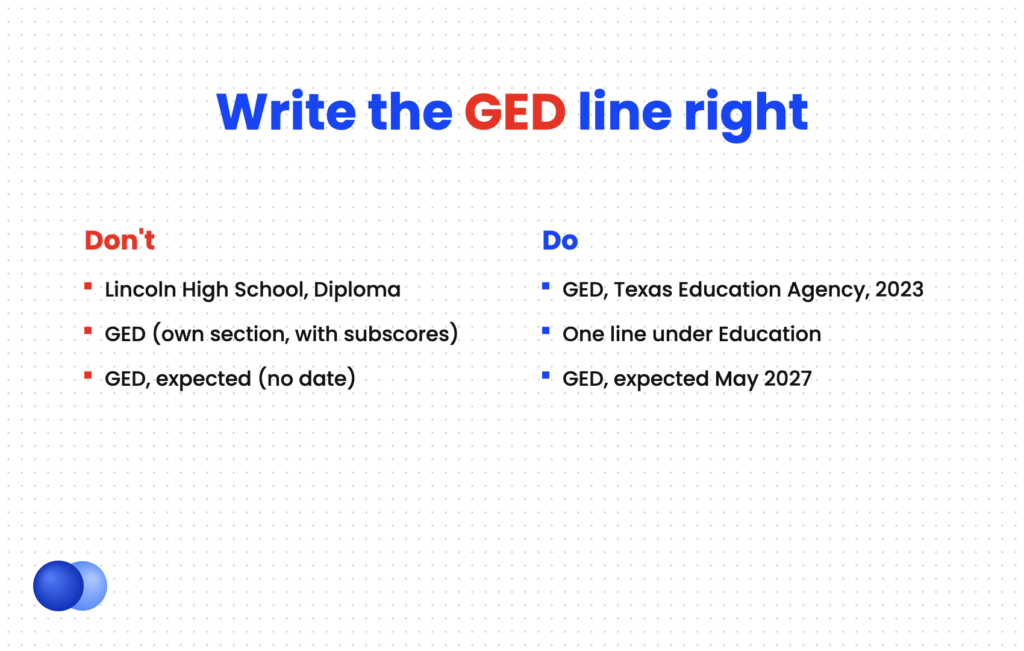
Write "GED (High School Equivalency), [State], [Year]" on one line
List a high school you left with the word "diploma" do: Put certifications and college credits next to the GED dont: Give the GED its own section or add test subscores do: Drop the GED once you earn an associate degree or higher dont: Apologize for or explain the GED anywhere on the resume do: Use the same wording on the application form and the resume dont: Leave education blank when a posting requires a diploma or equivalent
When you add an associate degree later, the GED comes off. Today's companion guide on how to list an associate degree on a resume shows the format that replaces it. And if you are weighing whether to show any pre-college education, see should I put high school on my resume.
To build the full page in minutes, the Rezoom AI resume builder formats your Education section, certifications and experience in an ATS-friendly layout.

Frequently asked questions
Is it bad to put a GED on a resume?
No. A GED meets the "high school diploma or equivalent" requirement for most jobs, and OPM accepts it for federal roles. Leaving it off when it is your highest credential is the bigger risk.
Should I put my GED on my resume if I went to college?
If you finished a degree, no. If you have college credits but no degree, list the college coursework first and keep the GED on the line below.
Do employers check if you have a GED?
Many do, through background checks that verify education with the issuing state. Texas, for example, directs employers to its official certificate search.
Should I list my GED score on a resume?
Usually not. Employers screen for the credential, not the score. Mention a score only if a program or employer explicitly asks for it.
Can I say high school diploma instead of GED?
Only if your credential is actually called a diploma by your state. Otherwise use "GED" or "High School Equivalency" to keep the resume consistent with background checks.
How do I list a GED I am still working on?
Write "GED (High School Equivalency), expected [Month Year]" and list any subject tests you have passed. Remove "expected" once you finish.



Comments