Highest Level of Education on Job Application: What to Pick
Highest level of education on job application forms: what to pick for a GED, some college, a degree in progress, a certificate or a foreign degree, and why.

On this pageWhat does highest level of education mean on a job application?
- What does highest level of education mean on a job application?
- Why do employers ask for your highest level of education?
- Which option should you pick in the education dropdown?
- What should you select if you are still in school or graduating soon?
- How do you answer for an unfinished degree, a certificate or a foreign degree?
- Do employers verify the highest level of education on job application forms?
- What should you check before you submit?
- FAQ
- Sources
Pick the highest level you have fully completed, not the one you attended or plan to finish. A GED counts as a high school diploma. College credits without a degree go under "Some college, no degree." If you are still in school, pick your last finished level unless the form offers "in progress" or an expected date. Never overstate it, because background checks confirm the degree title and award date.
For the highest level of education on job application forms, select the top level you have fully completed. A GED counts as high school. College credits without a diploma count as "Some college." A degree you are still earning counts only if the form offers "in progress."
The field looks simple, but the wrong click can cost you. Some systems screen out applicants below a set level. And if you pick a degree you don't hold, a background check can catch it after you get the offer.
Quick answers by situation
| Your situation | What to select | Example line |
|---|---|---|
| You have a GED or HiSET | High school diploma or equivalent | "High school diploma / GED, 2021" |
| You took college classes but did not finish | Some college, no degree | "Some college: 45 credits, Business" |
| You graduate in May and it's now March | Your last finished level, or "in progress" if offered | "Bachelor's, expected May 2027" |
| You earned a trade or technical certificate | Certificate, if listed; otherwise high school | "HVAC technician certificate, 2024" |
| You hold a JD, MD or PharmD | Professional degree | "Juris Doctor, 2019" |
| Your degree is from outside the US | The closest US level, per a credential evaluation | "Bachelor's (US equivalent, evaluated)" |
What does highest level of education mean on a job application?
It means the top level of school you have finished, with the diploma or degree awarded. It does not mean the level you attended, are enrolled in now or almost finished. So a senior three months from graduation still picks high school or "Some college" unless the form offers an "in progress" choice.
Most forms borrow their options from the government's survey categories. The US Census Bureau puts the rule in one line.
Educational attainment refers to the highest level of education that an individual has completed.
U.S. Census Bureau, About Educational Attainment
The Census page adds that attainment is "distinct from the level of schooling" you attend now. That means "completed" is the key word, even when the form leaves it out.
"Completed" vs "attended"
Some forms ask for "highest level attended" or "highest grade completed." Read the label before you pick. If it says attended, you can choose the level you reached. If it says completed, or says nothing, choose the level you finished.
Why do employers ask for your highest level of education?
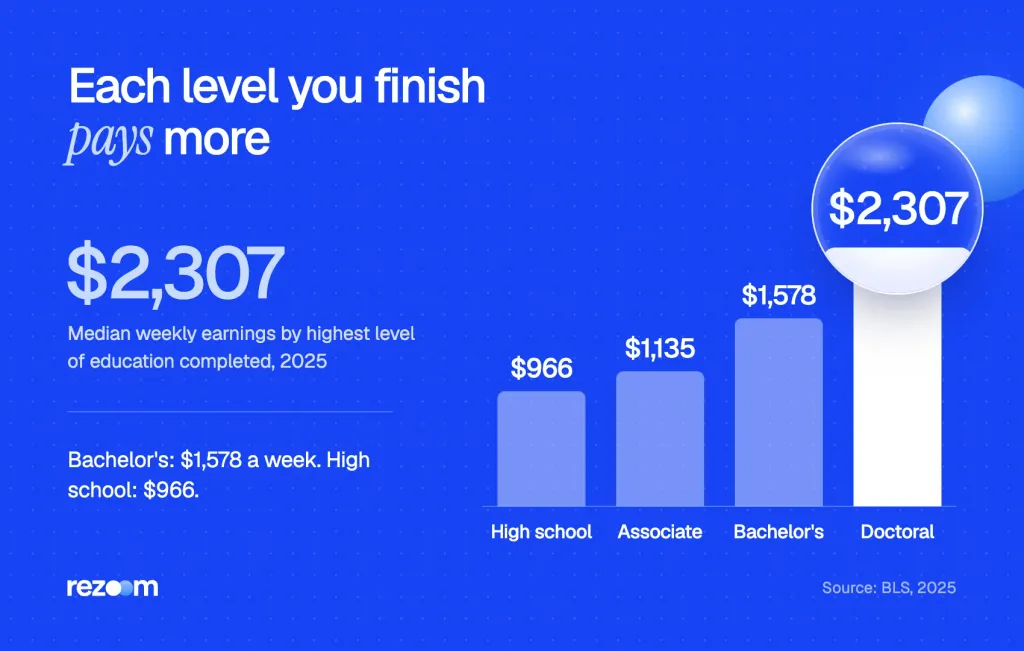
Employers use the field to screen for a job's minimum requirement and to report hiring data. Many systems filter on it, so a wrong pick can hide you from a recruiter. The level also tracks with pay: in 2025 BLS data, bachelor's degree holders earned a median $1,578 a week, against $966 for high school graduates.
A job post might say "bachelor's degree required" or "high school diploma or GED." So the dropdown gives the recruiter a quick yes or no. If you pick a level below the minimum, the system may never show you to a person.
The levels line up with pay
The Bureau of Labor Statistics tracks the same levels you see on most forms. Its 2025 earnings and unemployment table2 shows median weekly pay rising at each step. Workers with a doctorate earned $2,307 a week, and the unemployment rate fell from 6.1% without a diploma to 1.8% with a doctorate.
| Highest level completed | Median weekly earnings, 2025 | Unemployment rate, 2025 |
|---|---|---|
| Less than high school | $770 | 6.1% |
| High school diploma | $966 | 4.3% |
| Some college, no degree | $1,062 | 3.8% |
| Associate degree | $1,135 | 3.0% |
| Bachelor's degree | $1,578 | 2.8% |
| Master's degree | $1,876 | 2.6% |
| Professional degree | $2,294 | 1.9% |
| Doctoral degree | $2,307 | 1.8% |
BLS notes that its 2025 figures are 11-month averages, since October data went uncollected during the federal shutdown. They cover workers 25 and older who work full time.
Which option should you pick in the education dropdown?
Match your finished credential to the closest label. A GED or other equivalency is "High school." Any college credit without a degree is "Some college, no degree." Law, medical and pharmacy degrees are "Professional." A PhD or EdD is "Doctorate." If two options fit, pick the one the job post names.
Most US forms use the same eight or so levels. USAJOBS, for example, offers these academic levels4: high school or equivalent, technical certificate, associate, some college, bachelor's, master's, doctorate and professional.
High school diploma vs GED
Pick "High school diploma or equivalent" for a GED, HiSET or state equivalency. BLS counts a GED in its high school graduate category3. The GED Testing Service also says most colleges and employers5 see the GED and a diploma as the same.
If the form has a separate "GED" option, pick that one, so your answer matches your records.
How to list a GED on a resume: the exact Education line, GED vs high school diploma, HiSET and TASC, and when to drop it. 5 examples to copy word for word.
Some college, no degree
Choose this if you finished at least one college course but never earned a degree. BLS uses that exact rule for "some college." Then list your credits and major in the text box, if there is one, because "Some college" alone says little.
Associate, bachelor's and graduate degrees
Pick the highest degree you hold, even if your field changed. A nurse with an associate degree and a later bachelor's in business picks "Bachelor's." If you hold two master's degrees, pick "Master's" and list both in the detail fields.
Professional degree vs doctorate
BLS gives law and medicine as examples of professional degrees3. So a JD, MD, DDS or PharmD goes under "Professional." Choose "Doctorate" for a research degree such as a PhD or EdD.
The dropdown gives one word, but the free-text fields below it can say much more. Add your credits, major or expected date there. A recruiter who reads "Some college, 90 credits, Accounting" sees a near-graduate, not a dropout.
What should you select if you are still in school or graduating soon?
Select your last finished level unless the form offers "in progress," "currently enrolled" or an expected graduation date. If it does, pick the degree you are working toward and enter the month and year you expect to finish. Never pick the degree alone with no date, since that reads as finished.
USAJOBS gives a clear rule for federal jobs. Its education help page4 says to select the degree and enter the expected completion date if you are still completing it. Many private forms work the same way.
Highest level: [Your last finished level]
Degree in progress: [Degree], [Major], [School]
Expected graduation: [Month Year]
High school senior: High school (in progress), expected June 2027 College junior, no "in progress" option: Some college, no degree (75 credits) College senior with an expected-date field: Bachelor's degree, expected May 2027
Your resume should tell the same story as the form. Our student resume examples show how to put an expected date at the top of the education section. If you finish in the spring, these college graduate resume examples show how to lead with a new degree and internships.
College graduate resume example
See how a new graduate lists the degree, graduation date and internships in a clean education section.
When the form leaves no room for an expected date, put it in your cover letter's first lines. These student cover letter examples show how to mention a graduation date without making it the whole letter. For the resume side, see how to list an expected graduation date on a resume.
Free ATS score, the text the software extracts and your missing keywords. No sign-up.
How do you answer for an unfinished degree, a certificate or a foreign degree?
For an unfinished degree, pick "Some college, no degree" and list your credits. For a trade or technical certificate, pick "Certificate" if the form has it, or your last school level if not. For a foreign degree, pick the closest US level and back it with a credential evaluation when the employer asks.
These three cases cause the most wrong picks. So here is the rule for each.
An unfinished degree
Leaving school before the degree is common, but it doesn't count as the degree on a form. Pick "Some college," then add the school, major and credits you earned. Our guide on how to list an unfinished degree on a resume shows the matching resume lines.
Some college, no degree State University, Business Administration, 2021 to 2023 60 credits completed
Certificates and trade programs
BLS says vocational or trade training outside a regular school generally doesn't count as some college3. So if the dropdown has no certificate option, pick your last school level. Then list the certificate in the certifications section, or see our guide to resume certifications.
A degree from another country
Pick the US level that best matches your degree. Then be ready to prove it. NIH, for example, asks applicants with foreign education10 to get an evaluation from a member of NACES or AICE before it makes an offer.
How to list an unfinished degree on resume: 5 example formats for some college, a paused degree or one in progress, plus where it goes and how to explain it.
Do employers verify the highest level of education on job application forms?
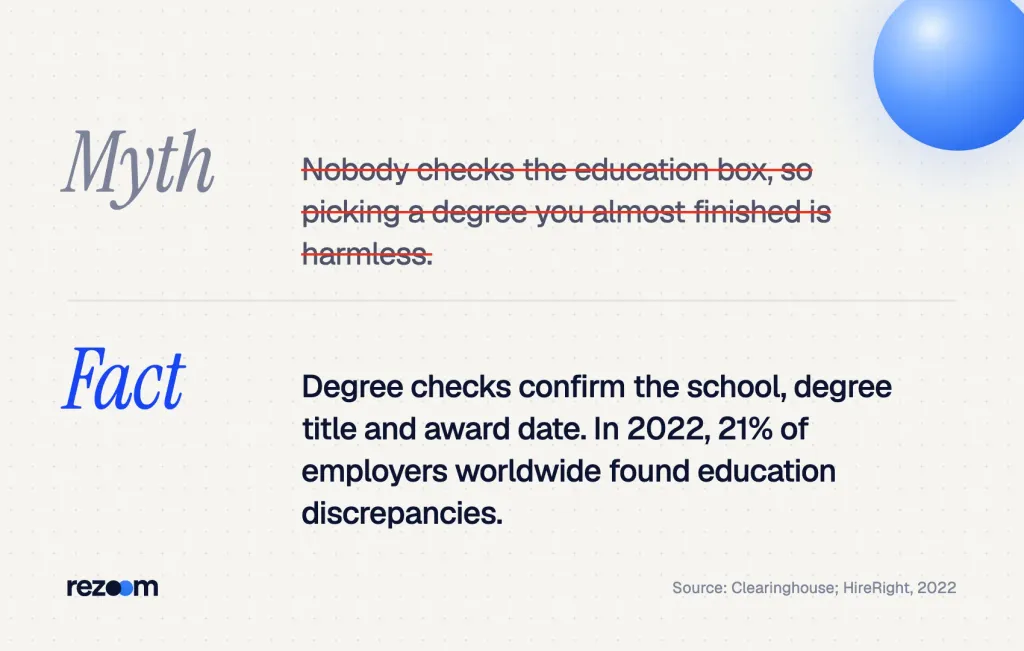
Many do, and it is quick. Screening firms confirm the school, the degree title and the award date, often through the National Student Clearinghouse. In HireRight's 2022 survey, 41% of US and Canadian employers with a screening program ran education checks, and 21% of employers worldwide found education discrepancies.
A degree check is fast and cheap for employers. The National Student Clearinghouse says its DegreeVerify reports6 always include the school name, degree title and award date. They may also show your major and dates of attendance.
How often employers check
Not every employer checks, but many do. HireRight's 2022 benchmark data7 found that 41% of US and Canadian employers with a screening program ran education checks. Worldwide, 21% of employers found education discrepancies.
First Advantage, which now runs Sterling's screening, says its education checks8 confirm degrees, majors and graduation dates. So a check would quickly catch a "Bachelor's" pick that has no award date behind it.
What happens if you overstate
A SHRM article on degree fraud9 lists four things screeners confirm: the school exists, it holds accreditation, you attended when you said, and it granted the degree. If one fails, the employer can pull the offer, even after you start.
- Find your exact credentialCheck your diploma or transcript for the degree title and award date.
- Read the field labelLook for "completed," "attended" or "in progress" before you pick.
- Pick the closest true levelChoose the level you finished, or the in-progress option if the form has one.
- Add detail in the text boxList credits, major or an expected date so the recruiter sees the full picture.
- Match your resumeMake sure your resume shows the same level and dates as the form.
What to say if they push back
- "The job asks for a bachelor's. Why did you apply?" Point to your credits and experience. Say when you expect to finish, if you are enrolled.
- "Your form says Some college. Did you drop out?" Keep it short and true: "I completed 60 credits, then took a full-time role. I still use what I learned."
- "Is your GED the same as a diploma?" Yes, for nearly every employer. Say it plainly and move on to your skills.
- "Can you prove your foreign degree?" Offer a credential evaluation from a NACES or AICE member, or say you have ordered one.
Interviewer: "This role lists a bachelor's degree. You selected Some college."
"That's right. I finished 90 credits in accounting, then ran payroll for 40 staff for three years."
Interviewer: "Do you plan to finish?"
"Yes. I'm enrolled online, and I expect to graduate in December 2027."
Do
- Pick the level you finished, with the degree awarded.
- Choose High school or equivalent for a GED.
- Use the in-progress option and an expected date if offered.
- Keep the form, resume and interview story the same.
Don’t
- Pick a degree you are close to but don't hold.
- List a certificate as an associate degree.
- Guess a US level for a foreign degree you can't back up.
- Leave the detail box blank when it can help you.
What should you check before you submit?
Before you submit, confirm the level you picked is one you finished, or is clearly marked as in progress with a date. Check that your resume shows the same level, school and dates. If your degree is foreign, have an evaluation ready. Then review the other form fields with the same care.
Before you submit
If a post says "associate degree or equivalent experience," your detail box can show that equivalence. Write your years of related work next to your education. Then the recruiter can match you to both halves of the rule.
Education is one field among many. Our guides on how to list education on your resume and the earliest start date on a job application cover the next questions you'll see. When your resume needs a refresh before you apply, our free AI resume builder can format your education section in minutes.
Tailored to the job post, checked against ATS.
Frequently asked questions
Does a GED count as a high school diploma on a job application?
Yes. Pick "High school diploma or equivalent." BLS counts a GED as a high school credential, and most employers treat the two the same.
What do I put if I'm still in college?
Pick your last finished level, unless the form offers "in progress." If it does, pick the degree you're earning and add your expected graduation date.
Should I select "Some college" if I took one class?
Yes, if you finished at least one college course for credit. Then list your credits in the detail box so the recruiter sees how far you got.
Is a certificate a higher level than high school?
Only if the form lists "Certificate" as an option. If it doesn't, pick high school and add the certificate in a separate field or on your resume.
Is a JD a doctorate or a professional degree?
Pick "Professional degree." BLS groups law and medical degrees as professional degrees, apart from research doctorates like a PhD.
Can an employer find out if I lied about my education?
Yes. Background checks confirm the school, degree title and award date, often in a day or two. An overstated degree can cost you the offer or the job.
Sources
We opened and read each page below. The small numbers in the text point here. Pages that carry no publication date show n.d.
- U.S. Census Bureaun.d.
Educational attainment is the highest level of education a person has completed, distinct from the level they attend now.
- U.S. Bureau of Labor Statistics2025
In 2025, median weekly earnings ranged from $770 without a high school diploma to $2,307 with a doctorate.
- U.S. Bureau of Labor Statisticsn.d.
BLS counts a GED as a high school credential and defines "some college" as one or more courses at a regular school.
- USAJOBSn.d.
Applicants still completing a degree select that degree and enter the expected completion date.
- GED Testing Service2022
Most colleges and employers see the GED and a high school diploma as the same.
- National Student Clearinghousen.d.
DegreeVerify reports always include the school name, degree title and award date.
- HireRight2023
In 2022, 41% of US and Canadian employers with a screening program ran education checks, and 21% of employers worldwide found education discrepancies.
- First Advantage2026
Education background checks confirm degrees, fields of study and graduation dates.
- SHRM2017
Degree checks confirm the school exists, holds accreditation, that the candidate attended and that it granted the degree.
- National Institutes of Healthn.d.
NIH requires a NACES or AICE member evaluation of foreign education before a job offer.
Mohammad has spent more than ten years designing consumer products and leads product at Rezoom, deciding what gets built and what gets left out. His guides cover the whole job search, from resume sections and cover letters to interview answers and career moves.
Goodi, M. (2026, November 11). Highest Level of Education on Job Application: What to Pick. Rezoom. https://rezoom.io/highest-level-of-education-on-job-application/