Do You Have Relatives Working for This Company? How to Answer
Do you have relatives working for this company? Learn who counts, what to write if yes, when it hurts, and the federal rule, with lines to copy for the form.

On this pageWhy do job applications ask "do you have relatives working for this company"?
- Why do job applications ask "do you have relatives working for this company"?
- Who counts as a relative on a job application?
- What should you write if you answer yes?
- Does answering yes hurt your chances?
- What are the rules for federal and government jobs?
- What if you don't know, or the interviewer asks about it?
- What should you check before you submit?
- FAQ
- Sources
Answer the question honestly. Employers ask so they can avoid one relative supervising or deciding pay for another, not to reject families. If you answer yes, give the person's name, how you're related and their department. A yes rarely blocks you unless the job would report to that relative. Federal law (5 U.S.C. 3110) bars officials from hiring or promoting their own relatives.
When a form asks "do you have relatives working for this company," answer truthfully. If yes, write the person's name, your relationship and their department. Employers use it to keep relatives out of each other's chain of command, not to screen out families.
The question looks personal, so many people pause on it. But it's usually a conflict-of-interest check. A plain, complete answer protects you, your relative and the employer.
Quick answers by situation
| Your situation | What to do | Example line |
|---|---|---|
| Your sibling works in another department | Answer Yes, add name, relationship, team | "Yes: Maria Lopez, sister, Accounting" |
| Your spouse or partner works there | Answer Yes and name the department | "Yes: Chris Hall, spouse, Warehouse, 2nd shift" |
| An in-law or step-relative works there | Answer Yes; most policies count them | "Yes: Dan Reed, brother-in-law, IT" |
| The relative would be your manager | Answer Yes and flag it | "Yes: Ann Cole, aunt, manages this team" |
| A friend works there, not family | Answer No | "No" |
| You aren't sure a distant cousin still works there | Answer Yes with a note, or ask HR | "Possibly: cousin, Tom Ruiz, location unknown" |
Why do job applications ask "do you have relatives working for this company"?
Employers ask so they can apply their employment-of-relatives policy. Most of these policies bar one relative from supervising, hiring, paying or reviewing another. Your answer tells HR whether the job you want would put you in that chain. It's a conflict-of-interest screen, and in most cases a yes simply means HR checks where each person sits.
The field also shows up as "List any relatives employed here" or "Are you related to a current employee?" Whatever the wording, it feeds the employer's anti-nepotism or "employment of relatives" policy. SHRM even publishes a sample employment of relatives policy1 for employers to adapt.
The real worry is the chain of command
These policies focus on control, not on family as such. Bowdoin College's nepotism policy2 won't place relatives where one "has supervision or influence over the other's employment." It also needs HR's approval before it hires or promotes someone related to a current staff member.
Some employers go further
Rules differ by employer. New York Institute of Technology's family relationships policy3 discourages relatives in the same department. If a later change puts two relatives under its rule, the one with less service must transfer, resign or leave within 30 days.
So the honest answer at the start saves everyone a much harder talk later.
Who counts as a relative on a job application?
Most policies count spouses, parents, children, siblings, grandparents, aunts, uncles, nieces, nephews and cousins. Many also count in-laws, step-relatives, half-siblings and domestic partners. Some public employers add people you live with in a romantic relationship. If the form gives no definition, list anyone who could plausibly count and let HR decide.
The definition depends on the employer, so read any note next to the field first. Here's how three real policies compare.
| Relationship | Federal law (5 U.S.C. 3110) | Bowdoin College | California state jobs (CalHR) |
|---|---|---|---|
| Spouse | Yes | Yes | Yes, current or former |
| Parent, child, sibling | Yes | Yes | Yes |
| In-laws | Yes | Yes | Yes, by marriage |
| Step and half relatives | Yes | Not listed | Not listed |
| First cousin | Yes | Not listed | Not listed |
| Grandparent or grandchild | Not listed | Yes | Not listed |
| Domestic partner | Not listed | Yes | Yes |
| Live-in romantic partner | Not listed | Not listed | Yes |
Partners and people you live with
Unmarried partners trip people up the most. California's state HR manual, in its nepotism policy4, covers relationships by "blood, adoption, current or former marriage, domestic partnership or cohabitation." It defines cohabitation as living with someone in a romantic relationship without being married.
But the same policy warns that asking about other relationships "may violate an employee's or applicant's right to privacy." So you don't need to list friends, roommates or exes the form doesn't name.
When to list it anyway
If you're unsure, list it with a short note. A cousin you rarely see costs you nothing to name. And a relationship you skipped can look like hiding something if it comes up after you start.
Write your relative's name the way it appears at work, not a family nickname. HR will search the employee list, so "Robert Kim" beats "Uncle Bobby." It's the same rule as typing your own legal name on a job application.
Previous names on job application forms: list former legal names like a maiden name, skip nicknames, and copy exact lines for marriage, divorce and more.
What should you write if you answer yes?
Write the relative's full name, how you're related, and their department or location. Add their job title if the form has room, and note it if they'd supervise the job you want. Keep it to one line. Don't explain your family history or argue your case in the box; HR only needs enough to check where each person sits.
The goal is to let HR find the person in one search. Three facts do that: who, how and where.
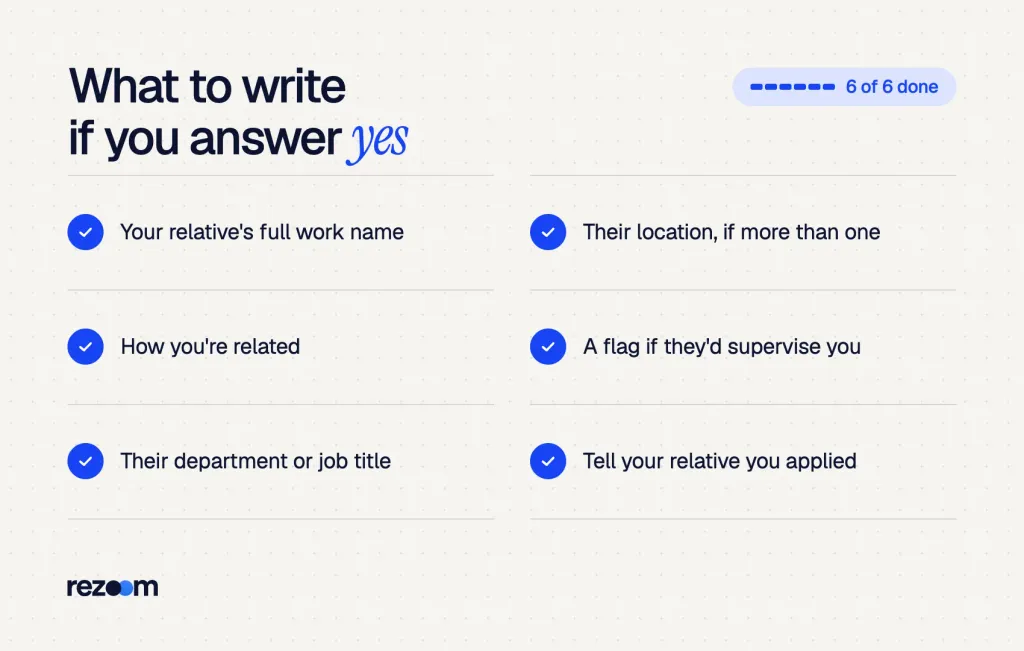
- Confirm the relative still works thereText them and ask for their current title and team. People move, and an old title can confuse HR.
- Get their work nameAsk how their name shows in the company directory, including any middle initial.
- Write name, relationship, departmentOne line, in that order. Add the location if the company has more than one site.
- Flag any reporting linkIf they'd manage, interview or approve pay for this job, say so plainly.
- Tell your relative you appliedThey may need to step out of the hiring process, and some employers ask them to disclose it too.
Yes: Maria Lopez, sister, Accounting (Dallas office) Yes: Chris Hall, spouse, Warehouse Supervisor, 2nd shift Yes: Dan Reed, brother-in-law, IT Help Desk. He has no role in this team.
Yes: [Full work name], [relationship], [department or job title], [location]. [Note if they would supervise this role.]
If the form only has a Yes/No box
Tick Yes, then add the details where the form allows. Use a comments box, the cover letter or a short note to the recruiter. If none exists, be ready to give the details at the screen.
Should you mention the relative in your cover letter?
Only if they referred you or the form gave no room. A short line is enough, and our HR cover letter examples show how to name a contact without leaning on them. A referral is a separate field, which our guide on how did you hear about us on a job application covers.
Does answering yes hurt your chances?
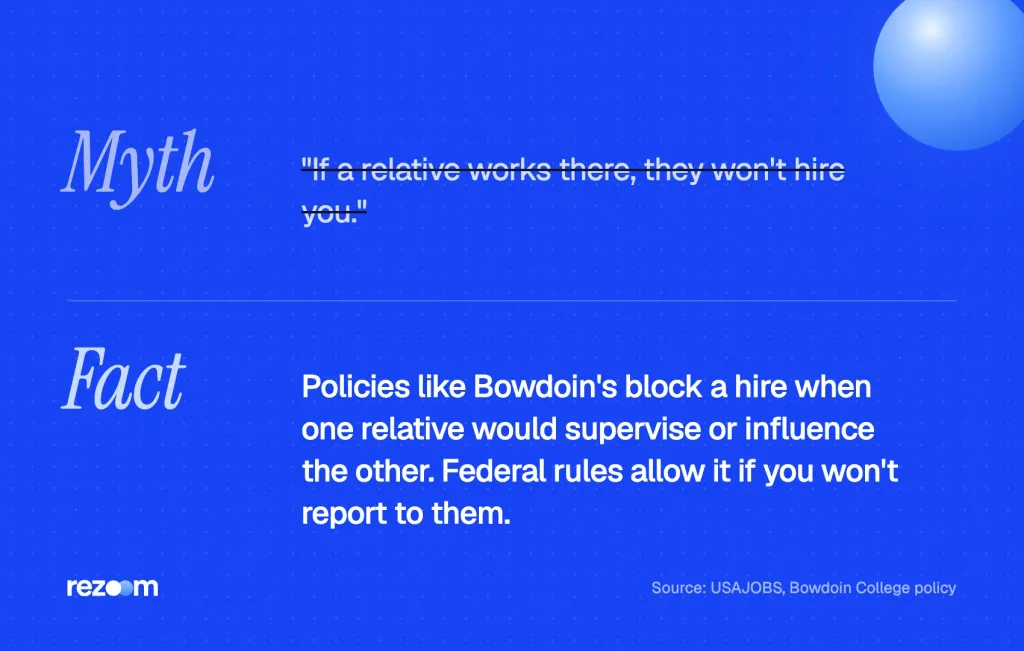
Usually not. Typical policies only block a hire when one relative would supervise or influence the other's job. If the role sits in another department, HR notes it and moves on. A yes can hurt when the job reports to your relative, and a hidden relationship can hurt far more than an honest one.
Federal jobs show the usual rule. USAJOBS says in its Pathways FAQ5 that you can apply at an agency where a relative works if "you would not be reporting directly to your relative." Your relative also can't advocate for your hiring or promotion.
When yes changes things
Expect a closer look when your relative would be your manager, your interviewer or the person who signs your timesheet. Then the employer may offer a different team or shift, or skip the hire. Some state laws also limit how far employers can go with married couples.
California, for example, bars a general ban on hiring spouses, per CalChamber's marital status guide7. Employers there can still keep spouses out of the same supervisory line for reasons tied to supervision, safety, security or morale. In a 2011 Hinshaw summary8, a Minnesota court treated a ban on married couples as illegal under that state's law.
This is general information, not legal advice. If a rule seems unfair, ask a local employment lawyer or your state's civil rights agency.
Who reads your answer
HR staff usually handle this field and any conflict-of-interest form that follows. If you work in HR yourself, the question carries more weight, because HR roles see pay, discipline and medical files. Browse these human resources resume examples to see how HR candidates show they handle confidential records.
Entry-level candidates can compare their draft with these HR assistant resume examples, which show onboarding, records and compliance work in plain bullets. That's the person who often checks your answer against the staff list.
HR assistant resume example
See how an HR assistant resume shows records, onboarding and confidential paperwork in clear bullet lines.
Hiding it is the real risk
Many offices are small enough that a relative turns up within weeks. Then the issue isn't the family tie; it's the false answer on a signed form. Most applications end with a line you sign saying your answers are true, so a wrong No can come back on you.
Free ATS score, the text the software extracts and your missing keywords. No sign-up.
What are the rules for federal and government jobs?
Federal law, 5 U.S.C. 3110, bars a public official from hiring, promoting or advocating for a relative in an agency they serve or control. The list covers spouses, parents, children, siblings, aunts, uncles, first cousins, nieces, nephews, in-laws, step-relatives and half-siblings. Anyone hired in violation isn't entitled to pay.
The federal rule targets the official, not you. The federal anti-nepotism statute6 says an official "may not appoint, employ, promote, advance, or advocate for appointment" of a relative in their agency. It also covers anyone with authority to recommend people for jobs there.
Who's on the federal list
The law names father, mother, son, daughter, brother, sister, uncle, aunt, first cousin, nephew and niece. It also lists husband, wife, every in-law pair, step-relatives and half-siblings. Grandparents and domestic partners aren't on it, but an agency or state can set wider rules.
What it means for you
If your relative works at the agency but has no say over your job, you can still apply. If they do have a say, they must stay out of it. The penalty is blunt: someone hired in violation "is not entitled to pay," per the statute.
State and city jobs often have their own rules, like the CalHR policy above. So read the posting and the agency's HR page, since a public form may ask the same question with a wider definition.
Be upfront about your relationship with your nephew from the beginning.
Johnny C. Taylor Jr., SHRM, 2025
SHRM's Ask HR column9 gave that advice to an employee who wanted to refer a relative. It applies just as well to you as the applicant.
What if you don't know, or the interviewer asks about it?
If you don't know whether a relative works there, answer No only if you've checked. Otherwise, write "Not sure" with the name, or ask the recruiter. If an interviewer asks, give the same facts as the form in two sentences, then steer back to why you fit the role.
Big employers make this hard. You may know a cousin "works at the hospital" without knowing which hospital. So send one text before you answer, the same way you'd check your earliest start date on a job application before you commit to it.
Possibly: Tom Ruiz, cousin. I believe he works at a different location but haven't confirmed.
What to say if they push back
- "Would that be a problem for you?" Say no and give the reason: "We're in different departments and he has no part in hiring for this role."
- "Did your relative help you get this interview?" Be exact. If they referred you, say so; if not, say you applied through the posting.
- "Why didn't you mention it on the form?" If you missed it, own it: "I wasn't sure my cousin still worked here. I've checked, and he does, in Facilities."
- "How often would you two work together?" Describe the real overlap, even if it's none, and offer to keep it that way.
Interviewer: "I see your sister works in Accounting. Would that be an issue?"
"No. She's in a different department and won't be part of this hire. I told her I applied so she can step back."
Interviewer: "What if you two end up on the same project?"
"I'd flag it to my manager, and we'd follow your policy. My work should stand on its own."
Do and don't for this field
Do
- Answer Yes for in-laws, step-relatives and partners if the form doesn't exclude them.
- Give name, relationship and department in one line.
- Flag it when your relative would supervise or interview you.
- Keep the form and your interview answer the same.
Don’t
- Answer No to avoid an awkward question.
- Ask your relative to put in a word with the hiring manager.
- List friends or exes the form doesn't ask about.
- Leave the field blank when it's required.
If your relative would sit near the role, email the recruiter a short question first. Ask if the policy allows it and whether a different team or shift would work. Then you know where you stand before you spend an hour on the form.
What to put for earliest start date on job application forms: the first day you could begin if hired. Examples if employed, unemployed or a student.
What should you check before you submit?
Before you submit, confirm every relative you listed still works there and that their name, relationship and department are correct. Make sure your answer matches what you'll say in the interview. Then check the rest of the form and your resume, since those decide the screen far more than this field does.
Before you submit
The rest of the form matters more
This field rarely decides a screen, but ATS knockout questions can. Answer those with the same care, along with pay fields like desired salary on a job application. Then run your resume through our free ATS resume checker to see what the system reads before a person does.
Free ATS score and your missing keywords. No sign-up.
Frequently asked questions
Is it legal for an employer to ask if I have relatives working there?
Yes, in general. Employers use it to apply anti-nepotism policies. Some states limit how they can treat married couples, so the question is allowed but a blanket ban on spouses may not be.
Do in-laws count as relatives on a job application?
Usually yes. Federal law, Bowdoin College and California state jobs all count in-laws. If the form doesn't define the term, list them.
Does a boyfriend or girlfriend count as a relative?
Not always. Some policies cover domestic partners or people you live with romantically, as California state jobs do. Read the form's definition, and ask HR if it's unclear.
Will I be rejected if my relative works there?
Not usually. Typical policies only block jobs where one relative would supervise or influence the other. A different department is rarely a problem.
What happens if I lie and say no?
You risk losing the offer or the job later, since most forms ask you to sign that your answers are true. The relationship is usually fine; the false answer is not.
Can I apply for a federal job if a relative works at the agency?
Yes, if you wouldn't report directly to them and they don't advocate for you, according to USAJOBS. The official with hiring power must stay out of decisions about you.
Sources
We opened and read each page below. The small numbers in the text point here. Pages that carry no publication date show n.d.
- SHRMn.d.
SHRM publishes a sample employment of relatives (anti-nepotism) policy for employers.
- Bowdoin Collegen.d.
Bowdoin won't place relatives where one has supervision or influence over the other and counts spouses, domestic partners, grandparents and in-laws.
- New York Institute of Technologyn.d.
NYIT bars one family member from supervising another and gives the employee with less service 30 days to transfer, resign or leave.
- CalHRn.d.
California state jobs define personal relationships by blood, adoption, marriage, domestic partnership or cohabitation.
- USAJOBSn.d.
You can apply at an agency where a relative works if you wouldn't report directly to them and they don't advocate for you.
- Cornell Law School LIIn.d.
5 U.S.C. 3110 bars public officials from hiring or promoting relatives, lists who counts and denies pay to anyone hired in violation.
- CalChambern.d.
California employers can't generally ban hiring spouses but may separate them for supervision, safety, security or morale reasons.
- Hinshaw & Culbertson2011
A 2011 Minnesota ruling found a policy barring married couples illegal under state marital status law.
- SHRM2025
SHRM's Ask HR column advises disclosing a family relationship from the start and staying out of the hiring process.
Mohammad has spent more than ten years designing consumer products and leads product at Rezoom, deciding what gets built and what gets left out. His guides cover the whole job search, from resume sections and cover letters to interview answers and career moves.
Goodi, M. (2026, November 11). Do You Have Relatives Working for This Company? How to Answer. Rezoom. https://rezoom.io/do-you-have-relatives-working-for-this-company/