Legally Authorized to Work in the US? How to Answer by Visa Status
Legally authorized to work in the US? See how to answer both job-application questions by status, from green card to OPT, H-1B, H-4 EAD and DACA.

On this pageWhat does "legally authorized to work in the US" mean?
- What does "legally authorized to work in the US" mean?
- How should you answer if you are a citizen, green card holder, refugee or asylee?
- How do F-1 students on OPT or STEM OPT answer?
- How do H-1B, H-4, L-2 and DACA holders answer?
- What can employers ask, and what can't they ask?
- Why does an honest Yes or No matter?
- What should you say when a recruiter asks follow-ups?
- FAQ
- Sources
Answer Yes to "Are you legally authorized to work in the United States?" if you can work for this employer today, including on a green card, refugee or asylee status, OPT, an EAD or an H-1B transfer. The sponsorship question is separate: answer Yes if you will ever need an employer to file a work visa for you, such as H-1B after OPT. The DOJ calls these two questions appropriate.
Are you legally authorized to work in the US? Answer Yes if you can legally start this job now, even on a temporary status like OPT. Then answer the sponsorship question on its own: Yes if you will ever need an employer to file a work visa for you.
Most forms pair these two questions, and they test different things. The first asks about today. The second asks about the future, so many people answer Yes to both.
This guide gives the answer by status, shows what employers may and may not ask, and gives you lines for recruiter follow-ups. This is general information, not legal advice. If your case is unusual, ask an immigration attorney or your school's international office.
Quick answers by situation
| Your situation | Authorized now? | Sponsorship now or later? |
|---|---|---|
| US citizen or green card holder | Yes | No |
| Refugee or asylee | Yes | No |
| F-1 student on OPT or STEM OPT | Yes, during your OPT dates | Yes, for work after OPT |
| H-1B worker changing jobs | Yes, once a new petition is filed | Yes, the new employer files it |
| H-4 EAD or L-2 spouse | Yes, while your status and EAD are valid | Depends on your plan; explain it |
| DACA recipient with a valid EAD | Yes, while the EAD is valid | Usually No; be ready to explain renewal |
What does "legally authorized to work in the US" mean?
It asks whether you can legally take this job today, not whether you are a citizen. Temporary permission counts. The second question asks whether you will ever need an employer to sponsor a work visa for you. The DOJ has named both questions as appropriate for employers to ask applicants.
The Justice Department's Immigrant and Employee Rights Section (IER) answers employer questions about hiring. In a 2022 technical assistance letter1, IER said it has identified two questions as appropriate for job applicants. These are the same two you see on most forms.
"Will you now or in the future require sponsorship for employment visa status (e.g., H-1B visa status)?"
DOJ Civil Rights Division, IER, 2022
Two questions, two time frames
The first question is about right now. If you hold any valid permission to work for this employer, your answer is Yes. That includes a green card, asylee status, an EAD card or OPT.
The second question looks ahead. Being legally authorized to work in the US today doesn't settle it. If your permission ends and you'd need an employer to file for H-1B or a similar status, the honest answer is Yes.
What the questions don't ask
Neither question asks for your citizenship or your visa type. IER's FAQ page2 says employers may generally ask about your legal right to work. It also calls it a best practice to avoid asking for more detail.
How should you answer if you are a citizen, green card holder, refugee or asylee?
Answer Yes to work authorization and No to sponsorship. Citizens and green card holders can work for any employer without a visa. USCIS says asylees are authorized to work whether or not they hold an EAD card, and the DOJ describes refugees as having indefinite work authorization. None of these groups needs an employer to file a visa.
These are the simplest cases. You are legally authorized to work in the US, and no employer has to file anything for you. So answer Yes, then No.
Refugees and asylees
USCIS states this plainly on its asylee benefits page6. If you are granted asylum, you are authorized to work whether or not you have an EAD. The DOJ's IER describes both refugees and asylees as having indefinite work authorization, so no employer has to file for them.
But some forms add a third question, such as "Is your work authorization permanent?" That can trip you up. IER's 2022 letter warned that this kind of question could confuse or deter people with indefinite work authorization, such as asylees and refugees.
Are you legally authorized to work in the United States? Yes Will you now or in the future require sponsorship? No
Should you add "US citizen" anywhere?
Usually not on your resume. Our guide on whether to put US citizen on a resume covers the few jobs where it helps, such as roles that need a security clearance.
Should you put US citizen on a resume? Only when the job requires it. See where the line goes, the exact wording, federal rules and what never to add.
How do F-1 students on OPT or STEM OPT answer?
Most F-1 students on OPT answer Yes to work authorization and Yes to sponsorship. OPT lets you work now, but it ends. USCIS allows up to 12 months of OPT, plus a 24-month STEM extension if you qualify. After that, most students need an employer to file H-1B or a similar status.
USCIS's OPT page5 says eligible students can get up to 12 months5 of OPT. STEM degree holders may add a 24-month5 extension, but only with an employer enrolled in E-Verify. You also can't start OPT work until USCIS approves your Form I-765.
Carnegie Mellon's international education office11 gives the same advice for both questions. Answer Yes if you have work authorization. Then answer Yes to sponsorship, because you will need authorization once your student status ends.
Add your dates when the form allows it
If there's a comments box, use it. CMU suggests listing your OPT dates and whether you qualify for the STEM extension. If the form has no box, tell the recruiter when they first contact you.
I am on F-1 OPT from [start date] to [end date].
I [qualify / expect to qualify] for the 24-month STEM OPT extension.
I would need H-1B sponsorship to continue after [date].
A No on the sponsorship question can get you an interview. But it can also end an offer once the employer learns your OPT has an end date. If both answers are Yes, an early No from an employer saves you weeks.
A software developer example
Many STEM OPT students apply for tech roles, where sponsorship is common. Browse our IT resume examples to see how tech resumes lead with skills and results. Then study the software developer resume examples, which put languages, projects and impact up front.
Software developer resume example
See how a developer resume puts languages, shipped projects and measurable results in plain, scannable lines.
How do H-1B, H-4, L-2 and DACA holders answer?
H-1B workers answer Yes to both, because a new employer must file a petition. H-4 EAD and L-2 spouses can usually answer Yes to authorization, and their sponsorship answer depends on their long-term plan. DACA recipients with a valid EAD answer Yes to authorization. Their rules are in active litigation, so check USCIS.
These cases have more moving parts. The table shows what each status means for the two questions, with the source you can check.
| Status | Why you can work now | Sponsorship question | Source to check |
|---|---|---|---|
| H-1B, changing jobs | Portability once the new I-129 is filed | Yes, the new employer files | Your school or employer's immigration office |
| H-4 spouse with EAD | EAD tied to the H-1B spouse's case | Depends on your long-term plan | USCIS H-4 EAD page |
| L-2 spouse | Authorized incident to status | Depends on your long-term plan | USCIS Policy Manual |
| DACA with valid EAD | EAD remains valid until it expires | Usually No; explain renewal | USCIS DACA updates |
H-1B workers changing employers
Temple University's international office12 explains H-1B portability. You can start with a new employer once it files a non-frivolous I-129 petition. So you are authorized to start once that filing happens, and the honest sponsorship answer is Yes.
H-4 EAD and L-2 spouses
USCIS says H-4 spouses7 can get an EAD if the H-1B spouse has an approved Form I-140 or an extension past the six-year7 H-1B limit under AC21. The USCIS Policy Manual8 says certain L-2 spouses are employment authorized incident to status.
Your permission depends on your spouse's status, not on this employer. If that is fine for the job's time frame, many people answer No to sponsorship and explain the link. If you'd need your own visa later, answer Yes.
DACA recipients
USCIS's DACA update9 from 20239 says current DACA grants and EADs remain valid until they expire. E-Verify's DACA notice10, updated in May 202510, says recipients with a valid EAD are still permitted to work. Courts keep changing this area, so check USCIS before you apply.
Free ATS score, the text the software extracts and your missing keywords. No sign-up.
What can employers ask, and what can't they ask?
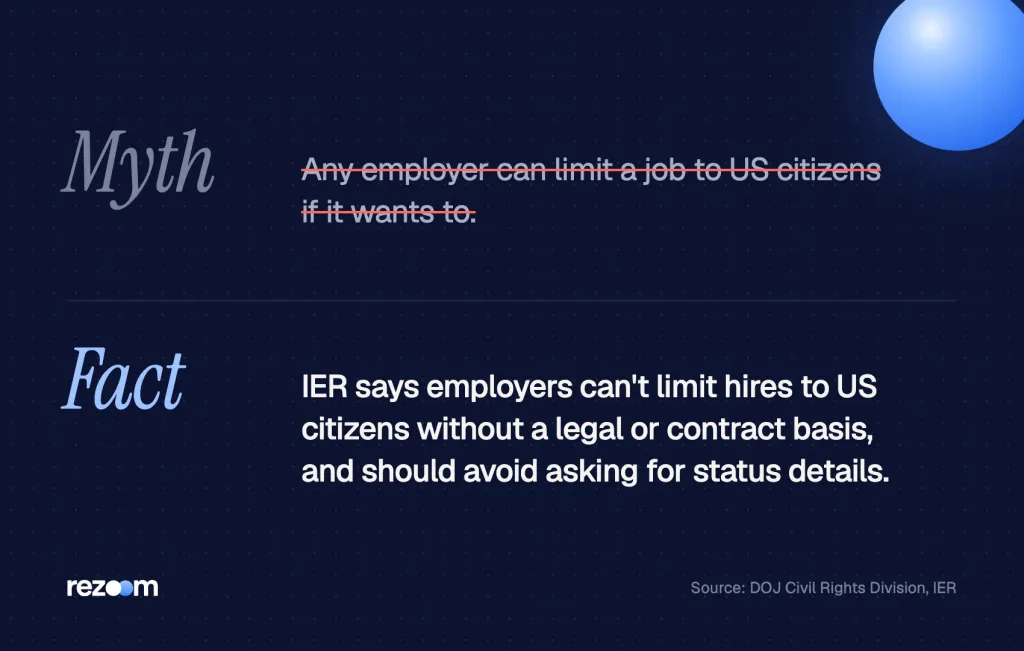
Employers may ask the two standard questions. IER warns against extra prescreening questions and says employers can't limit jobs to US citizens unless a law, regulation or government contract requires it. They also can't pick which Form I-9 documents you show. You can call IER or file a charge within 180 days.
IER's FAQ2 is direct on citizenship limits. Employers are not allowed to limit applicants or hires to US citizens unless a law, regulation or federal contract requires it. The citizenship-status rule applies to employers with four or more employees1.
Questions that cross the line
IER has repeatedly cautioned1 employers against prescreening questions beyond the two standard ones. Watch for questions like these.
- "What is your citizenship?" IER calls it a best practice not to ask for this detail.
- "Is your work permit permanent?" IER says this can confuse or deter asylees and refugees.
- "US citizens only." This needs a legal or contract basis, such as a clearance job.
- "Bring your passport." On Form I-9, you choose your documents from the lists of acceptable documents.
If you think you were screened out
IER runs a worker hotline at 1-800-255-76882. Charges must be filed within 180 days2 of the alleged discrimination. Keep a screenshot of the question and the job post.
Some knockout questions on these forms reject you in seconds. Our guide to ATS knockout questions shows how they work and how to answer them honestly.
What are knockout questions in recruitment? See common ATS knockout question examples, how to answer each one without an auto-rejection and which are legal.
Why does an honest Yes or No matter?
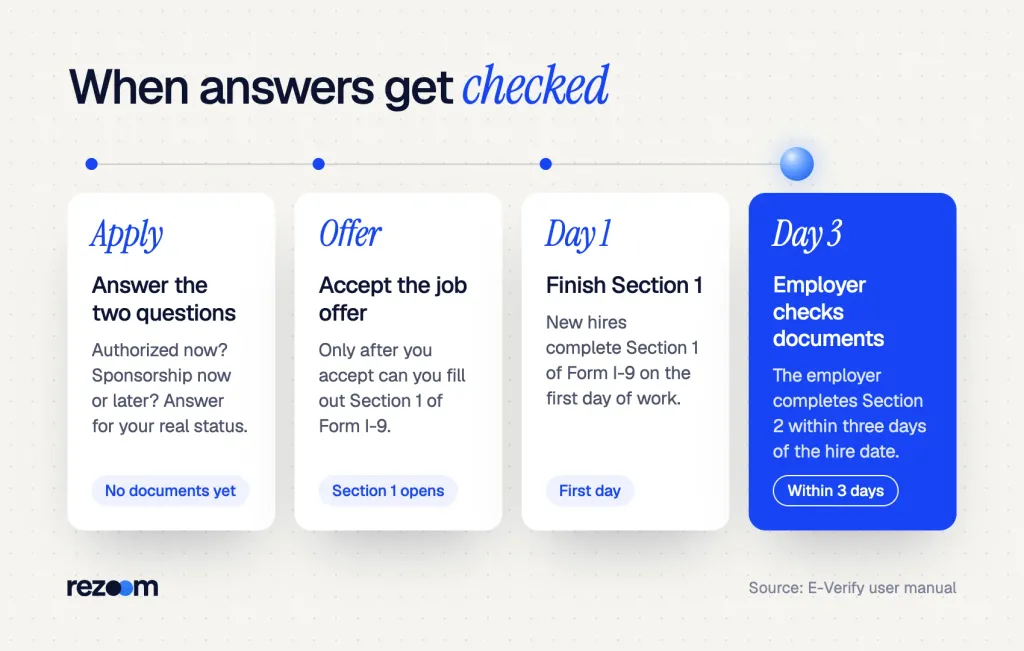
Your answer gets checked within days of hire. You complete Section 1 of Form I-9 on your first day, and your employer reviews your documents within three days. E-Verify employers then open a case. A wrong answer on the application rarely survives that check, and it can cost you the offer.
The E-Verify user manual3 sets the timing. New hires must complete Section 1 of Form I-9 on the first day of work. Employers must complete Section 2 within three days3 of the hire date.
The check comes after the offer
You may fill out Section 1 early, but only after you accept a job offer. E-Verify's user rules4 also bar employers from using E-Verify to prescreen applicants. So the form question is your one honest signal before the offer.
- Answer the two questionsAnswer Yes or No on the application based on your status today and your future need.
- Explain in the interviewShare your dates or status if the recruiter asks or your answers need context.
- Accept the offerOnly after you accept can you complete Section 1 of Form I-9.
- Show your documentsPick documents from the acceptable lists within the first days of work.
What a wrong answer costs
If you answer No to sponsorship while on OPT, the employer finds out at the latest when your EAD shows an end date. That can mean a withdrawn offer after you've turned down others. Pick the honest answer and explain it well.
Do
- Answer Yes to authorization if you can legally start this job now.
- Answer Yes to sponsorship if you will ever need an employer to file for you.
- Add your OPT or EAD dates in a comments box when one exists.
Don’t
- Answer No to sponsorship just to pass a screen.
- Volunteer your passport or visa type when no one asked.
- Assume "temporary" means "not authorized."
What should you say when a recruiter asks follow-ups?
Keep it short, true and focused on dates. Say when your work permission starts and ends and what you'd need after that. You don't need to share your country of birth or your full immigration history. If a question goes past the two standard questions, steer back to your start date.
Recruiters often ask follow-ups in a phone screen. A clear answer with dates sounds confident and saves them a guess. If they ask when you can begin, our guide to your earliest start date on a job application helps you pick a real date.
Recruiter: "You said you'll need sponsorship. Can you tell me more?"
"Sure. I'm on STEM OPT through June 2028, so I can start right away."
"After that, I'd need H-1B sponsorship to continue."
What to say if they push back
- "We don't sponsor." "Thanks for telling me early. Does that apply to every team, or only this role?"
- "Is your work permit permanent?" "I'm authorized to work for you now, and I can show my documents after an offer."
- "What's your visa?" "I'm authorized to work now. Is there a time frame the role needs me to cover?"
- "Can you bring your passport?" "After I accept an offer, I'll bring documents from the Form I-9 lists."
Recruiter: "Will you need us to sponsor you?"
"Not right now. My EAD is valid through March 2027 and is tied to my spouse's case."
"I'm happy to talk through the timeline if it matters for this role."
If the form gives you no comments box, add one plain line near the end of your cover letter. Keep it to dates and what you'd need later. Our IT cover letter examples show how to close with a clear, confident line.
Before you submit
Once your answers are set, build a resume that matches the job. The Rezoom AI resume builder turns the job post into tailored bullets in minutes, so your skills get as much attention as your status.
Tailored to the job post, checked against ATS.
Frequently asked questions
Does OPT count as being legally authorized to work in the US?
Yes, during your approved OPT dates. Most OPT students answer Yes to authorization and Yes to sponsorship, because OPT ends.
Should a green card holder say they need sponsorship?
No. A green card lets you work for any employer without a visa filing, so answer No.
Can an employer reject me because I need sponsorship?
Many employers choose not to sponsor visas. That is different from rejecting a refugee, asylee or green card holder for their status, which IER treats as a possible violation.
Can an employer ask what visa I have?
IER calls it a best practice to avoid asking for this detail. You can answer with your work dates instead of your status.
When do I prove my work authorization?
After you accept an offer. You complete Section 1 of Form I-9 by your first day, and the employer checks your documents within three days.
Is this legal advice?
No. This is general information. For your exact case, ask an immigration attorney or your school's international office.
Sources
We opened and read each page below. The small numbers in the text point here. Pages that carry no publication date show n.d.
- DOJ Civil Rights Division, IER2022
IER named the two work authorization and sponsorship questions as appropriate, warned against extra prescreening, and noted the rule covers employers with four or more employees
- DOJ Civil Rights Division, IERn.d.
Employers may generally ask about the legal right to work, should avoid asking for status details, can't limit hires to US citizens without a legal basis, and charges must be filed within 180 days via the 1-800-255-7688 hotline
- E-Verifyn.d.
New hires complete Section 1 of Form I-9 on the first day, only after accepting an offer, and employers complete Section 2 within three days of hire
- E-Verifyn.d.
Employers may not use E-Verify to prescreen job applicants
- USCISn.d.
Eligible F-1 students can get up to 12 months of OPT and a 24-month STEM extension with an E-Verify employer
- USCISn.d.
Asylees are authorized to work whether or not they have an EAD
- USCISn.d.
H-4 spouses may get an EAD if the H-1B spouse has an approved I-140 or AC21 status past the six-year H-1B limit
- USCISn.d.
Certain L-2 spouses are employment authorized incident to status
- USCIS2023
Current DACA grants and related EADs remain valid until they expire unless individually terminated
- E-Verify2025
DACA recipients with a valid EAD are still permitted to work, per a page updated in May 2025
- Carnegie Mellon University Office of International Educationn.d.
F-1 students with work authorization answer Yes, and answer Yes to sponsorship because they need authorization when student status ends
- Temple University ISSSn.d.
An H-1B worker can start with a new employer once it files a non-frivolous I-129 petition
Mohammad has spent more than ten years designing consumer products and leads product at Rezoom, deciding what gets built and what gets left out. His guides cover the whole job search, from resume sections and cover letters to interview answers and career moves.
Goodi, M. (2026, November 10). Legally Authorized to Work in the US? How to Answer by Visa Status. Rezoom. https://rezoom.io/are-you-legally-authorized-to-work-in-the-us/