Software Developer Amara Nwachukwu
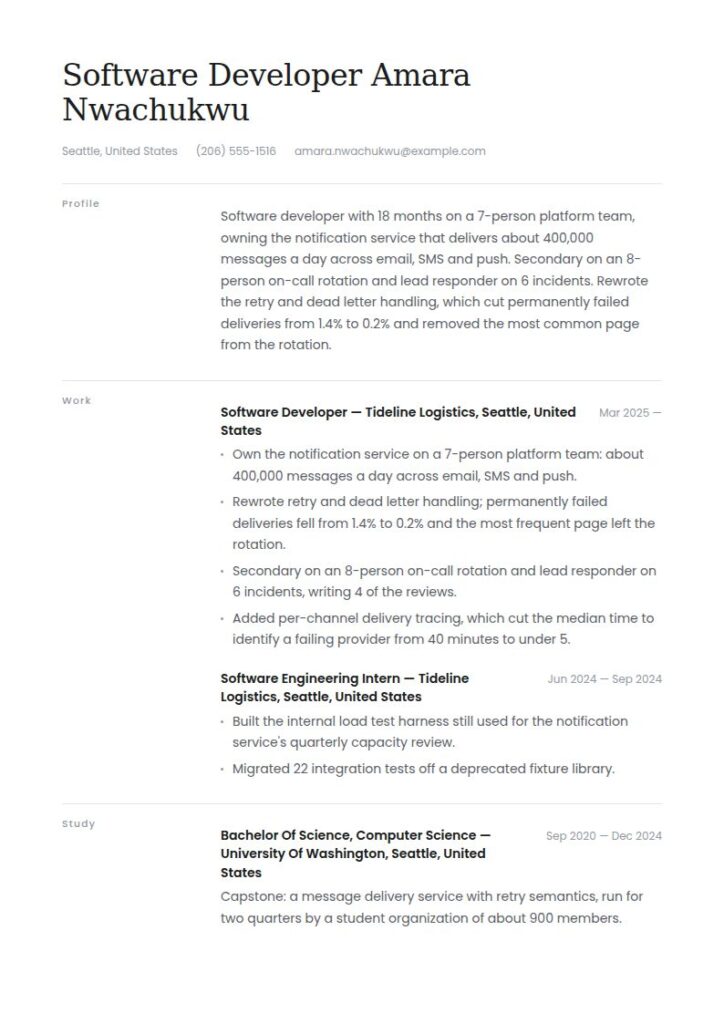
Software Developer
[email protected] | (206) 555-1516 | Seattle, United States
Profile
Software developer with 18 months on a 7-person platform team, owning the notification service that delivers about 400,000 messages a day across email, SMS and push. Secondary on an 8-person on-call rotation and lead responder on 6 incidents. Rewrote the retry and dead letter handling, which cut permanently failed deliveries from 1.4% to 0.2% and removed the most common page from the rotation.
Work Experience
03/2025 - Present, Software Developer, Tideline Logistics, Seattle, United States
- Own the notification service on a 7-person platform team: about 400,000 messages a day across email, SMS and push.
- Rewrote retry and dead letter handling; permanently failed deliveries fell from 1.4% to 0.2% and the most frequent page left the rotation.
- Secondary on an 8-person on-call rotation and lead responder on 6 incidents, writing 4 of the reviews.
- Added per-channel delivery tracing, which cut the median time to identify a failing provider from 40 minutes to under 5.
06/2024 - 09/2024, Software Engineering Intern, Tideline Logistics, Seattle, United States
- Built the internal load test harness still used for the notification service's quarterly capacity review.
- Migrated 22 integration tests off a deprecated fixture library.
Education
09/2020 - 12/2024, Bachelor of Science, Computer Science, University of Washington, Seattle, United States
Capstone: a message delivery service with retry semantics, run for two quarters by a student organization of about 900 members.
Skills
Go, 75
Python, 80
PostgreSQL, 70
Kafka and event consumers, 65
On-call response and incident review, 70
Distributed tracing, 70
Git and GitHub Actions, 80
Languages
English, native
Igbo, native
French, conversational
Certificates
11/2025, AWS Certified Solutions Architect, Associate, Amazon Web Services
Recertification on a three-year cycle.
Summary
A software developer resume is a one to two page document naming the production systems you were accountable for, the traffic or data they carried, and the availability you were held to. This guide gives you three adaptable versions, the ownership lines most applicants leave out, and current Bureau of Labor Statistics pay and outlook for the occupation.
Software Developer resume examples by experience level
A software developer resume is a one to two page document that names the production systems you were accountable for, says what each one carried, and shows what changed about it while you had it.
In fact, this is the largest occupation in its category: 1,905,400 jobs in 2025, with about 106,100 openings projected each year (BLS Occupational Outlook Handbook, 2025-35 projections). However, a hiring manager is not reading your file against four others. Instead, they are reading it against a pile, and almost every file in that pile lists the same languages.
What separates them is ownership. In other words, not "worked on" and not "contributed to", but: this system was mine, it carried this much, I was the one paged when it broke, and here is what I changed about it.
Resume guide for a software developer resume
Specifically, this guide and the corresponding software developer resume example will cover:
- How to write a software developer resume, section by section
- How to turn "worked on the platform" into an ownership line with a number in it
- Three adaptable summaries: junior, mid-level and senior
- What scale, availability targets and on-call rotations mean on a resume
- What the job market looks like and what you can expect to earn
How to write a software developer resume
Five sections: contact header, summary, experience, systems owned, and skills with education last. One page for your first four years, two after that.
The systems block is the section most resumes do not have, and it is the one that answers the question a hiring manager actually has. Everything else on the page, therefore, is context for it.
| Section | What it is answering | Where it goes |
|---|---|---|
| Summary | What did this person own, and how big was it? | Top, four lines |
| Experience | What changed about those systems while they held them? | Reverse chronological, numbers in every bullet |
| Systems owned | Which of these were theirs, and what did each carry? | Its own block, one line per system |
| Skills and education | Can they work in our stack, and where did they start? | Last, and short |
Convert every vague line into an ownership line with a number
Most software resumes describe activity. Hiring managers are reading for accountability, which is a different thing.
The conversion is mechanical. Take the sentence you wrote, then answer four questions about it: what was the system, what did it carry, what were you responsible for when it broke, and what is different about it now.
"Worked on the payments platform" becomes "owned 4 services in the payments platform handling about 12 million API calls a day, on a 6-person on-call rotation, and cut p99 checkout latency from 840ms to 210ms over two quarters."
The second sentence is not longer because it is padded. It is longer because it contains four facts the first sentence withheld.
Run the finished file through the ATS resume checker before you send it. At this volume of applicants, the parse happens before a person reads anything.
Choosing the best resume format for a software developer resume
Reverse chronological, with a systems block. After all, nothing else survives contact with a technical reader.
However, functional resumes are read here as a tenure problem, fairly or not. A hiring manager wants to see how long you stayed with a system, because the interesting parts of software ownership happen in year two: the migration, the incident, the rewrite you had to live with. In practice, a format that hides duration hides the only thing that separates two candidates with the same stack.
In general, one page is right for your first four years. Two is right after that, and three is never right. If you have twelve years of history, the oldest roles compress to one line each.
Include your contact information
| ✅ Right | ❌ Wrong |
|---|---|
| Amara Nwachukwu | Amara Nwachukwu |
| Software Developer, distributed systems and payments | Results-driven software professional |
| github.com/anwachukwu, Seattle, WA | Seattle, WA (Open to relocation anywhere) |
| (206) 555-1516, [email protected] | (206) 555-1516, [email protected] |
Also, put a specialization in the title line if you have one. "Software Developer" alone is accurate and tells a reader nothing; "Software Developer, distributed systems and payments" survives a keyword filter and tells a hiring manager which pile to put you in.
Then skip the objective, the address and the photograph. At this volume of applicants, that space is therefore better spent on something checkable.
Make use of a summary
In short, use four lines: years and domain, the system you own and its scale, the availability or reliability you were held to, and one change you made with a number attached.
Software developer with 18 months on a 7-person platform team, owning the notification service that delivers about 400,000 messages a day across email, SMS and push. Secondary on an 8-person on-call rotation and lead responder on 6 incidents. Rewrote the retry and dead letter handling, which cut permanently failed deliveries from 1.4% to 0.2% and removed the most common page from the rotation.
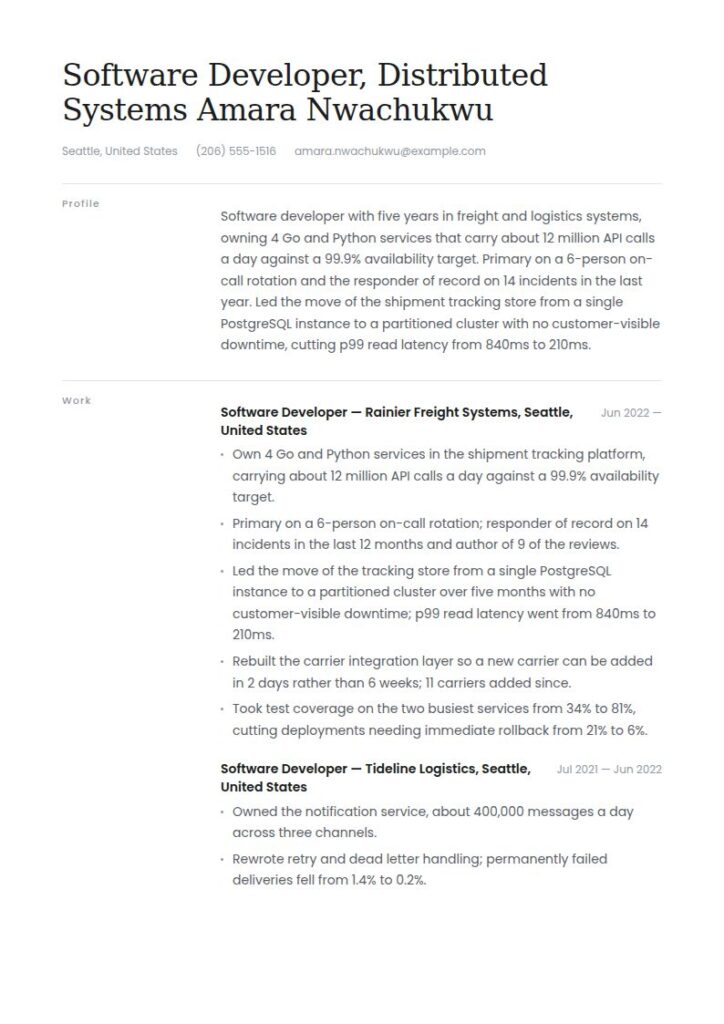
Software developer with five years in freight and logistics systems, owning 4 Go and Python services that carry about 12 million API calls a day against a 99.9% availability target. Primary on a 6-person on-call rotation and the responder of record on 14 incidents in the last year. Led the move of the shipment tracking store from a single PostgreSQL instance to a partitioned cluster with no customer-visible downtime, cutting p99 read latency from 840ms to 210ms.
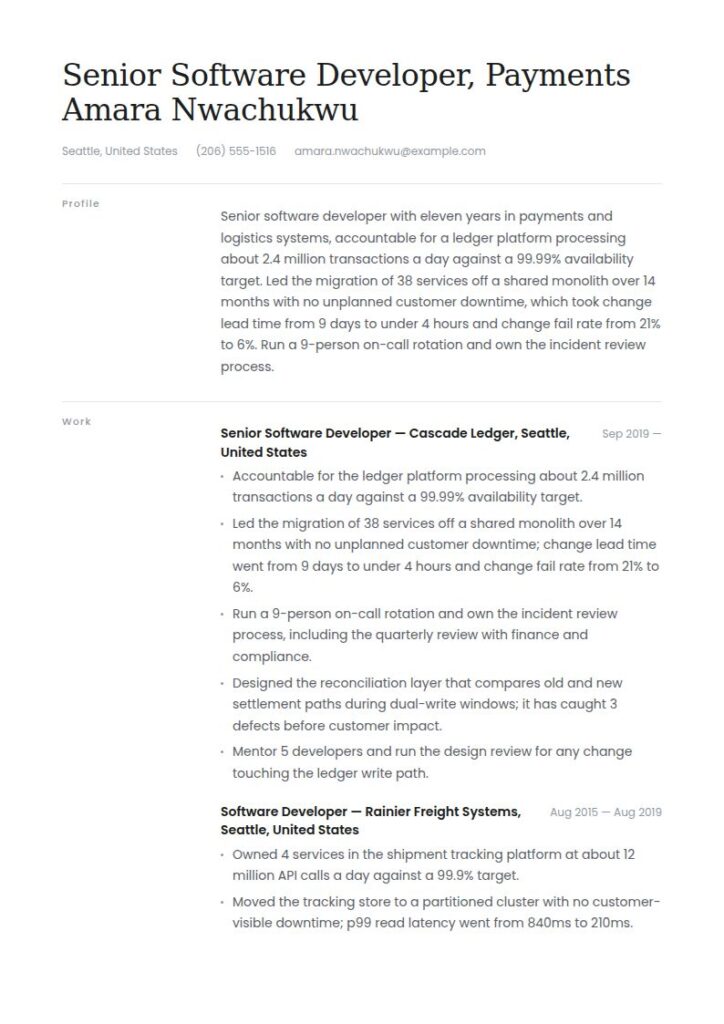
Senior software developer with eleven years in payments and logistics systems, accountable for a ledger platform processing about 2.4 million transactions a day against a 99.99% availability target. Led the migration of 38 services off a shared monolith over 14 months with no unplanned customer downtime, which took change lead time from 9 days to under 4 hours and change fail rate from 21% to 6%. Run a 9-person on-call rotation and own the incident review process.
Right vs wrong: the same software developer summary, twice
| ✅ Right | ❌ Wrong |
|---|---|
| Owns 4 Go and Python services carrying about 12 million API calls a day against a 99.9% availability target. | Experienced software developer with a strong background in backend development. |
| Primary on a 6-person on-call rotation, responder of record on 14 incidents last year. | Works well under pressure in fast-paced environments. |
| Moved the shipment tracking store to a partitioned cluster with no customer-visible downtime. | Involved in several large-scale database projects. |
| Cut p99 read latency from 840ms to 210ms. | Improved application performance and reliability. |
For example, the left column is a set of facts a reference check can confirm. In contrast, the right column is a set of claims that would survive being written by someone who had never done the job.
Outline your software development experience
Company, city, title, dates, then three to five bullets. Similarly, every bullet names a system and carries a number: a volume, a latency, a rate, a duration, a count of things migrated.
| Instead of | Use |
|---|---|
| Worked on the payments platform | Owned 4 services in the payments platform carrying about 12 million API calls a day |
| Participated in on-call | Primary on a 6-person rotation, responder of record on 14 incidents in 12 months |
| Improved system performance | Cut p99 read latency from 840ms to 210ms by partitioning the shipment tracking store |
| Helped migrate to microservices | Led the move of 38 services off a shared monolith over 14 months with no unplanned customer downtime |
| Wrote unit tests | Took service test coverage from 34% to 81% and cut change fail rate from 21% to 6% |
| Collaborated with stakeholders | Ran the quarterly capacity review with finance and operations for a system carrying 2.4 million transactions a day |
Software Developer, Rainier Freight Systems, Seattle, WA, June 2022 to Present
Own 4 Go and Python services in the shipment tracking platform, carrying about 12 million API calls a day against a 99.9% availability target agreed with the operations team.
Primary on a 6-person on-call rotation; responder of record on 14 incidents in the last 12 months, and author of 9 of the incident reviews.
Led the move of the tracking store from a single PostgreSQL instance to a partitioned cluster over five months with no customer-visible downtime; p99 read latency went from 840ms to 210ms.
Rebuilt the carrier integration layer so a new carrier can be added in 2 days rather than 6 weeks; 11 carriers added since.
Took test coverage on the two busiest services from 34% to 81%, which cut the share of deployments needing immediate rollback from 21% to 6%.
Name the systems you owned and the scale they ran at
A software developer resume should carry a short block listing each production system you were accountable for, what it carried, the availability you were held to, and whether you were on the rotation for it. Overall, three to five lines, one per system.
In fact, this is what a hiring manager tries to reconstruct from a normal resume and usually cannot. "Backend developer, five years, Go and Kubernetes" describes thousands of people with completely different careers. For instance, one has run a system at two million transactions a day; one has run an internal tool with forty users. Both are true and only one is the hire.
Five facts in a software ownership line
Five facts make an ownership line:
- What the system does, in six words. "Shipment tracking API", "ledger and settlement", "notification delivery".
- What it carries. Requests per day, transactions per day, records processed, events consumed, gigabytes stored, users served. Pick the unit your team actually watched on a dashboard.
- The availability target you were held to. Not what the system achieved on a good month: the number you were accountable for.
- Whether you carried a pager, and the size of the rotation. A 4-person rotation is a very different job from a 20-person one, and a resume that says "participated in on-call" tells the reader neither.
- What you changed. One thing that is different about the system because you owned it.
Systems owned:
Shipment tracking API, Go, about 12 million calls a day, 99.9% availability target, primary on a 6-person rotation since 2023. Moved the store to a partitioned cluster with no customer-visible downtime.
Carrier integration layer, Python, 11 carriers, 400,000 label requests a day. Rebuilt so onboarding a carrier takes 2 days rather than 6 weeks.
Notification delivery service, Go, about 400,000 messages a day across three channels. Rewrote retry and dead letter handling; permanently failed deliveries fell from 1.4% to 0.2%.
Internal capacity forecasting job, Python, runs nightly over 90 days of traffic history. Inherited unowned in 2024, documented and handed to the platform team in 2025.
Three of those lines are impressive, but the fourth is honest, which is the point. Indeed, a block where every entry is enormous reads as inflation. A block that includes one small system you inherited, fixed and handed on reads as someone who has actually held a pager.
An availability target is a published number, and so are the deployment metrics
Two things on that list are things you can anchor to a public definition rather than an internal convention.
The first is the availability target. Cloud providers publish theirs, which gives you a shared scale: the AWS Compute Service Level Agreement commits to a Monthly Uptime Percentage of at least 99.99% at the Region level and 99.5% for a single instance, with service credits at defined thresholds (Amazon Web Services, Compute SLA, last updated 25 May 2022). If your team held a 99.9% target, that is a real and describable commitment; say it rather than writing "high availability".
The second is delivery. DORA, the research program run by Google Cloud, defines change lead time as the time from a change being committed to version control to it being deployed in production, deployment frequency as the number of deployments over a period, change fail rate as the share of deployments requiring immediate intervention, and failed deployment recovery time as the time to recover from one (DORA, four keys guide, last updated 5 January 2026).
Those four are the most useful numbers a software developer can put on a resume, because the reader already knows what they mean and how hard they are to move.
If you have not owned a system yet
If you genuinely have not owned anything yet, say what you did own inside something larger: one endpoint, one job, one page, one library. "Owned the retry path of the notification service" is a smaller claim than "owned the notification service" and a much stronger one than "worked on notifications".
Build a snapshot of your key skills
Then list twelve to sixteen entries in four groups, ordered by how central each is to the work you want next. Do not list every language you have touched; instead, list the ones you would be comfortable being interviewed on.
Languages: Go, Python, SQL, TypeScript, Java
Data and storage: PostgreSQL, Redis, Kafka, partitioning and sharding, schema migration
Infrastructure and delivery: Kubernetes, Terraform, GitHub Actions, blue-green and canary deploys, feature flags
Operations: On-call and incident command, incident review writing, SLO definition and error budgets, distributed tracing, capacity forecasting
Meanwhile, the operations group is the one most software developers leave off, and it is what distinguishes an owner from a contributor. After all, a person who can write an incident review and define a service level objective has done a job someone with the same five languages may never have done.
List your education and certifications
Short, and last. Also, the typical entry-level requirement for the occupation is a bachelor's degree (BLS Occupational Outlook Handbook, software developers, quality assurance analysts and testers, 2025-35 edition), and past your first job the degree is a checkbox rather than an argument.
Bachelor of Science, Computer Science, University of Washington, Seattle, WA, 2021
Certifications: AWS Certified Solutions Architect, Associate, Amazon Web Services, 2024. Certified Kubernetes Administrator, Cloud Native Computing Foundation, 2023.
Also: co-author of the internal incident review standard adopted across 4 teams; run the monthly systems reading group.
Certifications matter more in consulting and government contracting than in product companies: at a computer systems design firm the certification is a line item on a bid, and at a software publisher it is a footnote.
Choose the right layout and design
Above all, use a single column, 11 or 12 point body type, plain headings, no photograph, no skill bars. Machine readable first, because it will be machine read first.
Export to PDF and check that your GitHub address is selectable text rather than an image. Beyond that, design effort here has no return and some risk, because a two-column layout can scramble the parse and drop half your experience section.
Name each production system you owned and what it carried. Give the availability target you were held to and the size of your on-call rotation. Put a number in every experience bullet: volume, latency, rate, duration or count. Say what is different about a system because you owned it. Include one small or unglamorous system you inherited and fixed. Keep it to one page for four years, two after that.
Do not write "worked on" or "contributed to" when you can write "owned". Do not list twenty languages; list the ones you would be interviewed on. Do not describe scale as "large-scale" or "high-traffic" when you know the actual number. Do not claim ownership of a system a reference would attribute to someone else. Do not pad with soft skills, an objective statement or a photograph.
Software developer job market and outlook
Overall, this is the largest occupation in this category by a wide margin, and one of the fastest growing.
| Measure | Value |
|---|---|
| Software developer, QA analyst and tester jobs, 2025 | 1,905,400 |
| Projected change, 2025-35 | 10% (much faster than average), +185,400 |
| Projected annual openings | about 106,100 |
| Typical entry-level education | Bachelor's degree |
| Median annual wage, software developers, May 2025 | $135,980 |
| Median annual wage, QA analysts and testers, May 2025 | $104,300 |
Source: U.S. Bureau of Labor Statistics, Occupational Outlook Handbook, 2025-35 projections and May 2025 wage data.
The size of the occupation is the reason specificity works
There are 1,905,400 jobs in this occupation group and about 106,100 openings projected a year, with the group median at $134,040 in May 2025 and software developers specifically at $135,980 (BLS Occupational Outlook Handbook, May 2025 wages and 2025-35 projections).
A market that large does two things at once. It means the work is there, which is the good news. It also means that every generic resume in it is competing against hundreds of thousands of identically generic resumes, all listing the same five languages and the same three cloud providers.
Specificity is the only filter that survives that volume. A hiring manager cannot tell two "experienced backend developers" apart. They can tell 12 million calls a day apart from 400,000, a 6-person rotation apart from a 20-person one, and a 14-month migration apart from a line that says "involved in modernization efforts".
Where the money sits by industry, for software developers:
| Industry | Median annual wage (May 2025) |
|---|---|
| Software publishers | $164,550 |
| Manufacturing | $136,330 |
| Management of companies and enterprises | $135,680 |
| Finance and insurance | $135,460 |
| Computer systems design and related services | $132,050 |
Source: U.S. Bureau of Labor Statistics, Occupational Outlook Handbook, May 2025.
What salary you can expect as a software developer
Specifically, the median annual wage for software developers was $135,980 as of May 2025, against $104,300 for quality assurance analysts and testers and $134,040 for the combined occupation group (BLS, May 2025).
Industry is the largest published lever. For example, software publishers pay a median of $164,550, roughly $32,500 above computer systems design services at $132,050 (BLS, May 2025). That gap is not a difference in difficulty; rather, it is a difference in how directly the work sits against the revenue.
In the end, the unpublished lever is scale and responsibility. A developer who has been accountable for a system at millions of requests a day, held a real availability target and carried a pager is not interchangeable with one who has not, and that is the distinction your systems block exists to make legible. Go into the conversation with the volumes, the target, the rotation size and the migration, because those are the facts that justify a number above the industry median.
Key takeaways for a software developer resume
- First, name the production systems you owned, one line each, with what they carried.
- Then give the availability target you were held to, instead of the uptime you happened to get.
- Say whether you carried a pager and how large the rotation was.
- Put a number in every experience bullet: volume, latency, rate, duration or count.
- In addition, replace "worked on" with "owned" wherever it is honest, and shrink the claim where it is not.
- Include one small system you inherited and fixed, because it reads as real.
- Finally, keep the education short, because past the first job it is a checkbox, not an argument.
Build your software developer resume in 15 minutes with our AI resume builder.
Related information technology resume examples
- Software engineer resume
- Senior software engineer resume
- Entry level software engineer resume
- Full stack developer resume
- Java developer resume
- Python developer resume
- DevOps engineer resume
- Data engineer resume
- Engineering manager resume
- Solution architect resume
- Systems analyst resume
- QA tester resume
Pair it with a matching software developer cover letter.
Software developer resume questions, answered
How long should a software developer resume be?
One page for your first four years, two after that. Three is never right. Compress the oldest roles to a single line each and spend the space you recover on the systems you owned most recently.
What do I put on a software developer resume with no professional experience?
Ownership at the scale you have had it. An internship service, a capstone system with real users, a maintained open source package with downloads, a tool your student organization actually ran on. Give the same facts: what it does, what it carries, who depended on it, what you changed. A project with twelve real users described precisely beats a tutorial clone described grandly.
Should I list every programming language I know?
No. List the ones you would be comfortable being interviewed on, in the order they matter to the job you want. Twenty languages reads as twenty things you have skimmed, and any one of them can become the question you cannot answer.
How do I describe scale if my company will not let me share numbers?
Use orders of magnitude and relative change. "About 10 million API calls a day" and "cut p99 latency by roughly 75%" disclose nothing proprietary and carry almost all of the signal. "High-traffic" does not work, because it is the word people use when they do not know the number.
Does the difference between software developer and QA analyst matter on a resume?
It matters to pay. BLS publishes a median of $135,980 for software developers against $104,300 for quality assurance analysts and testers as of May 2025, inside the same occupation group. If your work includes design and implementation of production systems and not only test authoring, make sure the resume says so in the title line and the systems block.
Is on-call experience worth putting on a resume?
Yes, and it is one of the most underused lines available. Being the person paged for a system is the clearest evidence of ownership there is. Give the rotation size, whether you were primary, how many incidents you responded to, and whether you write the reviews.