Web Developer Tomas Zielinski
Web Developer
[email protected] | (303) 555-1510 | Denver, United States
Profile
Web developer with one year at a Denver agency, building and maintaining marketing sites in HTML, CSS, JavaScript and WordPress. Shipped 9 client sites in the last 12 months, including 4 full rebuilds that moved from a failing mobile Largest Contentful Paint to under 2.5 seconds in field data. Run an automated accessibility scan and a manual keyboard pass on every template before handoff, and can supply live URLs for all 9.
Work Experience
06/2021 - Present, Web Developer, Alpenglow Interactive, Denver, United States
- Shipped 9 client sites in 12 months on WordPress block themes and a static build step, 4 of them full rebuilds.
- Moved all 4 rebuilds from a failing mobile Largest Contentful Paint to under 2.5 seconds in field data.
- Run an automated accessibility scan and a manual keyboard pass on every template before client handoff.
- Maintain live URLs and a one-line role note for every site shipped, used as the agency's own portfolio index.
09/2020 - 05/2021, Student Web Assistant, University of Colorado Denver, College of Arts and Media, Denver, United States
- Maintained 6 department sites on a shared WordPress multisite, including template updates and content migration.
- Rewrote the college events template to fix keyboard order and heading structure flagged in an internal review.
Education
08/2017 - 05/2021, Bachelor of Arts, Digital Media, University of Colorado Denver, Denver, United States
Concentration in web and interactive media. Senior project: an accessible event calendar component, documented and released publicly.
Skills
HTML and CSS, 85
JavaScript, 70
WordPress block themes, 75
Core Web Vitals field data analysis, 65
Keyboard and screen reader testing, 70
Git and GitHub, 70
Languages
English, native
Polish, conversational
Spanish, beginner
Certificates
03/2022, Certified Professional in Accessibility Core Competencies (CPACC), International Association of Accessibility Professionals
Maintained on a three-year professional development cycle.
Summary
A web developer resume is a one to two page document carrying a short block of live URLs, the role you held on each site, and two numbers a reviewer can verify without contacting you. This guide gives you three adaptable versions, the selected work block most applicants leave out, and current Bureau of Labor Statistics pay for the occupation.
Web Developer resume examples by experience level
In short, a web developer resume is a one to two page document that lists live URLs a reviewer can open, says exactly what your role was on each one, and gives two numbers anyone can check without asking you.
After all, web development is the one software job where the finished work is public. A database engineer has to be taken at their word; you do not, and that cuts both ways. A hiring manager can open your links from a phone while reading your summary, and a site that jumps under their thumb says something you did not intend.
Resume guide for a web developer resume
Specifically, this guide and the corresponding web developer resume example will cover:
- How to write a web developer resume, section by section
- The live work block: what to list, what to claim, and what to leave off
- Three adaptable summaries: junior, mid-level and lead
- The two published bars a reviewer can check on any URL you give them
- What the job market looks like and what you can expect to earn
How to write a web developer resume
Overall, it takes six sections: contact header with your portfolio address written out, summary, selected work with live links, employment history, skills grouped by stack, and education with certifications. In general, use one page for your first four or five years, then two once the work list is the argument.
That order is deliberate. A reviewer clicks before they read, so the links belong where their eye lands first.
| Section | What it is answering | Where it goes |
|---|---|---|
| Selected work, with URLs | What has this person shipped, and can I see it right now? | Directly under the summary |
| Employment history | What was their role on each of those, and for how long? | Reverse chronological, under the work block |
| Skills by stack | Can they work in what we actually run? | Grouped by layer, never one long comma list |
| Education and certifications | Is there a formal floor here, and does it bind? | Last, and short |
Two published numbers a reviewer can check before they call you
Google publishes the Core Web Vitals thresholds openly. A page rated good has a Largest Contentful Paint within 2.5 seconds, an Interaction to Next Paint of 200 milliseconds or less, and a Cumulative Layout Shift of 0.1 or less, each assessed at the 75th percentile of real page loads and reported separately for mobile and desktop (web.dev, Core Web Vitals, last updated 31 October 2024). Interaction to Next Paint replaced First Input Delay on 12 March 2024 (web.dev, 31 January 2024).
The second bar is accessibility. WCAG 2.2 reached W3C Recommendation status on 12 December 2024 and defines three conformance levels: A, AA and AAA (W3C, 12 December 2024). AA is the level that turns up in procurement paperwork, in contracts and in law.
Both are measurable by a stranger, on a URL you supplied. Put the numbers on the page yourself.
Run the finished file through the ATS resume checker before you send it. Teams parse applications into a system before a person opens them, and a portfolio address that exists only inside a header graphic is a link nobody clicks.
Choosing the best resume format for a web developer resume
In practice, keep it reverse chronological, with one structural addition: a named selected work block sitting above the employment history.
However, skills-first formats fail here for a precise reason. After all, the question is never "can this person write CSS". Instead, it is "what did this person own on the thing I am looking at". Therefore, a format that floats a skills list free of the projects makes that unanswerable.
Meanwhile, contract work is where the format bends: group it under one heading, such as "Independent web developer, Denver, CO, 2021 to 2024", with clients as engagements underneath. Eleven separate jobs in three years reads as churn even when it was a full order book.
Include your contact information
| ✅ Right | ❌ Wrong |
|---|---|
| Tomas Zielinski | Tomas Zielinski |
| Web Developer, front end and accessibility | Creative web ninja and problem solver |
| tomaszielinski.dev, github.com/tzielinski | Portfolio available on request |
| (303) 555-1510, [email protected], Denver, CO | (303) 555-1510, [email protected] |
First, write the portfolio address out in full, as selectable text, in the header. "Portfolio available on request" is the one line on a web developer resume that cannot be true, because the work is already public. If your GitHub profile is empty or eight years stale, leave it off.
Make use of a summary
In short, use four lines: what you build, the stack, the scale of the thing you built, and one number a reader can verify on a URL you listed.
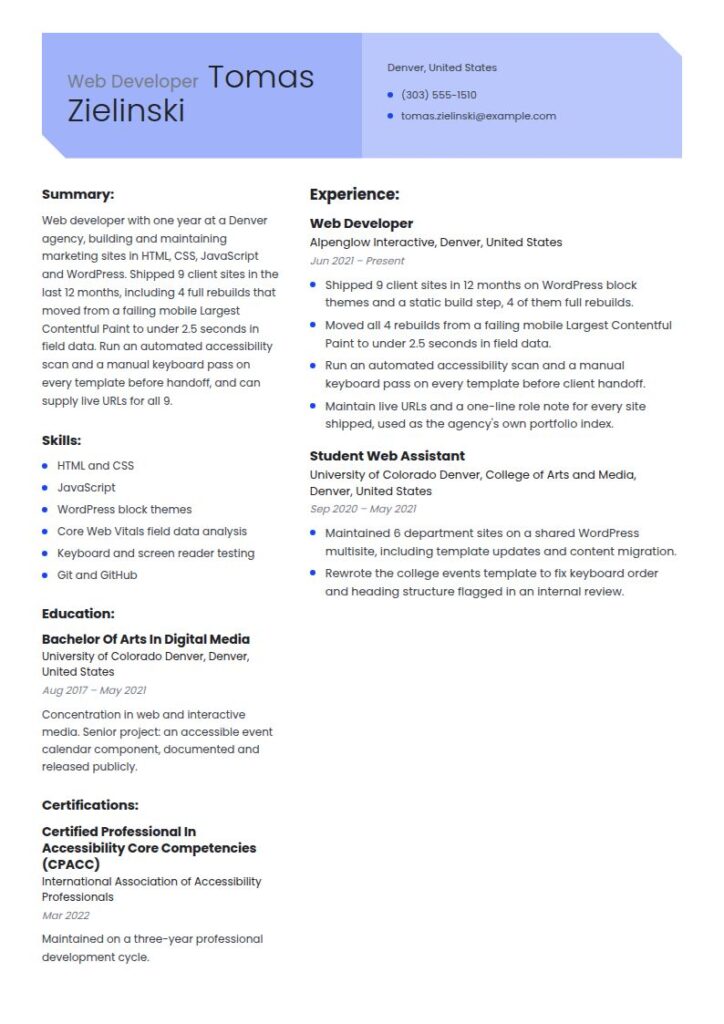
Web developer with one year at a Denver agency, building and maintaining marketing sites in HTML, CSS, JavaScript and WordPress. Shipped 9 client sites in the last 12 months, including 4 full rebuilds that moved from a failing mobile Largest Contentful Paint to under 2.5 seconds in field data. Run an automated accessibility scan and a manual keyboard pass on every template before handoff, and can supply live URLs for all 9.
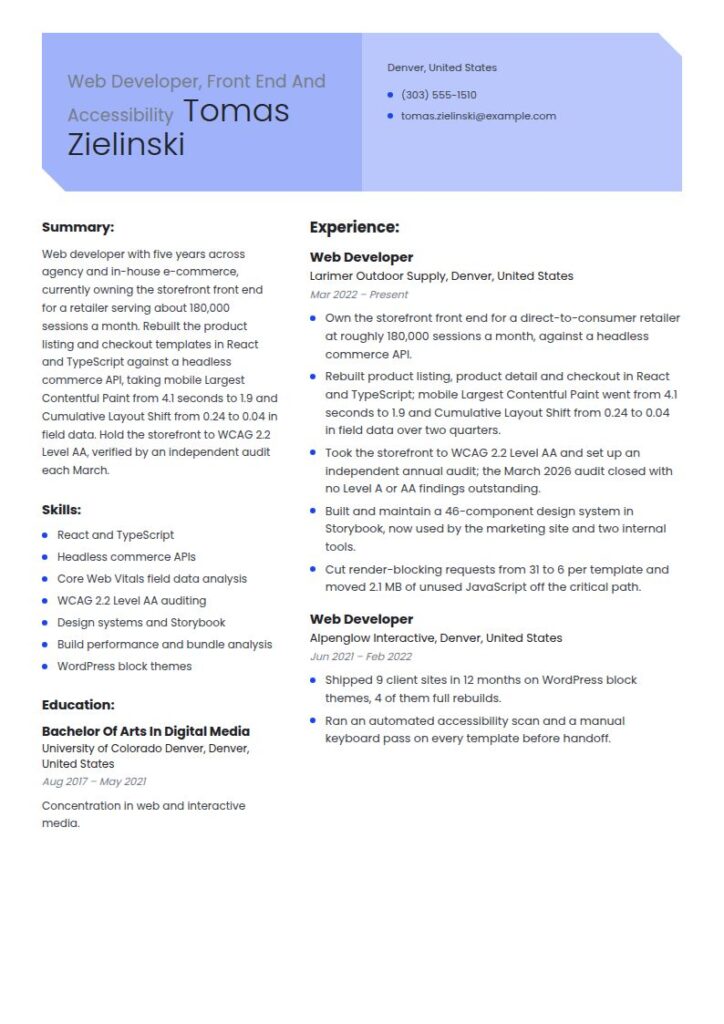
Web developer with five years across agency and in-house e-commerce, currently owning the storefront front end for a retailer serving about 180,000 sessions a month. Rebuilt the product listing and checkout templates in React and TypeScript against a headless commerce API, taking mobile Largest Contentful Paint from 4.1 seconds to 1.9 and Cumulative Layout Shift from 0.24 to 0.04 in field data. Hold the storefront to WCAG 2.2 Level AA, verified by an independent audit each March.
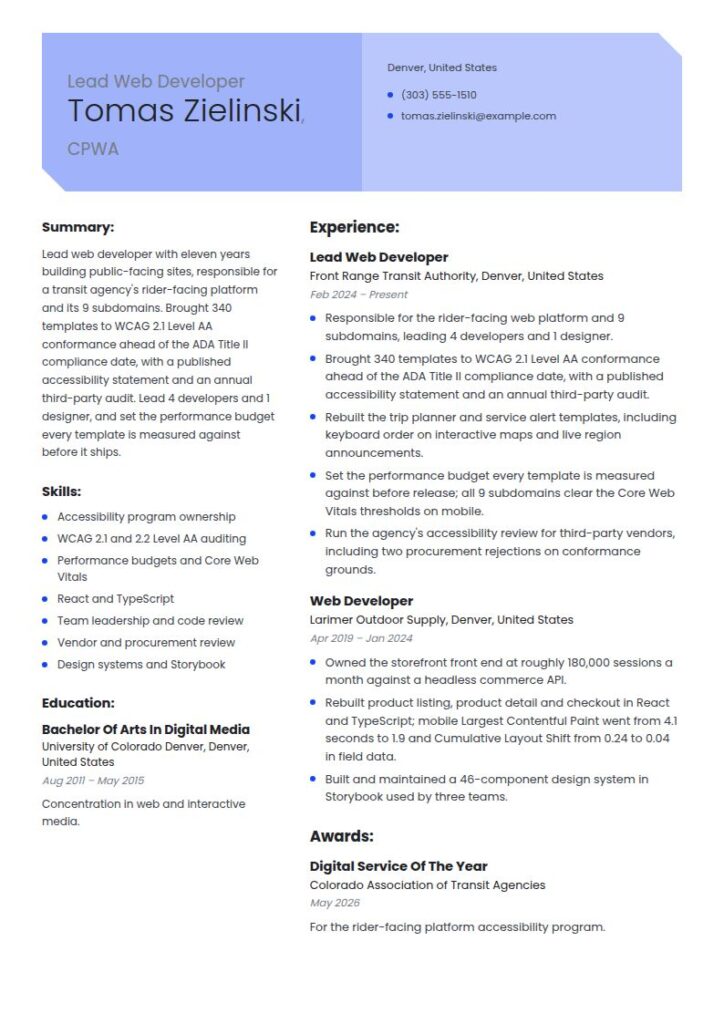
Lead web developer with eleven years building public-facing sites, responsible for a transit agency's rider-facing platform and its 9 subdomains. Brought 340 templates to WCAG 2.1 Level AA conformance ahead of the ADA Title II compliance date, with a published accessibility statement and an annual third-party audit. Lead 4 developers and 1 designer, and set the performance budget every template is measured against before it ships.
Right vs wrong: the same web developer summary, twice
| ✅ Right | ❌ Wrong |
|---|---|
| Web developer with five years across agency and in-house e-commerce, owning the storefront front end at about 180,000 sessions a month. | Creative web developer with a strong eye for detail and a love of clean code. |
| Rebuilt product listing and checkout in React and TypeScript against a headless commerce API. | Experienced with modern JavaScript frameworks and content management systems. |
| Mobile LCP from 4.1 seconds to 1.9 and CLS from 0.24 to 0.04 in field data. | Improved site performance and user experience across multiple projects. |
| Storefront held to WCAG 2.2 Level AA, independently audited each March. | Familiar with web accessibility best practices. |
For example, every line in the right column can be checked on a URL. However, not one line in the left column can be.
Outline your web development experience
Employer, city, title, dates, then three to five bullets. In other words, each names something that shipped and carries a number or a verifiable fact.
| Instead of | Use |
|---|---|
| Built websites for clients | Shipped 9 client sites in 12 months on WordPress and a custom block theme, 4 of them full rebuilds |
| Improved site speed | Took mobile LCP from 4.1 seconds to 1.9 and CLS from 0.24 to 0.04 in field data across all storefront templates |
| Made the site accessible | Brought 340 templates to WCAG 2.1 Level AA, confirmed by an annual third-party audit and a keyboard pass on every release |
| Worked closely with designers | Built and maintain a 46-component design system in Storybook, used by 3 product teams and the agency's contractors |
| Used React on the front end | Rebuilt product listing, product detail and checkout in React and TypeScript against a headless commerce API |
| Responsible for site SEO | Cut render-blocking requests from 31 to 6 per template and moved 2.1 MB of unused JavaScript off the critical path |
Web Developer, Larimer Outdoor Supply, Denver, CO, March 2022 to Present
Own the storefront front end for a direct-to-consumer retailer at roughly 180,000 sessions a month, working against a headless commerce API with a two-person back end team.
Rebuilt the product listing, product detail and checkout templates in React and TypeScript; mobile Largest Contentful Paint went from 4.1 seconds to 1.9 and Cumulative Layout Shift from 0.24 to 0.04 in field data over two quarters.
Brought the storefront to WCAG 2.2 Level AA and set up an independent annual audit; the March 2026 audit closed with zero Level A or AA findings outstanding.
Built and maintain a 46-component design system in Storybook, now used by the marketing site and two internal tools.
Cut render-blocking requests from 31 to 6 per template and moved 2.1 MB of unused JavaScript off the critical path.
Give a URL list a hiring manager can open in one click
A web developer resume should carry a short block of live addresses, each with the role you actually held on it and one fact about it a stranger can confirm. Four or five entries, not fourteen.
In practice, most resumes carry one portfolio link and leave the reader to work out which parts are theirs. That is asking a busy person to do research on your behalf, and they will not.
Three things belong with each entry:
- The address. Live, current, and still running the work you are claiming. If the client rebuilt the site last year, your version is gone and a reviewer catches that in fifteen seconds.
- Your role, stated narrowly. "Sole developer", "front end only, back end by an in-house team", "took over maintenance in 2024 and rewrote the templates". Vagueness is how a portfolio link backfires: the reviewer assumes you claim all of it, then finds a part that clearly is not yours.
- One checkable fact. A field performance number, a conformance level, a traffic figure, the year it shipped.
Selected work, all live at the time of writing:
larimeroutdoor.com. Sole front-end developer, March 2022 to present. React and TypeScript storefront against a headless commerce API. Mobile field data at last check: LCP 1.9s, INP 140ms, CLS 0.04. WCAG 2.2 Level AA, independently audited March 2026.
frontrangetransit.org and 9 subdomains. Lead developer, 2024 to present. Rebuilt the trip planner and service alert templates. WCAG 2.1 Level AA with a published accessibility statement and an annual audit.
alpenglow.studio/work/pearl-street-market. Sole developer, 2021, WordPress block theme with a static build step. Listed because the client still runs it unchanged and it still clears all three Core Web Vitals thresholds on mobile.
github.com/tzielinski/tab-order. A 300-line script that walks a page's tab order and reports focus traps. Written for my own release checks.
Performance and accessibility bars for web developers
Two bars decide whether that block helps or hurts you, and both are published, so a reviewer does not need your cooperation to apply them.
Field performance. If a site you listed fails the thresholds on mobile, fix it, drop it, or say plainly what happened. "Shipped 2021 against a client-supplied ad stack I did not control" is a respectable sentence and shows judgment a silent failing link does not.
Accessibility conformance. State the level, then say how you know: an independent audit with a date, an internal review against the full success criteria list, or an automated scan plus a manual keyboard and screen reader pass. Automated tooling alone catches a minority of issues, so "passes axe with no violations" and nothing else tells a specialist the manual work was skipped.
Accessibility conformance is now a dated deadline, not a preference
For public-sector work, WCAG conformance has become a compliance date rather than a quality argument.
The Department of Justice's ADA Title II rule on web and mobile application accessibility was published in the Federal Register on 24 April 2024 and adopts WCAG 2.1 Level AA as the technical standard for state and local government web content. An interim final rule published on 20 April 2026 extended the compliance dates by a year, to 26 April 2027 for entities serving 50,000 or more people and 26 April 2028 for smaller entities and special district governments (Federal Register, 20 April 2026).
Federal agencies have worked to a bar for longer: the Revised Section 508 Standards incorporate WCAG 2.0 Level A and AA, and agencies have been required to comply since 18 January 2018 (Section508.gov).
If you have shipped conformant work for a city, a county, a transit agency or a federal contractor, name it explicitly. Many public entities now have a dated obligation and few developers have done the work before.
If your work is behind a login or under an NDA, move the weight into the experience bullets and build one small public thing you control completely: a documented component, a plugin, an audit script. One artifact that is genuinely yours beats four you have to caveat.
Build a snapshot of your key skills
Twelve to sixteen entries in four groups, ordered by layer so a reviewer scanning for their own stack finds it in one pass.
Languages and markup: JavaScript, TypeScript, HTML, CSS, PHP, SQL
Frameworks and build: React, Next.js, Vite, Node.js, Tailwind CSS, Storybook
Platforms and content: WordPress block themes, headless commerce APIs, Contentful, Git and GitHub Actions
Performance and accessibility: Core Web Vitals field data analysis, Lighthouse and WebPageTest, axe and manual keyboard testing, VoiceOver and NVDA screen reader passes, WCAG 2.2 Level AA auditing
Also, name versions and flavors where they matter: "WordPress block themes" and "WordPress" are different jobs.
List your education and certifications
Short, and last. Indeed, the Bureau of Labor Statistics notes that educational requirements for web developers range from a high school diploma to a bachelor's degree, and that work experience or a portfolio of projects can substitute (BLS Occupational Outlook Handbook, web developers and digital designers, 2025-35 edition). That is why the work block outranks this one.
Bachelor of Arts, Digital Media, University of Colorado Denver, Denver, CO, 2021
Certifications: IAAP Web Accessibility Specialist (WAS), International Association of Accessibility Professionals, 2025. IAAP Certified Professional in Accessibility Core Competencies (CPACC), 2022. Holding both confers the Certified Professional in Web Accessibility (CPWA) credential, maintained on a three-year professional development cycle (IAAP, retrieved 16 September 2026).
Choose the right layout and design
Above all, use a single column, 11 or 12 point body type, plain headings, no photograph, no skill bars, no infographic. The irony, of course, is not lost on anyone: the people best equipped to build a beautiful document are the ones who should not.
Parsing is the first reason: applicant systems read the file into a structured record before a person opens it, and two-column layouts, text boxes and graphics are where that breaks. The second is that a decorated PDF invites a judgment you want made in a browser instead.
Then export to PDF and confirm every link is clickable in the exported file. Otherwise, a dead portfolio link in a web developer's PDF is an avoidable first impression.
Put four or five live URLs near the top with your exact role on each. State field performance and accessibility conformance as numbers, and say how you measured them. Name the traffic or scale of the sites you owned. Write the portfolio address as plain selectable text. Say which parts of a build were not yours. Keep the document single column and machine readable.
Do not link a site that has since been rebuilt by someone else. Do not write "portfolio available on request". Do not claim WCAG conformance without naming the method and the date behind it. Do not list fourteen links; four you can defend are stronger. Do not put skills in bar charts or rings, since a parser reads nothing from them and a reader cannot tell 70% from 80% anyway. Do not link an empty GitHub profile.
Web developer job market and outlook
A modestly sized occupation growing faster than average, and one where the Bureau of Labor Statistics counts two job titles together.
| Measure | Value |
|---|---|
| Web developer and digital designer jobs, 2025 | 220,100 |
| Projected change, 2025-35 | 5% (faster than average), +11,300 |
| Projected annual openings | about 13,600 |
| Typical entry-level education | Bachelor's degree |
| Median annual wage, May 2025 | $99,520 per year, $47.85 per hour |
Source: U.S. Bureau of Labor Statistics, Occupational Outlook Handbook, 2025-35 projections and May 2025 wage data.
The same BLS occupation holds two titles paid very differently
The Handbook reports industry medians separately for web developers and for web and digital interface designers, and the gap inside a single industry is large.
In computer systems design services, the May 2025 median was $109,990 for web and digital interface designers and $88,690 for web developers, a difference of $21,300. In the information industry the medians were $130,140 and $119,940, a difference of $10,200. The highest single figure in the set belongs to web and digital interface designers in finance and insurance, at $133,260 (BLS, May 2025).
None of that says who works harder. It says which title the employer posted the role under, and titles are partly a function of what your resume says you do. If your work genuinely includes interface design, information architecture or design system ownership, put it in your title line rather than describing yourself as a developer who also does some design.
Where the money sits by title and industry:
| Title and industry | Median annual wage (May 2025) |
|---|---|
| Web and digital interface designers, finance and insurance | $133,260 |
| Web and digital interface designers, information | $130,140 |
| Web developers, information | $119,940 |
| Web and digital interface designers, computer systems design | $109,990 |
| Web developers, computer systems design | $88,690 |
| Web developers, management consulting | $86,690 |
Source: U.S. Bureau of Labor Statistics, Occupational Outlook Handbook, May 2025.
What salary you can expect as a web developer
Specifically, the median annual wage for web developers and digital designers was $99,520 as of May 2025, or $47.85 an hour (BLS, May 2025).
Even so, two things inside that spread are things a resume can move. First, there is the title split above, worth roughly $21,300 in computer systems design alone. The second is industry: an agency doing project work for small clients sits near the bottom of the published range, while a product team inside finance or a software publisher sits near the top.
In addition, a third factor is not in the wage tables. Because accessibility conformance carries dated legal deadlines in the public sector, a developer who can take a site through an audit is solving a problem an organization cannot postpone. Therefore, negotiate against the industry row you are applying into, not a national median.
Key takeaways for a web developer resume
- To begin with, put four or five live URLs near the top, each with your exact role on it.
- Then state that role narrowly, because vagueness about what was yours is what makes a link backfire.
- Also give the two checkable numbers: field performance against the Core Web Vitals thresholds, and WCAG conformance with the method and date behind it.
- Name the traffic or scale of the sites you owned, because scale is experience.
- Similarly, watch the title you apply under, since BLS reports very different medians for the two titles in this occupation.
- If you have shipped conformant public-sector work, say so.
- Finally, keep the document single column and machine readable, and prove design judgment in the browser.
Build your web developer resume in 15 minutes with our AI resume builder.
Related information technology resume examples
- Front end developer resume
- Full stack developer resume
- Software developer resume
- Software engineer resume
- Web analyst resume
- Programmer resume
- Python developer resume
- Java developer resume
- DevOps engineer resume
- QA tester resume
- IT project manager resume
- Computer science resume
Pair it with a matching web developer cover letter.
Web developer resume questions, answered
How long should a web developer resume be?
One page for your first four or five years. Two once the work block earns the space: several sites you owned end to end, a design system, an accessibility program, or a team.
Do I need a portfolio site, or is GitHub enough?
GitHub is enough for back end and tooling work and not enough for web development, because what you are selling is the rendered result. If you cannot build a portfolio site you are proud of, a single case study page on your own domain, with screenshots, constraints and outcomes, does most of the job.
Should I list Core Web Vitals numbers on my resume?
Yes, when you have them from field data and the site is still live. Lab scores from a single run are weaker, because they come from one machine on one connection, and a reviewer who knows the metrics knows the difference.
Is a WCAG conformance claim worth making if I have not had an audit?
Yes, if you name the method. "WCAG 2.2 Level AA, verified by internal review against the full success criteria plus keyboard and screen reader passes on every release" is honest and useful. "WCAG compliant" with nothing behind it gets picked apart, because automated tooling alone misses a large share of the criteria.
Does a computer science degree matter for a web developer job?
Less than elsewhere in this category. BLS notes that requirements run from a high school diploma to a bachelor's degree and that work experience or a project portfolio can substitute (BLS Occupational Outlook Handbook, 2025-35 edition). Product teams in finance screen on credentials more often than agencies do, but a URL block where every site passes still moves faster than a degree with nothing attached.