Front-End Developer Lukas Brennan
Front-End Developer
[email protected] | (503) 555-1018 | Portland, United States
Profile
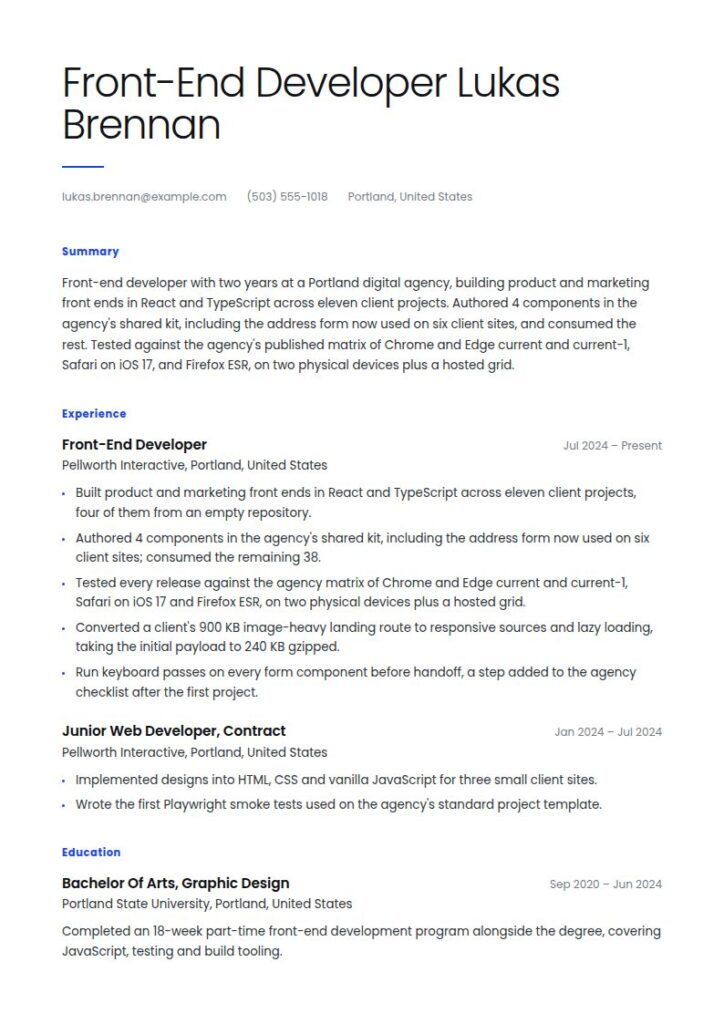
Front-end developer with two years at a Portland digital agency, building product and marketing front ends in React and TypeScript across eleven client projects. Authored 4 components in the agency's shared kit, including the address form now used on six client sites, and consumed the rest. Tested against the agency's published matrix of Chrome and Edge current and current-1, Safari on iOS 17, and Firefox ESR, on two physical devices plus a hosted grid.
Work Experience
07/2024 - Present, Front-End Developer, Pellworth Interactive, Portland, United States
- Built product and marketing front ends in React and TypeScript across eleven client projects, four of them from an empty repository.
- Authored 4 components in the agency's shared kit, including the address form now used on six client sites; consumed the remaining 38.
- Tested every release against the agency matrix of Chrome and Edge current and current-1, Safari on iOS 17 and Firefox ESR, on two physical devices plus a hosted grid.
- Converted a client's 900 KB image-heavy landing route to responsive sources and lazy loading, taking the initial payload to 240 KB gzipped.
- Run keyboard passes on every form component before handoff, a step added to the agency checklist after the first project.
01/2024 - 07/2024, Junior Web Developer, contract, Pellworth Interactive, Portland, United States
- Implemented designs into HTML, CSS and vanilla JavaScript for three small client sites.
- Wrote the first Playwright smoke tests used on the agency's standard project template.
Education
09/2020 - 06/2024, Bachelor of Arts, Graphic Design, Portland State University, Portland, United States
Completed an 18-week part-time front-end development program alongside the degree, covering JavaScript, testing and build tooling.
Skills
React and TypeScript, 70
HTML and CSS layout, 85
Component authorship, 60
Responsive images and lazy loading, 70
Cross-browser and device testing, 75
Keyboard interaction passes, 65
Playwright, 55
Vite, 60
Languages
English, native
German, intermediate
Certificates
11/2023, Responsive Web Design, freeCodeCamp
Completed during the part-time front-end program.
02/2024, JavaScript Algorithms and Data Structures, freeCodeCamp
Public certification, verifiable by certificate link on request.
Summary
A front-end developer resume is a one to two page document naming the components you authored rather than consumed, the teams that shipped with them, the browser and device matrix you actually tested, and the payload budget you had to hold. This guide gives you three adaptable versions and current Bureau of Labor Statistics pay for the published occupations the title sits between.
Front-End Developer resume examples by experience level
A front-end developer resume is a one to two page document that separates what you authored from what you consumed, and puts a number on both.
That distinction is the whole reading. In practice, almost every front-end resume says the candidate worked with React, a component library and a state management tool. Very few say which components in that library the candidate wrote, how many other teams imported them, what the payload budget was and who failed the build when it was exceeded. For this reason, those are the facts a front-end lead uses to tell a person who maintained a shared surface from a person who used one.
Resume guide for a front-end developer resume
In short, this guide and the corresponding front-end developer resume example will cover:
- How to write a front-end developer resume, section by section
- The component and support contract, and how to put it on one page
- Why authored and consumed have to be two different words on your resume
- Three adaptable summaries: first role, practicing developer and lead
- Which published occupations the title sits between, and what they pay
How to write a front-end developer resume
First, use six blocks: contact header, summary, the component and support contract, experience, skills, and education with certifications.
The contract block is the differentiator, so it goes directly under the summary. It takes six lines and it answers the questions a front-end interviewer would otherwise spend twenty minutes asking.
| Section | The question it answers | Where it goes |
|---|---|---|
| Summary | What surface did you own, and for how many teams? | Top, four lines |
| Component and support contract | Did you author shared code or only consume it? | Directly under the summary |
| Experience | What changed because of a screen you built? | Reverse chronological, numbers in every bullet |
| Skills | Which framework and tooling generation are you on? | Grouped, with versions |
| Education and certifications | Anything worth verifying? | Bottom, short |
Write the word authored or consumed next to every library you name
A front-end resume that lists a design system is ambiguous in a way that costs the candidate. The reader cannot tell whether you built components in it, contributed one, or imported it the way you would import any package.
Write the distinction into the line. "Authored 23 of the 140 components in the internal library" is a different claim from "shipped against the internal library", and only one of them survives a follow-up question.
The same applies to the build. "Vite" tells a reader nothing. "Moved the build from Webpack 4 to Vite 5 across 11 packages, cutting cold start from 94 seconds to 6" tells them you have been inside the tooling rather than beside it.
Run the finished file through the ATS resume checker before you send it, because front-end resumes are the ones most likely to have been laid out in two columns.
Choosing the best resume format for a front-end developer resume
Reverse chronological, single column. Also, keep one page for your first five years, two once you have owned a shared surface that other teams built on.
However, the temptation specific to this title is to design the resume. Resist it. For example, a front-end developer who submits a beautifully typeset two-column PDF is demonstrating visual skill to a parser that cannot see it, and the parser reads first. Instead, save the design judgment for the work you describe.
Include your contact information
| ✅ Right | ❌ Wrong |
|---|---|
| Lukas Brennan | Lukas Brennan |
| Front-End Developer, design system and shared components | Creative front-end developer who loves pixel-perfect UI |
| React 18, TypeScript, component library authorship | React, Redux, HTML5, CSS3, SASS, JavaScript, jQuery, Bootstrap |
| (503) 555-1018, [email protected], Portland, OR | (503) 555-1018, [email protected] |
The second line places you on a team before anyone reads a bullet. After all, a design system person, a product feature person and a performance person are three different hires, and most front-end resumes read as all three at once, which means none.
Make use of a summary
Then write four lines: the surface you owned, the framework generation you are on, one component fact with a reuse number, and one constraint you held.
Front-end developer with two years at a Portland digital agency, building product and marketing front ends in React and TypeScript across eleven client projects. Authored 4 components in the agency's shared kit, including the address form now used on six client sites, and consumed the rest. Tested against the agency's published matrix of Chrome and Edge current and current-1, Safari on iOS 17, and Firefox ESR, on two physical devices plus a hosted grid.
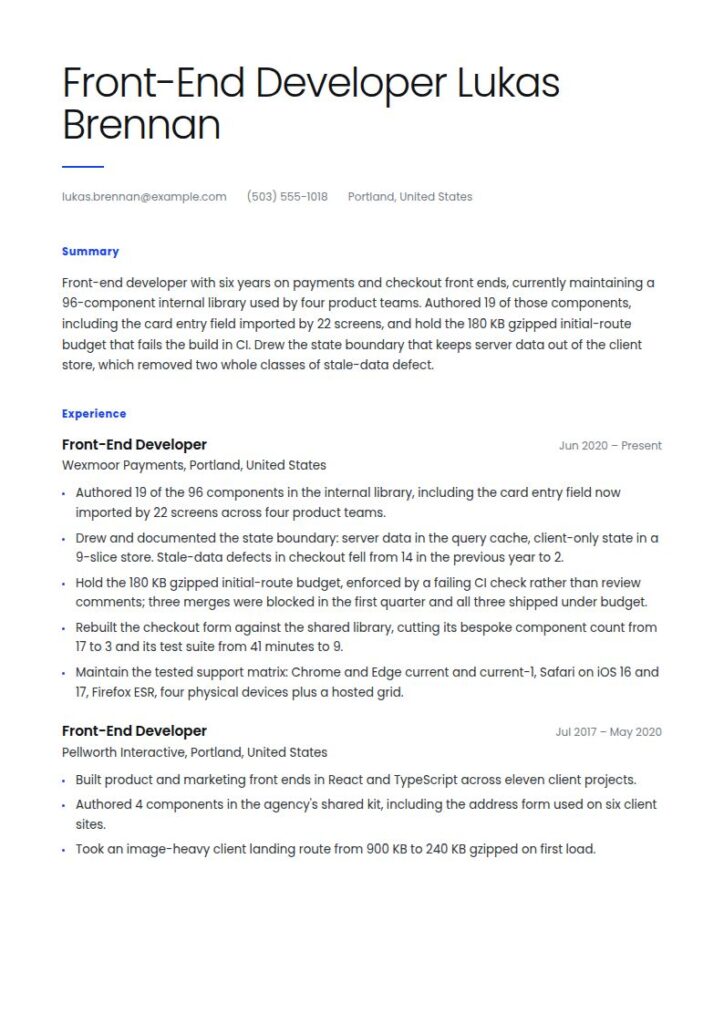
Front-end developer with six years on payments and checkout front ends, currently maintaining a 96-component internal library used by four product teams. Authored 19 of those components, including the card entry field imported by 22 screens, and hold the 180 KB gzipped initial-route budget that fails the build in CI. Drew the state boundary that keeps server data out of the client store, which removed two whole classes of stale-data defect.
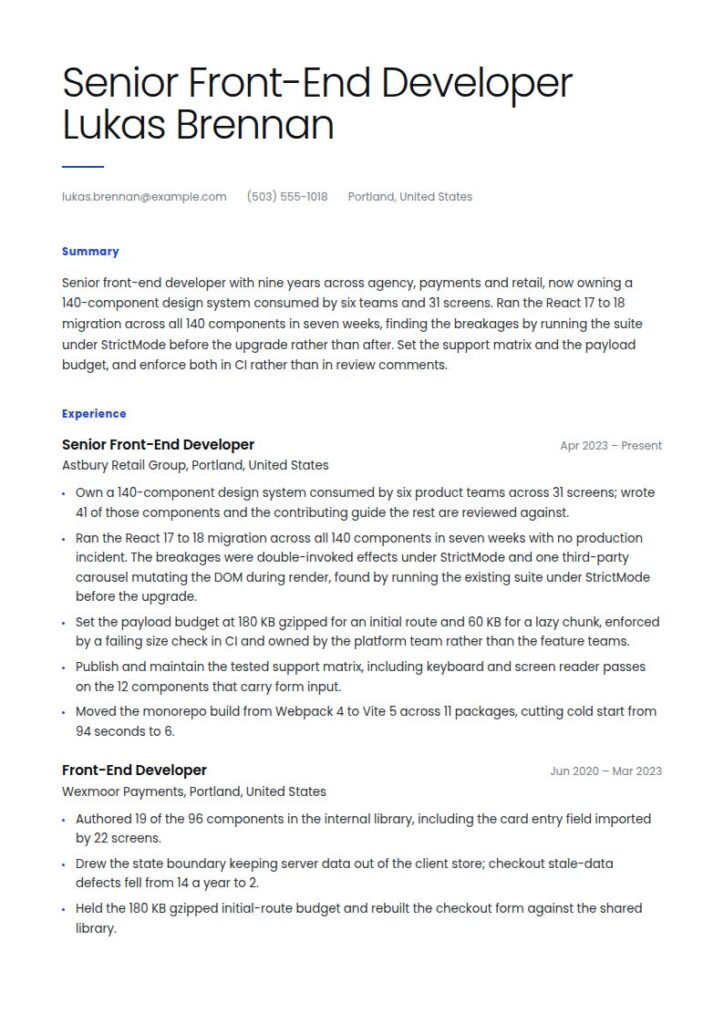
Senior front-end developer with nine years across agency, payments and retail, now owning a 140-component design system consumed by six teams and 31 screens. Ran the React 17 to 18 migration across all 140 components in seven weeks, finding the breakages by running the suite under StrictMode before the upgrade rather than after. Set the support matrix and the payload budget, and enforce both in CI rather than in review comments.
Right vs wrong: the same front-end developer summary, twice
| ✅ Right | ❌ Wrong |
|---|---|
| Maintain a 96-component internal library used by four product teams. | Experienced working with modern component-based architectures. |
| Authored 19 of those components, including the card field imported by 22 screens. | Built reusable UI components following best practices. |
| Hold the 180 KB gzipped initial-route budget, enforced in CI. | Focused on performance optimization and clean, maintainable code. |
As a result, every line on the left has a number that a reader could ask you to expand on, and a person who did the work can. That is the only test a summary has to pass.
Outline your experience
Next, give company, title, dates, and the framework generation in one clause. Then three to five bullets, each naming a surface and carrying a number.
| Instead of | Use |
|---|---|
| Built reusable components for the design system | Authored 19 of 96 components in the internal library; the card entry field is imported by 22 screens across four teams |
| Optimized application performance | Held the 180 KB gzipped initial-route budget in CI; three merges were blocked by it in the first quarter and all three shipped under budget |
| Migrated the application to the latest version of React | Ran React 17 to 18 across 140 components in seven weeks; the breakages were double-invoked effects and one carousel mutating the DOM during render |
| Ensured cross-browser compatibility | Tested against Chrome and Edge current and current-1, Safari on iOS 16 and 17, and Firefox ESR, on four physical devices plus a hosted grid |
| Managed application state | Kept server data in the query cache and client-only state in a 9-slice store; nothing a round trip could answer was allowed in the store |
Front-End Developer, Wexmoor Payments, Portland, OR, June 2020 to March 2023. React 17 and 18, TypeScript, internal component library.
Authored 19 of the 96 components in the internal library, including the card entry field now imported by 22 screens across four product teams.
Drew and documented the state boundary: server data in the query cache, client-only state in a 9-slice store. Stale-data defects in checkout fell from 14 in the previous year to 2.
Held the 180 KB gzipped initial-route budget, enforced by a failing CI check rather than review comments; three merges were blocked in the first quarter and all three shipped under budget.
Rebuilt the checkout form against the shared library, cutting its bespoke component count from 17 to 3 and its test suite from 41 minutes to 9.
The component and support contract you actually owned
Then add six lines, and make sure each one names something a colleague could confirm. In other words, this is the block that answers what a front-end interview spends its first twenty minutes on.
Authored against consumed: authored 19 of the 96 components in the internal library; consumed the remaining 77. Contributed 4 more to the shared kit at a previous employer.
Reuse and who shipped with it: the card entry field is imported by 22 screens across four product teams. Two of those teams ship without asking me anything, which is the point.
State boundary: server data lives in the query cache and never in the store; client-only state lives in a 9-slice store. The rule was written into the contributing guide, and the two exceptions are documented with their reasons.
Support matrix, tested rather than aspired to: Chrome and Edge current and current-1, Safari on iOS 16 and 17, Firefox ESR. Four physical devices in the office plus a hosted grid for the rest. Keyboard and screen reader passes on the 12 components that carry form input.
Payload budget: 180 KB gzipped for the initial route, 60 KB for a lazy chunk. Enforced by a size check in CI that fails the build. Owned by the platform team, not by the feature team that wants the exception.
Version migration: React 17 to 18 across 140 components in seven weeks. What broke was double-invoked effects under StrictMode and one third-party carousel mutating the DOM during render. Found by running the existing suite under StrictMode before the upgrade, which is why the migration had no production incident.
Next, read those six lines as a hiring manager and notice how little room there is to bluff. A candidate who only consumed a library cannot produce a reuse count, for example. Similarly, someone who never held a budget cannot say who enforced it or who was allowed to grant an exception. A candidate who sat next to a migration cannot describe what broke, and the specific answer is almost never the one people guess, either.
The budget line is the one that separates two otherwise identical files
Payload budgets are common in job descriptions and rare on resumes, which makes them unusually cheap evidence.
Write the number, the scope it applies to, the mechanism that enforces it and the person or team who owns exceptions. "Kept bundles small" is worth nothing. "180 KB gzipped for the initial route, enforced by a failing CI check, exceptions granted by the platform team" tells a reader that you have worked somewhere with a real constraint and lived inside it.
If your team never had a budget, say what you did instead: the number you measured, how often, and the one change that moved it most. Measuring without a policy is still more than most applicants can show.
Build a snapshot of your key skills
Later, in skills, group into four, name versions where a version matters, and keep the total between twelve and eighteen.
Framework and language: React 18, TypeScript, React Router, Suspense and code splitting, form libraries
Shared surface: component library authorship, API design for components, contributing guides, Storybook documentation, visual regression tests
State and data: query cache patterns, client store design, cache invalidation, optimistic updates and rollback
Build and delivery: Vite 5, module federation, bundle analysis, size checks in CI, feature flags, Playwright
Testing and support: unit and component tests, hosted device grid, keyboard and screen reader passes on input components
Versions matter here in a way they do not on a back-end resume, because the front-end tooling generation changes what you can be dropped into. That is why React 16 with class components and React 18 with Suspense count as different working environments, and a reader wants to know which one you have been living in.
List your education and certifications
Degree or program, then anything certifiable, then stop. This block is short on a front-end resume because the field has few meaningful certifications, and padding it is conspicuous.
Bachelor of Arts, Graphic Design, Portland State University, Portland, OR, 2017
Additional study: 18-week part-time front-end program, 2018, covering JavaScript, testing and build tooling.
Open source: maintainer of a small form-validation package, 2,100 weekly downloads, 14 contributors merged.
An open source line is worth more than a certificate here, provided it carries a number and is genuinely yours. Likewise, a maintainer line with a download figure and a contributor count is checkable in under a minute, which is exactly what makes it useful.
Choose the right layout and design
Finally, keep the format simple: single column, 11 or 12 point, plain headings, no photograph, no skill rating bars, no icon set. Export to PDF unless the portal asks otherwise.
Separate authored from consumed, in those words. Give a reuse count and name who else shipped with your components. State the state boundary and where it was drawn. Write the support matrix you actually tested rather than the one in the brief. Put the payload budget number on the page with its enforcement mechanism. Describe one major-version migration by what broke.
Do not design the resume; the parser reads before the person does. Do not list a design system without saying whether you wrote any of it. Do not claim browser support you never tested, because the follow-up question is which device. Do not use skill rating bars. Do not fill the page with framework names at the expense of the six contract lines.
Front-end developer job market and outlook
The Bureau of Labor Statistics publishes no current Occupational Outlook Handbook profile under the title front-end developer, so there is no federal employment or wage figure attached to it. Meanwhile, the work is counted inside two published occupations, and they are very different sizes.
| Measure | Web developers and digital designers | Software developers, QA analysts and testers |
|---|---|---|
| Jobs, 2025 | 220,100 | 1,905,400 |
| Projected change, 2025-35 | 5%, +11,300 | 10% (much faster than average), +185,400 |
| Projected annual openings | About 13,600 | About 106,100 |
| Median annual wage, May 2025 | $99,520 combined; web developers $92,650, web and digital interface designers $104,000 | $134,040 combined; software developers $135,980 |
| Typical entry-level education | Bachelor's degree | Bachelor's degree |
Source: U.S. Bureau of Labor Statistics, Occupational Outlook Handbook, 2025-35 projections and May 2025 wage data.
The same work, counted in two occupations of very different size
Web developers and digital designers held 220,100 jobs in 2025 with about 13,600 openings projected a year. Software developers, quality assurance analysts and testers held 1,905,400 jobs with about 106,100 openings a year (BLS Occupational Outlook Handbook, 2025-35 projections).
That is a difference of nearly nine to one in openings, for occupations that both contain people writing browser code all day. Which one a given employer's payroll classifies a front-end role under is not something the applicant controls; it follows from how the company describes the job internally.
The consequence is practical. Front-end roles inside product engineering organizations are usually counted in the larger, faster growing and better paid occupation, and those are the postings where component library authorship, state architecture and build tooling are the qualifying evidence. Roles counted in the smaller occupation weigh page production and visual implementation more heavily. The same resume performs differently in the two, and the contract block is what makes you legible to the first.
Where web developer pay sits by industry:
| Industry | Median annual wage (May 2025) |
|---|---|
| Information | $119,940 |
| Computer systems design and related services | $88,690 |
| Management, scientific and technical consulting services | $86,690 |
| Educational services | $84,450 |
Source: U.S. Bureau of Labor Statistics, Occupational Outlook Handbook, May 2025.
What salary you can expect as a front-end developer
However, no median wage is published for this job title. The Handbook has no front-end developer entry, so treat the three published occupations that contain the work as the ladder your offer sits on.
Instead, the rungs are web developers at $92,650, web and digital interface designers at $104,000, and software developers at $135,980, all as of May 2025 (BLS, May 2025). First, the step from the first rung to the second is $11,350. By contrast, the step from the second to the third is $31,980, which is nearly three times larger.
That asymmetry is worth planning around. In other words, moving from implementing designs to designing interfaces is a modest, well-trodden step. Moving from either into the occupation that contains product engineering is where the money changes shape, and the evidence that supports it is the contract block: shared code that other teams depend on, a state architecture you drew, a constraint you enforced in CI, and a migration you ran without an incident.
At the same time, industry matters inside each rung as well. For instance, web developers in information had a median of $119,940 against $84,450 in educational services, a difference of $35,490 (BLS, May 2025). Similarly, for web and digital interface designers the top industry median was $133,260 in finance and insurance (BLS, May 2025).
Key takeaways for a front-end developer resume
- To start, say authored or consumed next to every shared library you name.
- Then give a reuse count and name the teams that shipped with your components.
- Also, state the state boundary and where it was drawn, not the tool you used.
- Write the support matrix you tested, including the devices.
- In addition, put the payload budget number on the page with who enforced it.
- Finally, describe one major-version migration by what broke and how you found it.
- Keep the layout plain, because designing the resume helps nobody who reads it.
Build your front-end developer resume in 15 minutes with our AI resume builder.
Related information technology resume examples
- Web developer resume
- Full stack developer resume
- Software developer resume
- Software engineer resume
- Senior software engineer resume
- Entry-level software engineer resume
- Python developer resume
- QA tester resume
- Automation tester resume
- Web analyst resume
- Motion graphics artist resume
- Computer science resume
Pair it with a matching front-end developer cover letter.
Front-end developer resume questions, answered
How long should a front-end developer resume be?
One page for your first five years, two once you have owned a shared surface other teams built on. The six contract lines plus three jobs will fill a page. At three pages the cause is usually a framework list that has never been pruned.
What if I only ever consumed a component library?
Say so, in that word, and then give the strongest thing you did inside it. A candidate who consumed a library but can name the component they extended, the design review they pushed back in, and the defect class they removed reads far better than one who implies authorship and cannot answer the reuse question.
Do I need to list every browser I support?
List the matrix you actually test, with the devices. Four browsers named with real device coverage is a stronger claim than a sentence about cross-browser compatibility, because the follow-up question is always which device and how often.
What do I put on a front-end developer resume with no professional experience?
Build something with a shared surface in it, then describe it the same way. A small component package with real downloads, a state boundary you drew and documented, a measured payload figure and the change that moved it. Numbers from a personal project are still numbers, provided you say where they came from.
Should I mention a framework I have not used since 2019?
Only in a short line marked as prior experience, and only if the posting asks for it. The tooling generation you are currently in is the thing a reader wants to establish, and an unmarked older framework in the main list makes them uncertain about the rest.
Does the BLS publish pay for front-end developers?
Not under that title. The Occupational Outlook Handbook carries no profile for front-end developers. The published occupations containing the work are web developers at $92,650, web and digital interface designers at $104,000 and software developers at $135,980 as of May 2025 (BLS, May 2025).