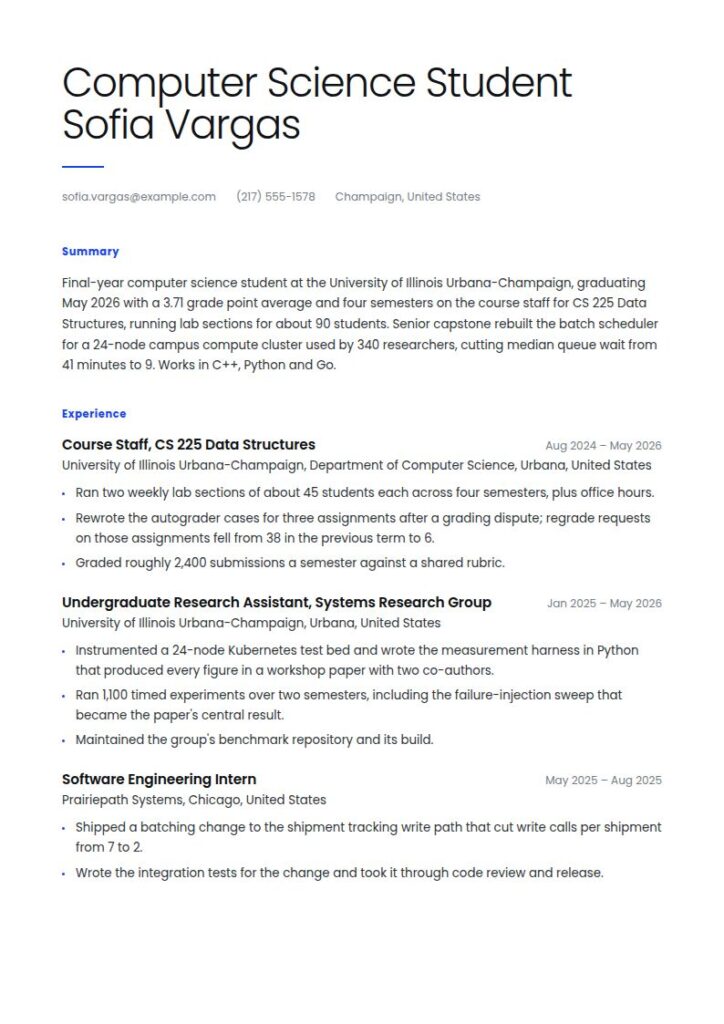
Computer Science Student Sofia Vargas
Course Staff, CS 225 Data Structures
[email protected] | (217) 555-1578 | Champaign, United States
Profile
Final-year computer science student at the University of Illinois Urbana-Champaign, graduating May 2026 with a 3.71 grade point average and four semesters on the course staff for CS 225 Data Structures, running lab sections for about 90 students. Senior capstone rebuilt the batch scheduler for a 24-node campus compute cluster used by 340 researchers, cutting median queue wait from 41 minutes to 9. Works in C++, Python and Go.
Work Experience
08/2024 - 05/2026, Course Staff, CS 225 Data Structures, University of Illinois Urbana-Champaign, Department of Computer Science, Urbana, United States
- Ran two weekly lab sections of about 45 students each across four semesters, plus office hours.
- Rewrote the autograder cases for three assignments after a grading dispute; regrade requests on those assignments fell from 38 in the previous term to 6.
- Graded roughly 2,400 submissions a semester against a shared rubric.
01/2025 - 05/2026, Undergraduate Research Assistant, Systems Research Group, University of Illinois Urbana-Champaign, Urbana, United States
- Instrumented a 24-node Kubernetes test bed and wrote the measurement harness in Python that produced every figure in a workshop paper with two co-authors.
- Ran 1,100 timed experiments over two semesters, including the failure-injection sweep that became the paper's central result.
- Maintained the group's benchmark repository and its build.
05/2025 - 08/2025, Software Engineering Intern, Prairiepath Systems, Chicago, United States
- Shipped a batching change to the shipment tracking write path that cut write calls per shipment from 7 to 2.
- Wrote the integration tests for the change and took it through code review and release.
Education
08/2022 - 05/2026, Bachelor of Science, Computer Science, University of Illinois Urbana-Champaign, Urbana, United States
Grade point average 3.71 of 4.00. Dean's List, five of eight semesters. Coursework: Compilers, Distributed Systems, Computer Architecture, Database Systems, Numerical Methods. Senior capstone rebuilt the batch scheduler for a 24-node campus compute cluster used by 340 researchers; median queue wait fell from 41 minutes to 9.
Skills
C++, 75
Python, 85
Go, 60
SQL and PostgreSQL, 65
Linux and Git, 80
Profiling and benchmarking, 70
Unit and integration testing, 70
Technical writing, 75
Languages
English, native
Spanish, native
Certificates
03/2025, AWS Certified Cloud Practitioner, Amazon Web Services
Valid through March 2028.
Summary
A computer science resume is written around a qualification rather than a job, and the decision it has to get right is how much room the degree takes at each stage. This guide gives you three adaptable versions, the coursework rules, how to write a capstone or research project as evidence, and current Bureau of Labor Statistics pay and openings for computing occupations.
Computer Science resume examples by experience level
A computer science resume is a one to two page document written around a qualification rather than an occupation, and the decision it has to get right is how much room the degree takes up.
That decision changes every year. In a final-year student's file the degree is the top third of the page. Two years into a job it is a four-line education block. Ten years in it is one line near the bottom.
The honest limit is worth saying at the start. A computer science degree gets you parsed. It does not get you read. What gets you read is the four or five lines underneath it showing you built something, measured it, and can say what happened.
Resume guide for a computer science resume
This guide and the corresponding computer science resume example will cover:
- How much room the degree gets at each stage, and what shrinks first
- Three adaptable summaries: final-year student, two years in, ten years in
- Which coursework earns a line on the page and which does not
- How to write a capstone or research project as evidence of work
- What the computing market pays, and the spread the group median hides
How to write a computer science resume
Six sections: contact header, summary, experience, projects, a skills snapshot, and education. One page while the degree is still the headline, two once the work outweighs it.
The ordering is the whole argument. The posting tells you which of three situations you are in, and the situation decides where the education block sits.
| Where you are | Where the degree goes | Why |
|---|---|---|
| Final year, or within a year of graduating | Under the summary, before experience | The strongest verified fact you have |
| One to three years into paid engineering work | Education block, four to six lines | Context now; the job is the evidence |
| Three years or more | Education block, two lines | Degree, field, institution, year |
| Seven to ten years or more | One line near the bottom | Nobody has asked since your first interview |
Name the language, the system and the size in the same sentence
"Proficient in Python" is the most common line on a computer science resume and it carries almost no information, because every applicant in the pile writes it and none of them are lying.
What carries information is a language attached to a thing with a size on it. "Wrote the measurement harness in Python for a 24-node test bed and ran 1,100 timed experiments over two semesters" says the same thing about Python and four more besides: you can instrument a system, keep an experiment running for months, design a controlled run, and be trusted with the cluster. Do that once per experience entry and the skills list becomes an index to claims made elsewhere.
Run the finished file through the free Rezoom ATS resume checker first, because large employers parse computing applications into structured fields before a human opens anything.
Choosing the best resume format for a computer science resume
Reverse chronological, single column, in nearly every case, including when you have more coursework than employment. A student file is still a timeline.
A projects block above employment is the one structural change worth making early, and it is not a functional format: keep the dates on everything and the history in order underneath. Do not use a skills-first functional layout, which in computing reads as a course list reformatted.
Include your contact information
| ✅ Right | ❌ Wrong |
|---|---|
| Sofia Vargas | Sofia Vargas |
| BS Computer Science, University of Illinois Urbana-Champaign, 2026 | Aspiring software engineer passionate about technology |
| (217) 555-1578, [email protected], Champaign, IL | (217) 555-1578, [email protected] |
| github.com/example, linkedin.com/in/example | Full mailing address, date of birth, photograph |
Use a personal email address rather than a university one, because campus accounts are switched off some months after graduation.
Make use of a summary
Three or four lines: what you are, the degree and where it is from while it still leads, the largest thing you have worked on, and one number that came out of it.
Final-year computer science student at the University of Illinois Urbana-Champaign, graduating May 2026 with a 3.71 grade point average and four semesters on the course staff for CS 225 Data Structures, running lab sections for about 90 students. Senior capstone rebuilt the batch scheduler for a 24-node campus compute cluster used by 340 researchers, cutting median queue wait from 41 minutes to 9. Works in C++, Python and Go.
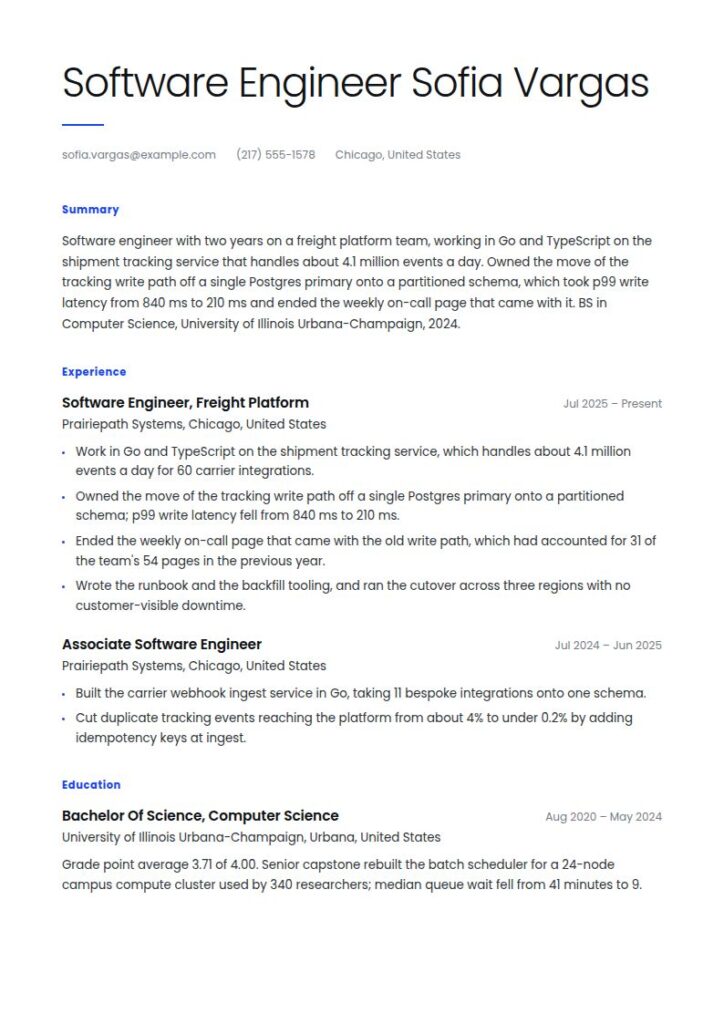
Software engineer with two years on a freight platform team, working in Go and TypeScript on the shipment tracking service that handles about 4.1 million events a day. Owned the move of the tracking write path off a single Postgres primary onto a partitioned schema, which took p99 write latency from 840 ms to 210 ms and ended the weekly on-call page that came with it. BS in Computer Science, University of Illinois Urbana-Champaign, 2024.
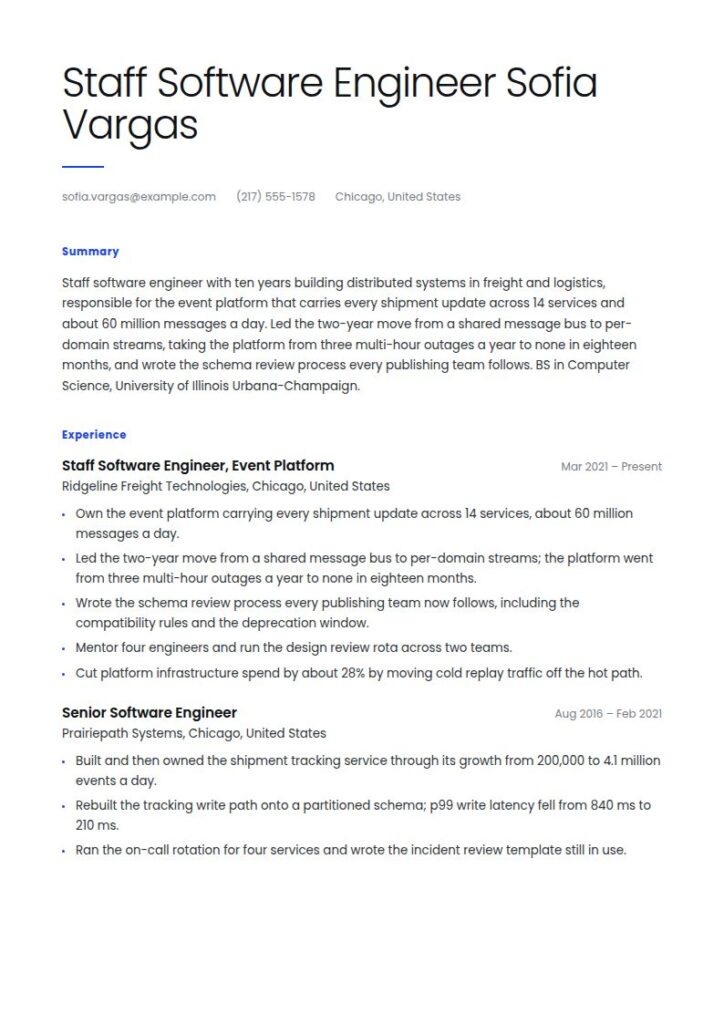
Staff software engineer with ten years building distributed systems in freight and logistics, responsible for the event platform that carries every shipment update across 14 services and about 60 million messages a day. Led the two-year move from a shared message bus to per-domain streams, taking the platform from three multi-hour outages a year to none in eighteen months, and wrote the schema review process every publishing team follows. BS in Computer Science, University of Illinois Urbana-Champaign.
Watch where the degree sits in those three. It opens the first, closes the second and is the last clause of the third. Getting the arc wrong is expensive both ways: a student who buries the degree loses the filter, and an experienced engineer who leads with it looks like someone whose best year was the year they graduated.
Right vs wrong: the same computer science summary, twice
| ✅ Right | ❌ Wrong |
|---|---|
| Four semesters on the course staff for CS 225 Data Structures, running labs for about 90 students. | Strong foundation in data structures and algorithms. |
| Capstone rebuilt the batch scheduler for a 24-node cluster used by 340 researchers. | Completed a challenging senior capstone project in distributed systems. |
| Median queue wait fell from 41 minutes to 9. | Achieved significant performance improvements. |
The right column is a set of claims somebody could check. The left column is a transcript with adjectives on it.
Outline your experience
Title, organization, city, dates, then two to five bullets. Put paid academic work here rather than in the education block: course staff, a research assistantship and a laboratory systems job are all jobs, with hours and somebody who can be called.
| Instead of | Use |
|---|---|
| Coursework in data structures and algorithms | Ran weekly lab sections for CS 225 Data Structures, about 90 students a semester, across four semesters |
| Worked on a group project in distributed systems | Built the batch scheduler for a 24-node campus cluster used by 340 researchers; median queue wait fell from 41 minutes to 9 |
| Familiar with Python and experimental methods | Wrote the measurement harness in Python and ran 1,100 timed experiments over two semesters |
| Undergraduate research assistant in a systems group | Instrumented a 24-node test bed and produced every figure in a workshop paper |
| Strong problem-solving skills | Placed 9th of 61 teams at the regional ICPC contest |
Course Staff, CS 225 Data Structures, Department of Computer Science, University of Illinois Urbana-Champaign, Urbana, IL, August 2024 to May 2026
Ran two weekly lab sections of about 45 students each across four semesters, plus office hours.
Rewrote the autograder cases for three assignments after a grading dispute; regrade requests on those assignments fell from 38 in the previous term to 6.
Graded roughly 2,400 submissions a semester against a shared rubric.
What a computer science degree is evidence of, and what it is not
This is what makes a computer science resume different from a software engineer resume, and most people get it wrong in the same direction: they ask the degree to prove things it cannot prove, then leave out what it does prove because that feels too obvious to write down.
| What the degree is evidence of | What it is not evidence of |
|---|---|
| You can reason about algorithmic complexity, memory, concurrency and data structures | That you have written code anyone else depends on |
| You finished a four-year sequence under grading, to deadlines, without supervision | That you can work inside an existing codebase you did not design |
| You have covered theory that is hard to pick up on the job: automata, compilers, operating systems, numerical methods | That you know the tooling any particular team uses |
| You clear the education filter on postings that name a bachelor's degree | That you can estimate, review, debug in production or hand work over |
Read the right column as the list of gaps the rest of the page has to fill, because that is what a hiring manager is doing with it.
Two consequences follow. Do not let the degree do work that belongs to a project: "studied distributed systems" is a claim you could make far better by naming the system you built and what changed. And stop paying rent on it; the commonest defect in a file from someone five years out is that the coursework and the grade point average never shrank.
Coursework, grade point average, and the lines that earn their space
Two blocks almost everyone either overuses or deletes, when the right answer for both is conditional.
Coursework earns a line when it is elective or when the posting names it. Compilers, operating systems, distributed systems, computer graphics, cryptography, machine learning and computer architecture all qualify, because a reader can infer content from the title. It does not earn a line when everyone in the pile has taken it: introduction to programming, discrete mathematics and computer organization are the core sequence, and listing them says only that you did the degree you already claimed.
| Instead of | Use |
|---|---|
| Relevant coursework: CS 125, CS 173, CS 225, CS 233 | Relevant coursework: Compilers, Distributed Systems, Computer Architecture |
| GPA: 3.71 | Grade point average 3.71 of 4.00 |
| Dean's List | Dean's List, five of eight semesters |
The grade point average follows the same logic. Keep it with the scale attached while it is strong and while you are within about two years of graduating, because early-career computing recruiting does ask for it and omitting a good one invites the assumption it is being hidden. Drop it at two years of full-time work, and if it is weak leave it off and put a project in the space.
How to write a capstone or research project as evidence
A project title is not evidence. It is a label, and a reader outside your subfield cannot open it. Rewrite it as work: what you built, how big it was, the constraint you designed against, and what happened when it ran.
| Instead of | Use |
|---|---|
| Senior capstone: "A Fault-Tolerant Scheduler for Heterogeneous Compute Clusters" | Rebuilt the batch scheduler for a 24-node campus cluster used by 340 researchers; median queue wait fell from 41 minutes to 9 |
| Machine learning course project on image classification | Trained a classifier on 38,000 labeled images; the error analysis found a labeling fault affecting 4% of the training set |
| Built a web application for a class | Built a scheduling tool three student organizations still use, roughly 200 bookings a month |
| Research assistant on a systems project | Instrumented a 24-node test bed and ran 1,100 timed experiments; the failure-injection sweep became the paper's central result |
Three rules separate a project block a reader trusts from one they skim. Give the disposition: whether it still runs and who maintains it. Say what you personally did, because group capstones are the norm and readers know it; "owned the scheduler and the failure-injection harness, two teammates built the web console" buys credibility for everything above it. And name the constraint, not just the outcome: a scheduler that got faster is unremarkable, one that got faster while holding fair-share allocation across four research groups is a design decision, and design decisions are what the interview is about.
Put the degree, institution and graduation date in one precise line, spelled out. Write paid academic work as employment, with hours and scale. Give every project a size and a measured before and after.
Do not list the core course sequence everyone in the pile has taken. Do not keep coursework or the grade point average once you have two years of engineering work. Do not write "proficient in" followed by nine languages, since the reader will pick the one you are weakest in. Do not claim a group capstone in the first person singular.
Build a snapshot of your key skills
Three groups: languages, systems and tools, and the practices that separate someone who has written code from someone who has worked on software.
Languages: C++, Python, Go, SQL, TypeScript, Java
Systems and tools: Linux, Git, Docker, Kubernetes, PostgreSQL, Redis, gRPC, Apache Kafka
Practice: Code review, Unit and integration testing, Profiling and benchmarking, Design documents, Incident debugging, Technical writing
The third group is the one most computer science graduates leave off, and it decides between two candidates with identical language lists. Every claim in it should be traceable to a line elsewhere on the page. If nothing on the page shows a code review, take code review out.
List your education and certifications
Degree, field, institution, city, graduation date, then the conditional blocks in order of how long they survive.
Bachelor of Science, Computer Science, University of Illinois Urbana-Champaign, Urbana, IL, May 2026. Grade point average 3.71 of 4.00. Dean's List, five of eight semesters.
Relevant coursework: Compilers, Distributed Systems, Computer Architecture, Database Systems, Numerical Methods.
Senior capstone, spring 2026: rebuilt the batch scheduler for a 24-node campus compute cluster used by 340 researchers; median queue wait fell from 41 minutes to 9 over the pilot term.
Certifications: AWS Certified Cloud Practitioner, Amazon Web Services, 2025.
Certifications sit below the degree and stay short: they signal a platform rather than a qualification.
Choose the right layout and design
Single column, 10 to 12 point body type, consistent headings, no photograph, no skill rating bars. Computing templates are full of rating bars and a bar at 80% is a number you cannot defend. Write the degree in full words at least once, since "Bachelor of Science (BS), Computer Science" parses reliably where "BSc CS" sometimes does not.
Computer science job market and outlook
A computer science degree is not an occupation, so the honest figure is the group it feeds rather than a single job inside it.
| Measure, computer and information technology occupations | Value |
|---|---|
| Median annual wage, May 2025 | $109,470 |
| Projected openings a year, 2025-35 | About 280,000 |
| Group outlook, 2025-35 | Projected to grow faster than the average for all occupations |
| Typical entry-level education across most of the group | Bachelor's degree |
Source: U.S. Bureau of Labor Statistics, Occupational Outlook Handbook, computer and information technology occupations, May 2025 wage data and 2025-35 projections, last modified 27 August 2026.
The group median is worth about as much as a national average temperature. The occupations inside it are what you apply to, and they are far apart.
| Occupation the degree feeds | Median annual wage, May 2025 | Typical entry-level education |
|---|---|---|
| Computer and information research scientists | $140,300 | Master's degree |
| Computer network architects | $134,050 | Bachelor's degree |
| Software developers, quality assurance analysts and testers | $134,040 | Bachelor's degree |
| Information security analysts | $129,180 | Bachelor's degree |
| Database administrators and architects | $126,760 | Bachelor's degree |
| Computer systems analysts | $105,850 | Bachelor's degree |
| Computer programmers | $100,390 | Bachelor's degree |
| Web developers and digital designers | $99,520 | Bachelor's degree |
| Network and computer systems administrators | $99,130 | Bachelor's degree |
| Computer support specialists | $62,890 | Varies |
Source: U.S. Bureau of Labor Statistics, Occupational Outlook Handbook, computer and information technology occupations, May 2025 wage data, last modified 27 August 2026.
One degree opens every row in that table, which is the argument for the qualification. But the rows differ by $77,410 at the median, and nothing in the degree decides which row you land in. That is decided by what the rest of the page shows.
The degree is common; the evidence on top of it is not
Postsecondary institutions in the United States conferred 108,503 bachelor's degrees in computer and information sciences in the 2021-22 academic year, up from 97,054 in 2019-20, alongside 51,338 master's degrees and 2,790 doctorates (National Center for Education Statistics, Digest of Education Statistics, Table 325.35, prepared November 2023).
Set that against about 280,000 projected openings a year across computer and information technology occupations from 2025 to 2035, at a group median annual wage of $109,470 as of May 2025 (BLS Occupational Outlook Handbook, 27 August 2026).
There are enough openings that the qualification is worth having, and enough people holding it that it sorts nobody. What sorts a pile of otherwise identical files is the four or five lines underneath the education block.
What salary you can expect with a computer science degree
The median annual wage across computer and information technology occupations was $109,470 as of May 2025 (BLS Occupational Outlook Handbook, last modified 27 August 2026). That is the group figure, and it is the wrong number to take into a negotiation.
The number to take in is the median for the occupation you are applying to, because the spread inside the group runs from $62,890 for computer support specialists to $140,300 for computer and information research scientists as of May 2025 (BLS, May 2025). Two graduates of the same program, in the same year, can land at either end of that.
What moves you inside a single row is not the degree either. It is the evidence layered on top: a system you owned with a size on it, a measured before and after, and a bullet that survives the follow-up question.
Key takeaways for a computer science resume
- Let your stage decide the placement: top third as a student, four lines at two years, one line at ten.
- Say what the degree proves and let projects prove the rest.
- List only elective coursework, and take it off after a year of work.
- Keep the grade point average with its scale while it is strong and recent.
- Rewrite the capstone as work: what you built, how big, the constraint, what happened.
- Give the disposition of every project, and say what you owned on a team.
- Aim at a specific occupation, because the group median hides a $77,410 spread.
Build your computer science resume in 15 minutes with our AI resume builder.
Related information technology resume examples
- Software developer resume
- Software engineer resume
- Entry level software engineer resume
- Programmer resume
- Computer engineering resume
- Full stack developer resume
- Front end developer resume
- Python developer resume
- Java developer resume
- Data scientist resume
- Data analyst resume
- Machine learning engineer resume
Pair it with a matching computer science cover letter.
Computer science resume questions, answered
How long should a computer science resume be?
One page while you are a student or within about three years of graduating. It is not a limit on what you have done; it is a test of whether you can rank it. Two pages once you have systems worth describing.
Do I need a computer science degree to get a software job?
No. The Bureau of Labor Statistics gives a bachelor's degree as the typical entry-level education for most computer and information technology occupations, but typical is not required (BLS Occupational Outlook Handbook, 27 August 2026). Without it, the projects section has to carry more, and it can.
Should I list relevant coursework on my resume?
Only electives, only within a year of graduating, and only courses you could answer a question about. Compilers, distributed systems and cryptography tell a reader something. Introduction to programming and discrete mathematics do not.
Where do I put my GPA, and when do I take it off?
In the education block, with the scale attached: "grade point average 3.71 of 4.00". Keep it while it is strong and recent, take it off at two years of full-time work, and leave it off entirely if it is weak.
How do I write a capstone project on a resume?
As work, not as a title: what you built, how big it was, the constraint you designed against, and what happened when it ran. Then the two facts most candidates miss, which are whether it still runs and what you owned on a group project.
Is a computer science degree still worth it financially?
The group figures say yes without drama. Computer and information technology occupations had a median annual wage of $109,470 as of May 2025, are projected to grow faster than the average for all occupations, and to produce about 280,000 openings a year from 2025 to 2035 (BLS Occupational Outlook Handbook, 27 August 2026). The caution is the spread: $62,890 to $140,300 at the median.