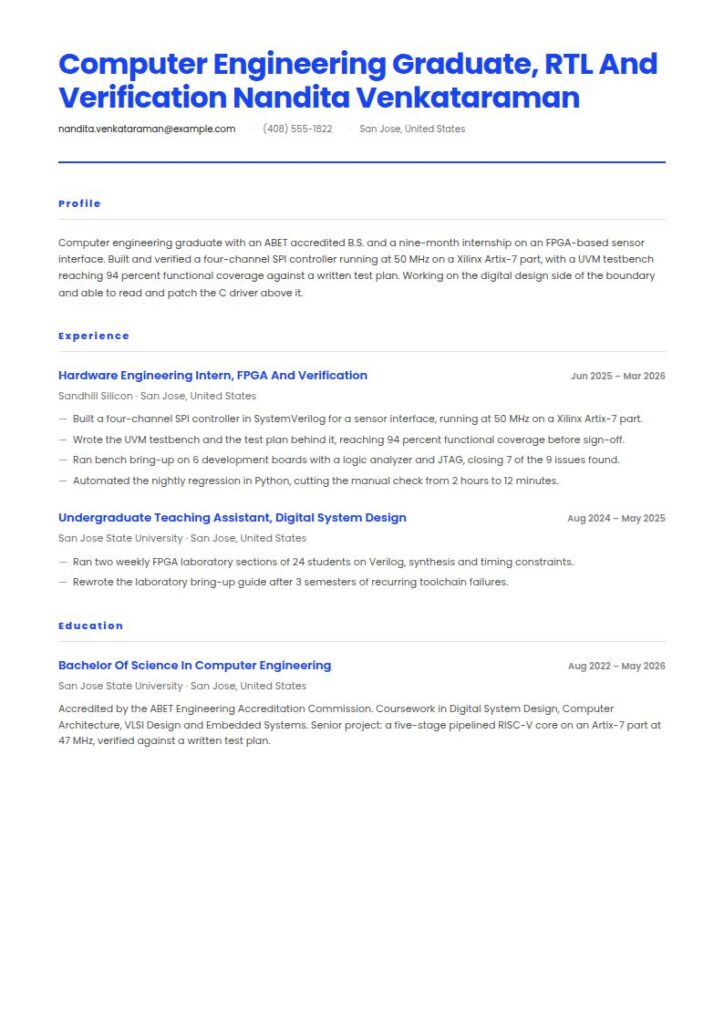
Computer Engineering Graduate, RTL and Verification Nandita Venkataraman
Hardware Engineering Intern, FPGA and Verification
[email protected] | (408) 555-1822 | San Jose, United States
Profile
Computer engineering graduate with an ABET accredited B.S. and a nine-month internship on an FPGA-based sensor interface. Built and verified a four-channel SPI controller running at 50 MHz on a Xilinx Artix-7 part, with a UVM testbench reaching 94 percent functional coverage against a written test plan. Working on the digital design side of the boundary and able to read and patch the C driver above it.
Work Experience
06/2025 - 03/2026, Hardware Engineering Intern, FPGA and Verification, Sandhill Silicon, San Jose, United States
- Built a four-channel SPI controller in SystemVerilog for a sensor interface, running at 50 MHz on a Xilinx Artix-7 part.
- Wrote the UVM testbench and the test plan behind it, reaching 94 percent functional coverage before sign-off.
- Ran bench bring-up on 6 development boards with a logic analyzer and JTAG, closing 7 of the 9 issues found.
- Automated the nightly regression in Python, cutting the manual check from 2 hours to 12 minutes.
08/2024 - 05/2025, Undergraduate Teaching Assistant, Digital System Design, San Jose State University, San Jose, United States
- Ran two weekly FPGA laboratory sections of 24 students on Verilog, synthesis and timing constraints.
- Rewrote the laboratory bring-up guide after 3 semesters of recurring toolchain failures.
Education
08/2022 - 05/2026, Bachelor of Science, Computer Engineering, San Jose State University, San Jose, United States
Accredited by the ABET Engineering Accreditation Commission. Coursework in Digital System Design, Computer Architecture, VLSI Design and Embedded Systems. Senior project: a five-stage pipelined RISC-V core on an Artix-7 part at 47 MHz, verified against a written test plan.
Skills
SystemVerilog and Verilog, 70
UVM verification, 60
Xilinx Vivado and FPGA synthesis, 70
Static timing and constraints, 55
Embedded C on Arm Cortex-M, 65
Python for bench automation, 75
Oscilloscope and logic analyzer debug, 65
Languages
English, native
Tamil, native
Hindi, intermediate
Certificates
04/2026, Fundamentals of Engineering, Electrical and Computer, NCEES
Passed April 2026. Not required for this occupation; taken as an open licensure path.
Summary
A computer engineering resume is a one to two page document that states which side of the hardware and software boundary you work on, then proves it with parts, tools and measured numbers. This guide gives you three adaptable versions, the boundary block that decides which pile your file lands in, what ABET and NCEES actually publish, and current Bureau of Labor Statistics pay.
Computer Engineering resume examples by experience level
A computer engineering resume is a one to two page document that tells a reader, inside the first four lines, which side of the hardware and software boundary you work on.
Computer engineering graduates scatter across two entirely different hiring markets. One designs silicon and boards, measured in gates, watts and board spins. The other writes the code that runs on them, measured in features, defects and release cadence. The certificate does not say which you are. Your resume has to.
Resume guide for a computer engineering resume
This guide and the corresponding computer engineering resume example will cover:
- How to write a computer engineering resume, section by section
- Why the hardware and software boundary belongs at the top of the page
- Three adaptable summaries: new graduate, working engineer and staff level
- What ABET and NCEES actually publish about this field
- Which published occupation your work maps onto, and what it pays
How to write a computer engineering resume
Six sections: contact header with a discipline line, summary, a boundary and platform block, experience, skills grouped by layer, and education with certifications. One page for your first four years, two once you have taped out or owned a subsystem end to end.
The order is set by what the reader is deciding. A hiring manager with an open requisition already knows which lane the seat is in. They are reading to find out whether you are in the right market at all, and that question gets abandoned in about eight seconds.
| Section | What it is answering | Where it goes |
|---|---|---|
| Discipline line | RTL, board, firmware or validation? | Directly under your name |
| Boundary block | Which layers has this person actually touched, and in what role? | Above experience |
| Experience | What did the part or the product do, and what number moved? | Reverse chronological |
| Education | Was the program ABET accredited, and in which commission? | Near the end unless you are a new graduate |
Write down five numbers about the last thing you shipped before you write a line
Whatever you worked on last, find five facts about it: the process node or board layer count, the clock frequency or interface standard, the power budget, the revisions it took to release, and the units built.
Almost no applicant has these at hand, which is why they work. Every resume in the stack says "designed and verified digital logic". One that says "16 nm, 1.2 GHz core clock, 4.8 W package budget, three silicon revisions, 40,000 units in the first year" has described a real object a reader can ask about. On the firmware side the equivalent five are the processor family, the flash and RAM footprint, the boot time, the release cadence and the field defect count.
Run the finished file through the ATS resume checker before you submit. Semiconductor and systems companies parse applications into a structured record before a person opens them.
Choosing the best resume format for a computer engineering resume
Reverse chronological, single column. One page through your first four years, two once the part list itself takes space.
Functional formats fail here. This field hires on continuity of product: which chip, which board, which generation, and whether you were there for the hard part. A skills-first layout with the dates pushed to the back reads as someone who worked on nothing long enough to name it.
Include your contact information
| ✅ Right | ❌ Wrong |
|---|---|
| Nandita Venkataraman | Nandita Venkataraman |
| Digital Design Engineer, RTL and verification | Computer Engineer |
| B.S. Computer Engineering, ABET accredited (EAC) | Engineering graduate seeking opportunities |
| (408) 555-1822, [email protected], San Jose, CA | (408) 555-1822, [email protected] |
The discipline line under your name is the highest-value edit on the page. "Computer Engineer" is a degree. "Digital Design Engineer, RTL and verification" is a seat, and the seat is what has a requisition number attached.
Make use of a summary
Four lines: your lane, your years, the largest thing you owned with one number, and your target if it differs from what you last did.
Computer engineering graduate with an ABET accredited B.S. and a nine-month internship on an FPGA-based sensor interface. Built and verified a four-channel SPI controller running at 50 MHz on a Xilinx Artix-7 part, with a UVM testbench reaching 94 percent functional coverage against a written test plan. Working on the digital design side of the boundary and able to read and patch the C driver above it.
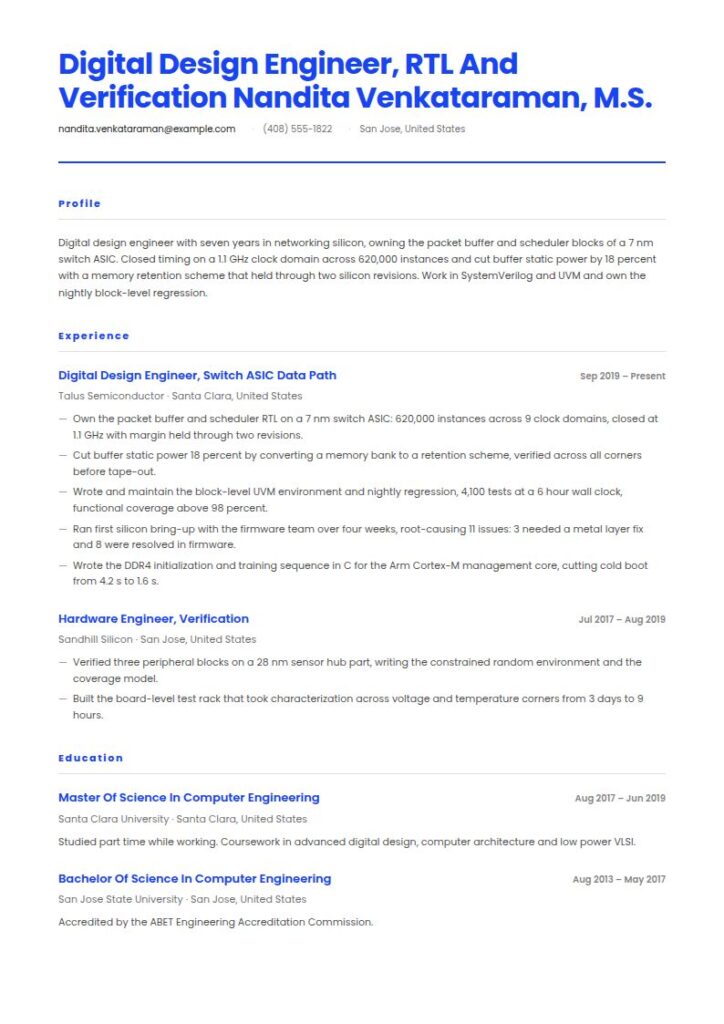
Digital design engineer with seven years in networking silicon, owning the packet buffer and scheduler blocks of a 7 nm switch ASIC. Closed timing on a 1.1 GHz clock domain across 620,000 instances and cut buffer static power by 18 percent with a memory retention scheme that held through two silicon revisions. Work in SystemVerilog and UVM and own the nightly block-level regression.
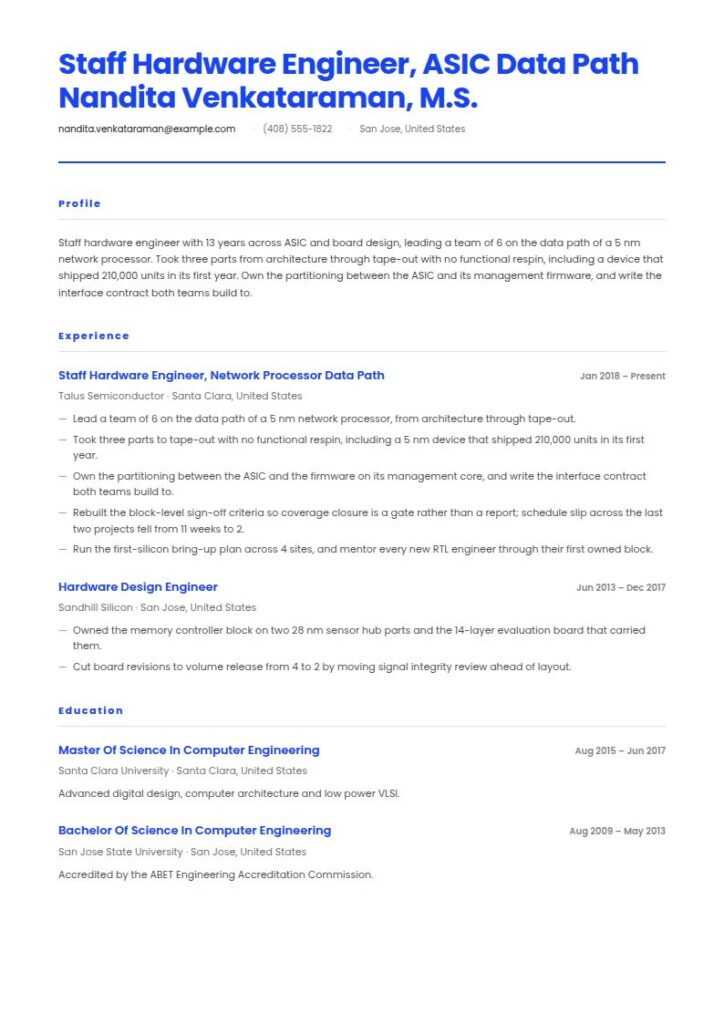
Staff hardware engineer with 13 years across ASIC and board design, leading a team of 6 on the data path of a 5 nm network processor. Took three parts from architecture through tape-out with no functional respin, including a device that shipped 210,000 units in its first year. Own the partitioning between the ASIC and its management firmware, and write the interface contract both teams build to.
Right vs wrong: the same computer engineering summary, twice
| ✅ Right | ❌ Wrong |
|---|---|
| Digital design engineer with seven years in networking silicon, owning the packet buffer and scheduler blocks of a 7 nm switch ASIC. | Computer engineer with strong hardware and software skills and a passion for technology. |
| Closed timing on a 1.1 GHz clock domain across 620,000 instances. | Experienced in the full design and verification lifecycle. |
| Cut buffer static power by 18 percent by moving a memory bank to a retention scheme, which held through two silicon revisions. | Proven track record of delivering high-quality engineering solutions. |
The right column names a block, a clock, an instance count and a change that survived a respin. The left could have been written by someone who has never opened a waveform viewer, and a reader who has spent eight years in this field knows it on sight.
Outline your computer engineering experience
Company, product, your role on it, and dates. Then three or four bullets, each naming a real object and carrying a number.
| Instead of | Use |
|---|---|
| Designed and verified digital logic blocks | Owned the packet buffer and scheduler RTL, 620,000 instances, closed at 1.1 GHz on a 7 nm node |
| Worked on hardware and software integration | Ran first silicon bring-up over four weeks, found and root-caused 11 issues, 3 of which needed a metal fix |
| Experience with embedded C programming | Wrote the DDR4 initialization and training sequence in C, cutting cold boot from 4.2 s to 1.6 s |
| Improved system performance | Moved a memory bank to a retention scheme and cut block static power by 18 percent |
Digital Design Engineer, Switch ASIC Data Path, Talus Semiconductor, Santa Clara, CA, September 2019 to Present
Own the packet buffer and scheduler RTL on a 7 nm switch ASIC: 620,000 instances across 9 clock domains, closed at 1.1 GHz with margin held through two revisions.
Cut buffer static power 18 percent by converting a memory bank to a retention scheme, verified across all corners before tape-out.
Wrote and maintain the block-level UVM environment and nightly regression, 4,100 tests at a 6 hour wall clock, functional coverage held above 98 percent against the signed test plan.
Ran first silicon bring-up with the firmware team over four weeks, root-causing 11 issues: 3 needed a metal layer fix and 8 were resolved in firmware.
Bring-up deserves its own bullet wherever you have done it. It cannot be faked, it is where hardware and firmware people meet, and almost nobody writes it down because it feels like debugging. It is the most persuasive four weeks on the page.
Say which side of the hardware and software boundary you work on
This is the block that decides which pile your file lands in, and most computer engineering resumes leave the reader to guess it.
The degree covers four working lanes. They share a curriculum and almost nothing else: different tools, different artifacts, different interview questions, different pay. A manager hiring for one cannot use a resume that averages across all four.
| Lane | What you actually produce | The numbers that prove it |
|---|---|---|
| RTL and verification | Synthesizable logic and the testbench that proves it | Instance or gate count, clock frequency, process node, coverage percentage, respin count |
| Board and system design | Schematics, layout, a bill of materials, a released revision | Layer count, interface standards routed, power budget, board revisions to release, units built |
| Embedded firmware | Code running on the part, drivers, boot and update paths | Processor family, flash and RAM footprint, boot time, release cadence, field defects |
| Validation and test | Bench and automated test coverage, characterization data | Corners covered, test time per unit, escape rate, yield movement |
Write the block as three lines, not as a paragraph.
Primary lane: RTL design and verification, SystemVerilog and UVM, 7 nm and 16 nm nodes, synthesis and static timing owned at block level.
Secondary lane: Embedded firmware in C on an Arm Cortex-M management core. Wrote the DDR4 initialization and training sequence and the register access layer both teams share.
Not my lane: PCB layout and signal integrity. I read schematics, review the register map against them and have run bring-up on 6 boards, but I have never owned a layout.
The third line is the one people flinch at, and it is the reason the block works. Nobody inflating their experience volunteers a limit, so the limit is what makes the other two lines read as literal. It costs you nothing: the job you lose by admitting you have never owned a layout is one you would have failed in the first month.
Build a snapshot of your key computer engineering skills
Twelve to sixteen entries in four groups, never one flat alphabetical list. The grouping is itself information: it tells the reader which layer you live at.
Design and verification: SystemVerilog, UVM, Verilog, formal property verification, clock domain crossing analysis, low power and UPF flows
Tools: Synopsys Design Compiler, PrimeTime, VCS, Verdi, Cadence Innovus, Xilinx Vivado
Firmware and software: C, Python for verification and bench automation, Arm Cortex-M bring-up, JTAG and SWD debug, Git and Jenkins
Bench and lab: Oscilloscope and logic analyzer debug, protocol analyzers for PCIe and DDR, temperature and voltage corner characterization
Interfaces: DDR4, PCIe Gen4, AXI and AHB, SPI, I2C, Ethernet MAC interfaces
Two rules make this section worth its space. List a tool only if you have driven it rather than read its output. And keep interfaces separate from tools: the interface list is what a manager scans against their product, the tool list is what a recruiter scans against a keyword string.
List your education and certifications
For a new graduate, education goes above experience and carries the accreditation. After about four years it moves to the bottom and shrinks to two lines.
Master of Science, Computer Engineering, Santa Clara University, Santa Clara, CA, 2019. Coursework in advanced digital design, computer architecture and low power VLSI.
Bachelor of Science, Computer Engineering, San Jose State University, San Jose, CA, 2017. ABET accredited by the Engineering Accreditation Commission.
Coursework worth naming for a first role: Digital System Design (SystemVerilog, FPGA), Computer Architecture, VLSI Design, Embedded Systems.
Fundamentals of Engineering, Electrical and Computer, NCEES, passed 2017.
What ABET and NCEES actually publish about this field
Computer engineering sits in an unusual place, and knowing exactly where saves you from writing something a reader will catch.
ABET accredits computer engineering through its Engineering Accreditation Commission, the same commission that accredits civil and mechanical engineering, while computer science sits under a separate Computing Accreditation Commission. In the 2025 to 2026 Criteria for Accrediting Engineering Programs, IEEE is the lead society for electrical, computer and similarly named programs with CSAB cooperating, and the program criteria require that any curriculum carrying the modifier "computer" in its title include discrete mathematics, on top of a general floor of 30 semester credit hours of mathematics and basic sciences and 45 of engineering topics.
On licensure, the Bureau of Labor Statistics Occupational Outlook Handbook states that computer hardware engineers do not need a license to enter the occupation. True, but not the whole picture. NCEES publishes a path: the Fundamentals of Engineering exam offers an Electrical and Computer module, one of seven FE disciplines, 110 questions in a six hour appointment, designed for students and recent graduates of EAC/ABET accredited programs, and the PE Electrical and Computer exam offers a Computer Engineering depth, 85 questions in a 9.5 hour appointment, administered once a year with the next sitting on 28 October 2026 (NCEES, retrieved 17 September 2026).
So the honest line is this: the PE is not required here and almost nobody in commercial silicon holds one. If you passed the FE, write it; it is verifiable and rare enough here to be noticed. Do not imply a license you neither need nor have.
Choose the right layout and design
Single column, 10 or 11 point body type, plain section headings, no photograph, no skill rating bars. Export to PDF, named for yourself and the lane.
Skill percentage bars are a particular problem here. A reader who has closed timing themselves will ask what "SystemVerilog 85 percent" means, and there is no answer. Replace the bar with a number attached to real work: instances, frequency, coverage.
Put your lane in the line under your name. Name the process node, part family or processor family in your first experience bullet. State what you did not own, in one line. Give instance counts, clock frequencies and revision counts rather than adjectives. Separate tools you drove from interfaces you worked with. Say whether the degree program was ABET accredited and under which commission. Put bring-up on the page.
Do not write "hardware and software" without saying which one you are applying for. Do not list every EDA tool your employer held a license for. Do not claim a tape-out you supported as one you owned; the interview will ask which blocks were yours. Do not use skill rating bars or a two-column template. Do not imply a professional engineer license this occupation does not require.
Computer engineering job market and outlook
Computer engineering is a degree title rather than a Handbook occupation, and the closest published profile is computer hardware engineers, which covers designing, developing and testing computer systems and components such as processors, circuit boards, memory devices and networks.
That mapping matters because of what sits on the other side of the boundary. If your work is RTL, board design or silicon validation, computer hardware engineers is your occupation. If you write the firmware and tooling above the part, the Handbook's software developers, quality assurance analysts and testers profile describes what you do, and it is a different market.
| Measure | Computer hardware engineers | Software developers, QA analysts and testers |
|---|---|---|
| Employment, 2025 | 76,100 | 1,905,400 |
| Projected change, 2025-35 | 9 percent, +6,900 | 10 percent, +185,400 |
| Projected annual openings | About 4,100 | About 106,100 |
| Median annual wage, May 2025 | $161,740 | $134,040 |
| Typical entry-level education | Bachelor's degree | Bachelor's degree |
Source: U.S. Bureau of Labor Statistics, Occupational Outlook Handbook, May 2025 wage data and 2025 to 2035 projections, published 27 August 2026.
One side pays more per seat, the other has 25 times the seats
Computer hardware engineers held 76,100 jobs in 2025 at a median annual wage of $161,740, with about 4,100 openings projected each year through 2035. Software developers, quality assurance analysts and testers held 1,905,400 jobs at a combined median of $134,040, with about 106,100 annual openings (BLS Occupational Outlook Handbook, May 2025 wages and 2025 to 2035 projections).
Read those two rows together and the strategy falls out of them. The hardware side pays a median roughly $27,700 higher and has one seat for every 25 on the software side. A file that reads as neither is screened out of the small market for lacking specificity and out of the large one for lacking relevance. The decision is not which market is better; it is that you have to pick, say so under your name, and put the matching numbers underneath.
The hardware work is concentrated. Semiconductor and electronic component manufacturing employed 24 percent of computer hardware engineers at a median of $166,150, research and development 18 percent at $171,820 and computer systems design 15 percent at $155,470 (BLS, May 2025). Three industries hold most of the occupation and all three cluster geographically, which is why relocation appears in these postings far more often than in software.
What salary you can expect in computer engineering
On the hardware side, the median annual wage for computer hardware engineers was $161,740 as of May 2025, or $77.76 an hour, with the lowest 10 percent under $92,940 and the highest 10 percent over $225,330 (BLS, May 2025). That is a spread of more than $132,000 between the deciles, wide even by engineering standards.
Three things move you inside that spread, and all three are resume material: node and complexity, meaning which parts you worked on and how recent the process technology is; ownership, meaning whether you carried a block through tape-out or contributed to someone else's; and whether you can cross the boundary, because an engineer who can write the firmware that brings up their own silicon is scarce and paid as such.
If you sit on the firmware side, negotiate against software developers, whose median was $135,980 in May 2025, the lowest 10 percent under $82,460 and the highest over $214,670 (BLS, May 2025). Do not quote the hardware median for a firmware seat; a manager who knows both numbers reads it as a resume that has not worked out what it is. Within the hardware occupation, research and development pays the highest industry median at $171,820, roughly $34,800 above the federal government at $136,990 (BLS, May 2025).
Key takeaways for a computer engineering resume
- Put your lane in the line under your name; "Computer Engineer" is a degree, not a seat.
- Write the boundary block, including the line about what you do not own.
- Name the process node, part family or processor family in your first bullet.
- Give instance counts, clock frequencies, footprints and revision counts rather than adjectives.
- Put bring-up on the page; it is the four weeks nobody can fake.
- Say whether the program was ABET accredited and under which commission.
- Negotiate against the published occupation your lane actually matches, not the one with the bigger number.
Build your computer engineering resume in 15 minutes with our AI resume builder.
Related information technology resume examples
- Computer science resume
- Software engineer resume
- Software developer resume
- Programmer resume
- Network engineer resume
- Systems analyst resume
- AI engineer resume
- Machine learning engineer resume
- Engineering manager resume
- Python developer resume
- Entry-level software engineer resume
- Information technology resume
Pair it with a matching computer engineering cover letter.
Computer engineering resume questions, answered
How long should a computer engineering resume be?
One page for your first four years. Two once the part list takes space: multiple products, multiple nodes, a tape-out you owned and a team you led. Three pages is an academic CV, not an industry application.
Is computer engineering a hardware degree or a software degree?
Both, which is the problem your resume has to solve. ABET accredits computer engineering through its Engineering Accreditation Commission alongside the other engineering disciplines, while computer science sits under a separate Computing Accreditation Commission (ABET, 2025 to 2026 criteria). The degree is built to span the boundary. The hiring market is not, so pick a lane on the page.
Do computer engineers need a PE license?
No. The Bureau of Labor Statistics Occupational Outlook Handbook states that computer hardware engineers do not need a license to enter the occupation. A path does exist: NCEES offers an Electrical and Computer module of the FE exam and a Computer Engineering depth on the PE Electrical and Computer exam, offered once a year (NCEES, retrieved 17 September 2026). It matters in settings where sealed drawings matter, and almost nobody in commercial silicon is in one.
What do I put on a computer engineering resume with no experience?
Course projects written as engineering work. Not "built a CPU in class" but the part, the tool, the artifact and the measurement: a five-stage pipelined RISC-V core on an Artix-7 part, 47 MHz, verified against a written test plan with a coverage number. One project at that depth beats six listed by name, because it shows decisions rather than attendance.
How do I move from firmware into hardware design, or the other way?
Say it in one sentence at the top with evidence attached, then let the boundary block carry the rest. A course sequence with the tool named, a verified block built on a development board, or work in your current role that reached across: the bring-up you joined, the register map you reviewed, the driver you wrote for your own silicon. Reviewers here are used to people crossing. What they will not do is guess which direction you are going.