Network Engineer, Switching and Campus Wireless Ingrid Brandvold
Network Engineer
[email protected] | (402) 555-1632 | Omaha, United States
Profile
Network engineer with two years supporting a multi-site agricultural cooperative, working access and distribution layer switching, campus wireless and a single-area OSPF core. Configure and troubleshoot Cisco Catalyst switches and Meraki wireless day to day, and completed the site refresh that moved 11 grain facilities onto a standard switch template and 802.1X wired authentication. CCNA current, earned March 2025 with recertification due March 2028, and working toward CCNP Enterprise.
Work Experience
05/2024 - Present, Network Engineer, Cornerstone Grain Cooperative, Omaha, United States
- Operate access and distribution layer switching, campus wireless and a single-area OSPF core across 11 grain facilities and a head office.
- Completed the site refresh that moved every facility onto a standard Cisco Catalyst switch template with 802.1X wired authentication and a monitored fallback for scale and controller hardware that cannot authenticate.
- Rebuilt the wireless survey and channel plan at four facilities, cutting reported wireless tickets from 22 a month to 6.
- Run the after-hours change window for switch software upgrades, with a written rollback step for each.
09/2022 - 05/2024, Network Technician, Cornerstone Grain Cooperative, Omaha, United States
- Handled VLAN, port and access point changes, structured cabling and first line network troubleshooting across the cooperative's sites.
- Built the IP address management record that replaced a spreadsheet maintained by three people.
Education
08/2018 - 05/2022, Bachelor of Science, Information Technology, University of Nebraska Omaha, Omaha, United States
Networking concentration, including routing and switching, wireless and network security coursework.
Skills
Cisco Catalyst switching, 80
Single-area OSPF operation, 65
Campus wireless and channel planning, 75
802.1X wired authentication, 70
Packet capture and analysis, 65
IP address management, 75
Languages
English, native
Norwegian, intermediate
Certificates
03/2025, CCNA, Cisco
Earned March 2025, recertification due March 2028.
02/2023, CompTIA Network+, CompTIA
Exam version N10-009.
Summary
A network engineer resume is a one to two page document naming the routing protocols you have operated and in what role, the switching and overlay technologies and vendor platforms behind them, and your certification tier with its recertification date. This guide gives you three adaptable versions, the credential ladder read honestly, and current Bureau of Labor Statistics pay for the two published occupations this title sits between.
Network Engineer resume examples by experience level
In short, a network engineer resume is a one to two page document that names the protocols you have run, the platforms you ran them on, and the certification tier that backs the claim.
In fact, depth is the whole question in this job, and it is the one thing most of these resumes hide. For example, two candidates can both write "routing and switching, Cisco environment" and be ten years apart in capability. One redistributed between OSPF and BGP during a datacenter move and can explain what happened to the routing table. The other, meanwhile, has changed VLANs on access switches for five years. A hiring manager needs to know which; however, the resume that answers it without being asked is rare enough to be memorable.
Resume guide for a network engineer resume
Specifically, this guide and the corresponding network engineer resume example will cover:
- How to write a network engineer resume, section by section
- The protocol, platform and certification block that shows depth
- Three adaptable summaries: first network role, operating engineer, lead
- What each certification tier actually licenses a reader to believe
- What the job market looks like and what you can expect to earn
How to write a network engineer resume
Overall, six sections: contact header, summary, certifications with their recertification dates, a protocol and platform block, network engineering experience, and education. Generally, one page for your first three years, two once you have run a migration or a design.
Certifications sit high because in this field they are a documented tier rather than a decoration, and because many postings screen against them before a human reads anything. The protocol and platform block sits under them because it is what turns a tier into evidence.
| Section | What it is answering | Where it goes |
|---|---|---|
| Certifications | Which tier, and is it still current? | Under the summary, with recertification dates |
| Protocol and platform block | What have they actually operated, and in what role? | Its own block, before experience |
| Experience | What did they migrate, design or fix? | Reverse chronological, with numbers |
| Education | Does it clear the stated degree requirement? | Bottom, unless you graduated this year |
Write the recertification date, not just the certification
Cisco's own recertification page states that most Cisco certifications are active for three years from the date you earn them, with entry-level CCST certifications running a five-year cycle (Cisco, recertification policy).
A resume line that reads "CCNP Enterprise" could mean a credential earned last spring or one that expired in 2021. A reader cannot tell, and the safe assumption is the unflattering one.
Write it as "CCNP Enterprise, Cisco, earned June 2024, recertification due June 2027." That single addition does two things: it proves the credential is live, and it tells the reader you understand the credential is a cycle rather than a trophy.
Run the finished file through the ATS resume checker before you send it, because the hospitals, banks and service providers hiring for this work parse applications into a structured record first.
Choosing the best resume format for a network engineer resume
Reverse chronological, then, with the protocol and platform block between the certifications and the first job. One page for your first three years, two after that.
The functional format is a particularly bad fit here. Network work is judged on the scope of what you were trusted to change and when, and a skills-grouped layout removes the sequence. It also tends to flatten configured, operated and designed into one verb, and those three words are the difference between three pay bands.
Include your contact information
| ✅ Right | ❌ Wrong |
|---|---|
| Ingrid Brandvold | Ingrid Brandvold |
| Network Engineer, Routing, Switching and Campus Wireless | Network professional with a passion for technology |
| CCNP Enterprise, recertification due June 2027. CCNA current | Cisco certified, CompTIA certified |
| (402) 555-1632, [email protected], Omaha, NE | (402) 555-1632, [email protected] |
Also, put the tier in the header with its date. It is the first thing screened for and the easiest thing to verify, and burying it at the bottom of page two costs you the screen rather than the interview.
At the same time, never put a public IP range, a device hostname, a configuration excerpt or a network diagram of an employer's estate on a resume or a portfolio site.
Make use of a summary
In short, four lines: what you operate, how long, two or three protocols with your actual role in them, and the certification tier with its date.
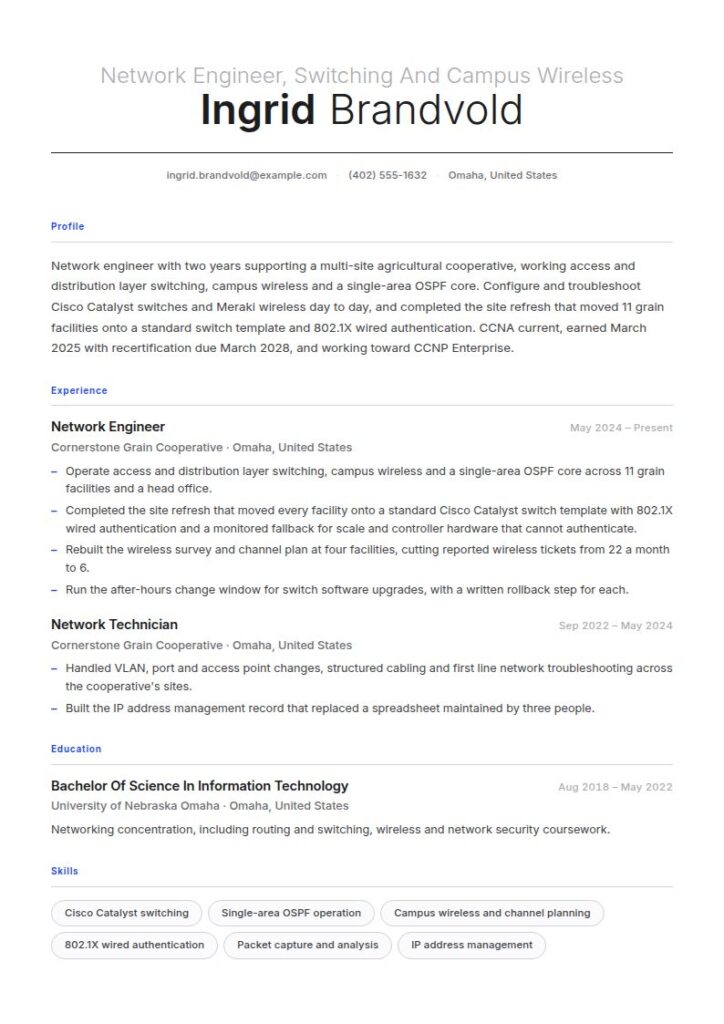
Network engineer with two years supporting a multi-site agricultural cooperative, working access and distribution layer switching, campus wireless and a single-area OSPF core. Configure and troubleshoot Cisco Catalyst switches and Meraki wireless day to day, and completed the site refresh that moved 11 grain facilities onto a standard switch template and 802.1X wired authentication. CCNA current, earned March 2025 with recertification due March 2028, and working toward CCNP Enterprise.
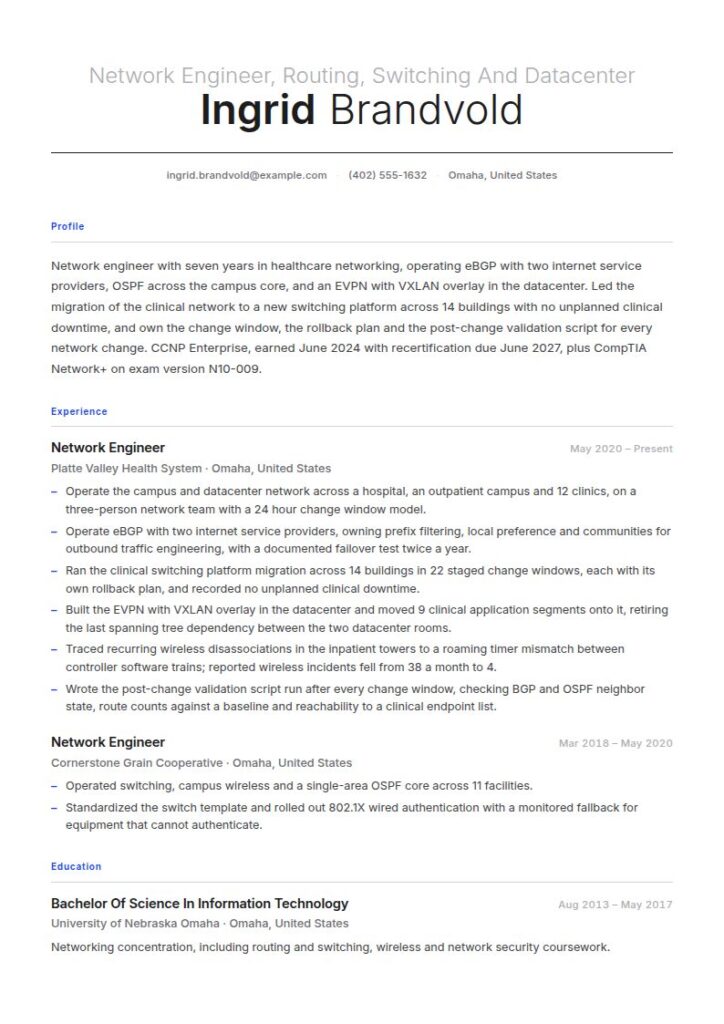
Network engineer with seven years in healthcare networking, operating eBGP with two internet service providers, OSPF across the campus core, and an EVPN with VXLAN overlay in the datacenter. Led the migration of the clinical network to a new switching platform across 14 buildings with no unplanned clinical downtime, and own the change window, the rollback plan and the post-change validation script for every network change. CCNP Enterprise, earned June 2024 with recertification due June 2027, plus CompTIA Network+ on exam version N10-009.
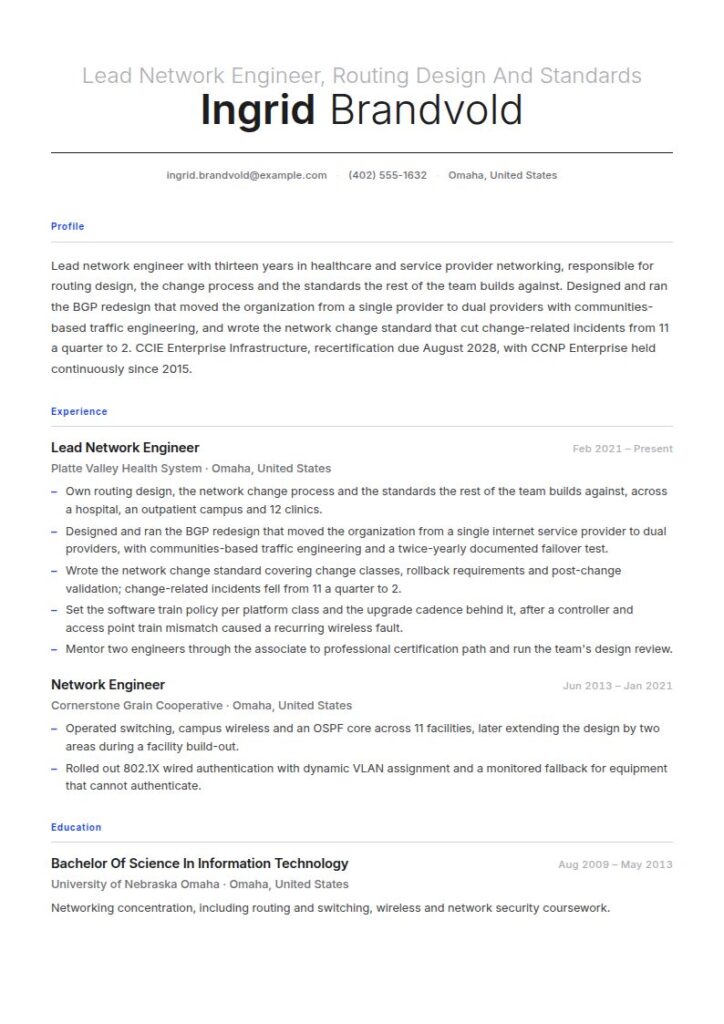
Lead network engineer with thirteen years in healthcare and service provider networking, responsible for routing design, the change process and the standards the rest of the team builds against. Designed and ran the BGP redesign that moved the organization from a single provider to dual providers with communities-based traffic engineering, and wrote the network change standard that cut change-related incidents from 11 a quarter to 2. CCIE Enterprise Infrastructure, recertification due August 2028, with CCNP Enterprise held continuously since 2015.
Right vs wrong: the same network engineer summary, twice
| ✅ Right | ❌ Wrong |
|---|---|
| Operate eBGP with two internet service providers and OSPF across the campus core. | Strong knowledge of routing and switching protocols. |
| Led the switching platform migration across 14 buildings with no unplanned clinical downtime. | Involved in various network upgrade and migration projects. |
| CCNP Enterprise, earned June 2024, recertification due June 2027. | Cisco certified professional. |
For instance, the left column tells a reader exactly what to ask about in an interview. The right column, on the other hand, could describe a network architect or a person who has reset access points for six years, and the only way to find out is to spend an hour of two people's time.
Outline your network engineering experience
Employer, title, dates, and one line on what kind of network it was: campus, datacenter, service provider, industrial, or a mix, and whether you were operating it, changing it or designing it. Then three to five bullets, each naming a protocol or a platform and a result.
| Instead of | Use |
|---|---|
| Responsible for routing and switching | Operate eBGP with two internet service providers, including prefix filtering, communities and failover testing twice a year |
| Worked on network upgrades | Migrated 14 buildings to a new switching platform in 22 staged change windows with no unplanned clinical downtime |
| Troubleshot network issues | Traced recurring wireless disassociations to a roaming timer mismatch, cutting reported wireless incidents from 38 a month to 4 |
| Implemented network security | Deployed 802.1X wired authentication with dynamic VLAN assignment across 11 sites, with a monitored fallback for medical devices that cannot authenticate |
| Documented the network | Wrote the post-change validation script now run after every change window, checking neighbor state, route counts and reachability |
Network Engineer, Platte Valley Health System, Omaha, NE, May 2020 to Present
Campus and datacenter network across a hospital, an outpatient campus and 12 clinics, operated by a three-person network team on a 24 hour change window model.
Operate eBGP with two internet service providers, including prefix filtering, local preference and communities for outbound traffic engineering, with a documented failover test twice a year.
Ran the clinical switching platform migration across 14 buildings in 22 staged change windows, with a per-window rollback plan and no unplanned clinical downtime.
Built the EVPN with VXLAN overlay in the datacenter and moved 9 clinical application segments onto it, retiring the last spanning tree dependency between the two datacenter rooms.
Traced recurring wireless disassociations in the inpatient towers to a roaming timer mismatch between controller software trains; reported wireless incidents fell from 38 a month to 4.
Wrote the post-change validation script run after every change window: BGP and OSPF neighbor state, route counts against a baseline, and reachability to a list of clinical endpoints.
Name the protocols, the platforms and the certification tier, with the recertification date
This is the block that shows depth; moreover, it is the one almost nobody writes. Four lines, each answering a question a network manager asks in the first two minutes.
Routing protocols, with your role in each. Not a list of acronyms. For each protocol, say whether you operated it, changed its design, or inherited it. "OSPF: operate a multi-area design, added two areas during the clinic build-out" and "BGP: operate eBGP with two providers, wrote the prefix filtering and communities policy" are sentences with a scope in them. "OSPF, BGP, EIGRP" is a list of words that a candidate who has read a study guide can also write.
Switching and overlay technologies. Spanning tree and where you have had to reason about it, link aggregation, first hop redundancy, VLAN and trunking design, and whatever overlay you have run: EVPN with VXLAN, a vendor fabric, or none. If you have never run an overlay, say what you run instead. Honest absence is far better than a claimed technology you cannot discuss.
Vendor platforms and network certification tiers
Vendor platforms and software trains. Name the platforms and the operating systems, and if you can, the train you standardized on and why. Software train discipline is a mark of a mature operator, and mismatched trains between controllers, switches and access points are the cause of a surprising share of the incidents that get escalated to a network team.
Certification tier with its recertification date. Cisco publishes four levels: entry with CCST, associate with CCNA, professional with CCNP, and expert with CCIE and CCDE. Its recertification page states that most certifications are active for three years, and gives the continuing education credits needed to recertify: 30 at associate, 40 at specialist, 80 at professional and 120 at expert (Cisco, recertification policy). CompTIA's Network+ sits alongside the associate tier as a vendor-neutral credential; its current exam version is N10-009, launched on 20 June 2024 (CompTIA).
Routing: eBGP with two internet service providers, operate and own policy, including prefix filtering, local preference and communities. OSPF multi-area, operate and extended the design by two areas. Static routing and route redistribution between OSPF and BGP at the edge.
Switching and overlay: EVPN with VXLAN in the datacenter, built and operate. Rapid spanning tree at the campus edge, first hop redundancy, link aggregation, 802.1X wired authentication with dynamic VLAN assignment.
Platforms and software trains: Cisco Catalyst and Nexus, Cisco wireless controllers and access points, a standardized software train per platform class with a documented upgrade cadence, Palo Alto firewalls at the perimeter operated jointly with the security team.
Certifications: CCNP Enterprise, Cisco, earned June 2024, recertification due June 2027. CCNA, Cisco, continuously current since 2018. CompTIA Network+, exam version N10-009.
Be honest about the tier boundary, because interviewers probe it. For example, an associate certification tells a reader you can configure and troubleshoot within an existing design. Similarly, a professional certification tells them you can operate and change that design. Finally, an expert certification tells them you can be handed a requirement and produce a design. Claiming one tier of capability while holding another is the single most common way these interviews go wrong, and the fix is simply to write what you have done alongside what you hold.
Build a snapshot of your key skills
Twelve to eighteen entries in four labeled groups, named by protocol and platform rather than by category.
Routing: BGP, OSPF, static routing and redistribution, route filtering and policy, traffic engineering with communities, failover design and testing
Switching and overlay: EVPN with VXLAN, rapid spanning tree, link aggregation, first hop redundancy, VLAN and trunk design, 802.1X wired authentication
Platforms and operations: Cisco Catalyst and Nexus, wireless controllers and access points, firewall policy alongside a security team, software train management, change windows and rollback plans
Tooling and automation: Python and Netmiko for configuration pushes, Ansible network modules, NetFlow analysis, SNMP and syslog monitoring, packet capture and analysis, IP address management
In addition, automation belongs on this page even in small amounts. A single well-described script, such as a post-change validation check, says more than a line claiming network automation experience.
List your education and certifications
Certifications first with their dates, then the degree. Both published occupations this title sits between record a bachelor's degree as the typical entry-level education, while computer network architects additionally record five years or more of work experience in a related occupation as typical (BLS Occupational Outlook Handbook, May 2025 data).
| Tier | Credential | What it licenses a reader to assume |
|---|---|---|
| Entry | CCST | Familiarity with fundamentals; a five-year certification cycle |
| Associate | CCNA | Configure and troubleshoot inside an existing design; 30 continuing education credits to recertify |
| Professional | CCNP | Operate and change a design; 80 continuing education credits to recertify |
| Expert | CCIE, CCDE | Produce a design from a requirement; 120 continuing education credits to recertify |
Source: Cisco certification and recertification pages; generally, most certifications stay active for three years from the date earned.
CCNP Enterprise, Cisco, earned June 2024, recertification due June 2027
CCNA, Cisco, continuously current since 2018
CompTIA Network+, exam version N10-009
Bachelor of Science, Information Technology, University of Nebraska Omaha, Omaha, NE, 2017
Choose the right layout and design
For layout, then: single column, 10 or 11 point body type, plain headings, no photograph, no graphics, no skill bars. PDF unless the portal says otherwise.
Above all, give the protocol and platform block real space and keep it to four labeled lines. After all, it is the part a technical reader will read closely and the part a recruiter will scan for keywords, which is unusual and worth designing for.
Write the certification with the month earned and the recertification date. Say operated, changed or designed for each protocol. Name the vendor platforms and, if you can, the software trains. Say which overlay you run, or say you run none. Describe one change window end to end, including the rollback plan. Put one automation example on the page with what it checks.
Do not write "routing and switching" as a skill; it is the job title, not evidence. Do not list a protocol you have only read about, because the follow-up question arrives immediately. Do not claim design work for changes you made inside someone else's design. Do not put a hostname, a public IP range, a configuration excerpt or an estate diagram on the page. Do not leave an expired credential undated.
Network engineer job market and outlook
The Bureau of Labor Statistics publishes no Occupational Outlook Handbook profile under the title "network engineer"; as a result, there is no employment count, outlook or median wage attached to the title itself. Instead, the work is counted across two published occupations, and this title sits between them.
| Published occupation | Jobs, 2025 | Change, 2025-35 | Annual openings | Median wage, May 2025 |
|---|---|---|---|---|
| Computer network architects | 181,800 | 8%, +14,100 | ~9,600 | $134,050 |
| Network and computer systems administrators | 323,600 | -4%, -13,200 | ~13,400 | $99,130 |
Source: U.S. Bureau of Labor Statistics, Occupational Outlook Handbook, 2025-35 projections and May 2025 wage data.
The experience line is the real gate
The Bureau of Labor Statistics records computer network architects as typically requiring five years or more of work experience in a related occupation, with a bachelor's degree as typical entry-level education and no on-the-job training listed. Network and computer systems administrators carry no such experience requirement (BLS Occupational Outlook Handbook, May 2025 data).
The two occupations are also moving apart. Computer network architects are projected to grow 8% from 2025 to 2035, adding 14,100 jobs against about 9,600 openings a year, while network and computer systems administrators are projected to decline 4%, losing 13,200 jobs against about 13,400 openings a year (BLS, 2025-35 projections).
That is a map of a career rather than a market forecast. The published path from the second occupation to the first runs through years of related experience, and the resume evidence for those years is design work: what you were trusted to change, and what you produced from a requirement rather than from a ticket.
Where network architecture work sits, by median pay:
| Industry | Median annual wage (May 2025) |
|---|---|
| Management of companies and enterprises | $139,820 |
| Finance and insurance | $139,230 |
| Computer systems design and related services | $133,610 |
| Administrative and support services | $129,710 |
| Telecommunications | $111,690 |
Source: U.S. Bureau of Labor Statistics, May 2025, computer network architects.
What salary you can expect as a network engineer
No median wage is published for this exact title, since the Handbook carries no profile under it. However, the two occupations the title straddles are published, and the distance between their medians is the number worth knowing: computer network architects at $134,050 and network and computer systems administrators at $99,130, a difference of $34,920 as of May 2025 (BLS).
In other words, that gap is what the protocol and platform block is arguing about. Indeed, nothing else on a network resume moves a reader across it. Operating an existing design reads as administration; on the other hand, owning routing policy, running migrations and producing designs from requirements reads as architecture, and the resume decides which of those a hiring manager pictures.
Moreover, the ranges inside each occupation are wide. Computer network architects earned less than $79,900 at the lowest 10 percent and more than $202,680 at the highest, while network and computer systems administrators ran from less than $62,640 to more than $155,050, both May 2025 (BLS).
Industry matters too. For instance, among computer network architects the published median runs from $139,820 in management of companies and enterprises down to $111,690 in telecommunications (BLS, May 2025), which is a useful corrective to the assumption that carrier work pays best.
Key takeaways for a network engineer resume
- Therefore, name each routing protocol with your actual role in it: operated, changed or designed.
- Likewise, say which overlay you run, or say plainly that you run none.
- Similarly, name vendor platforms and, where you can, the software trains you standardized on.
- Write the certification with the month earned and the recertification date.
- Finally, match your claimed tier to your described work; interviewers probe that seam first.
- Describe one change window end to end, including the rollback plan and the validation.
- Put one real automation example on the page, however small.
Build your network engineer resume in 15 minutes with our AI resume builder.
Related information technology resume examples
- Network administrator resume
- Network systems analyst resume
- System administrator resume
- Cyber security resume
- SOC analyst resume
- IT specialist resume
- IT help desk resume
- Solution architect resume
- IT manager resume
- Systems analyst resume
- Computer engineering resume
- IT director resume
Pair it with a matching network engineer cover letter.
Network engineer resume questions, answered
How long should a network engineer resume be?
One page for your first three years, two once you have run a migration or produced a design. The protocol and platform block earns its space at either length, because it is the only part of the page that shows depth rather than exposure.
Which certification should I put first?
The highest current tier you hold, with the month you earned it and the recertification date. Cisco states that most of its certifications are active for three years from the date earned, and entry-level CCST certifications for five (Cisco, recertification policy), so an undated credential invites the reader to assume it has lapsed.
Do I need a CCIE to be taken seriously?
No. Most network engineering postings are answered well by an associate or professional credential paired with described work. The expert tier matters where design from a requirement is the job, which is closer to the computer network architect occupation that BLS records as typically needing five years or more of related experience (BLS, May 2025 data).
What if I have no BGP experience?
Say what you do operate and be specific about it. OSPF design work, an overlay you built, an 802.1X rollout or a wireless troubleshooting record with numbers all show depth. A candidate who is precise about a narrower scope reads better than one who lists BGP and cannot discuss prefix filtering.
How do I show network automation without being a developer?
One concrete example is enough. A post-change validation script that checks neighbor state, route counts against a baseline and reachability to a named endpoint list tells a reader you can close the loop on your own changes. Name the language or tool, say what it checks, and say how often it runs.