Systems Administrator, Linux and Windows Server Dario Ardito
Junior Systems Administrator
[email protected] | (505) 555-1710 | Albuquerque, United States
Profile
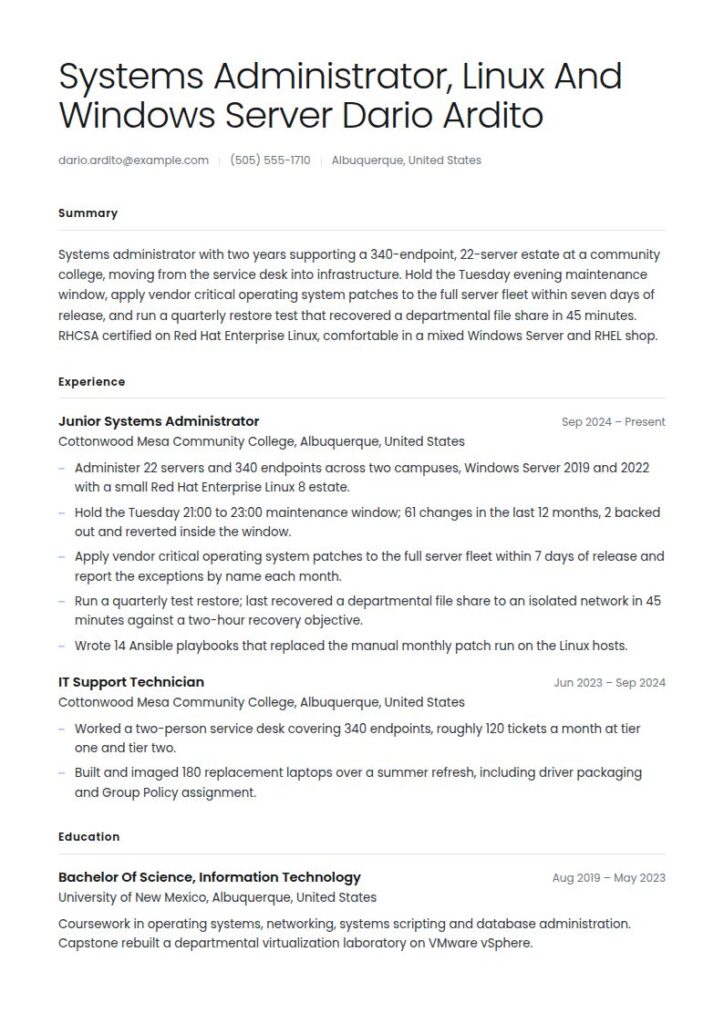
Systems administrator with two years supporting a 340-endpoint, 22-server estate at a community college, moving from the service desk into infrastructure. Hold the Tuesday evening maintenance window, apply vendor critical operating system patches to the full server fleet within seven days of release, and run a quarterly restore test that recovered a departmental file share in 45 minutes. RHCSA certified on Red Hat Enterprise Linux, comfortable in a mixed Windows Server and RHEL shop.
Work Experience
09/2024 - Present, Junior Systems Administrator, Cottonwood Mesa Community College, Albuquerque, United States
- Administer 22 servers and 340 endpoints across two campuses, Windows Server 2019 and 2022 with a small Red Hat Enterprise Linux 8 estate.
- Hold the Tuesday 21:00 to 23:00 maintenance window; 61 changes in the last 12 months, 2 backed out and reverted inside the window.
- Apply vendor critical operating system patches to the full server fleet within 7 days of release and report the exceptions by name each month.
- Run a quarterly test restore; last recovered a departmental file share to an isolated network in 45 minutes against a two-hour recovery objective.
- Wrote 14 Ansible playbooks that replaced the manual monthly patch run on the Linux hosts.
06/2023 - 09/2024, IT Support Technician, Cottonwood Mesa Community College, Albuquerque, United States
- Worked a two-person service desk covering 340 endpoints, roughly 120 tickets a month at tier one and tier two.
- Built and imaged 180 replacement laptops over a summer refresh, including driver packaging and Group Policy assignment.
Education
08/2019 - 05/2023, Bachelor of Science, Information Technology, University of New Mexico, Albuquerque, United States
Coursework in operating systems, networking, systems scripting and database administration. Capstone rebuilt a departmental virtualization laboratory on VMware vSphere.
Skills
Windows Server 2019 and 2022, 75
Red Hat Enterprise Linux 8, 65
Active Directory and Group Policy, 75
VMware vSphere, 60
Veeam backup and tested restores, 70
PowerShell and Bash, 65
Ansible, 55
Patch orchestration and change records, 70
Languages
English, native
Spanish, fluent
Italian, beginner
Certificates
11/2024, Red Hat Certified System Administrator (RHCSA), Red Hat, EX200
Practical examination covering files and directories, shell scripts, operating running systems, configuring storage, managing users and groups, and basic container management.
09/2023, CompTIA Server+, CompTIA
Summary
A system administrator resume is a one to two page document showing that you ran a fleet on a schedule: a maintenance window you held, a patch cadence stated as a rule, a change you backed out cleanly and a restore you actually performed. This guide gives you three adaptable versions, that operational record in full, and current Bureau of Labor Statistics pay and outlook.
System Administrator resume examples by experience level
In short, a system administrator resume is a one to two page document that proves you kept a fleet of machines running on a schedule somebody else could depend on.
Not that you know the tools. Almost every applicant knows the tools. The thing a hiring manager is trying to settle from a stack of these files is narrower and harder to fake: whether you operate with a routine, or whether you operate by reacting. Those two administrators, however, look identical on a skills list and nothing alike in an outage.
The difference shows up in four places, and this guide is built around putting all four on the page: the window you held, the cadence you patched to, the change you backed out, and the restore you performed on purpose before anybody made you.
Resume guide for a system administrator resume
Specifically, this guide and the corresponding system administrator resume example will cover:
- How to write a system administrator resume, section by section
- The change and restore record, which is the block almost nobody writes
- Three adaptable summaries: junior, practicing administrator and lead
- How to size a fleet so a reader can picture it in one line
- What the job market looks like and what you can expect to earn
How to write a system administrator resume
Six sections: contact header, summary, the estate you ran, administration experience, the change and restore record, then education and certifications. Generally, one page under five years, two once you own a window and a team.
The order follows what a reader settles first: the size of what you have carried, then whether you carried it with a method, then whether the method held when something went wrong.
| Section | What it is answering | Where it goes |
|---|---|---|
| Summary | What scale of estate has this person been responsible for? | Top of page, four lines |
| The estate | Servers, users, sites, operating systems, how much of it virtual | Directly under the summary, two or three lines |
| Experience | Did they run a routine, or fight fires? | Reverse chronological, a number in every bullet |
| Change and restore record | Do their claims about reliability survive a follow-up question? | Its own block, after the most recent role |
| Education and certifications | Do they clear the screen? | Last, short |
Size the estate in one line, near the top
A reader cannot calibrate anything you write until they know how big your world was. An administrator who patched 30 servers and one who patched 1,100 write identical bullets, and only one is describing the advertised job.
Write it as a single line under the summary: "410 servers (120 physical, 290 virtual) across two sites, Windows Server and RHEL roughly 60/40, 2,600 users, one four-hour monthly window."
That line does four jobs at once. It sizes you, it names your operating systems without a keyword dump, it shows whether you have run a mixed shop, and it introduces the window the rest of the page then evidences.
Run the finished file through the ATS resume checker before you send it. Infrastructure roles are often posted by managed service providers and staffing firms whose systems parse first and read second.
Choosing the best resume format for a system administrator resume
Reverse chronological, single column. Similarly, one page for your first five years, two once you have held a window, led a migration, or run a disaster recovery exercise you can describe.
Skills-based formats, however, fail here for a specific reason. System administration is judged on continuity: how long you held a system, what it looked like when you took it over, and what it looked like when you left. After all, a format that removes the timeline removes your only evidence of endurance.
Include your contact information
| ✅ Right | ❌ Wrong |
|---|---|
| Dario Ardito | Dario Ardito |
| Systems Administrator, Linux and Windows Server | Dedicated IT professional with a passion for technology |
| RHCSA (EX200), Red Hat | Multiple certifications |
| (505) 555-1710, [email protected], Albuquerque, NM | (505) 555-1710, [email protected] |
Two details matter more than they look. Put the operating systems in the title line, because the first filter on almost every administration vacancy is Linux, Windows or both. And give a city, because on-call rotations and data center access are geographic facts.
Make use of a summary
In short, four lines: what you administer, the size of the estate, the routine you keep, and one reliability number you can defend.
Systems administrator with two years supporting a 340-endpoint, 22-server estate at a community college, moving from the service desk into infrastructure. Hold the Tuesday evening maintenance window, apply vendor critical operating system patches to the full server fleet within seven days of release, and run a quarterly restore test that recovered a departmental file share in 45 minutes. RHCSA certified on Red Hat Enterprise Linux, comfortable in a mixed Windows Server and RHEL shop.
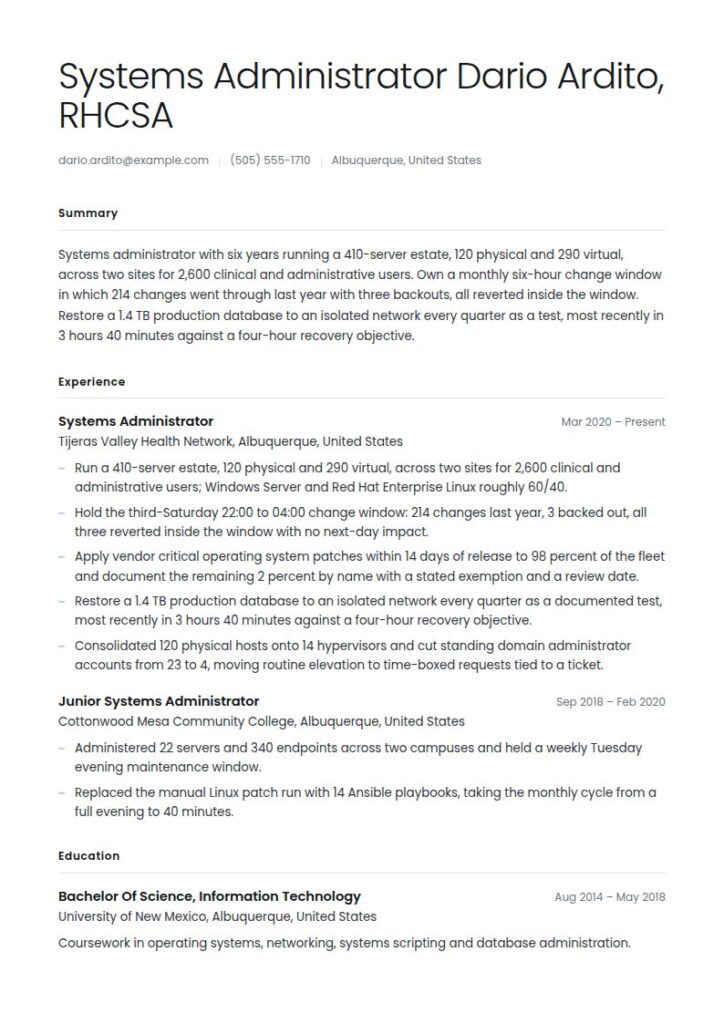
Systems administrator with six years running a 410-server estate, 120 physical and 290 virtual, across two sites for 2,600 clinical and administrative users. Own a monthly six-hour change window in which 214 changes went through last year with three backouts, all reverted inside the window. Restore a 1.4 TB production database to an isolated network every quarter as a test, most recently in 3 hours 40 minutes against a four-hour recovery objective.
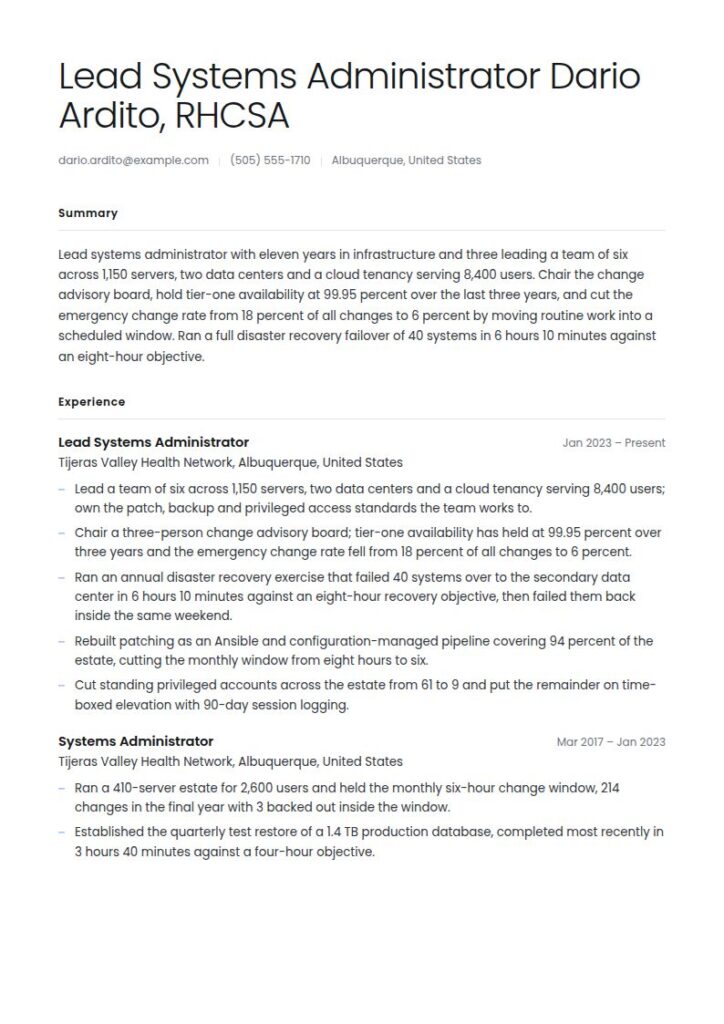
Lead systems administrator with eleven years in infrastructure and three leading a team of six across 1,150 servers, two data centers and a cloud tenancy serving 8,400 users. Chair the change advisory board, hold tier-one availability at 99.95 percent over the last three years, and cut the emergency change rate from 18 percent of all changes to 6 percent by moving routine work into a scheduled window. Ran a full disaster recovery failover of 40 systems in 6 hours 10 minutes against an eight-hour objective.
Right vs wrong: the same system administrator summary, twice
| ✅ Right | ❌ Wrong |
|---|---|
| Six years running a 410-server estate, 120 physical and 290 virtual, for 2,600 users. | Experienced systems administrator with a strong background in server management. |
| Own a monthly six-hour window; 214 changes last year, three backed out inside the window. | Responsible for maintaining system uptime and performing regular maintenance. |
| Restore a 1.4 TB production database to an isolated network quarterly, last run 3 hours 40 minutes. | Proficient in backup and disaster recovery best practices. |
For example, every line on the right can be checked in an interview, and the candidate who wrote it knows that. Every line on the left, on the other hand, dissolves on the first follow-up question, which is why an experienced reader stops asking.
Outline your system administration experience
Then list employer, sector, the size of the estate, dates. Then three to five bullets. Each one names a system and carries a number, and at least one of them describes something that went wrong.
| Instead of | Use |
|---|---|
| Responsible for server maintenance and updates | Patched 410 servers monthly inside a six-hour window, vendor critical fixes applied within 14 days of release on 98 percent of the fleet |
| Managed backups | Restored a 1.4 TB production database to an isolated network quarterly as a test; last run completed in 3 hours 40 minutes |
| Improved system reliability | Cut unplanned tier-one outage time from 11 hours to 2 hours a year by moving firmware work into the scheduled window |
| Handled user accounts and permissions | Cut standing domain administrator accounts from 23 to 4 and moved the rest to time-boxed elevation with ticket references |
Systems Administrator, Tijeras Valley Health Network, Albuquerque, NM, March 2020 to Present
Estate: 410 servers (120 physical, 290 virtual), two sites, Windows Server and Red Hat Enterprise Linux roughly 60/40, 2,600 users, one six-hour monthly window on the third Saturday.
Hold the monthly change window: 214 changes last year, 3 backed out, all three reverted inside the window with no next-day impact.
Apply vendor critical operating system patches within 14 days of release to 98 percent of the fleet, reporting the remaining 2 percent by name with the reason each is exempt.
Restore a 1.4 TB production database to an isolated network every quarter as a documented test, most recently in 3 hours 40 minutes against a four-hour recovery objective.
Consolidated 120 physical hosts onto 14 hypervisors and cut standing domain administrator accounts from 23 to 4.
The change and restore record: your window, your cadence, your backout
This is the block that separates a system administrator from somebody who is good with computers; moreover, it is missing from almost every resume in the stack.
Therefore, write it as four short, specific claims.
The maintenance window. When it runs, how long it is, how often, and who approves what goes in it. "Third Saturday of the month, 22:00 to 04:00, changes submitted by the Tuesday before and approved by a change advisory board" tells a reader more than a page of tool names. If you built the window rather than inheriting it, say so: that is the moment a shop stops being reactive.
The patch cadence, stated as a rule rather than a claim. "Kept systems up to date" is not something anyone can evaluate. A rule has three parts: which class of update, how fast after vendor release, and on what fraction of the fleet. "Vendor critical operating system patches within 14 days of release on 98 percent of the fleet" is a rule. So is the honest tail on it: name the exempt 2 percent and say why, because every real estate has machines that cannot be touched.
Change records, restores and privileged access
The change record, including one you backed out. Give the volume, then give the failures. "214 changes last year, 3 backed out" beats "214 changes last year", and both beat "managed change control". Then describe one backout in a sentence: what the change was, what made you call it, how long the revert took, and whether it finished inside the window. A candidate who has never reverted anything has either done very little or is not saying.
The restore you actually performed. This is the one that matters most, and the sentence to remember is simple: a backup you have never restored from is a claim, not evidence. Nobody is hired on backup job success rates. They are hired on a restore: what you restored, how large it was, where you restored it to, how long it took, and what recovery objective that time was measured against. A single restore forced by an incident is still worth writing, as long as you say that is what it was.
Maintenance window: third Saturday monthly, 22:00 to 04:00, changes submitted by the preceding Tuesday and approved by a three-person change advisory board. Emergency changes 6 percent of the total.
Patch cadence: vendor critical operating system patches within 14 days of release on 98 percent of 410 servers; remaining machines documented by name with a stated exemption and a review date. Firmware and hypervisor updates quarterly inside the same window.
Change record: 214 changes in the last 12 months, 3 backed out. The largest was a storage driver update that dropped two of four iSCSI paths on a hypervisor cluster; caught on the post-change path check, reverted in 35 minutes, completed inside the window, reapplied the following month with the vendor's corrected package.
Restore record: quarterly test restore of a 1.4 TB production database to an isolated network, last completed in 3 hours 40 minutes against a four-hour recovery objective, plus an annual restore of the file services estate to alternate hardware. Both are documented and signed off.
Privileged access: 4 standing domain administrator accounts, down from 23. All other elevation is time-boxed and tied to a ticket reference, with session logging retained for 90 days.
Keep the privileged access line short but keep it. Who held root, how many people that was, and whether elevation was standing or requested is something every mature shop now asks, and an administrator who has already cut that number is describing work their next employer has probably not finished.
Build a snapshot of your key skills
In addition, ten to fourteen entries in four groups: operating systems, virtualization and storage, identity and access, and automation. Also, put versions on the operating systems and nothing else.
Operating systems: Red Hat Enterprise Linux 8 and 9, Windows Server 2019 and 2022, Ubuntu Server LTS
Virtualization and storage: VMware vSphere, Hyper-V, iSCSI and fibre channel SAN, NFS, snapshot and replication scheduling
Identity and access: Active Directory, Group Policy, LDAP, time-boxed privileged elevation, certificate services
Backup and recovery: Veeam, tested restore procedures, recovery time and recovery point objectives, immutable offsite copies
Automation and monitoring: Ansible, PowerShell, Bash, patch orchestration, Zabbix alert thresholds and escalation paths
List your education and certifications
Degree, then certifications with the authority and the date. Likewise, name the exam where the exam code is what the job advertisement asks for.
Bachelor of Science, Information Technology, University of New Mexico, Albuquerque, NM, 2019
Red Hat Certified System Administrator (RHCSA), Red Hat, exam EX200, 2022
CompTIA Server+, CompTIA, 2021
Microsoft Certified: Windows Server Hybrid Administrator Associate, Microsoft, 2023
The typical entry-level education for network and computer systems administrators is a bachelor's degree, with no prior work experience and no on-the-job training listed (BLS Occupational Outlook Handbook, last modified 27 August 2026). Most people still arrive through a service desk or technician role, so write that as the progression it was rather than hiding the early years.
Choose the right layout and design
For layout, then: single column, 11 or 12 point, plain headings, no photograph, no skills bar charts. After all, a graphic saying you are 85 percent at Linux communicates nothing and costs you a line you could have spent on a number.
Size the estate in one line: servers, users, sites, operating systems. State the patch cadence as a rule with a class of update, a time and a fraction of the fleet. Give the change volume and the number you backed out. Name one restore you performed, its size, its duration and the objective behind it. Say how many people held standing administrator rights.
Do not write "responsible for system uptime" without a number and a period behind it. Do not claim disaster recovery experience when what you have is a backup job that reports success. Do not list every product you have opened; a 40-item skills block reads as exposure, not ownership. Do not hide a backout, because the reader has done hundreds and knows the ratio. Do not put a percentage skill bar anywhere.
System administrator job market and outlook
This is a published occupation with real federal figures, and they say something the page will not soften: employment is projected to shrink while hiring continues at volume.
| Measure | Value |
|---|---|
| Network and computer systems administrator jobs, 2025 | 323,600 |
| Projected change, 2025-35 | -4% (decline), -13,200 |
| Projected annual openings | About 13,400 |
| Typical entry-level education | Bachelor's degree |
| Median annual wage, May 2025 | $99,130 |
Source: U.S. Bureau of Labor Statistics, Occupational Outlook Handbook, 2025-35 projections and May 2025 wage data.
A declining occupation that still hires 13,400 people a year
Network and computer systems administrators are projected to decline 4 percent between 2025 and 2035, a loss of 13,200 jobs from a 2025 base of 323,600. Over the same decade BLS projects about 13,400 openings a year (BLS Occupational Outlook Handbook, 2025-35 projections).
Put those two numbers side by side. Ten years of decline removes 13,200 positions; ten years of openings is roughly 134,000. The occupation is shrinking slowly and turning over quickly, so roughly ten vacancies appear for every net position the decline removes.
Two things follow. You are almost always competing against people already doing the job, so vague experience loses to specific experience every time. And the decline is real, concentrated in estates being consolidated into managed services and cloud platforms, which means the administrators least exposed are the ones who can show they automated their routine work rather than performing it by hand.
Where the jobs sit:
| Industry | Share of employment, 2025 | Median annual wage, May 2025 |
|---|---|---|
| Computer systems design and related services | 16% | $101,560 |
| Educational services (state, local and private) | 13% | $86,180 |
| Finance and insurance | 9% | $101,110 |
| Information | 7% | $101,310 |
| Management of companies and enterprises | 7% | $103,810 |
Source: U.S. Bureau of Labor Statistics, Occupational Outlook Handbook, May 2025 wage data and 2025 employment shares.
Read that as five different jobs. For example, computer systems design is multi-client work under a managed service agreement, with a change process somebody else wrote. Meanwhile, educational services is the second largest employer and the lowest paid, and usually comes with a real window and a broad estate one person owns end to end. In contrast, finance and insurance is regulated change control and auditors. Therefore, match your record to whichever you are applying into.
What salary you can expect as a system administrator
To begin with, the median annual wage for network and computer systems administrators was $99,130 a year, or $47.66 an hour, as of May 2025. The lowest 10 percent earned less than $62,640 and the highest 10 percent more than $155,050 (BLS, May 2025).
That is a spread of $92,410 inside one occupation, and industry explains very little of it: four of the five largest employing industries sit between $101,110 and $103,810 at the median, and only educational services breaks away, at $86,180 (BLS, May 2025).
What moves you up the range is scale, criticality and whether you are trusted with change. An administrator responsible for 40 servers in an office is priced differently from one holding a tier-one estate under an availability commitment, and that difference is visible only if the estate, the window and the recovery objective are on the page.
One adjacent comparison is worth knowing before you negotiate. Information security analysts, meanwhile, had a median of $129,180 as of May 2025, $30,050 above the administrator median (BLS, May 2025). In fact, much of the security work advertised at that level is hardening, patch assurance, privileged access control and recovery testing, which is the contents of the block this page asked you to write. As a result, administrators who document that work are the ones who find the move available to them.
Key takeaways for a system administrator resume
- Above all, size the estate in one line: servers, users, sites, operating systems, how much of it virtual.
- Also state the patch cadence as a rule: class of update, time after release, fraction of the fleet, exceptions by name.
- Give the change volume and the number you backed out, then describe one backout in a sentence.
- Moreover, name a restore you performed, with its size, its duration and the recovery objective behind it.
- Say how many people held standing administrator rights, and whether that number fell under you.
- Finally, put versions on the operating systems and nowhere else; keep the skills block to a dozen grouped entries.
- Be honest about the outlook, and show automation, because that is the part of the occupation that is not shrinking.
Build your system administrator resume in 15 minutes with our AI resume builder.
Related information technology resume examples
- Network administrator resume
- Network engineer resume
- Network systems analyst resume
- IT specialist resume
- IT help desk resume
- IT manager resume
- IT resume
- DevOps engineer resume
- Systems analyst resume
- Cyber security resume
- Solution architect resume
- Computer engineering resume
Pair it with a matching system administrator cover letter.
System administrator resume questions, answered
How long should a system administrator resume be?
One page for your first five years. Two once you hold a maintenance window, lead a migration, or run a disaster recovery exercise you can describe in numbers. The second page should carry the change and restore record and the estate history, not more adjectives.
What do I write if I have never held a maintenance window?
Write what you did instead, accurately. Patching a set of machines on a schedule you set yourself is a cadence even when nobody called it one. If changes went in whenever somebody asked, say what you built to improve that: a submission deadline, a pre-change checklist, a rollback plan written before the change. Building the first version of a routine reads better than inheriting a mature one.
Is the RHCSA worth holding?
It is a practical exam rather than a multiple-choice one, which is why advertisements ask for it by name. Red Hat describes the RHCSA, exam EX200, as certifying the core system administration skills required in Red Hat Enterprise Linux environments, covering files and directories, shell scripts, operating running systems, configuring storage, managing users and groups, and basic container management. Put the exam code on the page, because that is the string the advertisement uses.
How do I show reliability if my employer never published an uptime figure?
Use whatever was measured: unplanned outages in a year and their total duration, changes that had to be backed out, the age of the oldest unpatched machine, the last time a restore was tested. Any of those is more persuasive than a rounded availability percentage nobody calculated.
Should I be worried that the occupation is projected to decline?
Treat it as information, not a verdict. BLS projects a 4 percent decline between 2025 and 2035 alongside about 13,400 openings a year, so the hiring volume is far larger than the shrinkage (BLS, 2025-35 projections). The work that is disappearing is manual and repetitive. Show automation, a written cadence and tested recovery, and you are describing the part of the occupation that is not going anywhere.