Network Operations Analyst Devon Ashworth
Network Operations Analyst
[email protected] | (919) 555-1560 | Raleigh, United States
Profile
Network operations analyst with two years on a three-building campus network of 64 switches, 1,700 endpoints and 900 users, monitored with SolarWinds Network Performance Monitor and syslog into Graylog. Hold CompTIA Network+ and Cisco CCNA, with CCNP Enterprise in progress. Rebuilt the wireless survey and channel plan for two buildings, which cut repeat wireless tickets from 41 a month to 12 over one semester. Working on the administration side of the title and moving toward design work.
Work Experience
01/2021 - Present, Network Operations Analyst, Neuse Valley Community College, Raleigh, United States
- Estate: three buildings on one campus, 900 users, 1,700 endpoints, 64 access switches, 96 access points and 2 internet circuits.
- Rebuilt the wireless survey and channel plan for two buildings; repeat wireless tickets fell from 41 a month to 12 over one semester.
- Run the weekly switch firmware compliance report and the port and cable map for all three buildings.
- Second-line escalation for network tickets, roughly 35 a week, with a 4 hour target on classroom outages.
- Configure and monitor 64 switches in SolarWinds Network Performance Monitor, with syslog into Graylog.
06/2020 - 12/2020, IT Service Desk Technician, Neuse Valley Community College, Raleigh, United States
- Closed about 60 tickets a week across accounts, endpoints and classroom technology for 900 staff and faculty users.
- Built the imaging and joined-device checklist still used for new staff laptops.
Education
08/2016 - 05/2020, Bachelor of Science, Information Technology, North Carolina State University, Raleigh, United States
Networking concentration. Senior project: an OSPF and VLAN redesign for a three-building campus lab.
Skills
VLAN and trunk configuration, 75
OSPF and static routing, 60
802.11ax wireless survey and channel planning, 70
SolarWinds Network Performance Monitor, 70
Wireshark packet capture, 65
IPv4 subnetting and address management, 80
Switch firmware and compliance reporting, 75
Languages
English, native
Spanish, intermediate
Certificates
09/2022, Cisco Certified Network Associate (CCNA), Cisco
Associate level routing and switching. Valid three years.
04/2021, CompTIA Network+ (N10-009), CompTIA
Vendor-neutral networking foundation.
Summary
A network systems analyst resume is a one to two page document that declares which half of the title you hold, analysis or administration, and sizes the network behind the claim in figures a reader can check. This guide gives you three adaptable versions, the estate block most applicants leave out, the certification ladder that gates the role, and current Bureau of Labor Statistics pay and outlook.
Network Systems Analyst resume examples by experience level
In short, a network systems analyst resume is a one to two page document that says which half of the title you hold and puts a size on the network you held it over.
The title, in fact, sits across two occupations the Bureau of Labor Statistics publishes separately, and they are moving in opposite directions. Specifically, computer systems analysts are projected to grow 8 percent between 2025 and 2035, adding 42,900 jobs; network and computer systems administrators are projected to decline 4 percent over the same decade, losing 13,200 (BLS Occupational Outlook Handbook, 2025-35 projections, published 27 August 2026).
As a result, the same two words on a job board can mean a requirements-and-design job on a growing ladder or a keep-it-running job on a shrinking one. Therefore, a resume that reads as both reads as neither. Pick a side, lead with it, then give the reader what almost every applicant leaves out: the size of the estate.
Resume guide for a network systems analyst resume
Accordingly, this guide and the corresponding network systems analyst resume example will cover:
- How to write a network systems analyst resume, section by section
- Which half of the title you are claiming, and how to say it in one line
- The estate block: sites, users, endpoints, switches, circuits and tooling
- Three adaptable summaries: first network role, practicing analyst and lead
- The vendor certification ladder and where it belongs
- What the job market looks like and what you can expect to earn
How to write a network systems analyst resume
Overall, six sections: contact header, summary, the estate you supported, experience, skills, and education with certifications. Generally, one page for your first five years, two once you carry multiple sites and a design record.
The order is deliberate. The estate block comes before experience because it is context. A reader who does not know whether you ran 60 switches or 600 cannot grade a single bullet underneath.
| Section | What it is answering | Where it goes |
|---|---|---|
| Summary line | Analysis or administration, and how senior? | First two lines under the header |
| Estate supported | How big was the thing you are describing? | Its own block, directly under the summary |
| Experience | What did you change, and did it hold? | Reverse chronological, a number in every bullet |
| Certifications | Which vendor ladder are you actually on? | With education, never buried in a skills list |
Write the estate before you write a single bullet
Draft the numbers first, on a separate sheet: sites, people, endpoints, switches and access points, WAN circuits and their bandwidth, the maintenance window, and what you monitored with.
Nine times out of ten that exercise changes the resume. Bullets you thought were strong turn out to be routine at that scale, and one you were going to cut turns out to be the only thing on the page a smaller shop could not have done.
If you do not know a number, get close and say so. "Roughly 300 access switches" is honest and useful. A range is evidence; silence is not.
Run the finished file through the ATS resume checker before you submit. Most large employers parse the file into a structured record before a person opens it.
Choosing the best resume format for a network systems analyst resume
Reverse chronological. Similarly, one page for your first five years, two once you have carried a multi-site estate, led a refresh or a migration, and have a full certification ladder.
Functional formats fail badly here. Indeed, the reader is grading continuity and scale: which estate, how big, for how long, and what broke on your watch. Consequently, a format that hides the timeline reads as a timeline worth hiding.
Include your contact information
| ✅ Right | ❌ Wrong |
|---|---|
| Devon Ashworth | Devon Ashworth |
| Network Systems Analyst, 11 sites and 2,400 users | Experienced IT professional and network guru |
| CCNP Enterprise, CCNA, CompTIA Network+ | Cisco certified, various certifications |
| (919) 555-1560, [email protected], Raleigh, NC | (919) 555-1560, [email protected] |
The second line, in fact, is doing real work. "Network Systems Analyst" on its own tells a reader nothing; "Network Systems Analyst, 11 sites and 2,400 users" gives them your scale before they have read a word of experience. Put the certification acronyms in the header as plain text, because a recruiter filtering for CCNP is searching for the string and a badge graphic is invisible to that search.
Make use of a summary
In short, four lines: which half of the title you hold, the estate in numbers, the platforms by vendor, and one change with a result.
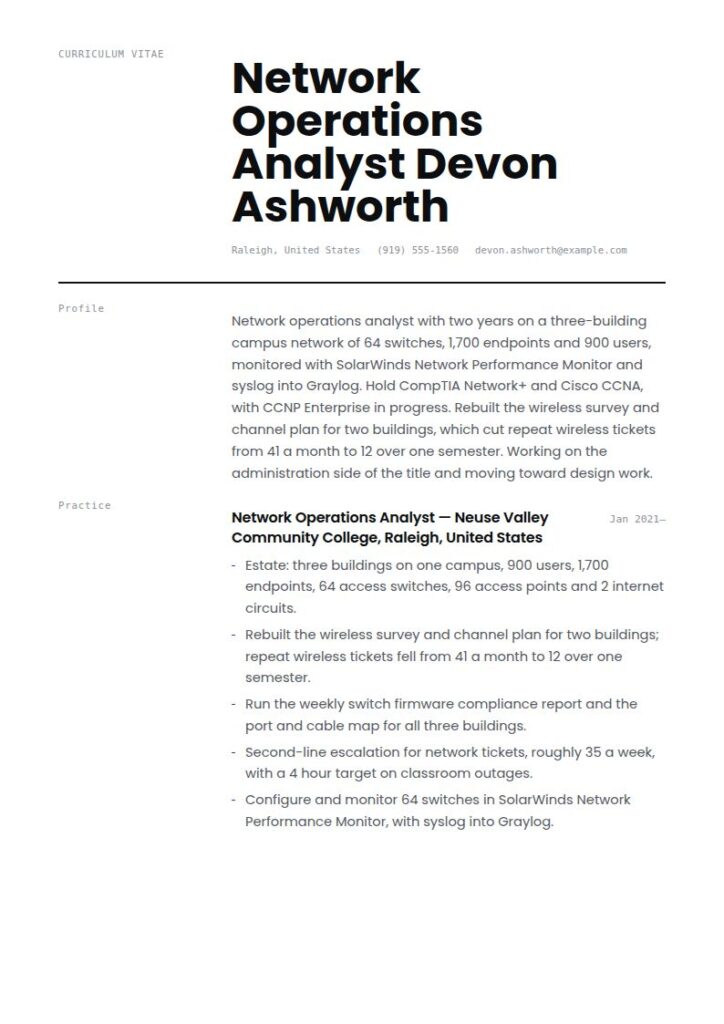
Network operations analyst with two years on a three-building campus network of 64 switches, 1,700 endpoints and 900 users, monitored with SolarWinds Network Performance Monitor and syslog into Graylog. Hold CompTIA Network+ and Cisco CCNA, with CCNP Enterprise in progress. Rebuilt the wireless survey and channel plan for two buildings, which cut repeat wireless tickets from 41 a month to 12 over one semester. Working on the administration side of the title and moving toward design work.
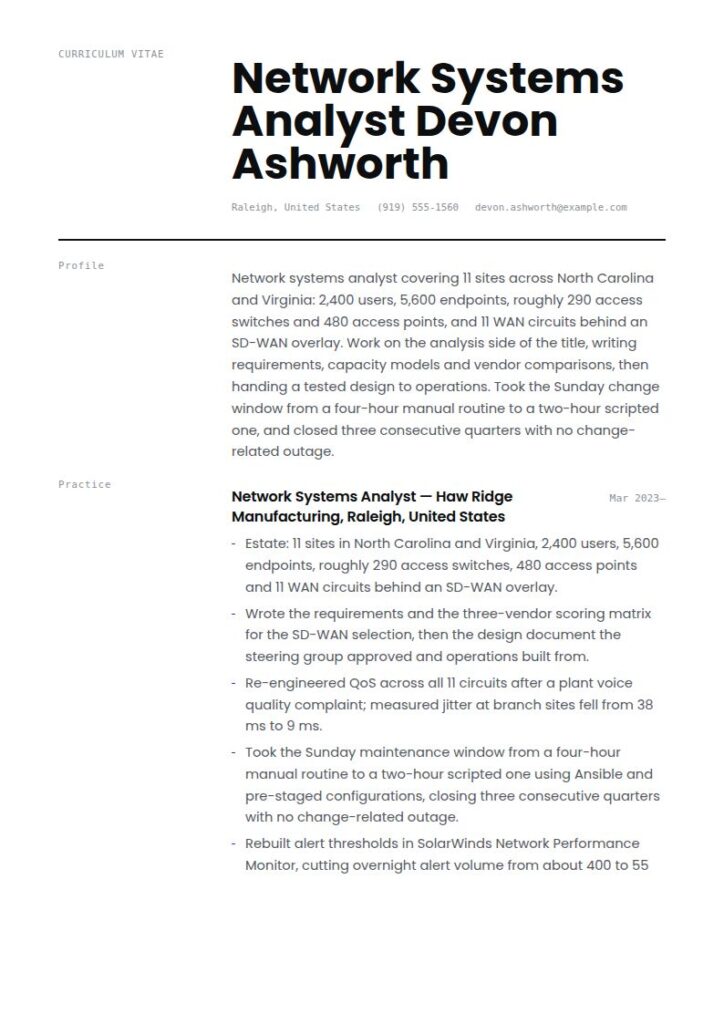
Network systems analyst covering 11 sites across North Carolina and Virginia: 2,400 users, 5,600 endpoints, roughly 290 access switches and 480 access points, and 11 WAN circuits behind an SD-WAN overlay. Work on the analysis side of the title, writing requirements, capacity models and vendor comparisons, then handing a tested design to operations. Took the Sunday change window from a four-hour manual routine to a two-hour scripted one, and closed three consecutive quarters with no change-related outage.
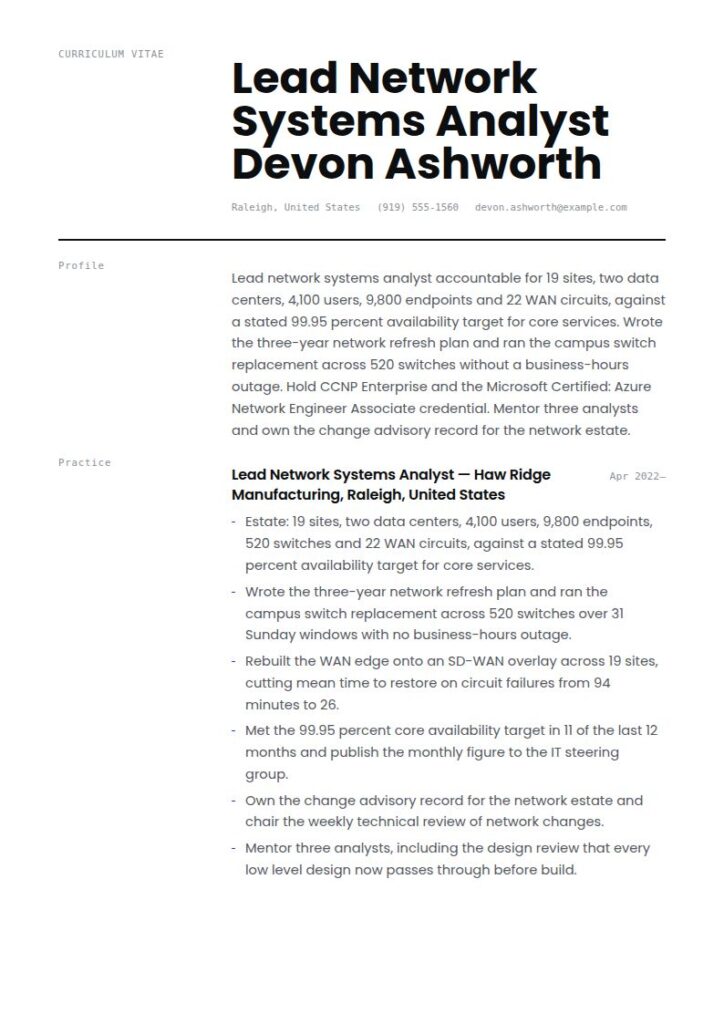
Lead network systems analyst accountable for 19 sites, two data centers, 4,100 users, 9,800 endpoints and 22 WAN circuits, against a stated 99.95 percent availability target for core services. Wrote the three-year network refresh plan and ran the campus switch replacement across 520 switches without a business-hours outage. Hold CCNP Enterprise and the Microsoft Certified: Azure Network Engineer Associate credential. Mentor three analysts and own the change advisory record for the network estate.
Right vs wrong: the same network systems analyst summary, twice
| ✅ Right | ❌ Wrong |
|---|---|
| Network systems analyst covering 11 sites, 2,400 users and 5,600 endpoints. | Experienced network professional with a strong background in IT infrastructure. |
| Work on the analysis side: requirements, capacity models and vendor comparisons. | Responsible for the design, implementation and support of network systems. |
| Took the Sunday change window from four hours to two and closed three quarters with no change-related outage. | Proven track record of maintaining network uptime and reliability. |
For instance, the right column can be compared against a posting in six seconds. The left column cannot, however, and a hiring manager with forty files is comparing, not admiring.
Outline your network systems analyst experience
Then list employer, city, dates, and one line of estate context for that job. Then four to six bullets, each naming a platform or a protocol and carrying a number, with at least two describing something that could have gone wrong.
| Instead of | Use |
|---|---|
| Responsible for network administration and support | Ran 290 access switches and 480 access points across 11 sites for 2,400 users |
| Improved network performance | Re-engineered QoS on 11 WAN circuits; voice jitter at branch sites fell from 38 ms to 9 ms |
| Assisted with network upgrades | Replaced 190 access switches across 7 sites over 14 Sunday windows with no business-hours outage |
| Monitored network systems | Rebuilt polling and alert thresholds, cutting nightly alert volume from about 400 to 55 while catching 3 circuit failures before the service desk did |
| Worked with vendors | Ran the SD-WAN comparison across 3 shortlisted products and wrote the scoring matrix the steering group approved |
Network Systems Analyst, Haw Ridge Manufacturing, Raleigh, NC, March 2023 to Present
Estate: 11 sites in North Carolina and Virginia, 2,400 users, 5,600 endpoints, roughly 290 access switches, 480 access points and 11 WAN circuits behind an SD-WAN overlay.
Wrote the requirements and the scoring matrix for the SD-WAN selection across three shortlisted vendors, then the design document the steering group approved and operations built from.
Re-engineered QoS across all 11 circuits after a plant voice quality complaint; measured jitter at branch sites fell from 38 ms to 9 ms and the complaint queue closed.
Took the Sunday maintenance window from a four-hour manual routine to a two-hour scripted one using Ansible and pre-staged configurations, closing three consecutive quarters with no change-related outage.
Rebuilt monitoring thresholds in SolarWinds Network Performance Monitor, cutting overnight alert volume from about 400 to 55 while surfacing three circuit failures before the service desk saw them, and own the IP address management record for 42 subnets.
Say which half of the title you hold, and size the estate you held it over
This is the section that decides the screen; even so, almost nobody writes it.
To begin with, employers use "network systems analyst" for two different jobs. For example, one is the analyst work the Bureau of Labor Statistics files under computer systems analysts: requirements, capacity modeling, vendor comparison, costing, and writing and testing the design. In contrast, the other is the administration work filed under network and computer systems administrators: configuration, patching, monitoring, incident response and executing the change. Most real jobs blend the two; however, every posting leans, and the leaning is visible in the verbs. "Evaluate", "recommend" and "cost" is the analysis side; "maintain", "configure" and "on-call" is the administration side.
Say which one you are in the second line, then prove it by what your bullets are about. For example, an applicant who claims the analysis side and lists six bullets about resetting switch ports has told the reader they are on the administration side and did not know it.
Size the network estate in eight numbers
Then size the estate. Eight numbers do it, and a reader can check every one against the job they are filling.
| The number | Why the reader wants it | Example |
|---|---|---|
| Sites | Multi-site work is a different job from single-campus work | 11 sites in two states |
| Users supported | The blast radius of a bad change | 2,400 |
| Endpoints | The real device count, usually far above headcount | 5,600 |
| Switches and access points | The configuration surface you managed | 290 access switches, 480 access points |
| WAN circuits and bandwidth | Whether you have carrier and contract experience | 11 circuits, 4 at 1 Gbps dedicated, 7 broadband backup |
| Change and maintenance window | What discipline you worked under | Two Sundays a month, 02:00 to 06:00 Eastern |
| Monitoring stack | Whether you ran observability or only read a dashboard | SolarWinds NPM, LibreNMS, Grafana, syslog to Graylog |
| Availability target | Whether a number was ever attached to your work | 99.95 percent on core services |
Estate supported (current role)
Sites: 11 across North Carolina and Virginia, including two plants running 24 hours
Users and endpoints: 2,400 users, 5,600 endpoints including 620 plant floor devices on a segmented VLAN
Network hardware: roughly 290 access switches, 12 core and distribution pairs, 480 access points, 11 site firewalls
WAN: 11 circuits, 4 at 1 Gbps dedicated internet access and 7 broadband backup, behind an SD-WAN overlay
Change: two Sunday windows a month, 02:00 to 06:00 Eastern, all changes through a weekly change advisory board
Monitoring: SolarWinds Network Performance Monitor, LibreNMS at the edge, Grafana dashboards, syslog into Graylog
Availability: 99.95 percent target on core services, met in 11 of the last 12 months
Finally, keep the block honest and keep it to seven or eight lines. If someone else owned the monitoring thresholds, write "monitored with" instead of "built".
Build a snapshot of your key network systems analyst skills
Twelve to sixteen entries in four groups: routing and switching, security and access, analysis and documentation, and tooling. Name versions and vendors, because that is what a posting is matched against.
Routing and switching: OSPF, BGP, EIGRP, VLAN and trunk design, spanning tree, link aggregation, IPv4 subnetting and IPv6 dual stack
Wireless and access: 802.11ax deployment and survey, 802.1X and RADIUS, network access control, guest and plant floor segmentation
WAN and edge: SD-WAN overlay design, MPLS and dedicated internet access, QoS policy, carrier circuit management and contract renewal
Security: site firewall policy, access control lists, network segmentation, certificate management for 802.1X
Analysis and documentation: requirements gathering, capacity modeling, vendor scoring matrices, high level and low level design documents, test plans
Platforms and tooling: Cisco IOS XE and Catalyst Center, Juniper Junos, Fortinet FortiGate, SolarWinds Network Performance Monitor, LibreNMS, Grafana, Graylog, Ansible, NetBox, Wireshark
List your education and certifications
Degree first, then the certification ladder in the order a reader expects, each with issuing authority, year, and whether it is current. Credentials here expire; moreover, an expired one listed as current is the kind of small dishonesty that ends an application.
To begin with, CompTIA Network+ is the vendor-neutral foundation, and CompTIA's current version of that exam is N10-009 (CompTIA, retrieved 16 September 2026). Similarly, Cisco's Certified Network Associate sits at associate level with the Cisco Certified Network Professional Enterprise credential above it at professional level (Cisco, retrieved 16 September 2026). Meanwhile, Juniper Networks runs a parallel track beginning with JNCIA-Junos. Finally, on the cloud side, Microsoft publishes the Microsoft Certified: Azure Network Engineer Associate credential, earned through exam AZ-700 (Microsoft Learn, retrieved 16 September 2026).
Bachelor of Science, Information Technology, North Carolina State University, Raleigh, NC, 2020
Certifications:
Cisco Certified Network Professional Enterprise (CCNP Enterprise), Cisco, earned 2025, current
Cisco Certified Network Associate (CCNA), Cisco, earned 2022, renewed 2025
CompTIA Network+ (N10-009), CompTIA, earned 2021, current
Juniper Networks Certified Associate, Junos (JNCIA-Junos), Juniper Networks, earned 2024
Microsoft Certified: Azure Network Engineer Associate, Microsoft, earned 2026, renews annually
A bachelor's degree is the typical entry-level education for both halves of the title; in addition, neither occupation requires prior related work experience or typical on-the-job training (BLS Occupational Outlook Handbook, 2025-35 edition). Therefore, the certifications do the gatekeeping the degree does not.
Choose the right layout and design
In particular: single column, 11 or 12 point body type, clear headings, no photograph and no vendor badge images. After all, applicant systems read these into a structured record, and two columns and text boxes are where that reading breaks.
Say which half of the title you hold in the second line. Put the estate block directly under the summary, in seven or eight lines. Name protocols and vendor platforms in full, since that is the string being matched. Give a number and a period of time in every experience bullet. List certifications with issuing authority and year.
Do not write "responsible for the design, implementation and support of network systems"; it is the posting read back. Do not claim design work when your bullets are all ticket work. Do not list an expired certification without the word expired next to it. Do not use badge graphics in place of the text of the credential.
Network systems analyst job market and outlook
In short, two published occupations sit under one title and they are moving in opposite directions.
| Measure | Computer systems analysts | Network and computer systems administrators |
|---|---|---|
| Jobs, 2025 | 544,400 | 323,600 |
| Projected change, 2025-35 | 8% (much faster than average), +42,900 | -4% (decline), -13,200 |
| Projected annual openings | About 32,900 | About 13,400 |
| Median annual wage, May 2025 | $105,850, or $50.89 per hour | $99,130, or $47.66 per hour |
| Typical entry-level education | Bachelor's degree | Bachelor's degree |
Source: U.S. Bureau of Labor Statistics, Occupational Outlook Handbook, 2025-35 projections and May 2025 wage data, published 27 August 2026.
One title, two trend lines, and a $6,720 gap
Between them the two occupations are projected to produce about 46,300 openings a year through 2035, from opposite directions: 32,900 a year on the analyst side, growing 8 percent, and 13,400 a year on the administration side, declining 4 percent (BLS Occupational Outlook Handbook, 2025-35 projections). Computer systems analysts earned a median of $105,850 in May 2025 against $99,130 for administrators, a gap of $6,720 (BLS, May 2025).
The consequence for the resume is direction of travel. If you are on the administration side, the bullets that move you are the analysis ones: the vendor comparison you scored, the capacity model you built, the design document you wrote, the business case you costed.
Where the work sits differs too. Computer systems design and related services employed 23 percent of computer systems analysts in 2025 and 16 percent of administrators, while educational services employed 13 percent of administrators and does not appear in the analyst top five (BLS, 2025).
What salary you can expect as a network systems analyst
Which half of the title you are hired into sets the band before anything else does.
The median annual wage for computer systems analysts was $105,850 as of May 2025, or $50.89 an hour, with the lowest 10 percent under $67,340 while the highest 10 percent earned over $167,710. For network and computer systems administrators, in contrast, the median was $99,130, or $47.66 an hour, with the lowest 10 percent under $62,640 and the highest 10 percent over $155,050 (BLS, May 2025).
Industry moves the rest. On the analyst side, May 2025 medians ran to $108,270 in computer systems design and related services, $107,980 in management of companies and enterprises, $107,240 in information, $106,000 in finance and insurance and $100,190 in government. On the administration side, meanwhile, they ran to $103,810 in management of companies and enterprises, $101,560 in computer systems design and $86,180 in educational services (BLS, May 2025). That last figure sits $12,950 below the administration median, which is a real cost for a pleasant sector to work in.
Above all, what a resume moves inside a band is scale. For instance, a compensation team benchmarking an offer looks at sites, users, endpoints, circuits and the availability commitment, and each is a number you wrote down or left them to assume.
Key takeaways for a network systems analyst resume
- First of all, say which half of the title you hold, analysis or administration, in the second line of the page.
- Then put the estate block directly under the summary: sites, users, endpoints, switches, circuits, window, tooling and availability target.
- Make the bullets match the half you claimed, because a reader grades the claim against them.
- Also name protocols, vendors and platform versions in text, not as badge images.
- Finally, list the certification ladder with issuing authority and year, and mark anything in progress as in progress.
- Put a number and a time frame in every experience bullet, including at least one thing that was broken first.
- If you want the growing side of the title, write the analysis work: requirements, models, scoring matrices, design documents and costs.
Build your network systems analyst resume in 15 minutes with our AI resume builder.
Related information technology resume examples
- Network engineer resume
- Network administrator resume
- System administrator resume
- Systems analyst resume
- IT specialist resume
- IT help desk resume
- SOC analyst resume
- Cyber security resume
- DevOps engineer resume
- Solution architect resume
- IT manager resume
- Data engineer resume
Pair it with a matching network systems analyst cover letter.
Network systems analyst resume questions, answered
How long should a network systems analyst resume be?
One page for your first five years. Two once you carry multiple sites, have led a refresh or a migration, and have a certification ladder worth listing in full. The estate block earns its space on either length.
Should I call myself an analyst or an administrator?
Whichever the posting is describing, as long as it is true of your work. Read the verbs: "evaluate", "recommend" and "cost" is analysis; "maintain", "configure" and "on-call" is administration. The Bureau of Labor Statistics projects 8 percent growth for computer systems analysts against a 4 percent decline for administrators through 2035, so if you can honestly claim the analysis side, claim it.
Do I need a CCNP to be taken seriously?
Not universally, but it is the credential most often named in postings at this level. Cisco's professional-level enterprise credential is CCNP Enterprise, sitting above the associate-level CCNA (Cisco, retrieved 16 September 2026). If you do not hold it, list what you do hold, name the one you are studying for, and let the estate block carry the weight.
What do I put on a network systems analyst resume with no experience?
Size whatever you have run. A home lab with three switches, a router, VLANs and a monitoring stack is a real estate, and describing it in the same eight numbers a workplace estate uses beats a paragraph about being eager to learn. Add the certification you hold, any help desk work with ticket volumes attached, and one project where you documented a design rather than only configured a device.
How do I show results when the network just worked?
Use the numbers the network produces. Alert volume before and after threshold tuning, jitter or latency at named sites, devices moved in a window, consecutive windows with no rollback, mean time to restore on circuit failures, firmware compliance across the estate, and tickets in a category before and after a fix. Uptime without a number reads as a wish; uptime with a target and a hit rate reads as a record.
Is it worth listing the monitoring tools by name?
Yes. Tooling is one of the few things a reader can use to place you quickly, and the names are what an applicant tracking system matches. Name the polling platform, the log destination, the dashboard layer, the configuration management tool and the address management record, and say which you built rather than only used.