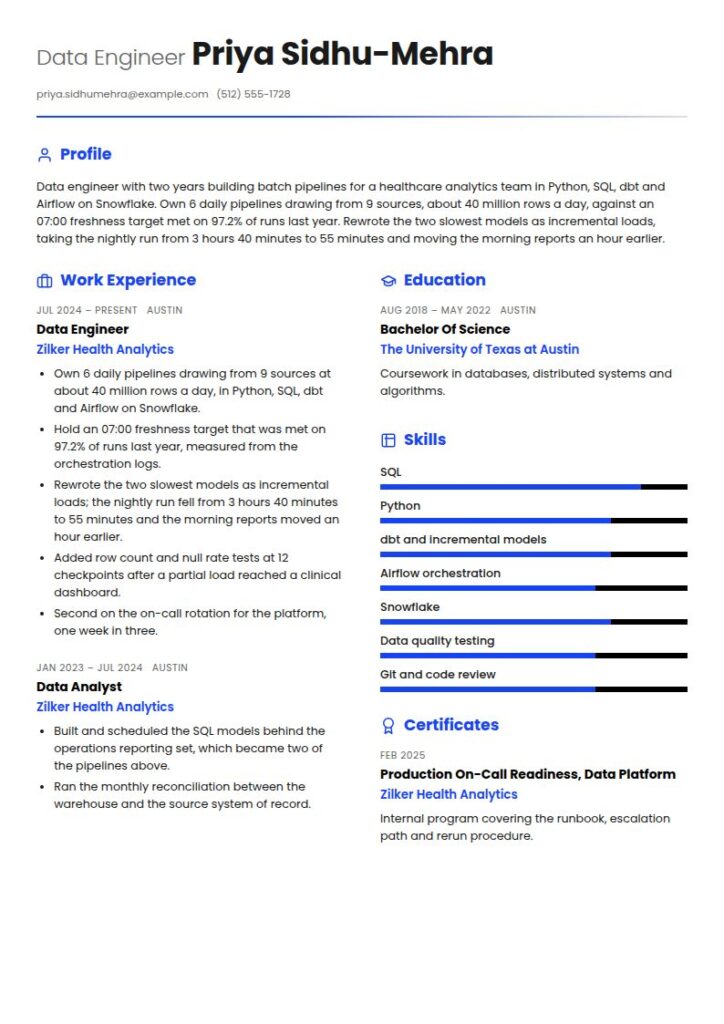
Data Engineer Priya Sidhu-Mehra
Data Engineer
[email protected] | (512) 555-1728 | Austin, United States
Profile
Data engineer with two years building batch pipelines for a healthcare analytics team in Python, SQL, dbt and Airflow on Snowflake. Own 6 daily pipelines drawing from 9 sources, about 40 million rows a day, against an 07:00 freshness target met on 97.2% of runs last year. Rewrote the two slowest models as incremental loads, taking the nightly run from 3 hours 40 minutes to 55 minutes and moving the morning reports an hour earlier.
Work Experience
07/2024 - Present, Data Engineer, Zilker Health Analytics, Austin, United States
- Own 6 daily pipelines drawing from 9 sources at about 40 million rows a day, in Python, SQL, dbt and Airflow on Snowflake.
- Hold an 07:00 freshness target that was met on 97.2% of runs last year, measured from the orchestration logs.
- Rewrote the two slowest models as incremental loads; the nightly run fell from 3 hours 40 minutes to 55 minutes and the morning reports moved an hour earlier.
- Added row count and null rate tests at 12 checkpoints after a partial load reached a clinical dashboard.
- Second on the on-call rotation for the platform, one week in three.
01/2023 - 07/2024, Data Analyst, Zilker Health Analytics, Austin, United States
- Built and scheduled the SQL models behind the operations reporting set, which became two of the pipelines above.
- Ran the monthly reconciliation between the warehouse and the source system of record.
Education
08/2018 - 05/2022, Bachelor of Science, Computer Science, The University of Texas at Austin, Austin, United States
Coursework in databases, distributed systems and algorithms.
Skills
SQL, 85
Python, 75
dbt and incremental models, 75
Airflow orchestration, 70
Snowflake, 75
Data quality testing, 70
Git and code review, 70
Languages
English, native
Hindi, native
Certificates
02/2025, Production on-call readiness, data platform, Zilker Health Analytics
Internal program covering the runbook, escalation path and rerun procedure.
Summary
A data engineer resume is a one to two page document stating what each pipeline promises downstream and what happens when the promise breaks: freshness, volume, cadence, idempotency, schema change and who gets paged. This guide gives three adaptable versions, the pipeline contract most applicants leave out, and Bureau of Labor Statistics pay and outlook for the published occupations this work sits between.
Data Engineer resume examples by experience level
A data engineer resume is a one to two page document that says what each pipeline you built promises the people downstream, and what happens when that promise breaks.
Almost every resume for this job is a list of technologies: Airflow, dbt, Spark, Kafka, Snowflake, one cloud or another. The list describes the tools in the room rather than the work, and every other candidate has written a version of it.
The work is a contract. Somebody downstream, a dashboard, a model, a finance close, an operations team, relies on data arriving by a certain time, containing a certain amount, meaning the same thing today as yesterday. Your resume is read to find out whether you knew what you had promised, and what you did the night you could not keep it.
Resume guide for a data engineer resume
This guide and the corresponding data engineer resume example will cover:
- How to write a data engineer resume, section by section
- The pipeline contract: freshness, volume, cadence, idempotency, schema change
- Three adaptable summaries: first platform role, pipeline owner and lead
- What to say about on-call, backfills and the load that failed
- What the job market looks like and what you can expect to earn
How to write a data engineer resume
Six sections: contact header, summary, a pipeline block, engineering experience, skills by layer, and education. One page for your first three years, two once you own pipelines other teams depend on. The pipeline block goes above experience because it carries the shape of the systems you ran: experience bullets say what you did, the pipeline block says what it was.
| Section | What it is answering | Where it goes |
|---|---|---|
| Pipeline block | What did they promise, at what scale, and how often did they keep it? | Its own block, under the summary |
| Experience | What did they build, migrate or fix, and what changed downstream? | Reverse chronological, with numbers |
| Skills by layer | Ingestion, storage, transformation, orchestration, serving | Grouped, not one long list |
| Education | Does it clear the stated degree line? | Bottom, unless you graduated this year |
Give freshness as a target and a measurement, not an adjective
"Built real-time data pipelines" is the most common sentence on a data engineering resume and it survives no follow-up question. Real time to a trading desk is milliseconds; real time to a logistics dashboard is fifteen minutes.
Write the target and the record against it: "hourly load with a 20 minute freshness target, met on 98.6% of runs over the last two quarters". That is three facts in eleven words, and it says you have looked at your own service level rather than described one.
If your team never set a target, say what the pipeline actually did and over what window. A measured number beats an unmeasured promise.
Run the finished file through the ATS resume checker first: the platform keywords a reviewer searches for are exactly the ones a broken parse loses.
Choosing the best resume format for a data engineer resume
Reverse chronological, with the pipeline block between your summary and your first job. One page for your first three years, two after that.
Skills-based formats fail because the interesting question is which systems you were responsible for when they broke, and that is a question about time and ownership. A format that lists Kafka without saying whose cluster it was has removed the part a reader wanted.
Include your contact information
| ✅ Right | ❌ Wrong |
|---|---|
| Priya Sidhu-Mehra | Priya Sidhu-Mehra |
| Data Engineer, batch and streaming pipelines | Data professional with a strong background in big data |
| Python, SQL, Spark, Airflow, dbt, Snowflake, Kafka | Proficient in various data technologies |
| (512) 555-1728, [email protected], Austin, TX | (512) 555-1728, [email protected] |
The title line is worth one extra clause. "Data Engineer" alone leaves a reader guessing between someone who writes transformation models on a warehouse somebody else runs and someone who operates the ingestion layer at 3am. Those are not interchangeable hires. Put a short, honest stack line under the title: it is the first keyword surface on the page, and a promise the rest of the file has to keep.
Make use of a summary
Four lines: what you build, the scale in one number, the freshness or reliability record, and the thing downstream that depends on it.
Data engineer with two years building batch pipelines for a healthcare analytics team in Python, SQL, dbt and Airflow on Snowflake. Own 6 daily pipelines drawing from 9 sources, about 40 million rows a day, against an 07:00 freshness target met on 97.2% of runs last year. Rewrote the two slowest models as incremental loads, taking the nightly run from 3 hours 40 minutes to 55 minutes and moving the morning reports an hour earlier.
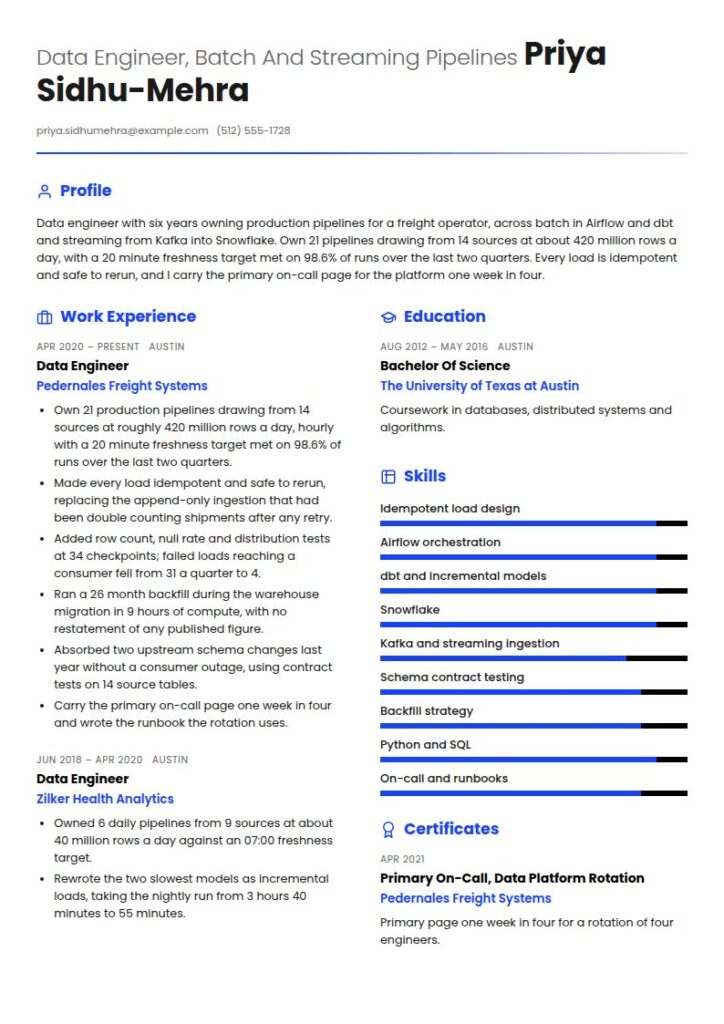
Data engineer with six years owning production pipelines for a freight operator, across batch in Airflow and dbt and streaming from Kafka into Snowflake. Own 21 pipelines drawing from 14 sources at about 420 million rows a day, with a 20 minute freshness target met on 98.6% of runs over the last two quarters. Every load is idempotent and safe to rerun, and I carry the primary on-call page for the platform one week in four.
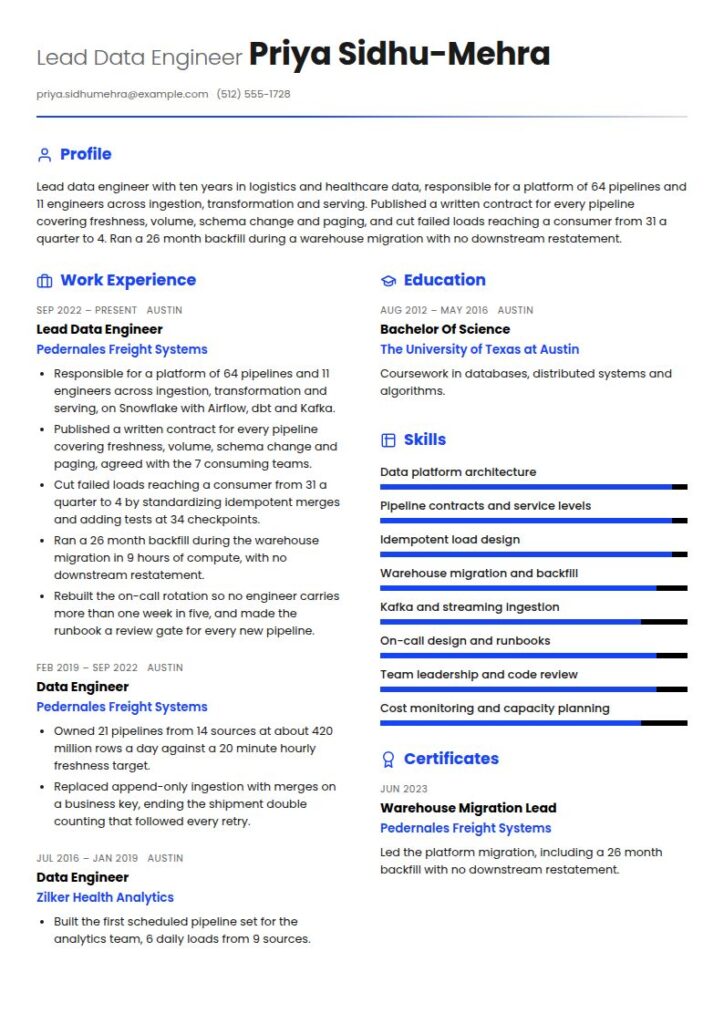
Lead data engineer with ten years in logistics and healthcare data, responsible for a platform of 64 pipelines and 11 engineers across ingestion, transformation and serving. Published a written contract for every pipeline covering freshness, volume, schema change and paging, and cut failed loads reaching a consumer from 31 a quarter to 4. Ran a 26 month backfill during a warehouse migration with no downstream restatement.
Right vs wrong: the same data engineer summary, twice
| ✅ Right | ❌ Wrong |
|---|---|
| Own 21 pipelines drawing from 14 sources at about 420 million rows a day. | Experience building scalable data pipelines for large datasets. |
| A 20 minute freshness target met on 98.6% of runs over the last two quarters. | Built reliable, real-time data infrastructure. |
| Every load is idempotent and safe to rerun, and I carry the primary page one week in four. | Responsible for monitoring and maintaining data pipelines. |
The right-hand column is what a reviewer reads forty times in an afternoon. The left answers the questions they would have asked in the screen.
Outline your data engineering experience
Employer, what the platform was for, dates, and one line on its shape: the warehouse, the orchestration, the rough scale. Then three to five bullets, each with a number and a downstream consequence.
| Instead of | Use |
|---|---|
| Built and maintained ETL pipelines | Own 21 pipelines from 14 sources, about 420 million rows a day, hourly with a 20 minute freshness target |
| Improved pipeline performance | Rewrote the two slowest models as incremental loads; the nightly run fell from 3 hours 40 minutes to 55 minutes |
| Handled data quality issues | Added row count, null rate and distribution tests at 34 checkpoints; failed loads reaching a consumer fell from 31 a quarter to 4 |
| Migrated data to the cloud | Ran a 26 month backfill during the warehouse migration in 9 hours of compute, with no downstream restatement |
Data Engineer, Pedernales Freight Systems, Austin, TX, April 2020 to Present
Freight operator, about 3,400 staff; Snowflake, Airflow, dbt, and Kafka for telematics events.
Own 21 production pipelines drawing from 14 sources at roughly 420 million rows a day, hourly with a 20 minute freshness target met on 98.6% of runs over the last two quarters.
Made every load idempotent and safe to rerun, replacing the append-only ingestion that had been double counting shipments after any retry.
Added row count, null rate and distribution tests at 34 checkpoints; failed loads reaching a consumer fell from 31 a quarter to 4.
Ran a 26 month backfill during the warehouse migration in 9 hours of compute, with no restatement of any published figure, and carry the primary on-call page one week in four.
The pipeline contract: what your data promises, and what happens when it breaks
A pipeline is a promise, and this block is where you write it down. Eight facts, one pipeline or group at a time. Most candidates give none of them.
| Contract term | The number or fact to give | The claim it replaces |
|---|---|---|
| Sources | How many, and of what kind: databases, vendor APIs, event topics, files | "Multiple data sources" |
| Freshness | The target as a time, and the share of runs that met it over a stated window | "Real-time" |
| Volume | Rows or gigabytes per run, not lifetime totals | "Large-scale data" |
| Cadence | Batch or streaming, and how often: hourly, nightly, continuous with a lag target | "Automated pipelines" |
| Idempotency | What a rerun does to yesterday's numbers | "Robust error handling" |
| Schema change | One upstream change you absorbed without breaking a consumer, and how | "Maintained data models" |
| Backfill | How much history, how long it took, whether anything downstream was restated | "Migrated historical data" |
| Paging | Who is woken when a load fails, and what the runbook tells them | "Monitored pipeline health" |
Idempotency is the most useful word on this page. A pipeline safe to rerun is one whose owner thought about failure before it happened; one that is not quietly double counts every time somebody retries it. If you replaced an append-only load with a merge keyed on a business identifier, that is a sentence worth writing in full.
Schema change is the second. Upstream systems change columns without telling you, and how a pipeline behaves that morning is the difference between a mature platform and a fragile one. "The billing system added a nullable currency column and split one status field into two; the contract test caught it, the load held at the previous schema for one run, and the dashboard consumer saw no gap" shows more judgment than a paragraph of tool names.
What happens at 3am
Then the part almost nobody writes, which is what your pipeline does when it fails at three in the morning.
Who gets paged. A named rotation, its size, and how often you are on it. A candidate who cannot say who gets paged has described a script rather than a pipeline.
What the runbook says. Whether there is one, whether you wrote it, and whether the first step is a rerun or a call. A rerun is only the first step if the load is idempotent, which is why the two facts belong together.
Who you tell. Consumers of a late or partial dataset are the people whose morning you are about to change. Say how they hear: a status channel, a freshness dashboard, a column marking the run as partial. A platform that fails silently is worse than one that fails loudly.
What changed afterwards. One failure that produced a permanent fix rather than a rerun. That sentence is often the strongest thing on a data engineering resume, because it is evidence of the loop closing.
Platform: Snowflake warehouse, Airflow orchestration, dbt transformation, Kafka for telematics events; 21 production pipelines, 14 sources.
Freshness: hourly loads with a 20 minute target, met on 98.6% of runs over two quarters; nightly finance load with an 07:00 target, met on 99.4%.
Volume: about 420 million rows a day across all pipelines; the telematics topic peaks near 9,000 events a second.
Idempotency: every load is a merge on a business key and is safe to rerun; a rerun of yesterday leaves yesterday's published numbers unchanged.
Schema change: contract tests on 14 source tables; two upstream changes absorbed last year with no consumer outage.
Backfill: 26 months of history reloaded during the warehouse migration in 9 hours of compute, with no restatement of a published figure.
Quality: row count, null rate and distribution tests at 34 checkpoints; failed loads reaching a consumer down from 31 a quarter to 4.
Paging: primary on-call one week in four for a rotation of 4; runbook written and current; late or partial runs published to a freshness dashboard the 7 consuming teams watch.
Name products only where they are genuinely yours. There is a difference between operating a Kafka cluster and reading from a topic somebody else operates, and between writing Airflow DAGs and clicking a managed pipeline in a console. Both are real work, but a reader who finds out in the interview that you meant the second has stopped listening.
Build a snapshot of your key skills
Group by layer rather than by vendor, so a reader can see the shape of what you do before the logos.
Ingestion and streaming: Kafka, change data capture, vendor API integration, file and SFTP ingestion, schema registry and contract tests
Storage and modeling: Snowflake, Parquet on object storage, dimensional modeling, partitioning and clustering, slowly changing dimensions
Transformation and orchestration: dbt, Airflow, Spark, incremental and merge patterns, idempotent load design, backfill strategy
Reliability and practice: data quality testing, freshness monitoring, on-call and runbooks, cost monitoring, Terraform, Python and SQL
Twelve to eighteen entries is plenty. Thirty tools reads as a list of things seen rather than owned, and the interviewer will pick the one you are weakest on.
List your education and certifications
Put the degree at the bottom unless you graduated this year, and be honest about certifications: no single credential gates this work the way a license gates a trade.
That absence cuts both ways. Nothing on your page is doing the job a license does, so the evidence has to come from the pipeline block. If you hold a vendor credential, write its exact name, the issuing authority and the exam code, because platform credentials are versioned.
Two things are worth more page space than a certification. The first is the migration or upgrade you survived, named and dated. The second is anything you wrote that other engineers use: an internal library, a contract testing framework, or the runbook for the rotation.
Bachelor of Science, Computer Science, The University of Texas at Austin, Austin, TX, 2016
Platform work: warehouse migration lead, 2023, including a 26 month backfill with no downstream restatement. Author of the internal contract testing library used by 4 teams.
Choose the right layout and design
Single column, 10 or 11 point body type, plain headings, no graphics, no skill bars, no logos. PDF unless the portal asks otherwise. The pipeline block tempts people into two columns to save space; resist it, because the screen here is often a keyword match on a platform name that has to survive the parse intact.
Give freshness as a target plus the share of runs that met it. State volume per run with its window. Say whether loads are idempotent and what a rerun does. Name one schema change you absorbed and one backfill you ran. Say who gets paged and how often you are on the rotation.
Do not write "real-time" without a number. Do not give lifetime row counts; they are unfalsifiable and every candidate's are large. Do not list thirty tools. Do not claim you built a platform you consumed. Do not describe a failure without saying what changed afterwards.
Data engineer job market and outlook
The Bureau of Labor Statistics publishes no Occupational Outlook Handbook profile titled data engineer. There is no federal employment count, projected growth rate or median wage for the title, and the retired wage pages still circulating belong to an older cycle. This page quotes no data engineer wage, and builds on the two published occupations the work sits between.
| Published occupation | Jobs, 2025 | Projected change, 2025-35 | Annual openings | Median annual wage, May 2025 |
|---|---|---|---|---|
| Database administrators and architects | 144,500 | 4% (as fast as average), +6,500 | About 7,300 | $126,760 |
| Data scientists | 275,600 | 35% (much faster than average), +95,400 | About 24,800 | $120,230 |
Source: U.S. Bureau of Labor Statistics, Occupational Outlook Handbook, 2025-35 projections and May 2025 wage data.
Those two rows describe the pull on this job from either side. The database occupation is the one whose daily work most resembles a data engineer's, and it turns over only about 7,300 openings a year. The data science occupation is growing 35 percent and turning over about 24,800, and most of what those roles need to exist at all is a pipeline somebody else maintains.
The $34,880 gap inside one occupation
BLS reports database administrators and architects as one occupation with a combined median of $126,760 as of May 2025, but publishes the halves separately: administrators at $104,620 and architects at $139,500, a difference of $34,880 (BLS, May 2025).
The projections split the same way. Database administrator employment is projected to change 0 percent from 2025 to 2035 while architects grow 9 percent, from bases of 75,000 and 69,500 jobs (BLS, 2025-35 projections).
Read that as the clearest published statement of what your resume should evidence. The keep-it-running half of data work is flat and paid at $104,620; the design-it half grows and is paid at $139,500. The pipeline contract is a design artifact, which is why writing one down moves a file toward the second number.
What salary you can expect as a data engineer
There is no Handbook wage figure to quote for this job title, because the occupation is not one the Handbook carries. Treat the two published occupations around it as the band an offer falls inside, and take an occupation figure into the conversation rather than a title.
Database administrators and architects had a combined median annual wage of $126,760 as of May 2025, which is $60.94 an hour: administrators at $104,620 and architects at $139,500. The lowest 10 percent of administrators earned less than $60,230 and the highest 10 percent more than $163,320; for architects, less than $86,240 and more than $204,000. Data scientists had a median of $120,230, with the lowest 10 percent under $67,240 and the highest 10 percent over $199,130 (BLS, May 2025).
| Where the work sits | Median annual wage, May 2025 |
|---|---|
| Database architects, infrastructure providers and data processing | $152,560 |
| Database architects, computer systems design | $148,680 |
| Data scientists, publishing and broadcasting | $142,240 |
Source: U.S. Bureau of Labor Statistics, May 2025.
Inside that band, three things move the number. Ownership is the first: whether the pipelines were yours to design or yours to run. Blast radius is the second, how much breaks when your system does, which is why the consumer count and the freshness record matter more than the row count. The third is on-call, because a candidate who has carried a page and written the runbook is priced as someone who can be trusted with production.
Key takeaways for a data engineer resume
- Write the contract, not the tool list: freshness, volume, cadence, idempotency, schema change.
- Give freshness as a target and the share of runs that met it over a stated window.
- Say whether loads are idempotent and what a rerun does to yesterday's numbers.
- Name one schema change you absorbed and one backfill you ran, with its duration.
- Say who gets paged, how often you are on the rotation, and what the runbook says.
- Describe one failure that produced a permanent fix rather than a rerun.
- Name products only where the work was yours, and say which layer you owned.
Build your data engineer resume in 15 minutes with our AI resume builder.
Related information technology resume examples
- Data analyst resume
- Data scientist resume
- AWS data engineer resume
- SQL developer resume
- Python developer resume
- Machine learning engineer resume
- Software engineer resume
- DevOps engineer resume
- Power BI developer resume
- Tableau developer resume
- Solution architect resume
- Java developer resume
Pair it with a matching data engineer cover letter.
Data engineer resume questions, answered
How long should a data engineer resume be?
One page for your first three years, two once you own pipelines other teams depend on. The pipeline block earns its space at either length, because it replaces a tool list every other candidate has written.
What should I put on a data engineer resume with no data engineering job title?
The pipelines you have already built under another title. Analysts, backend engineers and BI developers often own scheduled loads, incremental models and quality checks. Write them as pipelines with their contract terms: sources, cadence, freshness, volume, and what broke. Then be explicit about the layer you have not worked at, because a reader will find out anyway.
Do I need a certification to get a data engineering job?
No single credential gates this work. Vendor platform certifications can help a file past a keyword screen and are worth listing with the exact name, authority and exam code. They do not substitute for the pipeline block, which is what an engineer on the panel reads for.
Should I put row counts and data volumes on my resume?
Yes, per run and with the window, not as lifetime totals. "About 420 million rows a day across 21 pipelines" is checkable and comparable. "Processed billions of records" is neither, and appears on so many files that it has stopped carrying information.
How do I write about a pipeline that failed?
Plainly, and with the fix. Say what broke, what the downstream effect was, how it was detected, and what changed so it could not happen the same way again. Data engineering interviews spend more time on failure than on architecture, and a candidate who has already written one honest failure sentence has set the tone.