Priya Sidhu-Mehra Data Engineer Austin, 78704, United States [email protected] · (512) 555-1728
16 September 2026
Mr. Andrzej Szwed Data Platform Waterloo Health Partners Austin, United States
Application for Data Engineer, Waterloo Health Partners
Dear Mr. Szwed,
I am applying for the Data Engineer post at Waterloo Health Partners. I own the ingestion and transformation layers of a freight data platform: 21 production pipelines drawing from 14 sources at about 420 million rows a day, in Airflow and dbt on Snowflake with Kafka for telematics events. Your posting asks for someone who can take the clinical operations pipelines off a single person, which is close to the position I was hired into.
The pipeline I would describe is the hourly operations load, because it is the one seven teams watch. It carries a 20 minute freshness target and met it on 98.6% of runs over the last two quarters. Every load is a merge on a business key, so a rerun of yesterday leaves yesterday's published numbers unchanged; that replaced an append-only ingestion that had been double counting shipments after any retry. Last year it absorbed two upstream schema changes without a consumer outage, because contract tests on 14 source tables hold the load at the previous schema for one run and raise rather than fail silently. I carry the primary page for the platform one week in four and wrote the runbook the rotation uses.
The failure worth telling you about is the one that changed the design. An upstream API began returning partial pages without an error status, and we published a short day before anyone noticed. We now compare row counts against a seven day band at 34 checkpoints, and failed loads reaching a consumer fell from 31 a quarter to 4.
Your engineering blog describes a move from nightly batch to hourly loads on the clinical side, which is the migration I ran here, including a 26 month backfill in 9 hours of compute with no restatement downstream. I can give four weeks' notice and I am happy to join an on-call rotation. Thank you for reading.
Sincerely, Priya Sidhu-Mehra
Summary
A data engineer cover letter takes one pipeline you owned and states its contract: how fresh the data was meant to be, how much of it there was, what a rerun did, and who got paged when it broke. This guide gives a full adaptable letter, the openings that work, how to write about a failure, and what changes when you move in from analytics or backend engineering.
Data Engineer cover letter examples by experience level
A data engineer cover letter is a one-page letter that takes a single pipeline you owned and says what it promised, at what scale, and what happened the night it broke.
That is a narrower brief than most cover letter advice gives, and it is deliberate. The reader is an engineer with production systems to keep running, and they want evidence that you have carried one. A letter that lists tools repeats the resume; a letter that describes one system in its own terms tells them something the resume cannot fit.
Guide to a data engineer cover letter
This guide and the corresponding data engineer cover letter example will cover:
- How to structure the letter, paragraph by paragraph
- Why one pipeline beats a list of platforms
- Writing about a load that failed, and what changed afterwards
- What to say when you are moving in from analytics or backend engineering
- The openings that work, and the ones that waste the first line
How to write a data engineer cover letter
| Paragraph | Its job | Length |
|---|---|---|
| Opening | The post, the layer you own, one pipeline in a clause | 2 to 3 sentences |
| Evidence | That pipeline's contract: sources, freshness, volume, rerun behavior | 4 to 5 sentences |
| Fit | Something specific about their platform, and the problem you would take | 3 to 4 sentences |
| Close | On-call, availability, thank you | 2 sentences |
One pipeline, eight facts, beats a paragraph of platforms
The strongest paragraph you can write is one pipeline described completely: how many sources it drew from, how fresh the data was meant to be and how often it was, how much moved per run, whether the load is idempotent, one schema change it survived, and who gets paged when it fails.
Eight facts fit in five sentences, and none can be written by a candidate who has not done the work. The letter should be expensive to fake.
Pick the pipeline closest to what the posting describes, not the largest one you touched. A well-described hourly load for seven teams beats a vague sentence about petabytes.
A data engineer cover letter example you can adapt
Dear Mr. Szwed,
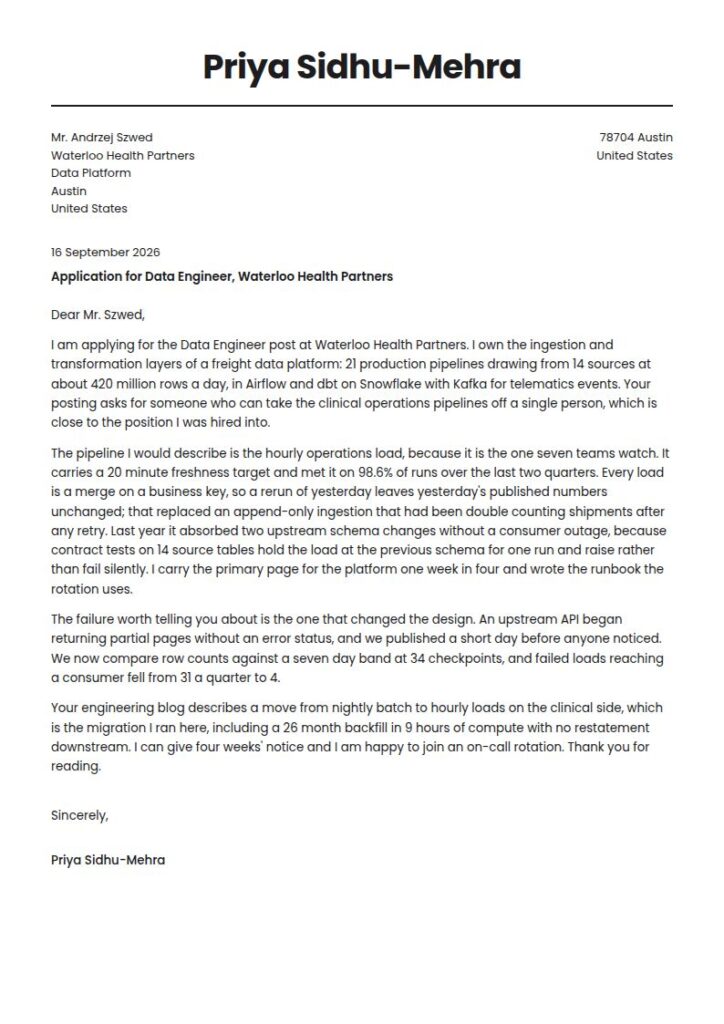
I am applying for the Data Engineer post at Waterloo Health Partners. I own the ingestion and transformation layers of a freight data platform: 21 production pipelines drawing from 14 sources at about 420 million rows a day, in Airflow and dbt on Snowflake with Kafka for telematics events. Your posting asks for someone who can take the clinical operations pipelines off a single person, which is close to the position I was hired into.
The pipeline I would describe is the hourly operations load, because it is the one seven teams watch. It carries a 20 minute freshness target and met it on 98.6% of runs over the last two quarters. Every load is a merge on a business key, so a rerun of yesterday leaves yesterday's published numbers unchanged; that replaced an append-only ingestion that had been double counting shipments after any retry. Last year it absorbed two upstream schema changes without a consumer outage, because contract tests on 14 source tables hold the load at the previous schema for one run and raise rather than fail silently. I carry the primary page for the platform one week in four and wrote the runbook the rotation uses.
The failure worth telling you about is the one that changed the design. An upstream API began returning partial pages without an error status, and we published a short day before anyone noticed. We now compare row counts against a seven day band at 34 checkpoints, and failed loads reaching a consumer fell from 31 a quarter to 4.
Your engineering blog describes a move from nightly batch to hourly loads on the clinical side, which is the migration I ran here, including a 26 month backfill in 9 hours of compute with no restatement downstream. I can give four weeks' notice and I am happy to join an on-call rotation. Thank you for reading.
Sincerely, Priya Sidhu-Mehra
Openings that work
| Instead of | Use |
|---|---|
| I am passionate about working with data at scale | I own the ingestion and transformation layers of a freight data platform, 21 pipelines from 14 sources |
| I have extensive experience with modern data stack tools | Airflow and dbt on Snowflake, with Kafka for telematics events, at about 420 million rows a day |
| I build robust and scalable data pipelines | A 20 minute freshness target, met on 98.6% of runs over two quarters |
Each right-hand cell invites a follow-up question; each left-hand cell is a fact about nobody. That is the only test worth applying to a sentence in this letter.
How to write about a load that failed
Candidates avoid this paragraph, and it is usually the one that gets the interview. Every data platform of any size has published something wrong at least once, and the reader knows it.
| Part | What to write |
|---|---|
| What broke | The mechanism in one clause, without naming a vendor |
| What it did downstream | Who saw wrong or missing data, and for how long |
| How it was found | A test, a monitor, a reconciliation or a consumer, and be honest if it was a consumer |
| What changed | The permanent fix, with the number it moved |
Two rules. Do not blame an upstream team in writing, because the reader cannot check it and will assume the worst reading. Do not include a customer name, a client identifier, a hostname or a credential path: a data engineer is trusted above all with exactly the thing they would be careless with by writing it down.
The gap between running data and designing it is $34,880
BLS publishes no Occupational Outlook Handbook profile titled data engineer. Of the published occupations around it, database administrators and architects is closest in daily work, with a combined median annual wage of $126,760 as of May 2025. Inside it, database administrators had a median of $104,620 and database architects $139,500, a difference of $34,880 (BLS, May 2025).
The projections split the same way: administrator employment is projected to change 0 percent from 2025 to 2035 while architects grow 9 percent. Data scientists, the other published occupation this work supports, had a median of $120,230 and are projected to grow 35 percent (BLS, 2025-35 projections).
The reading for a letter is simple. Describing yourself as someone who keeps pipelines running puts you beside the flat, lower-paid half of that occupation; describing what you designed, and the contract you wrote for it, puts you beside the other half.
Moving in from analytics or backend engineering
Take the scheduled loads you already own and write them as pipelines with their contract terms: sources, cadence, freshness, volume and rerun behavior. Say which layer you have not worked at, because the reader will find out anyway. Name the one thing you would need to learn on their stack and how close your equivalent is.
Do not claim you built a platform you consumed. Do not write "real-time" without a number. Do not give lifetime row counts. Do not describe a failure without the fix that followed it. Do not name a vendor, customer, hostname or credential path anywhere in the letter.
Analysts and BI developers often have a stronger case than they think. If you own incremental models, scheduled refreshes and quality tests, you are already writing half the contract; what is usually missing is ingestion and the paging story, and saying so plainly is more convincing than implying otherwise.
Length, format and sending it
One page, four paragraphs, 250 to 400 words. PDF unless the portal asks otherwise, named for yourself and the post: priya-sidhu-mehra-data-engineer-cover-letter.pdf. Address a person, because a specific letter addressed to nobody reads as one sent to twenty companies.
Keep every number identical to the one on your resume. Our data engineer resume example is built on the same figures, and a freshness percentage that changes between the two documents loses the benefit of having given one.
Key takeaways
- Describe one pipeline completely rather than several vaguely.
- Give freshness as a target plus the share of runs that met it, over a stated window.
- Say whether loads are idempotent and what a rerun does to yesterday's numbers.
- Name one schema change you absorbed and one backfill you ran.
- Say who gets paged and how often you carry it.
- Write one failure with what changed afterwards and the number it moved.
- Keep vendors, customers, hostnames and credentials out of the letter.
Write your data engineer cover letter in 10 minutes with our AI cover letter builder.
Data engineer cover letter questions, answered
How long should a data engineer cover letter be?
One page, four paragraphs, 250 to 400 words. Engineers read these quickly and skeptically, and one fully described pipeline does more than three pages of platform names.
Do I need a cover letter if the application is a portal?
Attach one wherever there is a field. The portal collects the same record from everyone, so the letter is the only place you can state a pipeline's contract: freshness against a target, volume per run, rerun behavior and who carries the page.
What do I write if I have never had the data engineer title?
Write the scheduled loads you already own as pipelines, with their contract terms. Incremental models, refreshes and quality tests are pipeline work whatever your title says. Then name the layer you have not worked at, usually ingestion, and say what your nearest equivalent is.
Should I mention certifications?
Only briefly, with the exact name, the issuing authority and the exam code, because platform credentials are versioned. No certification gates this work, and a letter that leads with one spends its best sentence on the weakest evidence you have.
How specific can I be about my current employer's systems?
Specific about shape, never about identity. Row counts, freshness percentages, source counts, cadences and consumer counts describe a system without identifying it. Vendor names, customer names, hostnames and anything resembling a credential do not belong in a letter, and a reader who sees them wonders what you would write about theirs.