Amara Nwachukwu Software Developer, distributed systems Seattle, 98122, United States [email protected] · (206) 555-1516
16 September 2026
Mr. Silas Okoro Ledger Engineering Cascade Ledger Seattle, United States
Application for Senior Software Developer, Cascade Ledger
Dear Mr. Okoro,
I am applying for the Senior Software Developer post on the ledger team at Cascade Ledger. I currently own four Go and Python services in the shipment tracking platform at Rainier Freight Systems, carrying about 12 million API calls a day against a 99.9% availability target, and I am primary on a six-person on-call rotation.
The work closest to your posting is a storage migration. The tracking store had grown to the point where p99 reads ran at 840ms and the nightly reconciliation job overlapped the morning peak. Over five months I moved it from a single PostgreSQL instance to a partitioned cluster with no customer-visible downtime, using dual writes and a read cutover per partition. The p99 settled at 210ms. I wrote the runbook and the rollback plan, and I was on the pager for both cutover weekends.
Your engineering blog describes moving settlement off the shared monolith one service at a time while holding a 99.99% target. That is the problem I want next, and the part I have done before is the unglamorous half: the dual-write window, the reconciliation between old and new, and the reviews when a partition behaves differently under load than it did in staging.
I am available with four weeks of notice and would be glad to walk through the migration. Thank you for your time.
Sincerely, Amara Nwachukwu
Summary
A software developer cover letter names one production system you were accountable for, says what it carried and what you were held to, and gives one number you moved. This guide gives you a full adaptable letter, the ownership sentence to build it around, and how the letter changes between product companies, consultancies and regulated employers.
Software Developer cover letter examples by experience level
A software developer cover letter is a one-page letter that names one production system you were accountable for, says what it carried and what standard you had to meet, and gives one number that is different because you owned it.
That narrow brief is deliberate. This occupation had 1,905,400 jobs in 2025 and about 106,100 openings projected each year (BLS Occupational Outlook Handbook, 2025-35 projections). The reader is working through a stack of letters that all describe the same five languages, so one concrete system, described precisely, is the whole opportunity.
Guide to a software developer cover letter
In short, this guide and the corresponding software developer cover letter example will cover:
- First, how to structure the letter, paragraph by paragraph
- Then, the ownership sentence, and the four facts in one
- What counts as evidence of scale when you cannot share exact numbers
- Also, how the letter changes for product companies, consultancies and regulated employers
- Finally, the openings that make a reader open the file
How to write a software developer cover letter
| Paragraph | Its job | Length |
|---|---|---|
| Opening | The post, the system you own, and what it carries | 2 to 3 sentences |
| Evidence | One change you made to it, with a number and a period | 4 sentences |
| Fit | Something specific about their system, and what you would take on | 3 sentences |
| Close | Availability and thank you | 2 sentences |
Open with the system, not with yourself
Nearly every software cover letter opens with a sentence about the writer: their years, their enthusiasm, their interest in the company. None of it is information.
Open with the system instead. "I own four services in a shipment tracking platform carrying about 12 million API calls a day, on a 99.9% availability target and a six-person on-call rotation." Every clause is a fact the reader can size.
Then spend the second paragraph on one thing you changed, with a before and an after.
A software developer cover letter example you can adapt
Dear Mr. Okoro,
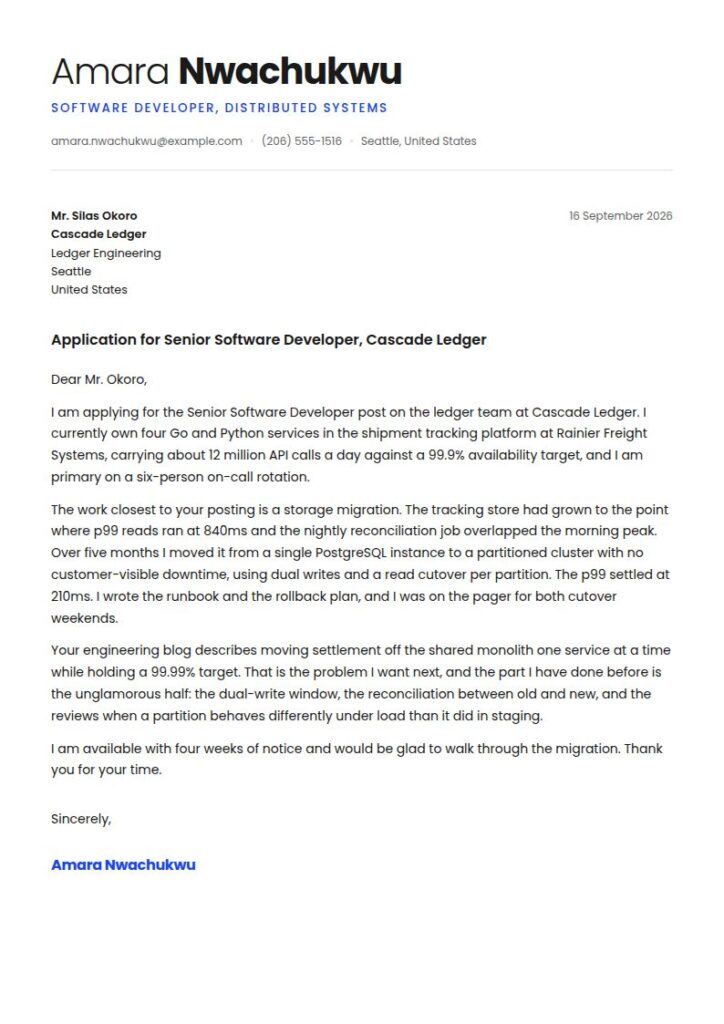
I am applying for the Senior Software Developer post on the ledger team at Cascade Ledger. I currently own four Go and Python services in the shipment tracking platform at Rainier Freight Systems, carrying about 12 million API calls a day against a 99.9% availability target, and I am primary on a six-person on-call rotation.
The work closest to your posting is a storage migration. The tracking store had grown to the point where p99 reads ran at 840ms and the nightly reconciliation job overlapped the morning peak. Over five months I moved it from a single PostgreSQL instance to a partitioned cluster with no customer-visible downtime, using dual writes and a read cutover per partition. The p99 settled at 210ms. I wrote the runbook and the rollback plan, and I was on the pager for both cutover weekends.
Your engineering blog describes moving settlement off the shared monolith one service at a time while holding a 99.99% target. That is the problem I want next, and the part I have done before is the unglamorous half: the dual-write window, the reconciliation between old and new, and the reviews when a partition behaves differently under load than it did in staging.
I am available with four weeks of notice and would be glad to walk through the migration. Thank you for your time.
Sincerely, Amara Nwachukwu
Openings that work
| Instead of | Use |
|---|---|
| I am a passionate software developer with 5 years of experience | I own four services carrying about 12 million API calls a day on a 99.9% availability target |
| I am writing to express my interest in your Software Developer role | I am applying for the Senior Software Developer post on the ledger team |
| I have a proven track record of delivering scalable solutions | I moved the tracking store to a partitioned cluster with no customer-visible downtime |
| I thrive in fast-paced, collaborative environments | I am primary on a six-person rotation and wrote nine of last year's incident reviews |
The ownership sentence, and how to build one
Four facts make the sentence the letter hangs on: what the system does, what it carries, what standard you had to meet, and whether you carried the pager.
Then write it once, plainly, in the first paragraph. The hard part is usually the second fact, because most people have never had to name the unit that measured their system. In practice, pick the one your team watched on a dashboard: requests a day, transactions a day, records processed, events consumed, gigabytes stored.
However, the third fact is the one almost nobody includes. After all, an availability target is a commitment somebody made, and naming it tells the reader what engineering culture you came from. Cloud providers publish theirs as a reference scale: the AWS Compute Service Level Agreement commits to a Monthly Uptime Percentage of at least 99.99% at the Region level and 99.5% for a single instance (Amazon Web Services, Compute SLA, last updated 25 May 2022). If your team held 99.9%, say 99.9%.
If you have not owned a whole system, however, shrink the claim rather than inflate it. "I own the retry and dead letter path of a notification service delivering about 400,000 messages a day" is a real ownership sentence.
What counts as evidence of scale
| Kind of evidence | What it looks like in a sentence |
|---|---|
| Throughput | About 12 million API calls a day across 4 services |
| Data | 90 days of traffic history reprocessed nightly |
| Availability | Held to 99.9%, with an error budget reviewed monthly |
| Pager | Primary on a six-person rotation, responder of record on 14 incidents |
| Delivery | Change lead time from 9 days to under 4 hours |
| Migration | 38 services moved off a monolith over 14 months |
Four delivery numbers the reader already knows how to read
DORA, the research program run by Google Cloud, publishes definitions for the metrics most engineering organizations now use: change lead time is the time from a change being committed to version control to being deployed in production, deployment frequency is the number of deployments over a period, change fail rate is the share of deployments requiring immediate intervention, and failed deployment recovery time is how long recovery from one takes (DORA, four keys guide, last updated 5 January 2026).
They are unusually good numbers for a cover letter: the reader does not need them explained and knows how hard they are to move.
The market rewards that specificity. Software developers had a median of $135,980 in May 2025 and the occupation group is projected to grow 10% through 2035 (BLS Occupational Outlook Handbook, May 2025 wages and 2025-35 projections). At that volume of applicants, the letters that get read carry facts a reader can size.
Product companies, consultancies and regulated employers
For a product company, lead with one system you held for years and what it looks like now. For a consultancy, lead with range: how many client systems, how many stacks, how fast you became useful on an unfamiliar codebase. For a bank, insurer or government contractor, lead with what they worry about: audit trails, reconciliation, change control, incident review, and the availability target you were held to. Name one real thing from their engineering blog.
Do not open with your years of experience. Do not write "scalable" or "robust" where a number belongs. Do not claim a system a reference would attribute to someone else. Do not list every technology you have touched; the letter is one story, not an inventory.
Length, format and sending it
Overall, one page, four paragraphs, 250 to 400 words. PDF unless the portal says otherwise, named for yourself and the role.
Address a person. Also, engineering leadership is usually public on a company's site or engineering blog, and "Dear Hiring Manager" reads as one of forty.
Keep the numbers identical to the resume. If the letter says 12 million calls a day and the resume says 8 million, the reader stops reading for content and starts reading for errors. Our software developer resume example is built on the figures used here.
Key takeaways
- First, open with the system, not with yourself.
- Give four facts: what it does, what it carries, what standard you had to meet, whether you carried the pager.
- Spend the second paragraph on one change, with a before, an after and a duration.
- Name one real thing from their engineering blog.
- Shrink the claim rather than inflate it.
- In addition, keep every number identical to the resume.
- Finally, address a person and keep it to one page.
Write your software developer cover letter in 10 minutes with our AI cover letter builder.
Software developer cover letter questions, answered
How long should a software developer cover letter be?
One page, four paragraphs, 250 to 400 words. Its job is to make the reader open the resume with one specific system in mind.
Do cover letters still matter for software roles?
They matter unevenly, which is a reason to send one. Many teams skim them, some read closely, a few use them as a first writing sample. A good one takes twenty minutes once the ownership sentence is written.
What do I write with no professional experience yet?
Write about the largest thing you have been responsible for, at whatever scale: an internship service, a capstone with real users, a maintained package, a tool a student organization depended on. Same four facts. A small system described precisely reads as someone who understands ownership.
How do I handle a company that will not let me share numbers?
Use orders of magnitude and relative change. "Roughly ten million calls a day" and "cut p99 latency by about 75%" disclose nothing and carry nearly all the signal. "High-volume" signals that you never knew the number.
Should I mention on-call and incidents in a cover letter?
Yes. It is the fastest way to establish that you were accountable rather than adjacent. Give the rotation size, whether you were primary, and one incident you could talk through.