Nadia Belhaj SOC Analyst, Tier 2 Arlington, 22203, United States [email protected] · (703) 555-1552
16 September 2026
Mr. Emeka Nwosu Security Operations Manager Tidewater Grid Cooperative Richmond, United States
Application for Tier 2 SOC Analyst, Tidewater Grid Cooperative
Dear Mr. Nwosu,
I am applying for the Tier 2 SOC Analyst post at Tidewater Grid Cooperative. I have seven years in security operations, the last four on Tier 2 investigations and detection tuning in Microsoft Sentinel with Defender for Endpoint telemetry, and I have worked a rotating night roster for three of them. I hold GCIH and CompTIA Security+.
The work I would most want to bring with me is tuning. When I moved to Tier 2 I inherited a rule family generating about 310 alerts a week that had not produced a confirmed true positive in 90 days, and the shift had quietly learned to close it without reading it, which is the real risk in a noisy queue. I backtested the logic against 12 months of data, ran a 30 day shadow period, documented the coverage the retirement gave up, and took it out. The identity detections I wrote to replace part of that coverage caught a session-token reuse case three weeks later. In total I have written 46 detections in KQL and Sigma mapped to 31 ATT&CK techniques.
Your posting mentions consolidating operational technology monitoring into the same queue as enterprise alerting, which is the part of the role I would most want to work on. I have not run an OT environment, but I did the equivalent on the cloud side, bringing 40 subscriptions into a queue built for endpoints, and the hard part was the same: deciding what deserves an alert before the volume decides for you.
I am available on a rotating roster including nights and weekends, and can start on four weeks of notice. Thank you for your time.
Sincerely, Nadia Belhaj
Summary
A SOC analyst cover letter tells a security operations manager which tier you can work, which shift you can cover, which SIEM and EDR you already know, and what you did on one incident. This guide gives you a full adaptable letter, a method for describing an investigation without disclosing anything, and where certifications and clearance belong in the text.
SOC Analyst cover letter examples by experience level
A SOC analyst cover letter is a one-page letter telling a security operations manager which seat on their roster you can fill and what you would be doing in it on day one.
SOC hiring is roster hiring. The manager reading your letter has a coverage gap with a shape: a Tier 2 seat, a night rotation, a Sentinel migration nobody has time to tune. A letter that names the gap and answers it is unusual, because most letters in the folder describe an interest in cybersecurity.
Guide to a SOC analyst cover letter
This guide and the corresponding SOC analyst cover letter example cover:
- How to structure the letter, paragraph by paragraph
- Why tier, shift and stack belong in the first three sentences
- How to describe an investigation without disclosing anything
- Where certifications and clearance go, and how much space they get
How to write a SOC analyst cover letter
| Paragraph | Its job | Length |
|---|---|---|
| Opening | The role, your tier, your stack, and the shift you can work | 2 to 3 sentences |
| Evidence | One investigation: what you saw, what you decided, how long it took | 4 to 6 sentences |
| Fit | Something real about their environment | 3 to 4 sentences |
| Close | Certifications, clearance, availability | 2 sentences |
Name the tier and the shift in the first three sentences
A SOC manager is not reading for enthusiasm. They are reading to find out whether you close a hole in a schedule.
So the first paragraph does three things: it names your tier, the SIEM and EDR you know, and the shift you can cover. "I currently work Tier 2 in Microsoft Sentinel with Defender for Endpoint, and I have worked a rotating night roster for three of my seven years" answers more of their questions than a page of background.
If the posting names a stack you do not know, say what you do know and how close it is. An analyst fluent in SPL who has never touched KQL is a two-week problem, not a refusal.
A SOC analyst cover letter example you can adapt
Dear Mr. Nwosu,
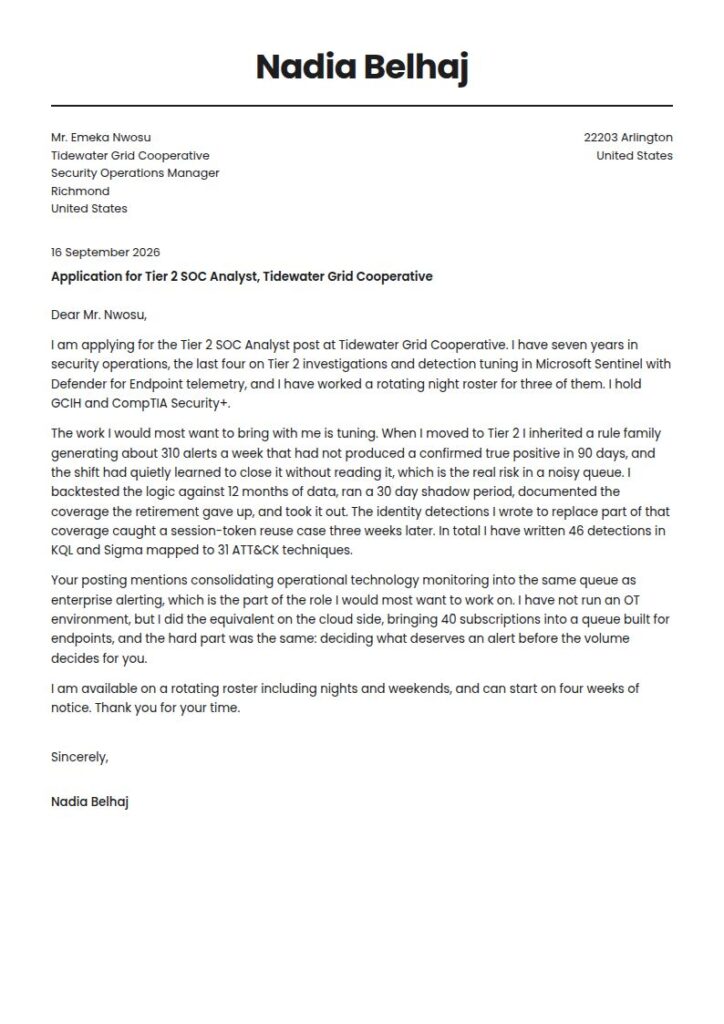
I am applying for the Tier 2 SOC Analyst post at Tidewater Grid Cooperative. I have seven years in security operations, the last four on Tier 2 investigations and detection tuning in Microsoft Sentinel with Defender for Endpoint telemetry, and I have worked a rotating night roster for three of them. I hold GCIH and CompTIA Security+.
The work I would most want to bring with me is tuning. When I moved to Tier 2 I inherited a rule family generating about 310 alerts a week that had not produced a confirmed true positive in 90 days, and the shift had quietly learned to close it without reading it, which is the real risk in a noisy queue. I backtested the logic against 12 months of data, ran a 30 day shadow period, documented the coverage the retirement gave up, and took it out. The identity detections I wrote to replace part of that coverage caught a session-token reuse case three weeks later. In total I have written 46 detections in KQL and Sigma mapped to 31 ATT&CK techniques.
Your posting mentions consolidating operational technology monitoring into the same queue as enterprise alerting, which is the part of the role I would most want to work on. I have not run an OT environment, but I did the equivalent on the cloud side, bringing 40 subscriptions into a queue built for endpoints, and the hard part was the same: deciding what deserves an alert before the volume decides for you.
I am available on a rotating roster including nights and weekends, and can start on four weeks of notice. Thank you for your time.
Sincerely, Nadia Belhaj
Openings that work
| Instead of | Use |
|---|---|
| I am writing to express my interest in the SOC Analyst position | I am applying for the Tier 2 SOC Analyst post at Tidewater Grid Cooperative |
| I am passionate about cybersecurity and protecting organizations | I have seven years in security operations, the last four working Tier 2 investigations and detection tuning |
Every line in the right column answers a question on a staffing spreadsheet.
One incident, written without disclosing anything
The best paragraph in a SOC cover letter is one investigation told properly, and the obstacle is that most of what made it interesting cannot be written down. Remove the identifiers and keep the reasoning, because the reasoning is what is being assessed.
| Keep | Remove |
|---|---|
| What the alert was, in generic terms: anomalous session, suspicious scheduled task | The detection name, rule ID and case number |
| What you checked and in what order | Hostnames, usernames, IP addresses and domains |
| The decision you made and who you told | Client or business unit names, ticket identifiers and dates |
| What changed afterwards: a rule, a playbook, a control | Anything about a classified system beyond what its guidance permits |
A paragraph built from the left column tells a manager how you think under time pressure and gives away nothing. One built from the right column tells them something else entirely.
What the current threat data says your letter should be about
The Verizon 2026 Data Breach Investigations Report, published on 19 May 2026, found exploitation of software vulnerabilities to be the leading breach entry point at 31%, overtaking stolen credentials for the first time in the report's nineteen years, with third parties involved in 48% of breaches (Verizon DBIR, May 2026).
The Bureau of Labor Statistics projects information security analyst employment to grow 21% from 2025 to 2035, adding 40,600 jobs, with about 14,100 openings a year (BLS, 2025-35 projections).
Growth of that size means the manager is comparing many similar candidates, so specificity is the whole advantage. An incident story about exploitation, third-party access or identity abuse reads as current; one whose only example is a phishing email reads as Tier 1 whatever your tier.
Certifications, clearance and the shift you can cover
List the certifications you hold, names only, in the first or last paragraph. State the shift patterns you can work, because coverage is the manager's live problem. Say your clearance level and status if you hold one. Name the SIEM and EDR you know, and be honest about the ones you do not.
Do not list a certification you are studying for as though you hold it. Do not mention clearances if you do not hold one. Do not restate your resume in paragraph form. Do not name a client, case number, hostname or indicator anywhere. Do not open with a sentence about your interest in cybersecurity; every letter in the folder has one.
For federal and defense contract postings the qualification bar is written into the contract, not the job description. DoD Manual 8140.03 was issued on 15 February 2023 and canceled the older DoD 8570.01-M from 2005; it requires foundational qualification through education, training, or a certification accredited to ISO/IEC 17024 (DoD CIO, DoDM 8140.03). If a posting names a work role and a level, put your matching credential in the first paragraph.
Length, format and sending it
One page, four paragraphs, 250 to 400 words. PDF unless the portal says otherwise, named for yourself and the post: nadia-belhaj-soc-analyst-cover-letter.pdf.
Address a person. SOC managers are usually findable from the posting or a team page, and "Dear Hiring Manager" undoes an otherwise specific letter.
Keep the numbers identical to your resume; two documents disagreeing about your alert volume reads badly in an occupation built on accuracy. Our SOC analyst resume example uses the figures in this letter, and you can write the letter in about ten minutes.
Key takeaways
- Name the tier you work, the stack you know and the shift you can cover in the first paragraph.
- Tell one investigation: what you saw, what you decided, how long it took, what changed after.
- Strip every identifier and keep the reasoning.
- Put certifications in as a plain list, and clearance only if you hold one.
- Pick a current incident type rather than a phishing story, unless phishing is the role.
- Say one true thing about their environment, taken from their own posting.
- One page, four paragraphs, numbers matching your resume.
SOC analyst cover letter questions, answered
Do SOC analyst jobs still ask for cover letters?
Managed service providers hiring Tier 1 in volume usually do not read them. Internal SOCs, federal contractors and smaller teams often do. Judge by whether a person is named in the posting.
What do I write with no SOC experience?
Write the adjacent work as security work: a help desk role covering account lockouts, phishing reports and endpoint reimaging is relevant, and BLS records related work experience as typical for this occupation (BLS, 2025-35 projections). Then describe a home lab the way you would describe a job: the SIEM you deployed, the log sources, a detection you wrote and what it caught.
Should I put my certifications in the cover letter or leave them to the resume?
Both, but in the letter they are one clause. "I hold GCIH and CompTIA Security+" is enough. The exception is a posting naming a required certification or qualification level, which belongs in your first paragraph.
How do I describe an incident I am not allowed to discuss?
Keep the reasoning and remove the identifiers: what the alert was in generic terms, what you checked and in what order, the decision you made, how long it took, and what changed afterwards. That discloses nothing and beats a redacted narrative full of gaps.
Should I mention that I am willing to work nights?
Yes, if it is true, and put it in the first paragraph. Night and weekend coverage is the hardest part of running a 24x7 roster and is often the reason the post exists. A candidate who volunteers it answers a question the manager was going to have to ask carefully.