Nandita Venkataraman Digital Design Engineer, RTL and Verification San Jose, 95128, United States [email protected] · (408) 555-1822
11 September 2026
Ms. Adaeze Okonjo Hardware Engineering Redwood Fabric Systems Santa Clara, United States
Application for Digital Design Engineer, Redwood Fabric Systems
Dear Ms. Okonjo,
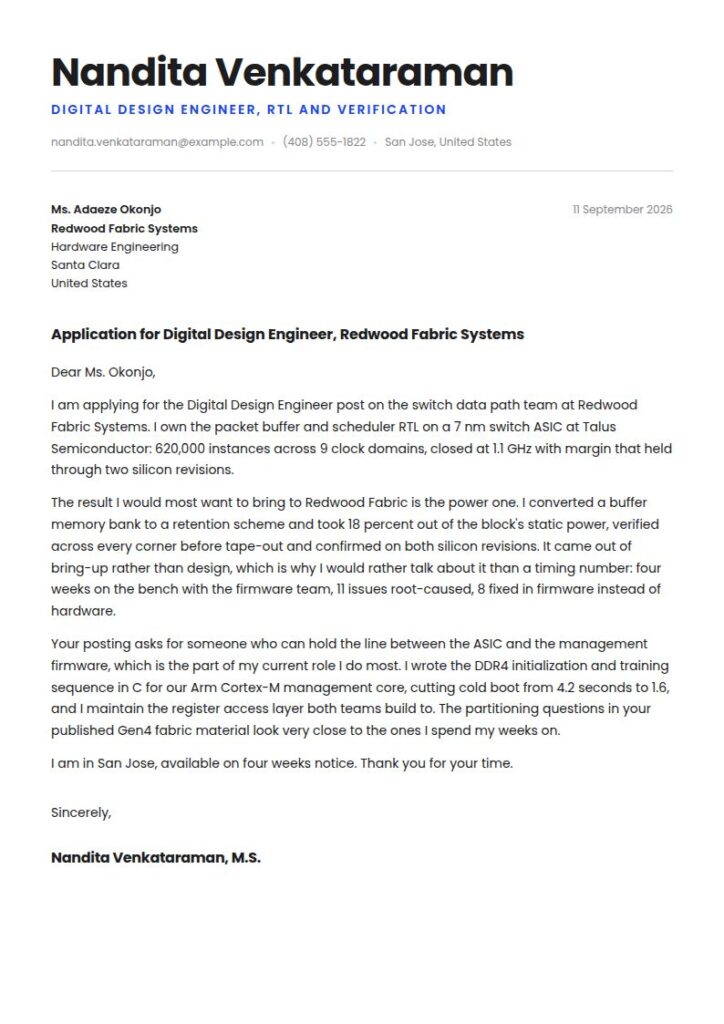
I am applying for the Digital Design Engineer post on the switch data path team at Redwood Fabric Systems. I own the packet buffer and scheduler RTL on a 7 nm switch ASIC at Talus Semiconductor: 620,000 instances across 9 clock domains, closed at 1.1 GHz with margin that held through two silicon revisions.
The result I would most want to bring to Redwood Fabric is the power one. I converted a buffer memory bank to a retention scheme and took 18 percent out of the block's static power, verified across every corner before tape-out and confirmed on both silicon revisions. It came out of bring-up rather than design, which is why I would rather talk about it than a timing number: four weeks on the bench with the firmware team, 11 issues root-caused, 8 fixed in firmware instead of hardware.
Your posting asks for someone who can hold the line between the ASIC and the management firmware, which is the part of my current role I do most. I wrote the DDR4 initialization and training sequence in C for our Arm Cortex-M management core, cutting cold boot from 4.2 seconds to 1.6, and I maintain the register access layer both teams build to. The partitioning questions in your published Gen4 fabric material look very close to the ones I spend my weeks on.
I am in San Jose, available on four weeks notice. Thank you for your time.
Sincerely, Nandita Venkataraman, M.S.
Summary
A computer engineering cover letter names the lane you work in, the part or board you worked on, and one measured result from it. This guide gives you a full adaptable letter, what changes when you are crossing the hardware and software boundary, and the openings that get an engineering file read rather than filed.
Computer Engineering cover letter examples by experience level
A computer engineering cover letter is a one-page letter that tells a hiring manager which lane you work in, which part or board you worked on, and what number moved because you were on it.
The reader is almost always a working engineer, not a recruiter, and is checking one thing: whether you have done this specific work, or are a good general engineer hoping to be taught. Both get hired, for different requisitions, and the letter decides which.
Guide to a computer engineering cover letter
This guide and the corresponding computer engineering cover letter example will cover:
- How to structure the letter, paragraph by paragraph
- Why your lane and the part belong in the first two sentences
- What counts as evidence when the work is under NDA
- How to write it when you are crossing the hardware and software boundary
- The openings that get an engineering file read rather than filed
How to write a computer engineering cover letter
| Paragraph | Its job | Length |
|---|---|---|
| Opening | The requisition, your lane, the part you last worked on | 2 to 3 sentences |
| Evidence | One block or board, what you owned, one number, one period | 4 to 5 sentences |
| Fit | Something specific about their product, and the gap you fill | 3 to 4 sentences |
| Close | Availability, clearance or relocation, thank you | 2 sentences |
Name the part in the first two sentences
An engineering manager has an open seat with a shape: an RTL seat on a data path block, a firmware seat on a management core, a board seat on the next platform revision. Give them the sentence that says whether you fit it, immediately. "I am applying for the Digital Design Engineer post on your switch data path team. I currently own the packet buffer and scheduler RTL on a 7 nm switch ASIC, 620,000 instances closed at 1.1 GHz." Two sentences, and the reader knows the answer.
Then, if it is true, add the rare line: "I also wrote the DDR4 initialization sequence in C for the management core on that part." Engineers who work both sides are scarce and nobody expects it in a letter, which is why it lands.
A computer engineering cover letter example you can adapt
Dear Ms. Okonjo,
I am applying for the Digital Design Engineer post on the switch data path team at Redwood Fabric Systems. I own the packet buffer and scheduler RTL on a 7 nm switch ASIC at Talus Semiconductor: 620,000 instances across 9 clock domains, closed at 1.1 GHz with margin that held through two silicon revisions.
The result I would most want to bring to Redwood Fabric is the power one. I converted a buffer memory bank to a retention scheme and took 18 percent out of the block's static power, verified across every corner before tape-out and confirmed on both silicon revisions. It came out of bring-up rather than design, which is why I would rather talk about it than a timing number: four weeks on the bench with the firmware team, 11 issues root-caused, 8 fixed in firmware instead of hardware.
Your posting asks for someone who can hold the line between the ASIC and the management firmware, which is the part of my current role I do most. I wrote the DDR4 initialization and training sequence in C for our Arm Cortex-M management core, cutting cold boot from 4.2 seconds to 1.6, and I maintain the register access layer both teams build to. The partitioning questions in your published Gen4 fabric material look very close to the ones I spend my weeks on.
I am in San Jose, available on four weeks notice. Thank you for your time.
Sincerely, Nandita Venkataraman, M.S.
Openings that work
| Instead of | Use |
|---|---|
| I am passionate about hardware and software and love solving problems | I own the packet buffer and scheduler RTL on a 7 nm switch ASIC, 620,000 instances at 1.1 GHz |
| I am writing to express my interest in the engineering position | I am applying for the Digital Design Engineer post on your switch data path team |
| I have extensive experience across the full development lifecycle | I have taken three parts to tape-out with no functional respin, most recently on 5 nm |
| I would be a valuable addition to your engineering team | The partitioning questions in your Gen4 fabric material are the ones I spend my weeks on |
The pattern is the same: replace an adjective about yourself with a noun about something you worked on.
What counts as evidence when the work was confidential
Most of this field is under NDA, which is why so many of these letters retreat into generality. They need not.
| What you cannot say | What you can say instead |
|---|---|
| The customer and the product name | The class of part, node and market: a 7 nm switch ASIC for data center networking |
| The exact die area or gate count | An instance count, a clock frequency, a number of clock domains |
| Unreleased architecture detail | The interface standards, which are public: DDR4, PCIe Gen4, AXI |
| Internal yield or defect figures | A relative change: static power down 18 percent, board revisions 4 to 2 |
Every row on the right is specific enough to prove the work and general enough to survive legal review. The test: could a competitor learn anything from this sentence that is not already in the datasheet? If not, write it.
Crossing the hardware and software boundary
Say which lane you are in now and which the job is in, in the first paragraph, if they differ. Give the evidence you already have for the destination: the driver you wrote for your own silicon, the bring-up you joined, the register map you reviewed, the course sequence with the tool named. Say what you would still need to learn.
Do not claim both lanes equally; a reader who does one for a living will test it in the first ten minutes. Do not describe a course as experience. Do not narrate the move as a personal journey. Do not send the same letter to an RTL seat and a firmware seat with the nouns swapped, because the evidence that supports one does not support the other.
Two markets, one degree, and a 25 to 1 difference in size
Computer hardware engineers held 76,100 jobs in 2025 at a median annual wage of $161,740, with about 4,100 openings projected each year through 2035. Software developers, quality assurance analysts and testers held 1,905,400 jobs at a combined median of $134,040 with about 106,100 annual openings (BLS Occupational Outlook Handbook, May 2025 wages and 2025 to 2035 projections, published 27 August 2026).
That is one hardware seat for roughly every 25 on the software side, at a median about $27,700 higher. So hardware postings are scarce and specific: a hardware engineer is nearly always writing about a particular block on a particular kind of part, because that is how the requisitions are written.
Length, format and what belongs in the close
One page, four paragraphs, 250 to 400 words, PDF unless the portal says otherwise, named for yourself and the post: nandita-venkataraman-digital-design-engineer-cover-letter.pdf. Put in the close anything that changes whether you can start: location, notice, relocation, and a clearance if the posting asks. Hardware work clusters in a few regions, so the geography sentence earns its place.
Address a person. "Dear Hiring Manager" on a letter that is otherwise this specific is the one generic note in it. Use the same figures as your resume so the two agree; our computer engineering resume example is written with the numbers used here.
Key takeaways
- Name your lane and the part you worked on in the first two sentences.
- Pick one block or board and one number with a period attached.
- Say the boundary-crossing line if it is true; nobody expects it.
- Work inside the NDA using class, node, interface and relative change.
- If you are moving lanes, name the evidence for the destination.
- Put location and notice in the close, since hardware work is regional.
- One page, four paragraphs, addressed to a person.
Write your computer engineering cover letter in 10 minutes with our AI cover letter builder.
Computer engineering cover letter questions, answered
How long should a computer engineering cover letter be?
One page, four paragraphs, 250 to 400 words. The reader is an engineer with a full week and an open requisition, and length is not read as effort here.
Do I even need a cover letter for an engineering role?
Attach one wherever there is a field for it. The form collects the same structured data from everyone; the letter is the only place you can say which lane you are in, which the form does not ask and the manager most wants answered.
How do I write about work that is under NDA?
Describe the class of part, the node, the public interface standards, the durations and the relative changes. Leave out the customer, the product name, absolute yield or defect figures and unreleased architecture detail. That still leaves plenty: a 7 nm switch ASIC, 620,000 instances, 1.1 GHz, static power down 18 percent.
Should I mention the FE exam or a PE license?
The FE is worth one clause if you have passed it. The Bureau of Labor Statistics Occupational Outlook Handbook states that computer hardware engineers do not need a license, so a PE is not expected, though NCEES offers a Computer Engineering depth on the PE Electrical and Computer exam once a year (NCEES, retrieved 17 September 2026). Never imply a license you do not hold.
What do I write with no industry experience yet?
Write one course or personal project the way this letter writes a work block: the part, the tool, the artifact and the measurement. A verified SPI controller on a named FPGA with a coverage number against a written test plan says more than six projects listed.