Caleb Nwachukwu DevOps Engineer, Delivery and Release Engineering Denver, 80211, United States [email protected] · (303) 555-1626
11 September 2026
Mr. Dmitri Volkov Platform Engineering Lindstrom Freight Denver, United States
Application for DevOps Engineer, Lindstrom Freight
Dear Mr. Volkov,
I am applying for the DevOps Engineer post at Lindstrom Freight. I own the release path for 14 services on a regulated claims platform at Arrowpoint Insurance, where the team now deploys 14 times a week against one release a fortnight when I arrived. Your posting describes a weekly release train you want to break up, which is the problem I spent the last two years on.
Two numbers describe most of that work. Median change lead time from commit to production went from 11 days to 6 hours on rolling 90 day windows, almost entirely from rebuilding the build with parallel stages, dependency caching and ephemeral preview environments. Change fail rate went the other way that people usually expect it to go when deployments speed up: it fell from 24% to 9%, because the same change let us ship smaller and roll back automatically on error budget burn. Failed deployment recovery time fell with it, from a median of 3 hours 40 minutes to 22 minutes. We were not collecting deployment rework rate at all when I started, so I added the pipeline hooks, and the first full quarter read 17% against 6% now.
The part I would want to bring to a freight platform is the on-call work rather than the pipeline work. An alert audit retired 41 alerts that had no defined action, and pages per engineer per week fell from 9 to 2 with no increase in incidents anyone missed. Replacing ticket-driven deployment approval with a policy check in the pipeline removed about 240 engineer-hours a quarter of manual release steps. I noticed your engineering posts mention a nightly batch window that constrains deploys, which is the kind of constraint that decides what progressive delivery can and cannot look like.
I would want to see your current metric definitions first, because most of the disagreement in this work is about what counts as a failure. I am in Denver and available on four weeks' notice. Thank you for your time.
Sincerely, Caleb Nwachukwu
Summary
A DevOps engineer cover letter names two or three delivery metrics with the value before you and the value after you, the change that moved each one, and what happened to the on-call rota. This guide gives you a full adaptable letter, the five metrics DORA actually publishes, and the openings that get a strong file read to the end.
DevOps Engineer cover letter examples by experience level
A DevOps engineer cover letter is a one-page letter that says what a team's delivery numbers were when you arrived and what they were when you left.
That is a narrow claim, and narrow is the point. Most letters for this work are a list of platforms with an adjective in front of each. Two before-and-after numbers, each with a measurement window, answer the only question the hiring manager has: will this person make our releases better, and how would we know?
Guide to a DevOps engineer cover letter
This guide and the corresponding DevOps engineer cover letter example will cover:
- How to structure the letter, paragraph by paragraph
- Why two delivery metrics beat a list of eleven tools
- The five metrics DORA publishes, and why postings still say four
- What to write about on-call and toil
- The openings that get a strong file read to the end
How to write a DevOps engineer cover letter
| Paragraph | Its job | Length |
|---|---|---|
| Opening | The post, what you own, and one delivery number | 2 to 3 sentences |
| Evidence | Two metrics with a before, an after, a window and the change | 4 to 6 sentences |
| Fit | On-call and toil, plus one real thing about them | 3 to 4 sentences |
| Close | What you would want to see first, availability, thanks | 2 sentences |
Name all five metrics, then use two of them
DORA's guide page, last updated on 5 January 2026, lists five delivery metrics: change lead time, deployment frequency, failed deployment recovery time, change fail rate and deployment rework rate, grouping the first three as throughput and the last two as instability.
Postings still ask for four because the set moved. DORA's history page records that mean time to recover was renamed and redefined as failed deployment recovery time in the Accelerate State of DevOps 2023 report, and that deployment rework rate was added as the fifth metric in the 2024 report.
You do not need all five in a letter. You need to know there are five, use the two you have real numbers for, and be ready for a question about the rest.
A DevOps engineer cover letter example you can adapt
Dear Mr. Volkov,
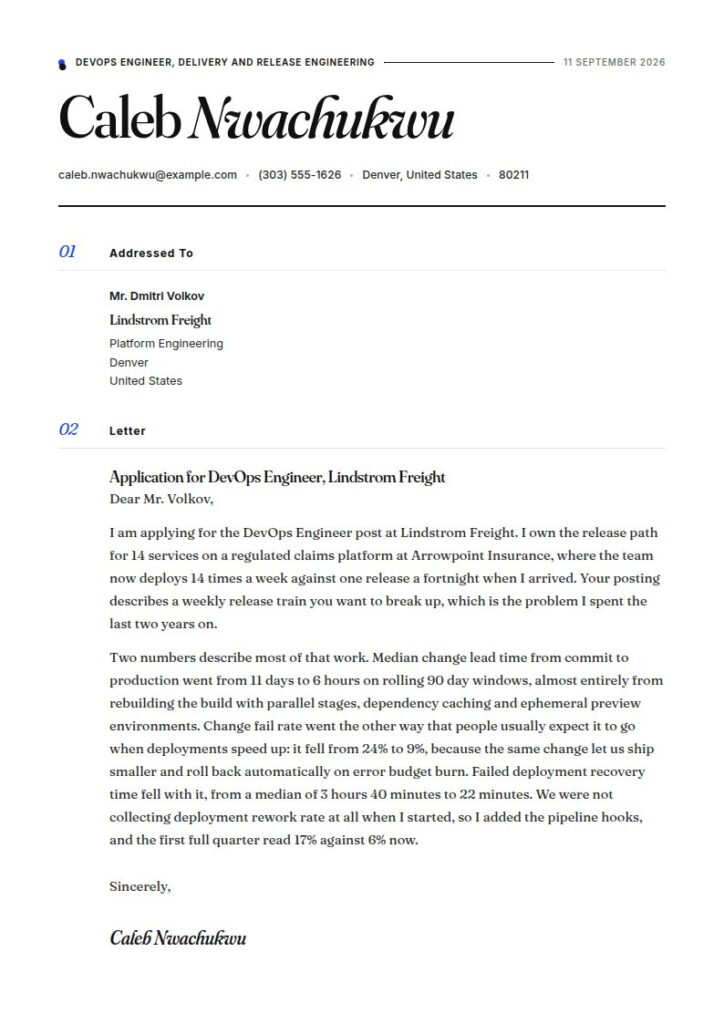
I am applying for the DevOps Engineer post at Lindstrom Freight. I own the release path for 14 services on a regulated claims platform at Arrowpoint Insurance, where the team now deploys 14 times a week against one release a fortnight when I arrived. Your posting describes a weekly release train you want to break up, which is the problem I spent the last two years on.
Two numbers describe most of that work. Median change lead time from commit to production went from 11 days to 6 hours on rolling 90 day windows, almost entirely from rebuilding the build with parallel stages, dependency caching and ephemeral preview environments. Change fail rate went the other way that people usually expect it to go when deployments speed up: it fell from 24% to 9%, because the same change let us ship smaller and roll back automatically on error budget burn. Failed deployment recovery time fell with it, from a median of 3 hours 40 minutes to 22 minutes. We were not collecting deployment rework rate at all when I started, so I added the pipeline hooks, and the first full quarter read 17% against 6% now.
The part I would want to bring to a freight platform is the on-call work rather than the pipeline work. An alert audit retired 41 alerts that had no defined action, and pages per engineer per week fell from 9 to 2 with no increase in incidents anyone missed. Replacing ticket-driven deployment approval with a policy check in the pipeline removed about 240 engineer-hours a quarter of manual release steps. I noticed your engineering posts mention a nightly batch window that constrains deploys, which is the kind of constraint that decides what progressive delivery can and cannot look like.
I would want to see your current metric definitions first, because most of the disagreement in this work is about what counts as a failure. I am in Denver and available on four weeks' notice. Thank you for your time.
Sincerely, Caleb Nwachukwu
Openings that work
| Instead of | Use |
|---|---|
| I am passionate about automation and continuous improvement | I own the release path for 14 services, deploying 14 times a week against one release a fortnight when I arrived |
| I am writing to express my interest in the DevOps Engineer position | I am applying for the DevOps Engineer post, and the weekly release train you want to break up is the problem I spent two years on |
| I have extensive experience with Kubernetes, Terraform and CI/CD | Median change lead time went from 11 days to 6 hours on rolling 90 day windows |
| I am a team player with strong problem-solving skills | An alert audit cut pages per engineer per week from 9 to 2, with no increase in missed incidents |
The on-call and toil paragraph
This is the paragraph that separates letters: almost nobody writes it and every engineering manager is thinking about it.
| What to give | What it looks like in a sentence |
|---|---|
| Rotation shape | Shared weekday and weekend rotation, one week in six |
| Page load | Pages per engineer per week from 9 to 2 over two years |
| After-hours load | After-hours pages from 3.1 a week to 0.4 |
| Alert quality | Retired 41 alerts with no defined action, no increase in missed incidents |
| Toil removed | About 240 engineer-hours a quarter, counted as retired checklist steps times their recorded duration |
Say how you counted the toil. An hours figure with a method behind it is evidence; the same figure without one is a guess with a decimal point.
One title, two published occupations
The Bureau of Labor Statistics publishes no Occupational Outlook Handbook profile under the title "DevOps engineer". The work is counted inside two published occupations moving in opposite directions: software developers, projected to grow 10% from 2025 to 2035 and adding 174,700 jobs, with a median annual wage of $135,980 in May 2025; and network and computer systems administrators, projected to decline 4% and lose 13,200 jobs, with a median annual wage of $99,130 in May 2025 (BLS Occupational Outlook Handbook, 2025-35 projections and May 2025 data).
Your letter decides which a reader has in mind. Maintaining pipelines and monitoring systems reads as administration; what you changed and what the numbers did reads as engineering, and both can be true of the same two years.
What to write with less experience
Use whatever you genuinely measured, even on one service. Give the build time you cut and the manual steps you removed, with the counting method. Name the on-call rotation you carried, however small. If your team measured nothing, say what you instrumented and what the first quarter read. Name one specific thing about the employer, from their own pages.
Do not write "the four DORA metrics"; the guide page has listed five since the 2024 report. Do not give a metric without a window. Do not present a number your team never collected. Do not claim you built a pipeline you inherited; say what you changed. Do not send a letter that is a list of tools with adjectives attached.
Length, format and sending it
One page, four paragraphs, 250 to 400 words. PDF unless the portal says otherwise, named for yourself and the post: caleb-nwachukwu-devops-engineer-cover-letter.pdf.
Address a person where one is findable; engineering leadership is usually public on a company's own site or engineering blog.
Use the same figures as your resume so the two agree. Our DevOps engineer resume example uses the numbers here, and the free ATS checker will tell you whether the pair parses cleanly.
Key takeaways
- Give two delivery metrics with a before, an after and a window.
- Name the one change that did most of the work on each.
- Know DORA publishes five metrics, not four, and be ready for the rest.
- Write the on-call paragraph: rotation shape, pages, after-hours pages.
- Put a number on toil removed, with your counting method.
- Name one real constraint of theirs, from their own pages.
- Say what you would want to see first; that reads as judgment, not eagerness.
Build your DevOps engineer resume in 15 minutes with our AI resume builder.
DevOps engineer cover letter questions, answered
How long should a DevOps engineer cover letter be?
One page, four paragraphs, 250 to 400 words. The letters read to the end are the ones with two real numbers in the second paragraph.
Should I list every tool I know in the letter?
No. The resume carries the inventory. A letter naming eleven platforms says nothing about which you changed, and it crowds out the before-and-after numbers that would.
What if my current team does not measure delivery metrics?
Say that, and say what you did about it. "We were not collecting deployment rework rate, so I added the pipeline hooks and the first full quarter read 17%" beats any estimate, and it describes exactly the work a hiring team wants done.
Is DevOps engineer a separate occupation in the official data?
No. The Bureau of Labor Statistics publishes no Handbook profile under the title. The work sits inside software developers, at a median of $135,980, and network and computer systems administrators, at $99,130, both May 2025 (BLS). Writing about change rather than upkeep puts a reader in the first frame.
How do I move into DevOps from a systems administration job?
Take the three things you automated, scripted or moved into version control, and write each with a before and an after: the manual runbook that became a pipeline step, the hand-built server that became a module, the ticket queue that became a self-service action. That is the evidence a platform team wants.