DevOps Engineer, Build and Release Caleb Nwachukwu
DevOps Engineer
[email protected] | (303) 555-1626 | Denver, United States
Profile
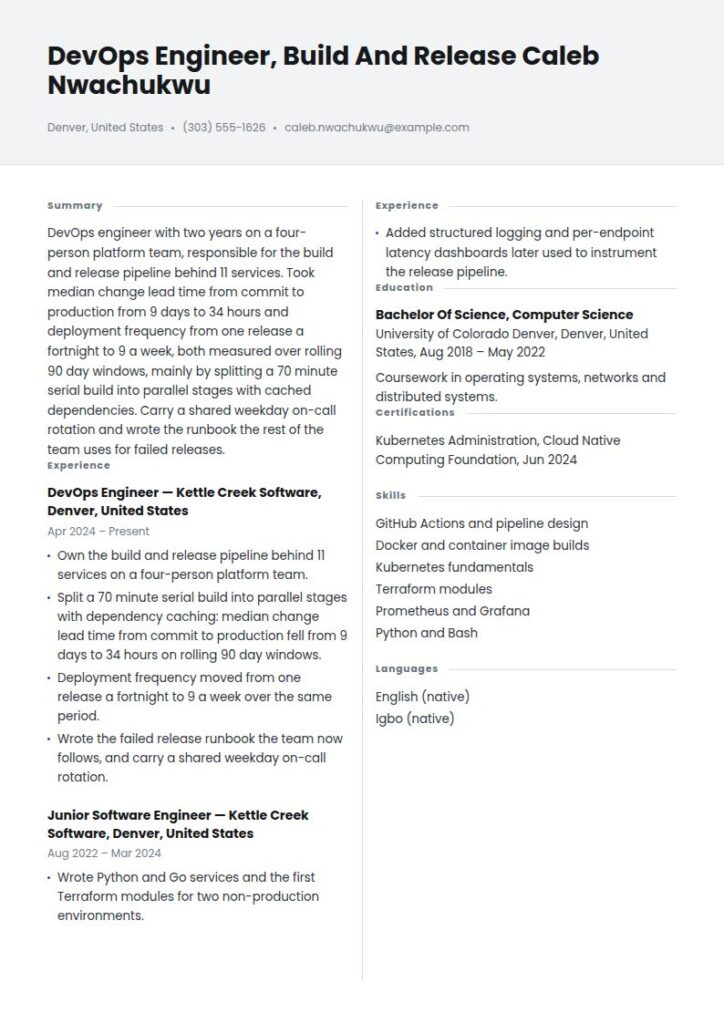
DevOps engineer with two years on a four-person platform team, responsible for the build and release pipeline behind 11 services. Took median change lead time from commit to production from 9 days to 34 hours and deployment frequency from one release a fortnight to 9 a week, both measured over rolling 90 day windows, mainly by splitting a 70 minute serial build into parallel stages with cached dependencies. Carry a shared weekday on-call rotation and wrote the runbook the rest of the team uses for failed releases.
Work Experience
04/2024 - Present, DevOps Engineer, Kettle Creek Software, Denver, United States
- Own the build and release pipeline behind 11 services on a four-person platform team.
- Split a 70 minute serial build into parallel stages with dependency caching: median change lead time from commit to production fell from 9 days to 34 hours on rolling 90 day windows.
- Deployment frequency moved from one release a fortnight to 9 a week over the same period.
- Wrote the failed release runbook the team now follows, and carry a shared weekday on-call rotation.
08/2022 - 03/2024, Junior Software Engineer, Kettle Creek Software, Denver, United States
- Wrote Python and Go services and the first Terraform modules for two non-production environments.
- Added structured logging and per-endpoint latency dashboards later used to instrument the release pipeline.
Education
08/2018 - 05/2022, Bachelor of Science, Computer Science, University of Colorado Denver, Denver, United States
Coursework in operating systems, networks and distributed systems.
Skills
GitHub Actions and pipeline design, 80
Docker and container image builds, 80
Kubernetes fundamentals, 70
Terraform modules, 70
Prometheus and Grafana, 70
Python and Bash, 80
Languages
English, native
Igbo, native
Certificates
06/2024, Kubernetes Administration, Cloud Native Computing Foundation
Earned while moving the build pipeline onto the shared cluster.
Summary
A DevOps engineer resume is a one to two page document that gives five delivery metrics, not four, each with the value when you arrived, the value when you left, and the window it was measured over. This guide gives you three adaptable versions, the on-call and toil lines most applicants leave out, and current Bureau of Labor Statistics pay for the two published occupations this title straddles.
DevOps Engineer resume examples by experience level
In short, a DevOps engineer resume is a one to two page document that shows what happened to a team's delivery numbers while you were there.
However, job postings for this work still ask for "the four DORA metrics". There are five. DORA, the research program run by Google Cloud, lists five on its guide page as last updated on 5 January 2026: change lead time, deployment frequency, failed deployment recovery time, change fail rate, and deployment rework rate. In fact, knowing that, and being able to name all five with a definition and a measurement window attached to each, is itself a filter. In other words, it separates candidates who have read a conference talk from candidates who have been measured against these numbers on a real team.
Resume guide for a DevOps engineer resume
Specifically, this guide and the corresponding DevOps engineer resume example will cover:
- How to write a DevOps engineer resume, section by section
- The five delivery metrics, and the before-and-after shape that makes them evidence
- Three adaptable summaries: first platform role, owning delivery, leading a platform team
- The on-call and toil lines almost nobody writes down
- What the job market looks like and what you can expect to earn
How to write a DevOps engineer resume
Overall, six sections: contact header, summary, a delivery metrics block, engineering experience, skills, and education with certifications. Generally, one page for your first three years, two once you have moved a team's numbers and can prove it.
The delivery metrics block sits directly under the summary because it is the only part of the page that says what changed. The rest of a DevOps resume, on the other hand, is a tooling inventory, and those are nearly identical between candidates.
| Section | What it is answering | Where it goes |
|---|---|---|
| Delivery metrics block | What were the numbers before you, and after? | Its own block, under the summary |
| Engineering experience | What did you build or change to move them? | Reverse chronological, with numbers |
| Skills | Which platforms, pipelines and languages, by name? | Grouped, named by product |
| Education and certifications | Does it clear the stated bar? | Bottom, unless you graduated this year |
Write the measurement window next to every metric
A delivery metric without a window is not a number, it is an impression. "Deployment frequency: daily" could mean one team deployed daily in its best week, or that forty teams averaged a deployment a day over a year.
Write the definition you used and the period it covers: "median change lead time from commit to production of 6 hours, measured over a rolling 90 days across 14 services". That sentence also tells the reader you had the instrumentation to know, which is a claim in itself.
If your team never measured one of the five, say so rather than estimating it. "We did not measure deployment rework rate; I put the pipeline hooks in to start collecting it" is a better answer in an interview than a number you cannot defend.
Run the finished file through the ATS resume checker before you send it, because the employers hiring for this work almost always parse the application before a person opens it.
Choosing the best resume format for a DevOps engineer resume
Reverse chronological, then, with the delivery metrics block between the summary and the first job. One page for your first three years, two after that.
The functional format, however, fails here in a specific way. This job is judged on change over time, and a format that groups skills instead of jobs removes the before and the after. A reader cannot tell whether you built a pipeline or arrived after someone else built it.
Include your contact information
| ✅ Right | ❌ Wrong |
|---|---|
| Caleb Nwachukwu | Caleb Nwachukwu |
| DevOps Engineer, Delivery Pipelines and Release Engineering | DevOps professional passionate about automation and innovation |
| Denver, CO, open to hybrid in Denver or remote | Denver, Colorado, USA |
| (303) 555-1626, [email protected] | (303) 555-1626, [email protected] |
Also, say which half of the work you do in the title line. "DevOps engineer" covers release engineering, platform and internal developer tooling, cloud infrastructure and cost, and production operations and on-call. Those are, in fact, four job descriptions with one name, and a manager filling one is scanning for it.
Make use of a summary
Four lines: what you own, how long, two or three delivery metrics with their before and after, and the on-call line.
DevOps engineer with two years on a four-person platform team, responsible for the build and release pipeline behind 11 services. Took median change lead time from commit to production from 9 days to 34 hours and deployment frequency from one release a fortnight to 9 a week, both measured over rolling 90 day windows, mainly by splitting a 70 minute serial build into parallel stages with cached dependencies. Carry a shared weekday on-call rotation and wrote the runbook the rest of the team uses for failed releases.
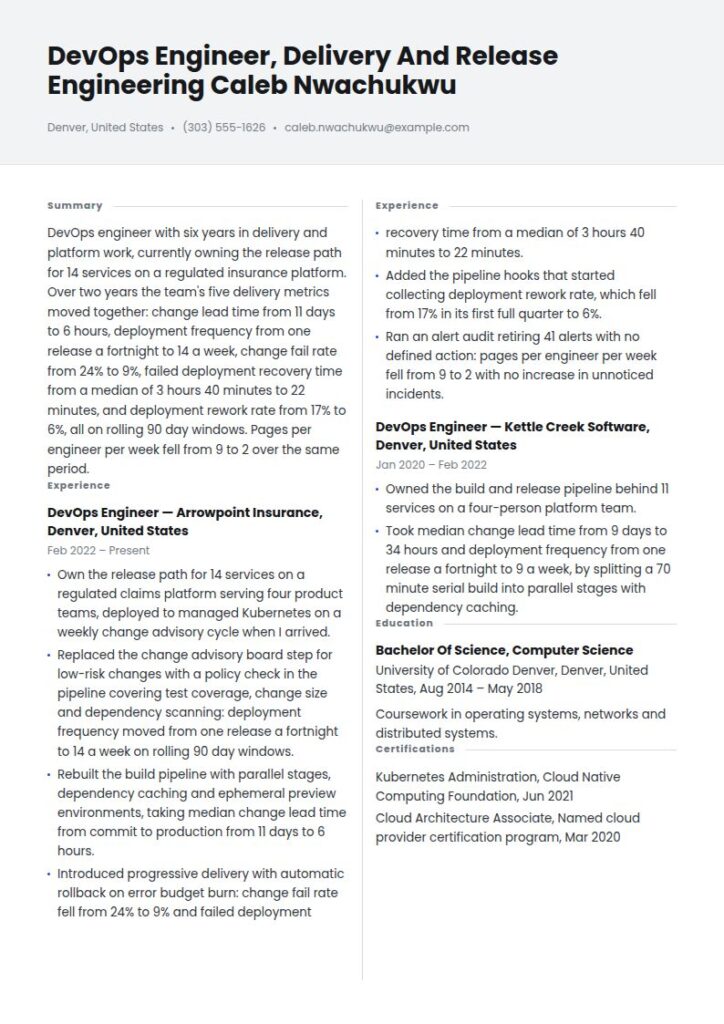
DevOps engineer with six years in delivery and platform work, currently owning the release path for 14 services on a regulated insurance platform. Over two years the team's five delivery metrics moved together: change lead time from 11 days to 6 hours, deployment frequency from one release a fortnight to 14 a week, change fail rate from 24% to 9%, failed deployment recovery time from a median of 3 hours 40 minutes to 22 minutes, and deployment rework rate from 17% to 6%, all on rolling 90 day windows. Pages per engineer per week fell from 9 to 2 over the same period.
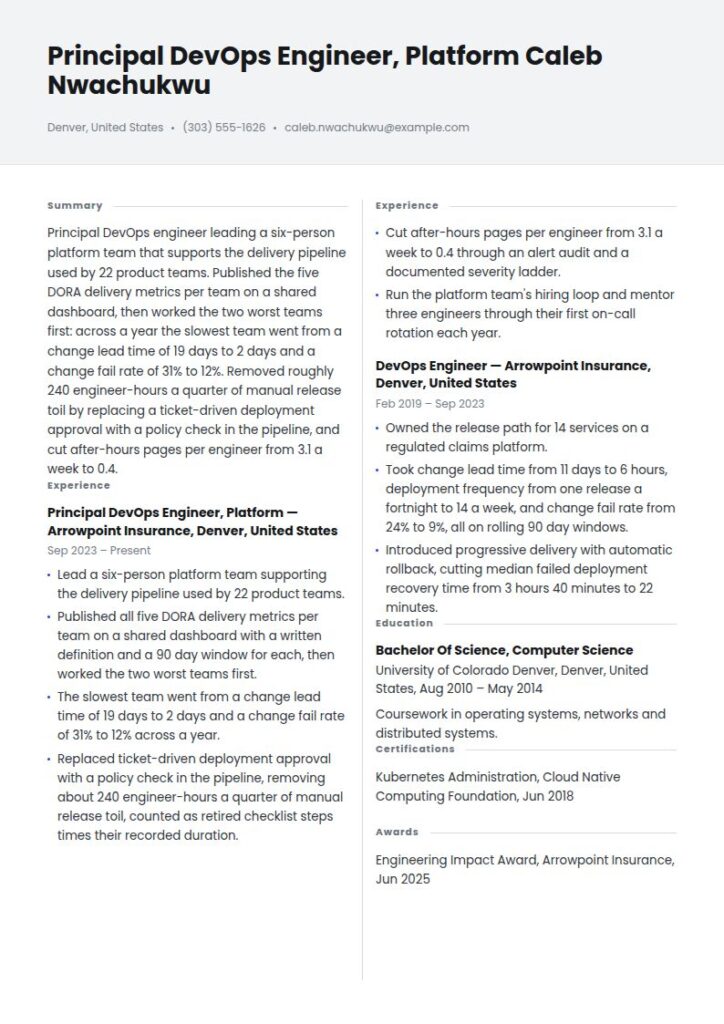
Principal DevOps engineer leading a six-person platform team that supports the delivery pipeline used by 22 product teams. Published the five DORA delivery metrics per team on a shared dashboard, then worked the two worst teams first: across a year the slowest team went from a change lead time of 19 days to 2 days and a change fail rate of 31% to 12%. Removed roughly 240 engineer-hours a quarter of manual release toil by replacing a ticket-driven deployment approval with a policy check in the pipeline, and cut after-hours pages per engineer from 3.1 a week to 0.4.
Right vs wrong: the same DevOps engineer summary, twice
| ✅ Right | ❌ Wrong |
|---|---|
| Change lead time from 11 days to 6 hours, on rolling 90 day windows. | Significantly improved deployment speed and efficiency. |
| Change fail rate from 24% to 9%; failed deployment recovery time from 3 hours 40 minutes to 22 minutes. | Reduced incidents and improved system reliability. |
| Pages per engineer per week from 9 to 2 across the same two years. | Participated in an on-call rotation supporting production systems. |
For example, the left column is a claim a reference check can confirm in one question. The right column is what every other file in the stack says, which means it adds nothing to the decision.
Outline your engineering experience
Employer, title, dates, and one line on the delivery setup: how many teams, how many services, which platform, and what the release process looked like when you arrived. Then three to five bullets, each naming a change you made and the metric it moved.
| Instead of | Use |
|---|---|
| Implemented CI/CD pipelines | Split a 70 minute serial build into parallel stages with dependency caching, taking median change lead time from 9 days to 34 hours |
| Automated deployment processes | Replaced a ticket-driven deployment approval with a policy check in the pipeline, removing about 240 engineer-hours a quarter of manual release work |
| Improved system reliability | Change fail rate fell from 24% to 9% after progressive delivery with automatic rollback on error budget burn |
| Managed infrastructure as code | Moved 14 services from hand-managed environments to Terraform modules with a shared release template, cutting environment drift incidents from 6 a quarter to 0 |
| Reduced on-call burden | Retired 41 alerts with no action attached; pages per engineer per week fell from 9 to 2 with no change in incident count |
DevOps Engineer, Arrowpoint Insurance, Denver, CO, February 2022 to Present
Own the release path for 14 services on a regulated claims platform serving four product teams, deployed to a managed Kubernetes platform on a weekly change advisory cycle when I arrived.
Replaced the change advisory board step for low-risk changes with a policy check in the pipeline covering test coverage, change size and dependency scanning. Deployment frequency moved from one release a fortnight to 14 a week, measured over rolling 90 days.
Rebuilt the build pipeline with parallel stages, dependency caching and ephemeral preview environments, taking median change lead time from commit to production from 11 days to 6 hours.
Introduced progressive delivery with automatic rollback on error budget burn: change fail rate fell from 24% to 9% and failed deployment recovery time from a median of 3 hours 40 minutes to 22 minutes.
Ran an alert audit that retired 41 alerts with no defined action, cutting pages per engineer per week from 9 to 2 with no increase in unnoticed incidents.
Five delivery metrics, not four: what each one was before you and after you
This is the block that separates this resume from every other one in the pile; above all, the first thing it proves is that you know there are five.
DORA publishes five delivery metrics as of its guide page last updated on 5 January 2026: change lead time, deployment frequency, failed deployment recovery time, change fail rate, and deployment rework rate. It groups the first three as throughput and the last two as instability. The list changed twice: DORA's own history page records that mean time to recover was renamed and redefined as failed deployment recovery time in the Accelerate State of DevOps 2023 report, and that deployment rework rate was added as the fifth metric in the Accelerate State of DevOps 2024 report.
That history is why so many postings still say four. Consequently, a candidate who writes five, correctly grouped, has said something true about how recently they engaged with the material.
Write each DevOps metric in one shape
Write each in the same shape: the metric, how your team defined it, the window, the value when you arrived, the value when you left, and the single change that did most of the work.
Change lead time. Say what you measured from and to, because teams differ. Commit to production and first line of code to production give very different numbers, and the second one flatters.
Deployment frequency. Per what: per team, per service, per pipeline? A team deploying 14 times a week across 14 services is not the same as a service deploying 14 times a week.
Failed deployment recovery time. Give the median rather than the mean, since one bad night distorts a mean beyond use, and say whether recovery means rollback or fix-forward.
Change fail rate. Say what counted as a failure. Rolled back, hotfixed within an hour, or caused an incident of a stated severity are three different denominators.
Rework rate, on-call and toil
Deployment rework rate. The newest of the five and the one most teams do not yet collect. If yours did not, say what you put in place to start collecting it; that is a stronger answer than a number nobody measured.
Measured across 14 services and 4 product teams, rolling 90 day windows, from the pipeline and incident records.
Change lead time, median commit to production: 11 days on arrival, 6 hours now.
Deployment frequency, per team per week: 0.5 on arrival, 14 now.
Failed deployment recovery time, median, rollback or fix-forward: 3 hours 40 minutes on arrival, 22 minutes now.
Change fail rate, share of deployments rolled back or hotfixed within one hour: 24% on arrival, 9% now.
Deployment rework rate: not collected on arrival; pipeline hooks added in 2024, 17% at first full quarter, 6% now.
On-call: shared weekday and weekend rotation, 1 week in 6. Pages per engineer per week 9 to 2; after-hours pages 3.1 to 0.4.
Toil: about 240 engineer-hours a quarter of manual release steps removed, measured as the release checklist steps retired times their recorded duration.
The on-call and toil lines are the two nobody writes, and a hiring manager with a tired team reads both twice. On-call says what you have carried and how a rotation you touched behaved afterwards. Similarly, toil says you can see manual work as a cost with a number on it, which is the premise of the job.
Build a snapshot of your key skills
Twelve to eighteen entries in four labeled groups, named by product, so a reader finds their own stack in one pass.
Pipelines and release: GitHub Actions, GitLab CI, Argo CD, progressive delivery and canary release, artifact signing, release policy as code, trunk-based development
Platform and infrastructure: Kubernetes, Terraform, Helm, AWS, container image build and supply chain, secrets management, ephemeral preview environments
Observability and on-call: Prometheus, Grafana, OpenTelemetry tracing, structured logging, service level objectives and error budgets, alert design, incident review
Languages and tooling: Python, Go, Bash, SQL, Makefiles, Git, policy engines for admission and pipeline checks
List your education and certifications
Degree, then certifications with the issuing body and year. The Bureau of Labor Statistics records a bachelor's degree as the typical entry-level education for both published occupations this title straddles, software developers and network and computer systems administrators (BLS Occupational Outlook Handbook, May 2025 data), though the field hires on demonstrated delivery more readily than most.
Cloud and Kubernetes certifications carry weight here because they expire, so a current one is evidence of current practice. Also put the year earned and, where the program sets one, the expiry.
Bachelor of Science, Computer Science, University of Colorado Denver, Denver, CO, 2018
Certifications: Kubernetes administration (2021, renewed 2024). Cloud architecture associate certification (2020, renewed 2023). Named by issuing body with the year on the live resume.
Public work: a Terraform module for ephemeral preview environments, in use by two teams outside the company, linked from the header.
Choose the right layout and design
For layout, then: single column, 10 or 11 point body type, plain headings, no photograph, no graphics, no skill bars. PDF unless the portal says otherwise.
Moreover, the delivery metrics block is where a small design decision pays. Seven short labeled lines, each with a before and an after, read faster than a paragraph and survive a parser. Therefore, resist the two-column template; it is where parsers drop half your tooling.
Name all five delivery metrics. Give each one a definition and a measurement window. Give a before and an after, with the change that moved it. Put the on-call line in: rotation shape, pages per engineer, after-hours pages. Put a number on toil you removed. Say which half of the work you do in the title line.
Do not write "the four DORA metrics"; the guide page has listed five since the 2024 report added deployment rework rate. Do not give a metric with no window. Do not quote a number your team never measured. Do not list every tool you have opened once. Do not claim a pipeline you inherited as one you built; say what you changed instead.
DevOps engineer job market and outlook
The Bureau of Labor Statistics publishes no Occupational Outlook Handbook profile under the title "DevOps engineer"; as a result, there is no employment count, outlook or median wage for the title itself. The work is counted inside two published occupations, and they are moving in opposite directions.
| Published occupation | Change, 2025-35 | Annual openings | Median wage, May 2025 |
|---|---|---|---|
| Software developers | 10%, +174,700 | group total ~106,100 | $135,980 |
| Network and computer systems administrators, 323,600 jobs in 2025 | -4%, -13,200 | ~13,400 | $99,130 |
Source: U.S. Bureau of Labor Statistics, Occupational Outlook Handbook, 2025-35 projections and May 2025 wage data. For instance, the software developers, quality assurance analysts and testers group held 1,905,400 jobs in 2025 and is projected to grow 10%, adding 185,400 jobs.
Two occupations, one title, opposite directions
Software developers are projected to grow 10% from 2025 to 2035, adding 174,700 jobs, with a median annual wage of $135,980 in May 2025. Network and computer systems administrators are projected to decline 4% over the same decade, losing 13,200 jobs, with a median annual wage of $99,130 in May 2025 (BLS Occupational Outlook Handbook, 2025-35 projections and May 2025 data).
Both fit parts of a DevOps engineer's week. Which one a reader maps you onto is decided by your resume, and the deciding evidence is whether you changed the delivery system or operated it.
That is the practical reason for the metrics block. "Maintained CI/CD pipelines and monitored production systems" reads as administration. "Took change lead time from 11 days to 6 hours and change fail rate from 24% to 9%" reads as engineering, and the same two years can honestly produce either sentence.
Where systems administration work sits, by median pay:
| Industry | Median annual wage (May 2025) |
|---|---|
| Management of companies and enterprises | $103,810 |
| Computer systems design and related services | $101,560 |
| Information | $101,310 |
| Finance and insurance | $101,110 |
| Educational services, state, local and private | $86,180 |
Source: U.S. Bureau of Labor Statistics, May 2025, network and computer systems administrators.
What salary you can expect as a DevOps engineer
There is no published median for this job title, because the Handbook carries no profile for it. What is published is the pair of occupations the work is split between, and the gap between them is large: software developers at a median of $135,980 and network and computer systems administrators at $99,130, both May 2025 (BLS).
The ranges inside each are wider still. Software developers earned less than $82,460 at the lowest 10 percent and more than $214,670 at the highest, while network and computer systems administrators ran from less than $62,640 to more than $155,050, both May 2025 (BLS).
A resume cannot change which occupation code an employer files you under, but it decides which picture a hiring manager has in mind while reading. Five metrics with a before and an after describe someone who changed a delivery system; a tooling list describes someone who operated one. The first is read against the developer band and the second against the administrator band, and that is most of the spread.
The other lever is industry. Among network and computer systems administrators, the published median runs from $103,810 in management of companies and enterprises down to $86,180 in educational services (BLS, May 2025): in other words, the same skills, priced by the sector that needs them.
Key takeaways for a DevOps engineer resume
- Above all, there are five delivery metrics, not four; naming all five correctly is itself a filter.
- Likewise, give each metric a definition and a measurement window, or leave it out.
- Give a before and an after, plus the single change that did most of the work.
- Finally, put the on-call line on the page: rotation shape, pages per engineer, after-hours pages.
- Put a number on the toil you removed and say how you counted it.
- Say which half of the work you do in the title line.
- Say what you changed rather than what you maintained; that is what decides how you are read.
Build your DevOps engineer resume in 15 minutes with our AI resume builder.
Related information technology resume examples
- DevOps professional resume
- Software engineer resume
- Software developer resume
- System administrator resume
- Network administrator resume
- IT manager resume
- QA tester resume
- Automation tester resume
- Solution architect resume
- AWS data engineer resume
- Python developer resume
- Full stack developer resume
Pair it with a matching DevOps engineer cover letter.
DevOps engineer resume questions, answered
How long should a DevOps engineer resume be?
One page for your first three years, two once you have moved a team's delivery numbers. The metrics block earns its space at either length, because it is the only section that distinguishes you from a tooling list.
Are there four DORA metrics or five?
Five. DORA's guide page, last updated 5 January 2026, lists change lead time, deployment frequency, failed deployment recovery time, change fail rate and deployment rework rate, grouping the first three as throughput and the last two as instability. Many postings still say four, because mean time to recover was renamed and redefined as failed deployment recovery time in the Accelerate State of DevOps 2023 report and deployment rework rate was added in the 2024 report.
What do I write if my team never measured any of this?
Write what you can defend and say plainly what was not collected. "Deployment frequency and change lead time came from the pipeline; change fail rate and recovery time were not tracked, so I added the pipeline hooks and the first full quarter read 17%" is a strong answer. An invented number is a weak one, and it is usually found in the first technical interview.
Do I need a certification to get a DevOps engineer job?
Not usually, though cloud and Kubernetes certifications help because they expire, so a current one shows current practice. The Bureau of Labor Statistics records a bachelor's degree as typical entry-level education for both published occupations this title straddles (BLS, May 2025 data), and neither lists a required certification.
How do I write a DevOps resume coming from systems administration?
Lead with change rather than upkeep. Take the three things you automated, scripted or moved into version control, and give each a before and an after. That is the evidence a platform team wants, and it reframes years of administration work as delivery engineering without overstating anything.