Build and Release Engineer Anton Kovalenko
Build and Release Engineer
[email protected] | (720) 555-1066 | Denver, United States
Profile
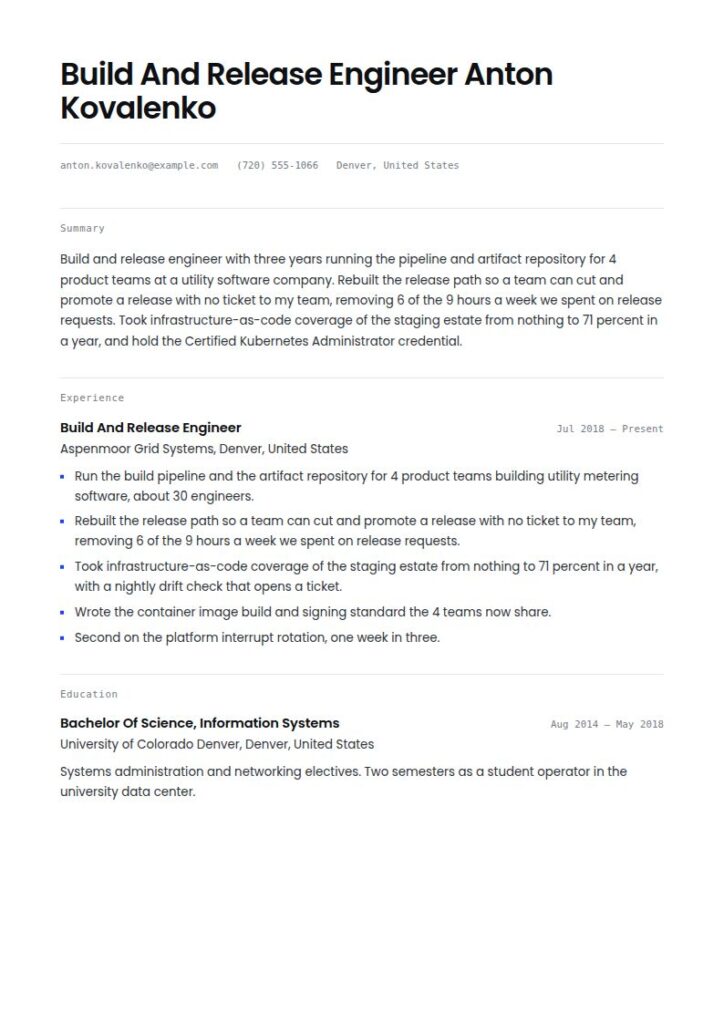
Build and release engineer with three years running the pipeline and artifact repository for 4 product teams at a utility software company. Rebuilt the release path so a team can cut and promote a release with no ticket to my team, removing 6 of the 9 hours a week we spent on release requests. Took infrastructure-as-code coverage of the staging estate from nothing to 71 percent in a year, and hold the Certified Kubernetes Administrator credential.
Work Experience
07/2018 - Present, Build and Release Engineer, Aspenmoor Grid Systems, Denver, United States
- Run the build pipeline and the artifact repository for 4 product teams building utility metering software, about 30 engineers.
- Rebuilt the release path so a team can cut and promote a release with no ticket to my team, removing 6 of the 9 hours a week we spent on release requests.
- Took infrastructure-as-code coverage of the staging estate from nothing to 71 percent in a year, with a nightly drift check that opens a ticket.
- Wrote the container image build and signing standard the 4 teams now share.
- Second on the platform interrupt rotation, one week in three.
Education
08/2014 - 05/2018, Bachelor of Science, Information Systems, University of Colorado Denver, Denver, United States
Systems administration and networking electives. Two semesters as a student operator in the university data center.
Skills
Build pipelines and artifact repositories, 80
Terraform, 70
Container image build and signing, 75
Kubernetes, 70
AWS, 70
Drift detection, 65
Release documentation, 80
Languages
English, native
Ukrainian, native
German, beginner
Certificates
03/2021, Certified Kubernetes Administrator, Cloud Native Computing Foundation, CKA-2100-4471-0812
Cluster architecture, workloads, networking and troubleshooting.
Summary
A DevOps professional resume is a one to two page document describing the platform you run for other engineers: how a team ships a new service without you, how many teams actually use it, the toil it removed, the cost it runs at and who is allowed to deploy. This guide gives you three adaptable versions and current Bureau of Labor Statistics pay for the published occupations.
DevOps Professional resume examples by experience level
A DevOps professional resume is a one to two page document about a platform other engineers use, written the way you would write about a product: what it does for its users, how many adopted it, what it costs to run, and who is allowed to do what with it.
That framing is the whole page. Most files under this title are tool inventories, and a reader cannot tell one tool inventory from the next because every candidate has opened the same tools. In other words, a platform with users, an adoption rate, a running cost and a permission model can only have been run by somebody.
Resume guide for a DevOps professional resume
In short, this guide and the corresponding DevOps professional resume example will cover:
- First, how to write a DevOps professional resume, section by section
- Then the platform block: self-service, adoption, toil, coverage, cost and permissions
- Also, three adaptable summaries: first platform role, platform engineer and platform lead
- Finally, why the title has no published wage, and which occupations do instead
How to write a DevOps professional resume
To start, plan six sections: contact header, summary, engineering experience, the platform block, skills, and education with certifications. Keep one page under five years, then two once you have run a platform with named internal customers.
| Section | What it is answering | Where it goes |
|---|---|---|
| Summary | What the platform is, how many teams use it, what it runs on | Top of page one |
| Engineering experience | What the candidate built and what it changed for other teams | Reverse chronological |
| The platform block | Adoption, toil, coverage, cost and permissions | Its own block, page one if it fits |
| Skills | Named products, grouped so a reader finds their own stack | Page one or two |
| Education and certifications | Background and credentials with their years | Page two |
Write the platform as a product with users, and name the users
An internal platform has customers: the product teams that deploy through it. Everything a product manager would say about a product is available to you, and almost nobody writes it down.
How many teams use it, out of how many exist. What a team does to get a new service into production, and how long that takes without you involved. What it costs to run per month, and which way that number is going.
Three sentences in that shape beat a fourteen-tool list, and they cannot be written by somebody who used the platform rather than ran it.
Run the finished file through the ATS resume checker before you send it: these applications are parsed before a human sees them, and product names are what the parser matches on.
Choosing the best resume format for a DevOps professional resume
Reverse chronological. The reader wants to know which platform you ran, for how long, and what the organization looked like around it, and that is a timeline question.
For example, one page holds a first platform role. Two pages become fair once you have run a platform for multiple teams, because the platform block earns real space.
However, skills-based formats fail for a specific reason: they present tools without the environment those tools ran in. For instance, Terraform across nine teams and two cloud accounts is a different claim from Terraform in a personal project, and only the timeline tells a reader which one this is.
Include your contact information
| ✅ Right | ❌ Wrong |
|---|---|
| Anton Kovalenko | Anton Kovalenko |
| Platform Engineering Lead, 12 product teams on AWS and Kubernetes | DevOps guru and automation enthusiast |
| Denver, CO, open to hybrid and remote in Mountain Time | Denver |
| (720) 555-1066, [email protected] | (720) 555-1066, [email protected] |
Also, the title line does two jobs: it says what you run and how many teams depend on it. That is why a reader deciding between a platform team of two and one of fourteen looks for that second number first.
Make use of a summary
Next, write four lines: what the platform is and who uses it, one adoption or self-service number, one cost or toil number, and the permission model in a clause.
Build and release engineer with three years running the pipeline and artifact repository for 4 product teams at a utility software company. Rebuilt the release path so a team can cut and promote a release with no ticket to my team, removing 6 of the 9 hours a week we spent on release requests. Took infrastructure-as-code coverage of the staging estate from nothing to 71 percent in a year, and hold the Certified Kubernetes Administrator credential.
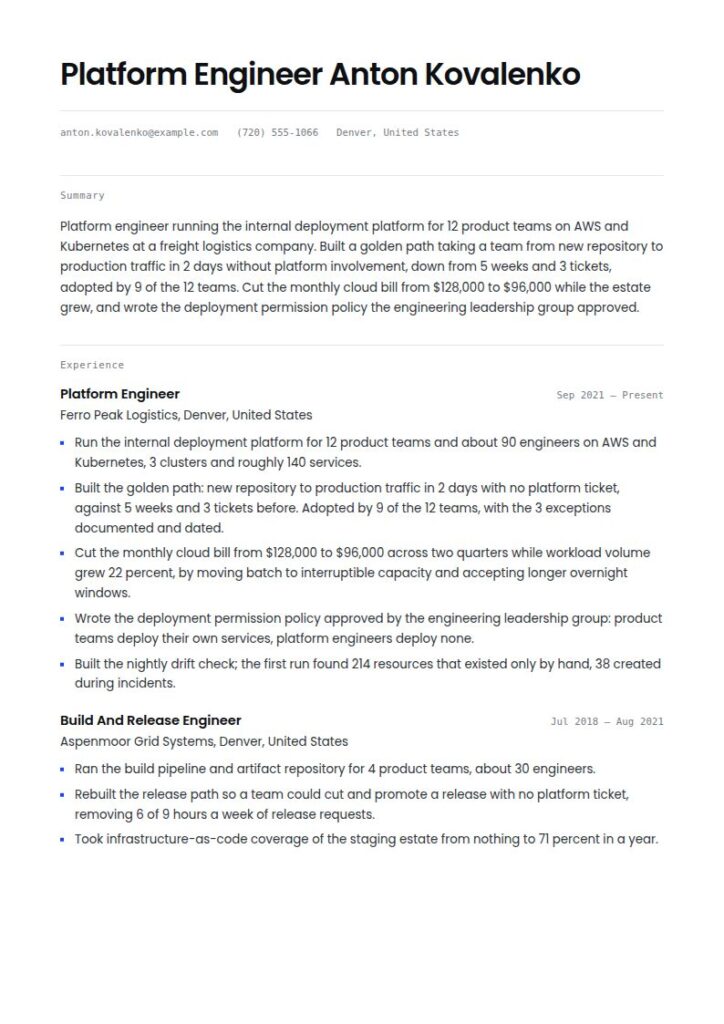
Platform engineer running the internal deployment platform for 12 product teams on AWS and Kubernetes at a freight logistics company. Built a golden path taking a team from new repository to production traffic in 2 days without platform involvement, down from 5 weeks and 3 tickets, adopted by 9 of the 12 teams. Cut the monthly cloud bill from $128,000 to $96,000 while the estate grew, and wrote the deployment permission policy the engineering leadership group approved.
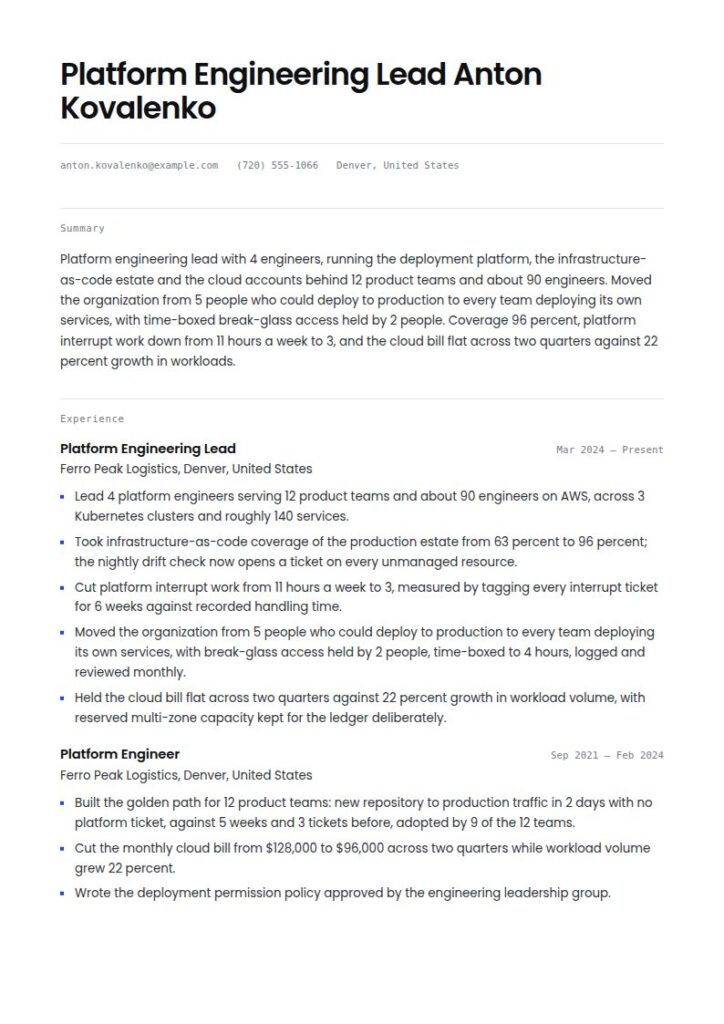
Platform engineering lead with 4 engineers, running the deployment platform, the infrastructure-as-code estate and the cloud accounts behind 12 product teams and about 90 engineers. Moved the organization from 5 people who could deploy to production to every team deploying its own services, with time-boxed break-glass access held by 2 people. Coverage 96 percent, platform interrupt work down from 11 hours a week to 3, and the cloud bill flat across two quarters against 22 percent growth in workloads.
Right vs wrong: the same DevOps professional summary, twice
| ✅ Right | ❌ Wrong |
|---|---|
| Platform engineer running the internal deployment platform for 12 product teams on AWS and Kubernetes. | Experienced DevOps professional skilled in AWS, Kubernetes, Terraform, Docker, Jenkins and Ansible. |
| New repository to production traffic in 2 days without platform involvement, down from 5 weeks and 3 tickets. | Automated infrastructure provisioning and streamlined deployment processes. |
| Adopted by 9 of the 12 teams; the other 3 are named, with the reason each one stayed off it. | Drove company-wide adoption of DevOps best practices. |
| Cut the monthly cloud bill from $128,000 to $96,000 while the estate grew. | Optimized cloud spend and improved resource efficiency. |
By contrast, the right column survives a follow-up question. The left is what a screener has read nine times before lunch.
Outline your platform engineering experience
Additionally, in experience, give employer, title, dates, then one line naming the organization's shape: product teams, engineers, what the estate runs on, and the platform team's headcount. Then three to five bullets, each naming something other teams could do afterwards that they could not before.
| Instead of | Use |
|---|---|
| Built and maintained CI/CD pipelines for multiple teams | Built a golden path taking a team from new repository to production traffic in 2 days with no platform ticket, down from 5 weeks; 9 of 12 teams on it |
| Automated infrastructure using Terraform | Took infrastructure-as-code coverage of the production estate from 63% to 96%; the first drift check found 214 resources that existed only by hand |
| Reduced manual work for the engineering team | Cut platform interrupt work from 11 hours a week to 3, measured by tagging every interrupt ticket for six weeks against recorded handling time |
| Optimized cloud costs | Monthly cloud bill from $128,000 to $96,000 across two quarters while workloads grew 22%, by moving batch to interruptible capacity with longer overnight windows |
| Improved deployment security and access control | Wrote the deployment permission policy: every team deploys its own services, no platform engineer deploys another team's, break-glass held by 2 people |
Platform Engineering Lead, Ferro Peak Logistics, Denver, CO, March 2024 to Present
Lead 4 platform engineers serving 12 product teams and about 90 engineers on AWS, across 3 Kubernetes clusters and roughly 140 services.
Built and run the golden path: a new service goes from repository creation to production traffic in 2 days with no platform ticket, against 5 weeks and 3 tickets when I arrived. Measured across the 14 services created in 2025.
Took infrastructure-as-code coverage of the production estate from 63 percent to 96 percent. The first drift check found 214 resources that existed only by hand, 38 created during incidents and never written back.
Cut the monthly cloud bill from $128,000 to $96,000 over two quarters while workload volume grew 22 percent, by moving batch to interruptible capacity and accepting longer overnight windows, with the ledger deliberately left on reserved multi-zone capacity.
Wrote the deployment permission policy adopted by the engineering leadership group: product teams deploy their own services, platform engineers deploy none, and break-glass access is held by 2 people, time-boxed to 4 hours and logged.
The platform you run for other engineers, and what it cost
This is the block that makes the page yours, and every line in it is a fact about other teams rather than about you. Then list six facts, each with a number and the way you measured it.
The self-service path, timed. Pick the thing product teams need most often, usually a new service, and time it end to end: from the moment a team decides it needs one to the moment it serves production traffic, with nobody from your team in the loop. Give the before and after, the number of tickets it used to take, and how many new services the measurement covers. A number from 14 real services is evidence; a number from the one you tried last Thursday is a demo.
The golden path, and how many teams are actually on it. Adoption separates a platform from a side project, and the denominator is the whole organization. Nine of twelve teams is a strong claim; nine teams with no denominator is not a claim at all. Then name the three that did not adopt it and why: a vendor appliance that cannot be containerized, a Windows estate, a team carrying its own pipeline. Writing the exceptions down is the most credible thing in this block, because every real platform has them.
Toil and infrastructure-as-code coverage
Toil removed, in hours per week, with the measurement attached. Say how you counted. Tagging every interrupt ticket for six weeks and multiplying by recorded handling time is a method. Eleven hours a week down to three, measured that way across a platform team of four, is a number a director can act on.
Infrastructure-as-code coverage, and what the first drift check found. Give coverage as a share of the estate, defined: resources, accounts, clusters or spend. Then the honest part, which is what was outside code the first time anyone looked. Two hundred and fourteen resources that existed only by hand, thirty-eight of them created during incidents, is a better sentence than any coverage percentage alone: it says you have seen the gap between the diagram and the account.
DevOps platform cost and permission boundaries
The bill, its direction, and what you traded for it. Cost is the part of platform work that reaches a chief financial officer, and most resumes leave it out. Give the monthly figure, the direction it was moving, the figure now, and what you gave up: interruptible capacity for batch in exchange for longer overnight windows, a single region for internal tooling. What you deliberately did not trade matters as much, because saying the ledger stayed on reserved multi-zone capacity shows you priced the risk rather than chasing the number.
The permission boundary, and who decided it. Who can deploy to production, who cannot, how emergency access works, and whose signature is on it. This is what separates a platform engineer from an administrator with a bigger cluster: an administrator holds the access, a platform engineer designs who holds it and then gives it away. Say plainly that you deploy none of the product teams' services if that is true; it sounds like a smaller claim and reads as a larger one.
Users: 12 product teams, about 90 engineers, 3 Kubernetes clusters, roughly 140 services, 2 AWS accounts.
Self-service: new repository to production traffic in 2 days with no platform ticket, from 5 weeks and 3 tickets. Measured across the 14 services created in 2025.
Adoption: golden path used by 9 of 12 teams. Of the 3 exceptions, 1 runs a vendor appliance that cannot be containerized, 1 holds a Windows estate scheduled for 2027, and 1 opted out and maintains its own pipeline as a documented exception.
Toil: platform interrupt work 11 hours a week down to 3, measured by tagging every interrupt ticket for 6 weeks against recorded handling time, across a team of 4.
Coverage: infrastructure as code 63 percent to 96 percent of production resources. First drift check found 214 resources outside code, 38 created during incidents. Drift check now runs nightly and opens a ticket.
Cost: monthly cloud bill $128,000 to $96,000 across two quarters while workload volume grew 22 percent. Traded: batch on interruptible capacity, longer overnight windows, internal tooling in one region. Not traded: multi-zone capacity for the ledger.
Permissions: every product team deploys its own services; platform engineers deploy none. Break-glass production access held by 2 people, time-boxed to 4 hours, logged and reviewed monthly. Policy written by me, approved by the engineering leadership group in 2025.
Build a snapshot of your key DevOps professional skills
Twelve to eighteen entries in four labeled groups, named by product so a reader finds their own stack in one pass. Put platform and cost first, because those are the groups a tool list cannot fake.
Platform and self-service: Internal developer platform design, Service templates and scaffolding, Golden path documentation, Backstage, Environment provisioning
Infrastructure as code: Terraform, Terragrunt, module design and versioning, drift detection, Helm, Kustomize
Cloud and runtime: AWS, Kubernetes, EKS, container image build and signing, autoscaling policy, interruptible capacity
Cost and access: Cloud cost allocation and tagging, capacity planning, least-privilege IAM design, break-glass access policy, audit logging
List your education and certifications
Degree, year and institution, then certifications with the year each was awarded. In platform work they are worth listing because they map to products in the posting, but only with dates: an undated credential invites the question you did not want.
Bachelor of Science, Information Systems, University of Colorado Denver, Denver, CO, 2017
Certified Kubernetes Administrator, Cloud Native Computing Foundation, 2021, retaken 2024
HashiCorp Certified: Terraform Associate, HashiCorp, 2022
AWS Certified DevOps Engineer, Professional, Amazon Web Services, 2023
If a credential has lapsed, write the year and leave it in the list rather than implying it is current. Platform teams check.
Choose the right layout and design
Lastly, use a single column, 11 or 12 point body type, real section headings, no photograph, no skill bars. As a result, the platform block is a set of short labeled lines, which parses cleanly and reads fast.
Write the platform as a product with named users and a denominator. Time the self-service path without you in it. Give adoption as a fraction of the teams that exist. Say how you measured toil. Give the bill, its direction and what you traded. Name who can deploy to production and who signed the policy.
Do not open with a list of fourteen tools. Do not give an adoption number without saying how many teams exist. Do not claim a cost reduction without saying what was given up for it. Do not hide the teams that refused the platform. Do not describe yourself as the person who deploys everything, which is the administrator's job description rather than the platform engineer's.
DevOps professional job market and outlook
The U.S. Note that the Bureau of Labor Statistics publishes no Occupational Outlook Handbook profile under the title "DevOps professional", so no employment count, projection or median wage exists for the title itself. Instead, the work is counted inside published occupations, and it sits across three of them.
| Published occupation | Jobs, 2025 | Change, 2025-35 | Annual openings | Median wage, May 2025 |
|---|---|---|---|---|
| Computer and information systems managers | 685,800 | 16%, +108,100 | About 53,500 | $175,140 |
| Software developers, QA analysts and testers (group) | 1,905,400 | 10%, +185,400 | About 106,100 | $134,040 |
| Software developers (within the group) | Included above | 10% | Included above | $135,980 |
| Network and computer systems administrators | 323,600 | -4%, -13,200 | About 13,400 | $99,130 |
Source: U.S. Bureau of Labor Statistics, Occupational Outlook Handbook, 2025-35 projections and May 2025 wage data.
One job description, three occupation codes, $76,010 apart
The three published occupations a platform job can be filed under carry median annual wages of $99,130 for network and computer systems administrators, $135,980 for software developers and $175,140 for computer and information systems managers, all May 2025 (BLS Occupational Outlook Handbook). The distance from the bottom of that set to the top is $76,010.
Nothing on your resume changes the occupation code your employer files. What it changes is which of the three a reader has in mind, and the evidence that decides it is ownership of an internal product rather than the number of tools named. Running a platform that other teams adopt, with a cost line and a permission policy you wrote, reads upward; operating systems somebody else designed reads downward.
Of these, the administration occupation is particularly worth watching. BLS projects network and computer systems administrators to decline 4 percent from 2025 to 2035, losing 13,200 jobs, while still producing about 13,400 openings a year, essentially all from replacement need (BLS, 2025-35 projections). Platform work is one of the routes out of that column, which is why the block in the middle of this page matters more than the tool list at the bottom.
What salary you can expect as a DevOps professional
No median wage exists for this job title, because the Handbook carries no profile that uses it. For this reason, any single number published for "DevOps professional" was assembled from job advertisements or self-reported surveys, and should be quoted as such or not at all.
The defensible anchors are the published occupations: software developers at a median annual wage of $135,980 in May 2025, the combined software developers, quality assurance analysts and testers group at $134,040, network and computer systems administrators at $99,130, and computer and information systems managers at $175,140 (BLS, May 2025).
Meanwhile, industry is the second lever, and for developer-side work it is a large one:
| Industry, software developers | Median annual wage (May 2025) |
|---|---|
| Software publishers | $164,550 |
| Manufacturing | $136,330 |
| Management of companies and enterprises | $135,680 |
| Finance and insurance | $135,460 |
| Computer systems design and related services | $132,050 |
Source: U.S. Bureau of Labor Statistics, May 2025, software developers.
Two things follow. Therefore, quote the published occupation with its cycle attached when compensation comes up, because "the BLS May 2025 median for software developers is $135,980" is a claim a compensation partner can check in a minute. And write the page so the reader lands on the anchor you want: readers price a platform with adopters, a cost line and a permission policy against the developer and manager figures, and a list of systems maintained against the administrator figure.
Key takeaways for a DevOps professional resume
- In short, write the platform as an internal product and name its users and their count.
- Then time the self-service path with you out of the loop, over real services.
- Similarly, give adoption as a fraction of the teams that exist, and name the exceptions.
- In addition, state toil in hours per week and say how you measured it.
- Give infrastructure-as-code coverage plus what the first drift check actually found.
- Also, give the bill, its direction, what you traded for it and what you refused to trade.
- Finally, name who can deploy to production, who cannot, and who approved that policy.
Build your DevOps professional resume in 15 minutes with our AI resume builder.
Related information technology resume examples
- DevOps engineer resume
- System administrator resume
- Network engineer resume
- Network administrator resume
- Software engineer resume
- Software developer resume
- Solution architect resume
- Systems analyst resume
- Data engineer resume
- AWS data engineer resume
- IT specialist resume
- IT help desk resume
Pair it with a matching DevOps professional cover letter.
DevOps professional resume questions, answered
How long should a DevOps professional resume be?
One page under five years, two once you have run a platform with named internal customers. The second page exists for the platform block, and a compressed version of it is worth less than a full one.
Is DevOps professional a real job title to put on a resume?
It is a real posting title but not a published occupation: the BLS Handbook has no profile under it, so no official wage or outlook attaches to the words. Use the employer's own posting title at the top of the file and let the platform block say what you ran.
What if I have never run a platform, only used one?
Say so, and write what you did own: a pipeline, an environment, a module library, a runbook other people followed. The honest smaller claim survives an interview. A first platform role is usually build and release work; the adoption and cost numbers come later.
How do I write about cloud cost without exposing confidential figures?
Use direction and proportion instead of absolutes: cut the monthly bill by about a quarter across two quarters while workloads grew 22 percent. Keep the trade visible, because the trade is the part that shows judgment rather than luck.
Which certifications are worth listing?
The ones that match products in the posting, each with its year. Kubernetes and Terraform credentials map cleanly onto what platform teams run. List a lapsed credential with its year rather than implying it is current.