Solution Architect, Policy Administration and Integration Obinna Achebe
Solution Architect, Policy Administration
[email protected] | (972) 555-1828 | Plano, United States
Profile
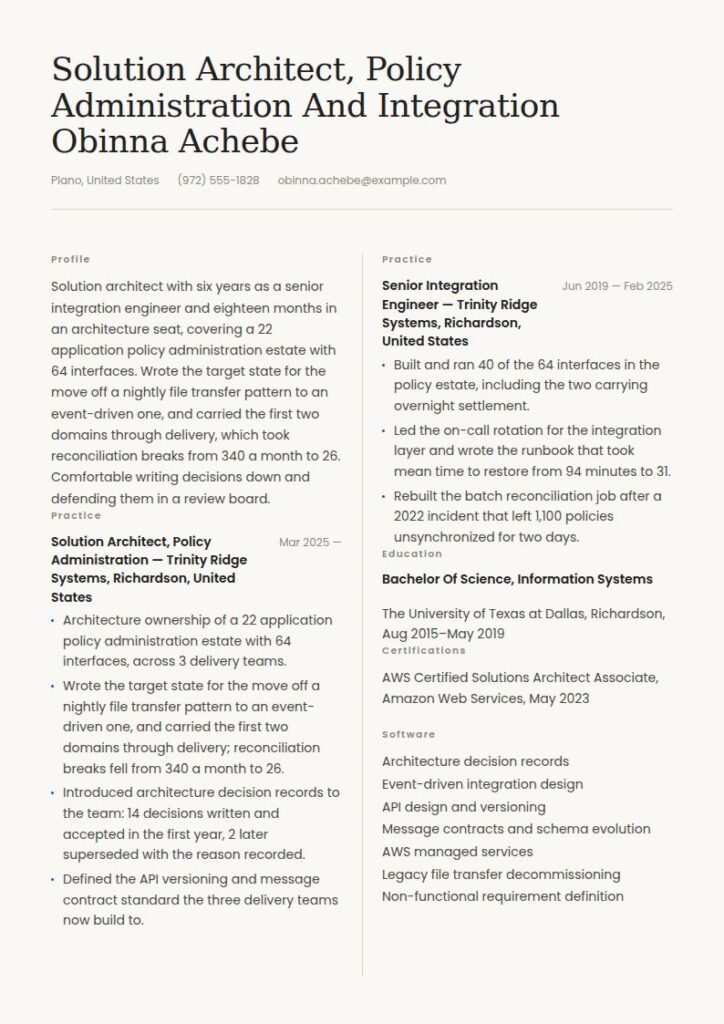
Solution architect with six years as a senior integration engineer and eighteen months in an architecture seat, covering a 22 application policy administration estate with 64 interfaces. Wrote the target state for the move off a nightly file transfer pattern to an event-driven one, and carried the first two domains through delivery, which took reconciliation breaks from 340 a month to 26. Comfortable writing decisions down and defending them in a review board.
Work Experience
03/2025 - Present, Solution Architect, Policy Administration, Trinity Ridge Systems, Richardson, United States
- Architecture ownership of a 22 application policy administration estate with 64 interfaces, across 3 delivery teams.
- Wrote the target state for the move off a nightly file transfer pattern to an event-driven one, and carried the first two domains through delivery; reconciliation breaks fell from 340 a month to 26.
- Introduced architecture decision records to the team: 14 decisions written and accepted in the first year, 2 later superseded with the reason recorded.
- Defined the API versioning and message contract standard the three delivery teams now build to.
06/2019 - 02/2025, Senior Integration Engineer, Trinity Ridge Systems, Richardson, United States
- Built and ran 40 of the 64 interfaces in the policy estate, including the two carrying overnight settlement.
- Led the on-call rotation for the integration layer and wrote the runbook that took mean time to restore from 94 minutes to 31.
- Rebuilt the batch reconciliation job after a 2022 incident that left 1,100 policies unsynchronized for two days.
Education
08/2015 - 05/2019, Bachelor of Science, Information Systems, The University of Texas at Dallas, Richardson, United States
Coursework in systems analysis, database design and enterprise integration.
Skills
Architecture decision records, 75
Event-driven integration design, 80
API design and versioning, 85
Message contracts and schema evolution, 80
AWS managed services, 70
Legacy file transfer decommissioning, 85
Non-functional requirement definition, 65
Languages
English, native
Igbo, native
Certificates
05/2023, AWS Certified Solutions Architect Associate, Amazon Web Services
Valid to 2026. Professional level booked for 2026.
Summary
A solution architect resume is a two page document proving you have made architecture decisions and can defend them, not that you have used a list of technologies. This guide gives you three adaptable versions, one decision written out in full, what the AWS professional-level certification actually requires, and current Bureau of Labor Statistics pay for the closest published occupation.
Solution Architect resume examples by experience level
A solution architect resume is a two page document that proves you have made architecture decisions, written them down, and lived with what they cost.
Almost every resume for this title does something else. It lists platforms, patterns and cloud services, which describes the room the work happens in rather than the work. A reviewer hiring an architect has one question: when this person had two defensible options and had to pick, what did they pick, why, and what went wrong afterwards. A technology list answers none of it.
Resume guide for a solution architect resume
This guide and the corresponding solution architect resume example will cover:
- How to write a solution architect resume, section by section
- Why one written architecture decision beats a page of platform logos
- Three adaptable summaries: first architecture seat, working architect and principal
- What the AWS professional-level certification actually asks for
- Which published occupation this title maps onto, and what the mapping costs you
How to write a solution architect resume
Six sections: contact header with a domain line, summary, experience, a decision block, skills grouped by concern, and education with certifications. Two pages is normal here and one page is usually a mistake, because the evidence for this job does not compress.
The order follows what a reviewer is testing. They first work out what kind of architect you are, because the title covers people who draw integration diagrams for one business unit and people who set standards across a bank. Then scope numbers. Then evidence that you decide rather than describe.
| Section | What it is answering | Where it goes |
|---|---|---|
| Domain line | Enterprise, integration, cloud, data or application architecture? | Directly under your name |
| Summary | How many systems, how many users, what you changed | Three or four lines |
| Experience | What you were accountable for, and what it cost | Reverse chronological |
| Decision block | Do you make calls, or attend meetings where calls are made? | Its own block |
| Certifications | Current, and at which level? | With education |
Write your scope in four numbers before you write a sentence
Architects are hired against the size of the thing they can hold in their head. Find four numbers: how many applications are in the estate you cover, how many interfaces you own, how many users or transactions the systems carry, and how many engineers build to your designs.
"Solution architect covering the claims platform" tells a reader nothing. "Solution architect over a 41 application claims estate, 118 interfaces, 2.3 million policies and 6 delivery teams" tells them what level you work at, and decides whether you are read for this job or the one above it. If your architecture work sits inside a delivery role rather than a titled seat, give the same four numbers for the piece you covered.
Run the finished file through the ATS resume checker first. Architecture postings draw high volume and are parsed into a structured record before anyone reads them.
Choosing the best resume format for a solution architect resume
Reverse chronological, single column, two pages. The exception is a consulting career with a dozen short engagements, where you group by employer and list engagements underneath, so the timeline stays readable.
Functional formats are particularly damaging here. The reader is establishing whether you grew into architecture from engineering or arrived sideways; both are acceptable, hiding the sequence is not. The Bureau of Labor Statistics lists five years or more of related work experience as typical entry for the closest published occupation, computer network architects, so the years themselves are part of the qualification.
Include your contact information
| ✅ Right | ❌ Wrong |
|---|---|
| Obinna Achebe | Obinna Achebe |
| Solution Architect, insurance claims and integration | Certified Solutions Architect and Technology Leader |
| AWS Certified Solutions Architect Professional, valid to 2028 | AWS Certified, Azure Certified, TOGAF |
| (972) 555-1828, [email protected], Plano, TX | (972) 555-1828, [email protected] |
The domain line matters more here than in most jobs. "Solution Architect" alone puts your file in a pile of two hundred. "Solution Architect, insurance claims and integration" puts it in a pile of four, and the four is where the interviews are.
Make use of a summary
Four lines: your domain, your years in and out of the architecture seat, your scope in numbers, and one decision with its result.
Solution architect with six years as a senior integration engineer and eighteen months in an architecture seat, covering a 22 application policy administration estate with 64 interfaces. Wrote the target state for the move off a nightly file transfer pattern to an event-driven one, and carried the first two domains through delivery, which took reconciliation breaks from 340 a month to 26. Comfortable writing decisions down and defending them in a review board.
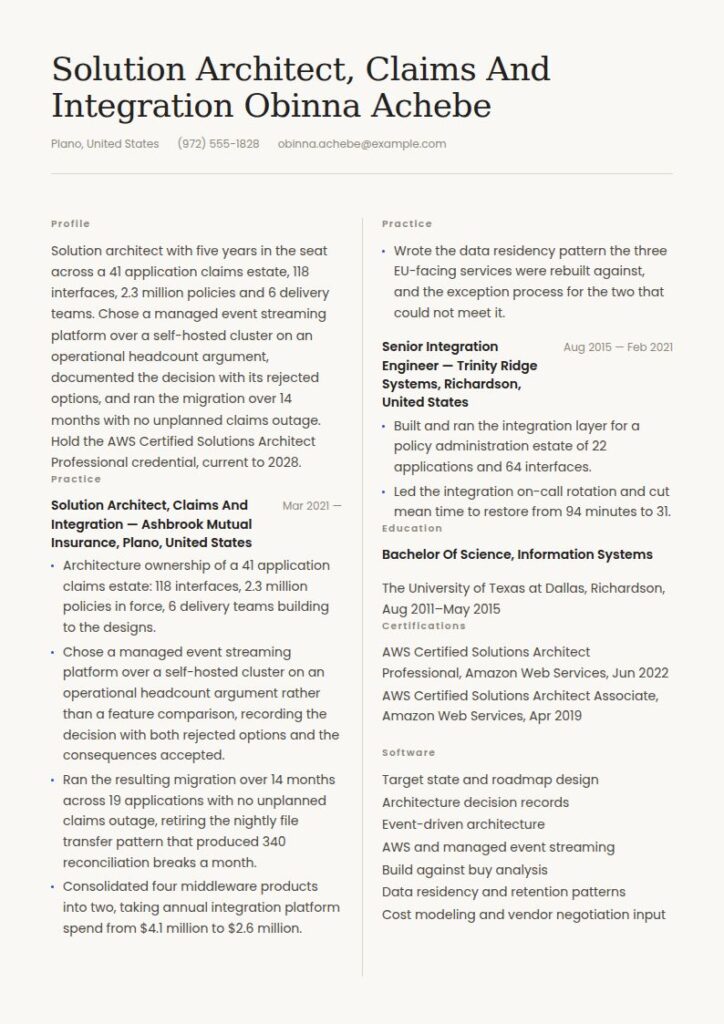
Solution architect with five years in the seat across a 41 application claims estate, 118 interfaces, 2.3 million policies and 6 delivery teams. Chose a managed event streaming platform over a self-hosted cluster on an operational headcount argument, documented the decision with its rejected options, and ran the migration over 14 months with no unplanned claims outage. Hold the AWS Certified Solutions Architect Professional credential, current to 2028.
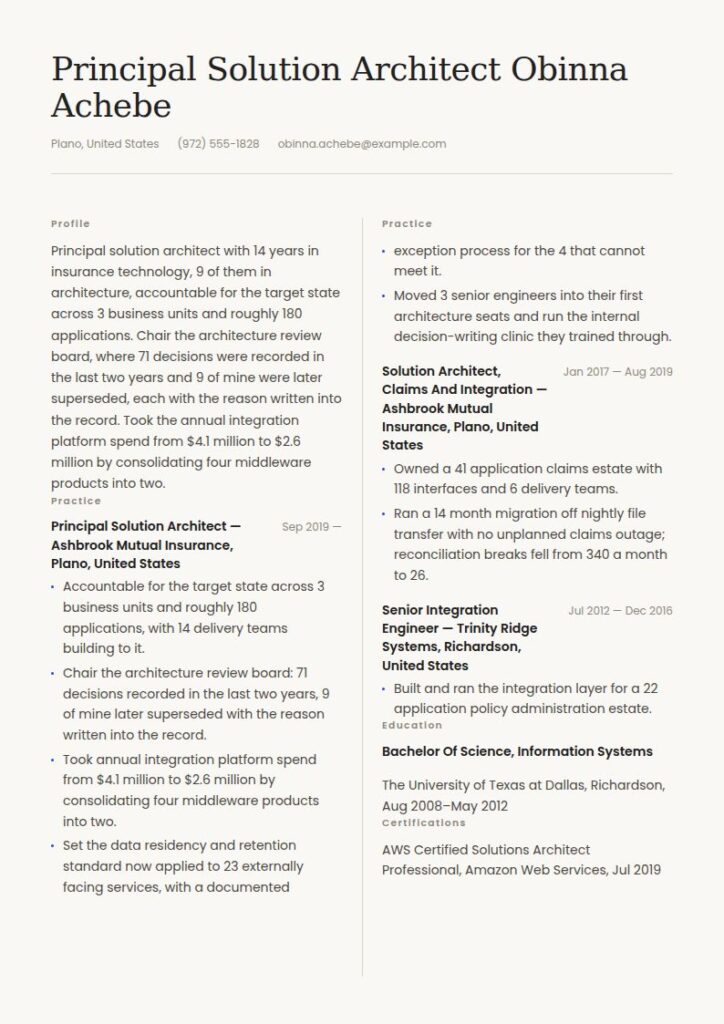
Principal solution architect with 14 years in insurance technology, 9 of them in architecture, accountable for the target state across 3 business units and roughly 180 applications. Chair the architecture review board, where 71 decisions were recorded in the last two years and 9 of mine were later superseded, each with the reason written into the record. Took the annual integration platform spend from $4.1 million to $2.6 million by consolidating four middleware products into two.
Right vs wrong: the same solution architect summary, twice
| ✅ Right | ❌ Wrong |
|---|---|
| Solution architect covering a 41 application claims estate, 118 interfaces, 2.3 million policies and 6 delivery teams. | Experienced solution architect with a strong background in enterprise technology. |
| Chose a managed event streaming platform over a self-hosted cluster on an operational headcount argument. | Skilled in cloud architecture, microservices, APIs, DevOps and digital transformation. |
| Ran the migration over 14 months with no unplanned claims outage. | Proven ability to deliver scalable, robust and future-proof solutions. |
The right column has a decision, a reason and a period. The left is a list of nouns that could have come from any advertisement for this title, which is usually where it came from.
Outline your solution architect experience
Employer, domain, dates and the scope line. Then four or five bullets, each describing something you decided or changed, with the number attached.
| Instead of | Use |
|---|---|
| Designed scalable and robust solutions for enterprise clients | Designed the claims event backbone: 118 interfaces, 2.3 million policies, 41 applications in scope |
| Experience with cloud migration projects | Moved 19 of 41 claims applications to managed services over 14 months, with no unplanned outage |
| Worked closely with stakeholders to gather requirements | Ran the architecture review board for 6 delivery teams; 71 decisions recorded in two years |
| Led digital transformation initiatives | Consolidated four middleware products into two, taking annual platform spend from $4.1m to $2.6m |
Solution Architect, Claims and Integration, Ashbrook Mutual Insurance, Plano, TX, March 2021 to Present
Architecture ownership of a 41 application claims estate: 118 interfaces, 2.3 million policies in force, 6 delivery teams building to the designs.
Chose a managed event streaming platform over a self-hosted cluster on an operational headcount argument rather than a feature comparison, recording the decision with both rejected options and the consequences accepted.
Ran the resulting migration over 14 months across 19 applications with no unplanned claims outage, and retired the nightly file transfer pattern that had produced 340 reconciliation breaks a month.
Consolidated four middleware products into two, taking annual integration platform spend from $4.1 million to $2.6 million.
Wrote the data residency pattern the three EU-facing services were rebuilt against, and the exception process for the two that could not meet it.
The reconciliation breaks bullet does more work than the spend bullet, and it is the kind most applicants leave out. A cost saving is a number an executive likes. A defect class that stopped happening is proof the design was right, and an architect reading your file is checking for that.
Write out one architecture decision the way you wrote it
This is the block that separates architects from people with the title, and it takes about a third of a page.
The architecture decision record is a documented practice with a citable origin. Michael Nygard proposed it in "Documenting Architecture Decisions", published on the Cognitect blog on 15 November 2011, as a short record kept for each architecturally significant choice, with five named sections: Title, Context, Decision, Status and Consequences. Status moves through proposed, accepted, deprecated and superseded. Nygard's argument is that an engineer inheriting an undocumented decision has only two options, to blindly accept it or blindly change it.
That is the shape to put on your resume, compressed to six lines.
Decision: Managed event streaming service over a self-hosted Kafka cluster, claims backbone, recorded and accepted March 2022.
Context: 41 applications, 118 point-to-point interfaces on a nightly file transfer pattern producing about 340 reconciliation breaks a month. Two platform engineers covering 24 hour claims operations.
Options rejected: Self-hosted Kafka on our own infrastructure, rejected on operational headcount rather than cost, since it needed a third and fourth platform engineer we were never going to be given. A commercial integration bus, rejected because its license renewal fell inside the migration window.
Consequences accepted: Vendor lock-in on the streaming layer, roughly $210,000 a year more than self-hosting, and a hard dependency on one region. We wrote the abstraction that would let us leave, then deliberately never used it.
Status: Accepted, still current, reviewed annually.
Superseded decision, same board: My 2023 decision to standardize on a single API gateway was superseded in 2025 when two business units turned out to have incompatible authentication requirements. The record says so, and says what I assumed that was wrong.
That last line is the one that gets interviews. Almost nobody volunteers a superseded decision, and every experienced architect knows a career with none in it is either very short or not being described honestly. Writing one down, with the assumption that failed, tells a review board what they want to know: that you can be wrong in public and keep the record either way.
Two rules keep the block usable. Give one decision, not five: depth is the point, and a list of decision titles is a technology list with a different noun. And pick one where the rejected option was genuinely defensible, since a decision whose alternative was obviously bad proves nothing.
Build a snapshot of your key solution architect skills
Twelve to sixteen entries, grouped by architectural concern rather than by vendor, because a vendor list dates fast and says nothing about how you think.
Architecture practice: Target state and roadmap design, architecture decision records, review board facilitation, non-functional requirement definition, build against buy analysis
Integration: Event-driven design, API design and versioning, message contracts and schema evolution, idempotency and replay, legacy file transfer decommissioning
Platform: AWS, Kubernetes, managed event streaming, infrastructure as code, identity and access design
Data and compliance: Data residency patterns, retention design, encryption in transit and at rest, audit evidence design
Delivery: Cost modeling, vendor and license negotiation input, mentoring engineers into architecture
Put "architecture decision records" on the page in those words. It is one of the few terms in this field with a specific meaning and a traceable origin, and a reviewer who runs a board reads it as evidence that you have worked somewhere decisions were written down rather than remembered.
List your education and certifications
A bachelor's degree is typical entry. After the first architecture seat, education compresses to two lines and certifications do the talking.
AWS Certified Solutions Architect Professional, Amazon Web Services, earned 2022, renewed 2025, valid to 2028.
AWS Certified Solutions Architect Associate, Amazon Web Services, earned 2019.
Bachelor of Science, Information Systems, The University of Texas at Dallas, Richardson, TX, 2011.
What the professional-level certification actually asks for
Certifications carry weight here partly because the Bureau of Labor Statistics Occupational Outlook Handbook notes that employers of computer network architects may require or prefer certification in the products they use. The value is in the level and the dates, not the logo.
For the AWS Certified Solutions Architect Professional exam, Amazon Web Services publishes this: the target candidate has two or more years of experience using AWS services to design and implement cloud solutions; the exam is 75 questions in a 180 minute appointment; it costs 300 USD; and the certification is valid for three years. The exam guide sets four domains, weighted as design solutions for organizational complexity 26 percent, design for new solutions 29 percent, continuous improvement for existing solutions 25 percent, and accelerate workload migration and modernization 20 percent (Amazon Web Services, retrieved 17 September 2026).
Two of those four domains are about systems that already exist. Read that twice, because most resumes for this title are written entirely about greenfield design and 45 percent of the professional exam is not. Put the migration and improvement work on the page, and write every credential with its level, year earned and expiry. "AWS Certified" undated is read as expired until proven otherwise.
Choose the right layout and design
Single column, 10 or 11 point type, clear headings, no photograph, two pages, exported to PDF.
Resist the diagram. It is the one thing architects always want to add and the one thing that never survives parsing, printing or a phone screen. The decision block does the work a diagram would do, in text a reader can skim and a tracking system can index.
Put your domain in the line under your name. Give scope in four numbers: applications, interfaces, users or transactions, delivery teams. Write one decision in full, with its rejected options and the consequences you accepted. Include a superseded decision and the assumption behind it. Name the level and expiry on every certification.
Do not list twenty technologies as a skills matrix; it reads as a job advertisement rather than a career. Do not include an architecture diagram. Do not claim a board's decision as your own, because a reference call settles it. Do not write "designed scalable solutions" anywhere. Do not put an undated certification on the file, or call yourself a visionary.
Solution architect job market and outlook
The Bureau of Labor Statistics publishes no Occupational Outlook Handbook profile under the title solution architect, and the closest published occupation is computer network architects, which is the only Handbook profile carrying the word architect in a technology context.
The mapping is imperfect and it is worth saying why. A computer network architect designs data communication networks: local area networks, wide area networks and intranets. A solution architect designs across applications, integrations and platforms, and may never touch a router. What transfers is the shape of the career rather than the subject matter, and one Quick Facts line in particular.
| Measure | Computer network architects | Computer systems analysts |
|---|---|---|
| Employment, 2025 | 181,800 | 544,400 |
| Projected employment, 2035 | 195,800 | 587,200 |
| Projected change, 2025-35 | 8 percent, +14,100 | 8 percent, +42,900 |
| Projected annual openings | About 9,600 | About 32,900 |
| Typical entry-level education | Bachelor's degree | Bachelor's degree |
| Related work experience needed | 5 years or more | None |
| Median annual wage, May 2025 | $134,050 | $105,850 |
Source: U.S. Bureau of Labor Statistics, Occupational Outlook Handbook, May 2025 wage data and 2025 to 2035 projections, published 27 August 2026.
The five year line is the whole architecture career in one row
Of the technology occupations the Handbook publishes, computer network architects is one of very few whose Quick Facts table lists five years or more of work experience in a related occupation as typical entry. Computer systems analysts, at 544,400 jobs and a $105,850 median in May 2025, lists none (BLS Occupational Outlook Handbook, May 2025 wages and 2025 to 2035 projections, published 27 August 2026).
That single row is why architecture resumes look different from every other technology resume. You are not screened on whether you can do the work, but on whether enough has gone wrong in front of you that you know which risks are real. Five years is the published proxy for it.
It also tells you what to do with your pre-architecture years: do not compress them to make room for the current role. The engineering decade is the qualification, and the file should show which systems you were inside when the outages happened.
Computer systems design services employed 25 percent of computer network architects at a median of $133,610, finance and insurance 11 percent at $139,230, management of companies 9 percent at $139,820 and telecommunications 9 percent at $111,690 (BLS, May 2025). Finance and insurance is where the largest architecture estates sit, because regulatory record-keeping makes written decisions a requirement rather than a preference.
What salary you can expect as a solution architect
There is no published median wage for a solution architect, because BLS classifies by occupation rather than job title and this one is spread across several. A figure invented for a title the Handbook has never defined is a weak thing to negotiate against.
Negotiate against computer network architects instead: median $134,050 in May 2025, or $64.45 an hour, with the lowest 10 percent under $79,900 and the highest 10 percent over $202,680. The same cycle put computer systems analysts, the occupation most people arrive from, at $105,850 (BLS, May 2025).
Read the distance between those two medians as the price of the architecture seat rather than as a raise. It is paid for accountability: for being the person named on the decision when the migration window closes badly. Three things move you inside the architect range. Estate size, which is the four numbers. Whether you set standards other teams must follow or produce designs other teams may adopt, which are different jobs at the same title. And whether you have owned a cost line, since an architect who has taken money out of a platform has a number that survives a compensation conversation.
Key takeaways for a solution architect resume
- Put your domain under your name; the bare title lands you in a pile of two hundred.
- Give scope in four numbers: applications, interfaces, users or transactions, delivery teams.
- Write one architecture decision in full, with the options you rejected and why.
- Include the consequences you accepted, not only the benefits you expected.
- Add a superseded decision and the assumption that was wrong.
- Keep your pre-architecture engineering years; the five year bar is the qualification.
- Date every certification and name its level, since an undated credential reads as expired.
Build your solution architect resume in 15 minutes with our AI resume builder.
Related information technology resume examples
- Network engineer resume
- Network administrator resume
- Systems analyst resume
- Network systems analyst resume
- DevOps engineer resume
- Senior software engineer resume
- AWS data engineer resume
- Data engineer resume
- Cyber security resume
- Technical project manager resume
- IT director resume
- System administrator resume
Pair it with a matching solution architect cover letter.
Solution architect resume questions, answered
How long should a solution architect resume be?
Two pages. This is one of the few technology titles where one page is a disadvantage, because scope numbers, a decision written out in full and a pre-architecture engineering history do not fit in one. Three is too many, and the material to cut is always the technology list.
Is a solution architect the same as an enterprise architect or a technical architect?
No, and a reviewer will assume you know the difference. Enterprise architecture works at the level of business capability and standards across an organization. Solution architecture works at the level of one system or domain and its interfaces. Technical architecture sits closer to a single platform. Use the employer's title, then let your domain line and scope numbers say where you actually operate.
How many years do I need before applying for an architect role?
The Bureau of Labor Statistics lists five years or more of related work experience as typical entry for computer network architects, the closest published occupation to this title (BLS Occupational Outlook Handbook, 2025 to 2035 projections). That is a useful floor rather than a rule. What matters more is whether you have been accountable for a decision that could have gone the other way, and can describe one at the depth this guide describes.
Which certification is worth taking?
Take one at professional level in the cloud platform your target employers run, and keep it current. Amazon Web Services publishes that its Solutions Architect Professional exam recommends two or more years of experience designing and implementing AWS solutions, runs 75 questions in 180 minutes, costs 300 USD and is valid for three years (Amazon Web Services, retrieved 17 September 2026). One current professional credential beats four expired associate ones.
How do I write about a decision that turned out badly?
Write it as the record would: the context, the option you chose, the assumption behind it, and what happened when the assumption failed. Then say what superseded it. Review boards keep superseded decisions on purpose, and describing one is the fastest way to show that you distinguish being wrong from being careless.