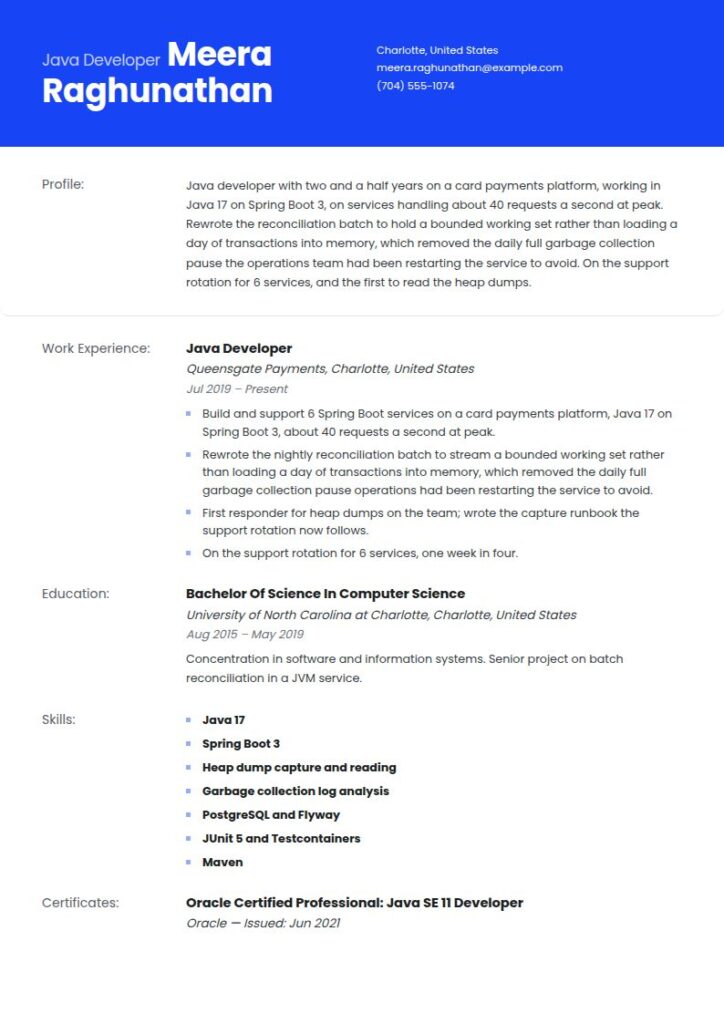
Java Developer Meera Raghunathan
Java Developer
[email protected] | (704) 555-1074 | Charlotte, United States
Profile
Java developer with two and a half years on a card payments platform, working in Java 17 on Spring Boot 3, on services handling about 40 requests a second at peak. Rewrote the reconciliation batch to hold a bounded working set rather than loading a day of transactions into memory, which removed the daily full garbage collection pause the operations team had been restarting the service to avoid. On the support rotation for 6 services, and the first to read the heap dumps.
Work Experience
07/2019 - Present, Java Developer, Queensgate Payments, Charlotte, United States
- Build and support 6 Spring Boot services on a card payments platform, Java 17 on Spring Boot 3, about 40 requests a second at peak.
- Rewrote the nightly reconciliation batch to stream a bounded working set rather than loading a day of transactions into memory, which removed the daily full garbage collection pause operations had been restarting the service to avoid.
- First responder for heap dumps on the team; wrote the capture runbook the support rotation now follows.
- On the support rotation for 6 services, one week in four.
Education
08/2015 - 05/2019, Bachelor of Science, Computer Science, University of North Carolina at Charlotte, Charlotte, United States
Concentration in software and information systems. Senior project on batch reconciliation in a JVM service.
Skills
Java 17, 80
Spring Boot 3, 80
Heap dump capture and reading, 70
Garbage collection log analysis, 65
PostgreSQL and Flyway, 70
JUnit 5 and Testcontainers, 75
Maven, 80
Languages
English, native
Tamil, native
Hindi, intermediate
Certificates
06/2021, Oracle Certified Professional: Java SE 11 Developer, Oracle, OCP11-4471902
Summary
A Java developer resume is a one to two page document that names your Java release and framework once, then spends its space on production diagnosis: heap sizing, the garbage collector you chose, a pause or memory problem you found, and a pool limit that was wrong. This guide gives you three adaptable versions and current Bureau of Labor Statistics pay for the published occupations.
Java Developer resume examples by experience level
A Java developer resume is a one to two page document that names your Java release and framework once, then spends everything it has left on what you diagnosed while a JVM was running in production.
The first part is cheap. After all, anyone can write Java 21 and Spring Boot 3.3, and half the applications in the stack do. However, nobody can copy the heap you sized, the collector you chose and why, the pause you traced to its cause, or the pool limit that looked like a network problem for three weeks. In fact, only somebody who was on the call can write those sentences.
Resume guide for a Java developer resume
In short, this guide and the corresponding Java developer resume example will cover:
- How to write a Java developer resume, section by section
- The runtime block: heap, collector, one diagnosis, one pool limit, one forced upgrade
- Three adaptable summaries: first Java role, senior developer and staff engineer
- Why one line of version naming is enough, and what replaces the rest
How to write a Java developer resume
First, plan six sections: contact header, summary, engineering experience, the runtime block, skills, and education with certifications. Keep one page for the first five years, then two once you have diagnosis worth the space.
| Section | What it is answering | Where it goes |
|---|---|---|
| Summary | Java release, framework, domain and one runtime fact | Top of page one |
| Engineering experience | What was built, at what volume, on what | Reverse chronological |
| The runtime block | Heap, collector, one diagnosis, one pool limit, one forced upgrade | Its own block, page one if it fits |
| Skills | Named libraries and infrastructure, grouped | Page one or two |
| Education and certifications | Degree, and Java certifications with dates | Page two |
Name the release and the vendor build once, then move on
Java's release model makes the version line more informative than it looks. Feature releases ship every six months, in March and September, and a subset are designated long-term support: Java 8 in March 2014, Java 11 in September 2018, Java 17 in September 2021, Java 21 in September 2023 and Java 25 in September 2025. Oracle states an intent to ship an LTS every two years, with Java 29 planned for September 2027 (Oracle Java SE Support Roadmap, as of 17 September 2026).
So "Java 21, Eclipse Temurin build, Spring Boot 3.3" tells a reader which side of the modern language features you sit on and whether the estate is current, in eight words.
What that line cannot show is judgment, and a resume that keeps going with a second and third version list has spent its page on the cheapest thing it could say. Name it once and give the rest of the space to what you diagnosed.
Run the finished file through the ATS resume checker before you send it: a parser is looking for those library names, and a two-column template is where they get lost.
Choosing the best resume format for a Java developer resume
Reverse chronological. That is because a reader is working out how long you have been near a running system and how big it was, which is a timeline question.
In practice, one page holds the first five years. Two pages become fair once the runtime block has real content, because that block is the part nobody else could have written.
Also, avoid the skills-first format that opens with thirty library names. It reads as things encountered rather than operated, and a reader cannot tell which is which.
Include your contact information
| ✅ Right | ❌ Wrong |
|---|---|
| Meera Raghunathan | Meera Raghunathan |
| Staff Java Engineer, payments and ledger systems, Java 21 on Spring Boot 3.3 | Java developer with 7+ years of experience |
| Charlotte, NC, open to hybrid in the Charlotte area | Charlotte |
| (704) 555-1074, [email protected] | (704) 555-1074, [email protected] |
The title line carries the version because it is the cheapest filter and readers use it anyway. Everything after it, then, has to earn its place.
Make use of a summary
Four lines: release and framework, the domain and its volume, one runtime fact with numbers, and what you answer for when it breaks.
Java developer with two and a half years on a card payments platform, working in Java 17 on Spring Boot 3, on services handling about 40 requests a second at peak. Rewrote the reconciliation batch to hold a bounded working set rather than loading a day of transactions into memory, which removed the daily full garbage collection pause the operations team had been restarting the service to avoid. On the support rotation for 6 services, and the first to read the heap dumps.
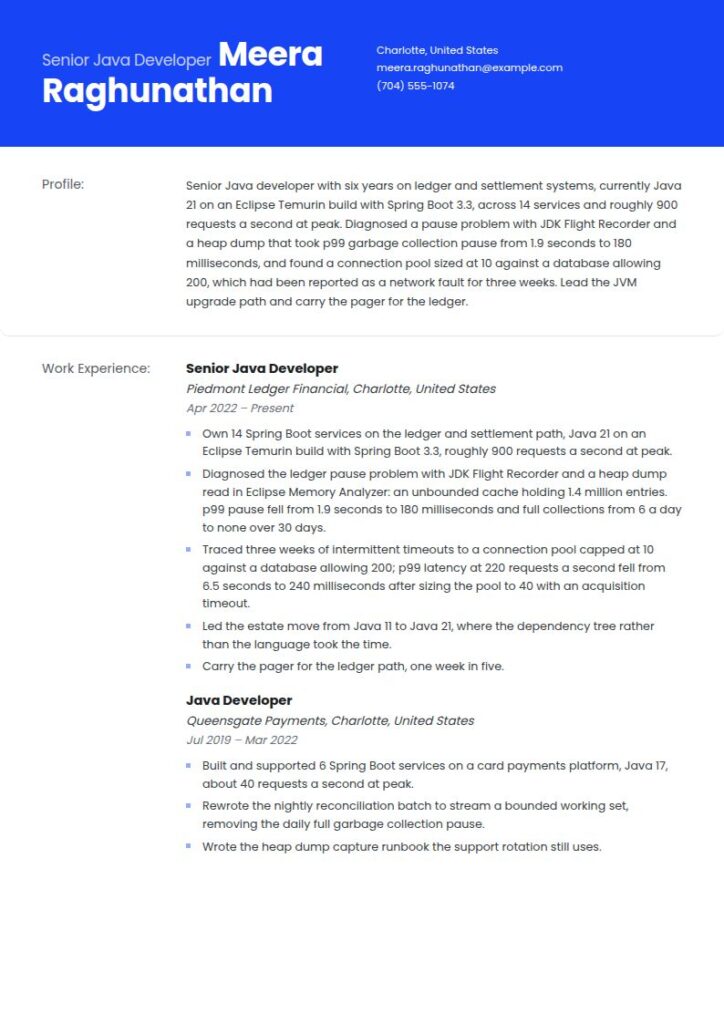
Senior Java developer with six years on ledger and settlement systems, currently Java 21 on an Eclipse Temurin build with Spring Boot 3.3, across 14 services and roughly 900 requests a second at peak. Diagnosed a pause problem with JDK Flight Recorder and a heap dump that took p99 garbage collection pause from 1.9 seconds to 180 milliseconds, and found a connection pool sized at 10 against a database allowing 200, which had been reported as a network fault for three weeks. Lead the JVM upgrade path and carry the pager for the ledger.
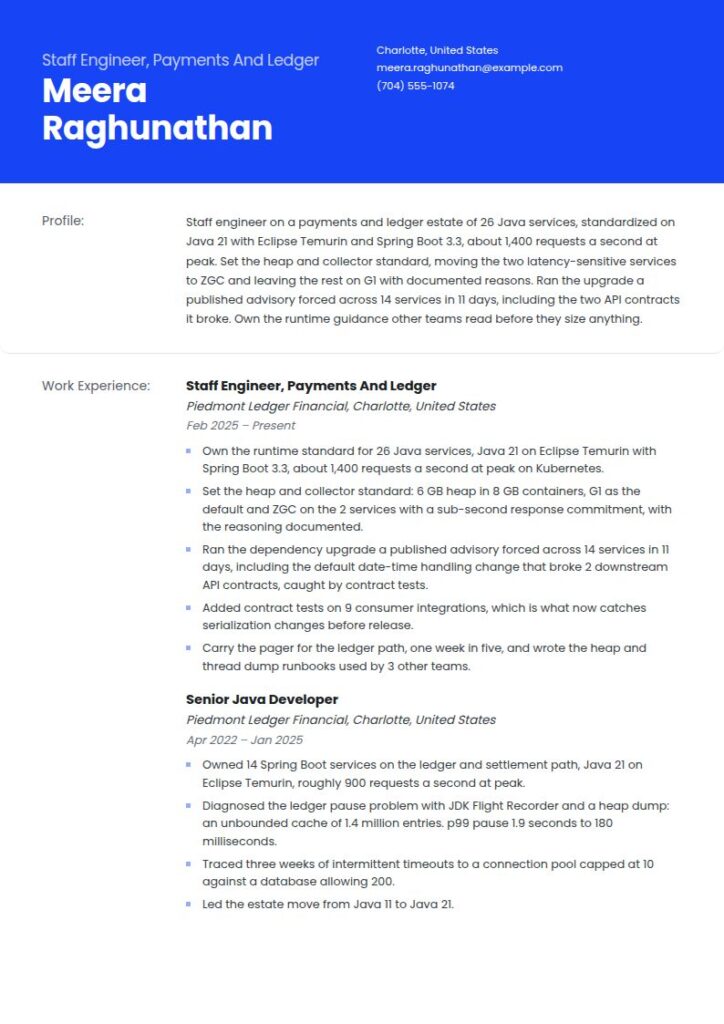
Staff engineer on a payments and ledger estate of 26 Java services, standardized on Java 21 with Eclipse Temurin and Spring Boot 3.3, about 1,400 requests a second at peak. Set the heap and collector standard, moving the two latency-sensitive services to ZGC and leaving the rest on G1 with documented reasons. Ran the upgrade a published advisory forced across 14 services in 11 days, including the two API contracts it broke. Own the runtime guidance other teams read before they size anything.
Right vs wrong: the same Java developer summary, twice
| ✅ Right | ❌ Wrong |
|---|---|
| Senior Java developer on ledger and settlement systems, Java 21 on Eclipse Temurin with Spring Boot 3.3. | Experienced Java developer skilled in Java, Spring, Spring Boot, Hibernate, Maven, JUnit and Kafka. |
| Took p99 garbage collection pause from 1.9 seconds to 180 milliseconds after a heap dump analysis. | Improved application performance and optimized memory usage. |
| Found a connection pool sized at 10 against a database allowing 200, reported as a network fault for three weeks. | Troubleshot and resolved complex production issues. |
| Carry the pager for the ledger, 14 services, roughly 900 requests a second at peak. | Worked on mission-critical enterprise applications. |
As a result, every line in the right column invites a follow-up question you can answer for twenty minutes. The left column ends the conversation, because there is nothing in it to ask about.
Outline your Java engineering experience
Employer, title, dates, then one line giving the estate: how many services, what they do, peak volume, what they run on. Then three to five bullets, each naming a thing that was wrong and what you did about it.
| Instead of | Use |
|---|---|
| Developed and maintained Java applications using Spring Boot | Own 14 Spring Boot services on the ledger path, Java 21 on Eclipse Temurin, roughly 900 requests a second at peak |
| Optimized application performance | Cut p99 garbage collection pause from 1.9s to 180ms by removing an unbounded cache found in a heap dump; full collections went from 6 a day to none in 30 days |
| Resolved production issues and bugs | Traced three weeks of intermittent timeouts to a connection pool capped at 10 against a database allowing 200; p99 latency fell from 6.5s to 240ms at the same load |
| Upgraded dependencies and frameworks | Ran the upgrade forced by a published advisory across 14 services in 11 days, including the date-handling change that broke 2 API contracts |
| Wrote unit and integration tests | Added contract tests on 9 consumer integrations, which is what caught the serialization change before it reached production |
Staff Engineer, Payments and Ledger, Piedmont Ledger Financial, Charlotte, NC, February 2025 to Present
Own the runtime standard for 26 Java services on the payments and ledger estate: Java 21 on Eclipse Temurin, Spring Boot 3.3, about 1,400 requests a second at peak, on Kubernetes.
Set the heap and collector standard: 6 GB heap in 8 GB containers, G1 as the default, ZGC on the two services with a sub-second response commitment, with the reasoning written down so teams stop choosing by rumor.
Diagnosed the ledger pause problem with JDK Flight Recorder and a heap dump read in Eclipse Memory Analyzer: an unbounded cache holding 1.4 million entries. Removing it took p99 pause from 1.9 seconds to 180 milliseconds and full collections from 6 a day to none over the next 30 days.
Found the connection pool capped at 10 against a database allowing 200. From outside it looked like a network fault: p99 latency went from 240 milliseconds to 6.5 seconds above 220 requests a second while processor use stayed near 30 percent.
Ran the dependency upgrade forced by a published advisory across 14 services in 11 days, including the date-time handling change that broke 2 downstream API contracts, caught by contract tests rather than a customer.
The runtime facts only somebody who has run a JVM in production can write
One sentence of versions, then five facts about what happened while the process was running. Almost nobody writes this, because almost nobody thinks of it as resume material.
The version sentence, and then stop. "Java 21 on an Eclipse Temurin build, Spring Boot 3.3" is complete. It says which language features are available to you, that somebody keeps the estate current, and which vendor build you run. A second version list adds nothing, and a third is how a page runs out of room for the material below.
Heap sizing and the collector you chose, with the reason. Give the heap, the container it sits in, the collector, and one sentence of why. Six gigabytes in an eight gigabyte container on G1 because throughput mattered more than tail latency; ZGC on the two services with a sub-second commitment. The reason is the part being assessed: somebody who chose a collector from a conference talk and somebody who chose one against a stated pause target write this sentence differently.
Java memory problems and pool limits
One memory or pause problem, diagnosed, with the tool named and the numbers either side. Name the tool, because the tools are how a reader knows you did the work: JDK Flight Recorder, JDK Mission Control, a heap dump read in Eclipse Memory Analyzer, garbage collection logs. Then the finding in plain words, and a before and after with a window. An unbounded cache of 1.4 million entries; p99 pause 1.9 seconds to 180 milliseconds; full collections six a day to none over thirty days.
A pool limit that was wrong, and what it looked like from outside. Thread pools and connection pools produce the most misdiagnosed incidents in Java systems, because the symptom appears somewhere else. Write both halves: the limit that was wrong, and the shape the outside world saw. A connection pool capped at 10 against a database allowing 200 looks like a network fault or a slow database, and processor use at 30 percent while latency climbs is the clue. Reading that signature is worth more than any framework on the page.
Forced upgrades and what they broke
A dependency upgrade forced by a published advisory, and what it broke. Every large Java estate has lived through one. Give the shape without internal detail: how many services, how many days, and what went wrong that nobody expected. A minor version bump that changed default date-time handling and broke two API contracts beats "kept dependencies up to date", because it says you have shipped an urgent upgrade and watched it land on somebody else's integration.
Runtime: Java 21, Eclipse Temurin build, Spring Boot 3.3, on Kubernetes. 26 services, about 1,400 requests a second at peak.
Heap and collector: 6 GB heap in 8 GB containers. G1 as the estate default; ZGC on the 2 services with a sub-second response commitment. Reasoning documented, so collector choice stops being folklore.
Pause diagnosis: JDK Flight Recorder plus a heap dump in Eclipse Memory Analyzer found an unbounded cache holding 1.4 million entries. p99 pause 1.9 seconds to 180 milliseconds; full collections 6 a day to 0 over the next 30 days.
Pool limit: connection pool capped at 10 against a database allowing 200. From outside, p99 latency went 240 milliseconds to 6.5 seconds above 220 requests a second with processor use near 30 percent. Pool sized to 40 with an acquisition timeout and a saturation alert.
Forced upgrade: published advisory against a serialization dependency; upgraded 14 services in 11 days. The minor version changed default date-time handling and broke 2 downstream API contracts, caught by contract tests before release.
On call: 1 week in 5 for the ledger path. Heap dump and thread dump capture runbooks written and used by 3 other teams.
Then read those lines against a framework list, and the difference is obvious. The list says what you installed; by contrast, the record says what happened, what you looked at and what changed.
Build a snapshot of your key Java developer skills
Later, in skills, list twelve to eighteen entries in four labeled groups. Put the runtime group first, because it is the one a tool list cannot fake.
Runtime and diagnosis: JVM tuning, G1 and ZGC, heap and thread dump analysis, JDK Flight Recorder, JDK Mission Control, Eclipse Memory Analyzer, garbage collection logs
Language and frameworks: Java 17 and Java 21, Spring Boot 3, Spring Data, Hibernate, Project Reactor
Data and messaging: PostgreSQL, HikariCP pool sizing, Flyway migrations, Apache Kafka, Redis
Build, test and delivery: Maven, Gradle, JUnit 5, Testcontainers, contract testing, Kubernetes
List your education and certifications
Degree, year and institution, then Java certifications with the release they cover and the year taken. A certification against an older Java is still worth listing, but it dates itself, and writing the year removes the question.
Bachelor of Science, Computer Science, University of North Carolina at Charlotte, Charlotte, NC, 2019
Oracle Certified Professional: Java SE 17 Developer, Oracle, 2023
Oracle Certified Professional: Java SE 11 Developer, Oracle, 2021
Internal training: JVM performance and diagnosis workshop, 2024
Certifications are worth less than the runtime block and more than a framework list. In short, they confirm language depth to a screener who cannot assess it, which is what they are for.
Choose the right layout and design
Finally, keep the format plain: single column, 11 or 12 point body type, real headings, no photograph, no skill bars. For this reason, the runtime block is a set of short labeled lines, which parses cleanly and reads fast.
Name the Java release, the vendor build and the framework once. Give the heap, the container size and the collector with its reason. Name the tool you diagnosed with. Give before and after numbers with a window. Write the pool limit and the symptom it produced outside the process. Say what you carry the pager for.
Do not list every library you have imported. Do not claim a performance improvement with no measurement behind it. Do not name a collector without saying why. Do not write "optimized memory usage", the sentence everyone writes and nobody can check. Do not claim end-of-support dates for a vendor build unless the vendor's page is open in front of you.
Java developer job market and outlook
The U.S. Bureau of Labor Statistics publishes no Occupational Outlook Handbook profile under the title "Java developer", and none for any programming language: there is no Java occupation, no Python occupation and no C# occupation anywhere in the Handbook. Language-titled postings are a hiring convention rather than a labor market category, and the work is counted in one large published group.
| Published occupation, BLS | Jobs, 2025 | Change, 2025-35 | Annual openings | Median wage, May 2025 |
|---|---|---|---|---|
| Software developers, quality assurance analysts and testers (group) | 1,905,400 | 10%, +185,400 | About 106,100 | $134,040 |
| Software developers (within the group) | Included above | 10% | Included above | $135,980 |
| Software quality assurance analysts and testers (within the group) | Included above | Included above | Included above | $104,300 |
Source: U.S. Bureau of Labor Statistics, Occupational Outlook Handbook, 2025-35 projections and May 2025 wage data.
One published group, two sub-titles, and no language anywhere in it
The software developers, quality assurance analysts and testers group held 1,905,400 jobs in 2025 and is projected to grow 10 percent through 2035, adding 185,400 jobs with about 106,100 openings a year. Inside it, software developers had a median annual wage of $135,980 in May 2025 and quality assurance analysts and testers $104,300 (BLS Occupational Outlook Handbook, 2025-35 projections and May 2025 data).
Nowhere in that structure is there a Java line, a Python line or any other language. The federal statistics distinguish building software from verifying it, and nothing else.
The consequence for the page is direct. The language in your job title says almost nothing about where you sit, which is why the runtime block exists: it moves you from a title a thousand people share to work a reader can picture.
Meanwhile, Java's release cadence is the other structural fact. Feature releases arrive every six months, and long-term support releases landed in September 2018, September 2021, September 2023 and September 2025, with Oracle stating an intent to ship an LTS every two years and Java 29 planned for September 2027 (Oracle Java SE Support Roadmap, as of 17 September 2026). Estates cluster on a handful of releases, so the one you name places you in that landscape immediately.
What salary you can expect as a Java developer
Because no Handbook profile carries this job title, there is no official median for a Java developer, and no published wage differential for any programming language either. Therefore, any figure of the form "Java developers earn X" comes from job advertisements or a self-reported survey, and should be labeled as such.
Instead, the defensible anchors are the published ones: software developers at a median annual wage of $135,980 in May 2025, quality assurance analysts and testers at $104,300, and the combined group at $134,040 (BLS, May 2025).
Even so, what moves a Java resume inside that structure is not the language or the framework count. It is runtime responsibility: whether the page shows somebody who writes services or somebody who is called when they stop. Indeed, employers hire those two at different levels out of the same published occupation, and the evidence separating them is diagnosis with numbers attached.
That is also the most useful thing to say in a compensation conversation. In other words, quote the published occupation with its cycle attached, because "the BLS May 2025 median for software developers is $135,980" can be checked in a minute, then argue the level from what your runtime block shows rather than from years on the page.
Key takeaways for a Java developer resume
- Name the Java release, the vendor build and the framework once, then stop.
- First, give the heap, the container size and the collector, with the reason for the choice.
- Describe one pause or memory problem, with the tool named and numbers on both sides.
- Give a window for every before and after, because a number without one is decoration.
- Then write one wrong pool limit and the symptom it produced outside the process.
- Also, describe the upgrade a published advisory forced on you, and what it broke.
- Finally, say what you carry the pager for, in services and peak volume.
Build your Java developer resume in 15 minutes with our AI resume builder.
Related information technology resume examples
- Software developer resume
- Software engineer resume
- Senior software engineer resume
- Full stack developer resume
- Programmer resume
- Python developer resume
- SQL developer resume
- Solution architect resume
- Data engineer resume
- QA tester resume
- Automation tester resume
- Entry level software engineer resume
Pair it with a matching Java developer cover letter.
Java developer resume questions, answered
How long should a Java developer resume be?
One page for the first five years, two once the runtime block has real content. The second page is justified by diagnosis, on-call responsibility and estate size, not by more libraries.
Which Java version should I put on my resume?
The one you run in production, with the vendor build if you know it. Long-term support releases landed in September 2018, September 2021, September 2023 and September 2025, with feature releases every six months between them (Oracle Java SE Support Roadmap, as of 17 September 2026). If your estate is on an older release, say so and add what you are doing about it.
What do I write if I have never tuned a JVM?
Write what you have seen: a memory problem somebody else diagnosed while you watched and then documented, a service you sized, a heap dump you captured, a garbage collection log you read. A junior candidate who describes one real incident accurately beats one whose tuning experience evaporates under a single question.
Is a Java certification worth having?
It is worth listing with its release and year, because it confirms language depth to a screener who cannot assess it directly. It does not replace the runtime block, and no certification makes a page without production evidence read as senior.
How do I show impact when the numbers are confidential?
Use relative measures and keep the shape: p99 pause down by roughly 90 percent over a stated window, full collections from six a day to none, latency restored at the same load. The method and the window are what make a relative number credible, and neither discloses anything about the business.