QA Tester Desmond Abernathy
QA Tester
[email protected] | (614) 555-1082 | Columbus, United States
Profile
QA tester with ten months on a point of sale platform used in 1,400 stores, working a monthly release against a 480-case regression pack across 6 store configurations. Filed 214 defects in that time, 187 accepted as reproducible, including 3 severity 1 issues in offline card capture. Write reproduction steps developers can follow without a call, and hold the ISTQB Certified Tester Foundation Level.
Work Experience
11/2025 - Present, QA Tester, Corvath Retail Systems, Columbus, United States
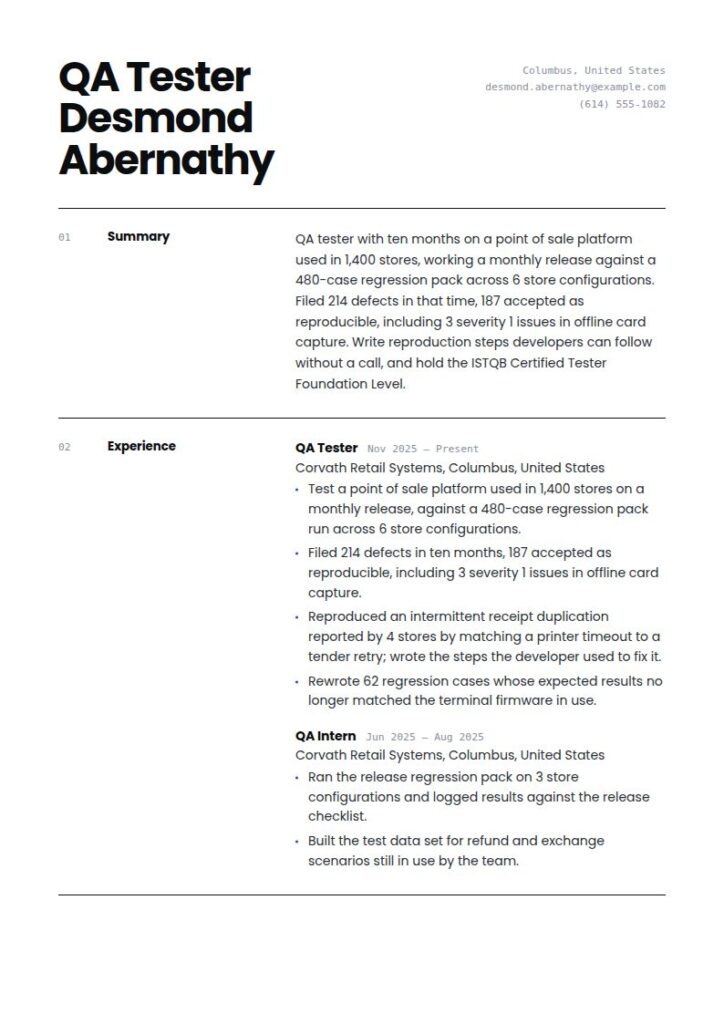
- Test a point of sale platform used in 1,400 stores on a monthly release, against a 480-case regression pack run across 6 store configurations.
- Filed 214 defects in ten months, 187 accepted as reproducible, including 3 severity 1 issues in offline card capture.
- Reproduced an intermittent receipt duplication reported by 4 stores by matching a printer timeout to a tender retry; wrote the steps the developer used to fix it.
- Rewrote 62 regression cases whose expected results no longer matched the terminal firmware in use.
06/2025 - 08/2025, QA Intern, Corvath Retail Systems, Columbus, United States
- Ran the release regression pack on 3 store configurations and logged results against the release checklist.
- Built the test data set for refund and exchange scenarios still in use by the team.
09/2023 - 05/2025, IT Help Desk Assistant, Kent State University, Kent, United States
- Handled about 40 tickets a week for student and faculty systems, reproducing reported faults before escalating them.
- Wrote 18 knowledge base articles from recurring tickets.
Education
08/2021 - 05/2025, Bachelor of Science, Computer Information Systems, Kent State University, Kent, United States
Capstone project on defect triage in an open source issue tracker. Coursework in databases, systems analysis and software quality.
Skills
Defect reporting and reproduction steps, 80
Regression suite execution, 75
Exploratory testing with session charters, 60
Boundary and equivalence analysis, 65
Jira and Zephyr, 75
SQL for result verification, 60
Point of sale and terminal integration, 65
Languages
English, native
Certificates
09/2025, ISTQB Certified Tester Foundation Level, American Software Testing Qualifications Board, ASTQB-CTFL-418772
Foundation Level certification in software testing.
Summary
A QA tester resume is a one to two page document that proves you found real defects, classified them on a scale you can name, and closed them. This guide gives you three adaptable versions, the defect record that replaces a test case count, and current Bureau of Labor Statistics pay for quality assurance analysts and testers against software developers.
QA Tester resume examples by experience level
A QA tester resume is a one to two page document that shows what you found, how you classified it, how you proved it, and what happened to it afterwards.
However, almost every resume in the pile says the opposite. Instead, it reports how much testing was done: test cases written, test plans authored, sprints covered. Those are volume claims, so a hiring manager cannot check one of them.
A defect is different. By contrast, it has a severity, a reproduction path, an owner, a fix and a date. As a result, write one down and the reader can picture the ticket. That is why the defect record sits where the tooling section usually sits.
Resume guide for a QA tester resume
In short, this guide and the corresponding QA tester resume example will cover:
- How to write a QA tester resume, section by section
- Why the defect record beats the test case count, and what goes in it
- Three adaptable summaries: first QA role, practicing analyst and QA lead
- How to name and define a severity scale so a stranger can read your numbers
- What the job market looks like and what you can expect to earn
How to write a QA tester resume
First, plan six sections: contact header, summary, testing experience, the defect record, skills, and education with certifications. Keep one page for your first four or five years, then two once you have carried a release sign-off.
The order matters because of who reads it: usually an engineering manager or a QA lead burned once by a hire who could describe a process but had never argued with a developer about whether something was a defect.
| Section | What it is answering | Where it goes |
|---|---|---|
| Summary | What software, at what cadence, at what risk | Top, four lines |
| Testing experience | What was under test, and what you owned | Reverse chronological, with numbers |
| The defect record | Did this person find real problems, and can they prove it? | Its own block, above skills |
| Skills | Domains, techniques, systems | Compact, grouped |
| Education and certifications | Degree, plus any certification with its body | Last, unless you are in your first year |
Write what was under test before you write what you did
"Tested new features" describes nothing. "Tested a card-present payment path across 6 terminal models and 3 acquirer sandboxes, on a two-week release train" describes a job.
Name three things in the first line of every experience entry: the system under test, the release cadence, and the consequence of a failure reaching a user. Payment capture, patient dosing and flight booking are different jobs with different standards of proof. Do this even when the product is dull: "an internal expense tool used by 4,000 employees, monthly release" beats an adjective.
Run the finished file through the ATS resume checker first, because most large employers parse the document into a structured record before anyone opens it.
Choosing the best resume format for a QA tester resume
Reverse chronological. Also, functional formats fail here for a particular reason: QA hiring reads for depth in one domain and for how long you stayed with a product. For example, a tester who has watched the same system for three years knows where its defects cluster; one who did two months on each of nine products has skimmed nine surfaces. In other words, two pages are earned by a defect record and a release history.
Include your contact information
| ✅ Right | ❌ Wrong |
|---|---|
| Desmond Abernathy | Desmond Abernathy |
| Software QA Analyst, Payments | Detail-oriented QA professional |
| ISTQB Certified Tester Foundation Level, ASTQB #ASTQB-CTFL-418772 | ISTQB Certified |
| (614) 555-1082, [email protected], Columbus, OH | (614) 555-1082, [email protected] |
Put the certification number on the line if you have one. Therefore, a checkable line at the top changes how the rest of the page is read.
Make use of a summary
Four lines: what you test, at what cadence and scale, one defect-side number, and the severity scale you work to.
QA tester with ten months on a point of sale platform used in 1,400 stores, working a monthly release against a 480-case regression pack across 6 store configurations. Filed 214 defects in that time, 187 accepted as reproducible, including 3 severity 1 issues in offline card capture. Write reproduction steps developers can follow without a call, and hold the ISTQB Certified Tester Foundation Level.
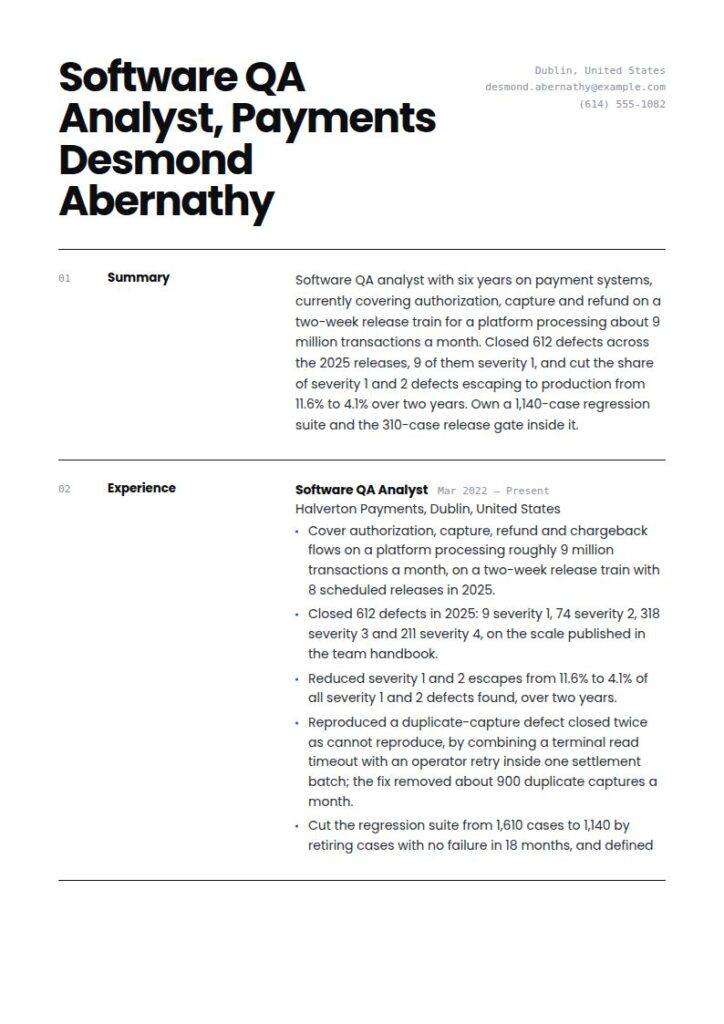
Software QA analyst with six years on payment systems, currently covering authorization, capture and refund on a two-week release train for a platform processing about 9 million transactions a month. Closed 612 defects across the 2025 releases, 9 of them severity 1, and cut the share of severity 1 and 2 defects escaping to production from 11.6% to 4.1% over two years. Own a 1,140-case regression suite and the 310-case release gate inside it.
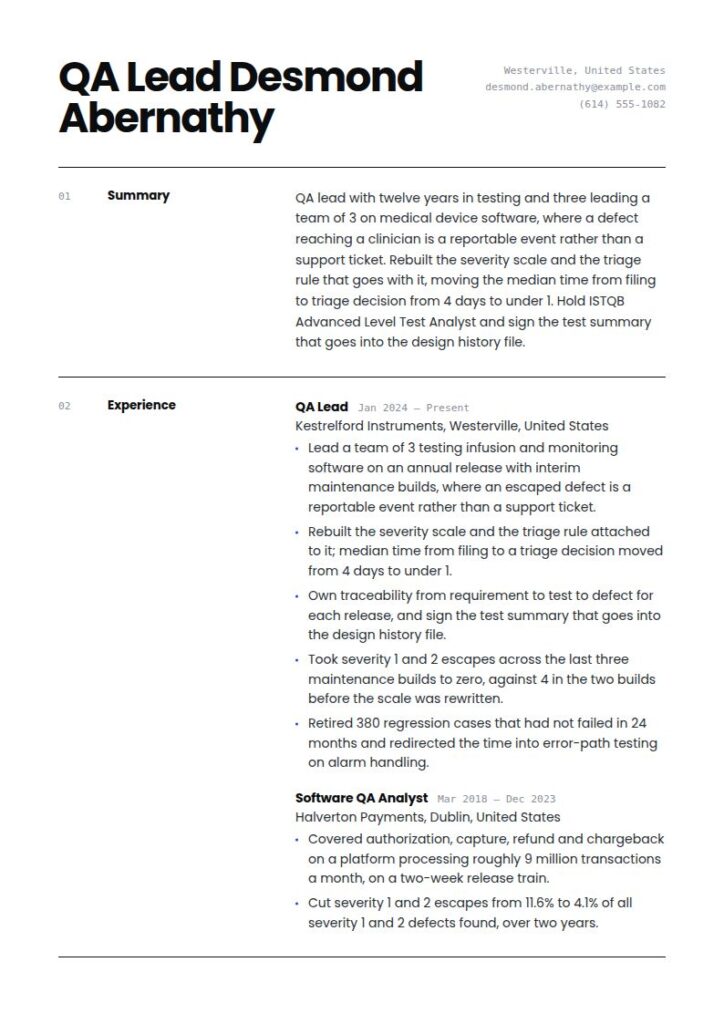
QA lead with twelve years in testing and three leading a team of 3 on medical device software, where a defect reaching a clinician is a reportable event rather than a support ticket. Rebuilt the severity scale and the triage rule that goes with it, moving the median time from filing to triage decision from 4 days to under 1. Hold ISTQB Advanced Level Test Analyst and sign the test summary that goes into the design history file.
Right vs wrong: the same QA tester summary, twice
| ✅ Right | ❌ Wrong |
|---|---|
| Software QA analyst with six years on payment systems, covering authorization, capture and refund. | Detail-oriented QA professional with extensive experience in software testing. |
| Closed 612 defects across the 2025 releases, 9 of them severity 1. | Wrote over 400 test cases and executed comprehensive test plans. |
| Cut severity 1 and 2 escapes from 11.6% to 4.1% over two years. | Ensured high quality and improved the overall quality of the product. |
Then read the wrong column as a hiring manager would: no system, no severity, no window, no number that could be false. On the other hand, the right column can be wrong, which is why it is worth reading.
Outline your testing experience
Additionally, in experience, give employer, product, release cadence, and your role in the release decision. Then four bullets, each naming a defect, a suite, a release or a rule you wrote.
| Instead of | Use |
|---|---|
| Performed manual and automated testing of web applications | Covered authorization, capture and refund on a two-week release train, 9 million transactions a month |
| Wrote and executed over 400 test cases | Closed 612 defects across 8 releases in 2025: 9 severity 1, 74 severity 2, 318 severity 3, 211 severity 4 |
| Reported bugs to the development team | Reproduced a duplicate-capture defect twice closed as cannot reproduce; the fix removed 900 duplicate captures a month |
| Maintained the regression test suite | Cut the regression pack from 1,610 cases to 1,140 by retiring cases with no failure in 18 months |
Software QA Analyst, Halverton Payments, Dublin, OH, March 2022 to Present
Cover authorization, capture, refund and chargeback flows on a platform processing roughly 9 million transactions a month, on a two-week release train with 8 scheduled releases in 2025.
Closed 612 defects in 2025 across those releases: 9 severity 1, 74 severity 2, 318 severity 3 and 211 severity 4, on the scale published in the team handbook.
Reduced severity 1 and 2 escapes from 11.6% to 4.1% of all severity 1 and 2 defects found, over two years.
Reproduced a duplicate-capture defect closed twice as cannot reproduce, by combining a terminal timeout with an operator retry inside the same settlement batch; the fix removed about 900 duplicate captures a month.
Cut the regression suite from 1,610 cases to 1,140 by retiring cases with no failure in 18 months, and defined the 310-case release gate inside it. Recommended holding the 4.6 release over an open severity 2 in refund reversal; it shipped nine days later with the fix.
Also, include no tool list, no sprint ceremonies, no claim about collaboration. Every bullet either happened or did not.
The defect record, not the test count
In practice, this is the section that does the work, and almost nobody writes it. Specifically, it replaces the paragraph most QA resumes spend on test case counts.
After all, "Wrote 400 test cases" is unverifiable in both directions. The reader cannot tell whether a case is a line in a spreadsheet or a documented scenario, or whether any of them ran. Worse, the number rewards the wrong behavior: 400 shallow cases look better on paper than 60 covering the states where money goes missing.
A defect is auditable. Six things make it so, and each is a resume line.
One: severity, on a scale you name and define. Severity is the most-used and least-defined word on QA resumes. "Found 14 critical bugs" means nothing until the reader knows what critical meant at your company: at one employer it means data loss, at the next a misaligned button.
Defect severity on a scale you define
Also, there is no live industry standard to hide behind. IEEE 1044-2009, the IEEE Standard Classification for Software Anomalies, was approved on 9 November 2009 and sets out a uniform approach to classifying software anomalies wherever in the lifecycle they are found, but IEEE SA moved it to inactive-reserved status on 5 March 2020. Instead, the scale that governs your work is your employer's, it is not the next employer's, and defining it falls to you.
Two: the distribution, not the total. A total is a workload number; a distribution is a judgment number. "612 defects: 9 severity 1, 74 severity 2, 318 severity 3, 211 severity 4" tells a reader you are not inflating the top of the scale, the most common failure of QA credibility. A tester reporting 200 critical defects a year is telling you their scale is broken.
Three: the escape rate, with its window. This is the one number that measures testing rather than activity. Write it as defects found after release against defects found before it, over a stated window, and say which severities you counted. A severity 4 escape is not interesting, and counting it flatters you.
Four: one "cannot reproduce" turned into a fix. Pick a defect a developer bounced, and say what you varied, what state you had to construct, what you wrote in the reproduction steps, and what the fix removed. It is the only claim on a QA resume that cannot be faked by someone who has not done the job, because reproducing an intermittent failure is a hard skill and describing one accurately requires having done it.
Five: the regression suite measured against the cadence it has to keep. A suite size alone is decoration; a suite size against a release cadence is a constraint. Say what you retired: cutting a suite is a stronger claim than growing one, because it means you read failure history rather than adding cases to feel safe.
Six: the release you recommended against, and what happened next. Say what the defect was, what you recommended, whether it was taken, and what became of the release. Both endings are usable. If it shipped over your objection and landed, say so plainly and say what changed afterwards, because a candidate who can describe being overruled is describing a real job rather than a fantasy of one.
Severity scale in use: S1, money moves incorrectly or cardholder data is exposed, no workaround. S2, a core flow fails for a class of merchants, workaround exists. S3, documented workaround, no financial impact. S4, cosmetic or documentation.
2025 defect record: 612 defects closed across 8 releases, 9 S1, 74 S2, 318 S3, 211 S4. S1 and S2 found after release: 4.1% of all S1 and S2 found, down from 11.6% across the 2023 releases.
Cannot reproduce turned into a fix: a duplicate-capture report closed twice as not reproducible. Reproduced by combining a terminal read timeout with an operator retry inside the same settlement batch, which requires the batch window open and the acquirer response late. Fix removed roughly 900 duplicate captures a month.
Regression suite: 1,140 cases against a two-week release train, cut from 1,610 by retiring cases with no failure in 18 months. A 310-case subset must pass before a release candidate leaves staging.
Release held: recommended holding 4.6 over an open S2 in refund reversal. Held nine days; fixed before it reached a merchant.
Automation and the audit test
Meanwhile, one sentence is all the automation your resume needs here: name what is automated and what is not, and leave frameworks for the interview. Then apply the audit test to every other bullet. "Wrote comprehensive test plans" cannot be disproved, which means it cannot be believed either; "closed 612 defects across 8 releases, 9 of them severity 1" takes four minutes to check in any tracker.
Build a snapshot of your key QA tester skills
Later, in skills, list twelve to fourteen entries in four short groups: what you test, how you test it, the systems you work in, and what you own at release time.
Domains: Payment authorization and capture, Refunds and chargebacks, Point of sale and terminal integration
Techniques: Exploratory testing with session charters, Boundary and equivalence analysis, State transition testing, Negative and error-path testing, Defect triage and severity classification, Regression suite curation
Systems: Jira and Zephyr, Postman, SQL for result verification, acquirer sandbox environments
Release: Release gate ownership, Test summary reporting, Risk-based scope calls
Then keep the systems group honest: list tools you have found a defect with, not ones whose documentation you have read. That is because a reader who uses the tool will ask a question only a user can answer.
List your education and certifications
Degree, then certifications with the awarding body and certificate number, then domain training if the domain is regulated.
Bachelor of Science, Computer Information Systems, Kent State University, Kent, OH, 2020
ISTQB Certified Tester Foundation Level, American Software Testing Qualifications Board, #ASTQB-CTFL-418772, 2020
ISTQB Certified Tester Advanced Level Test Analyst, American Software Testing Qualifications Board, #ASTQB-CTAL-TA-90113, 2023
Domain training: PCI DSS awareness for engineering staff, annual. Medical device software quality, employer-delivered, 2024.
Generally, a bachelor's degree is the typical entry-level education for the published occupation this job sits inside, according to the Bureau of Labor Statistics Occupational Outlook Handbook. It is not a legal requirement, and testers arrive from support and operations routes every year. If you came that way, write the route as experience. Certification is worth listing and worth little alone: give the body and the number, then spend your space on the defect record.
Choose the right layout and design
Finally, use a single column, plain type at 11 or 12 point, clear headings, no photograph, no skills rating bars. The defect record needs room, so give it line breaks rather than one dense paragraph.
Define your severity scale before you use severity numbers. Give the defect distribution, not just the total. State the escape rate with the severities counted and the window measured. Describe one intermittent defect you reproduced. Give the suite size against the cadence it serves.
Do not lead with a test case count; it is the least checkable number on the page. Do not call defects critical without saying what critical meant there. Do not list a tool you have not found a defect with. Do not claim automation coverage as a percentage without saying a percentage of what. Do not describe yourself as detail-oriented, since every competing file says it and none prove it.
QA tester job market and outlook
Note that the Bureau of Labor Statistics publishes no Handbook profile under the title "QA tester". The published title is software quality assurance analysts and testers, reported inside the combined occupation software developers, quality assurance analysts, and testers, so the outlook figures below cover all three titles together while the wages are reported separately.
| Measure | Value |
|---|---|
| Employment, software developers, QA analysts and testers, 2025 | 1,905,400 |
| Projected change, 2025-35 | 10% (much faster than average), +185,400 |
| Projected annual openings | ~106,100 |
| Typical entry-level education | Bachelor's degree |
| Median wage, QA analysts and testers, May 2025 | $104,300 |
| Median wage, software developers, May 2025 | $135,980 |
Source: U.S. Bureau of Labor Statistics, Occupational Outlook Handbook, 2025-35 projections and May 2025 wage data.
Two titles, one occupation, and $31,680 between them
Inside the same published occupation, the Bureau of Labor Statistics reported a May 2025 median annual wage of $135,980 for software developers and $104,300 for software quality assurance analysts and testers. The gap is $31,680, and it sits between two groups of people in the same standups.
The combined occupation held 1,905,400 jobs in 2025 and is projected to grow 10 percent through 2035, adding 185,400 jobs and producing about 106,100 openings a year (BLS Occupational Outlook Handbook, 2025-35 projections). That is a healthy market attached to a pay penalty for the title you hold in it. You compete on evidence of judgment, not volume of work, because the volume argument is what keeps the QA title priced where it is.
Where QA testing is paid differently by industry:
| Industry | Median annual wage, QA analysts and testers (May 2025) |
|---|---|
| Manufacturing | $129,930 |
| Finance and insurance | $104,260 |
| Administrative and support services | $102,660 |
| Software publishers | $101,070 |
| Computer systems design and related services | $99,960 |
Source: U.S. Bureau of Labor Statistics, Occupational Outlook Handbook, May 2025.
What salary you can expect as a QA tester
For reference, the median annual wage for software quality assurance analysts and testers was $104,300 as of May 2025 (BLS). Across the combined occupation, which includes developers, the lowest 10 percent earned less than $82,460 and the highest 10 percent more than $214,670, a spread of $132,210 (BLS, May 2025).
The industry table above is worth more than any negotiation tactic. For instance, QA analysts and testers in manufacturing had a median of $129,930 against $99,960 in computer systems design and related services: $29,970 for the same published title, close to the whole QA-to-developer gap.
The reason, in short, is what a defect costs in each setting. In manufacturing, which includes medical device, industrial control and vehicle software, a defect reaching a user can trigger a recall, a regulatory report or a physical harm, so testing is staffed and paid as a risk control. For example, in a services firm billing testing by the hour, it is a cost line.
So a QA resume moves money in two ways, and neither is asking for more. The first is the industry you test in: to cross into a higher-paying one, make your release evidence legible, including traceability from requirement to test to defect. Similarly, the second is the $31,680 question, where the route employers reward is depth in one domain plus the ability to write the evidence down.
Key takeaways for a QA tester resume
- To start, lead with what is under test, its cadence and the consequence of a failure reaching a user.
- Then replace the test case count with a defect record; the count is unverifiable and the record is not.
- Name and define your severity scale, because no live industry standard sits behind the word.
- Give the distribution across severities, not just a total, since the distribution shows judgment.
- State the escape rate as defects found after release against defects found before it, in a named window.
- Describe one intermittent defect you reproduced, because it is the claim nobody can fake.
- Finally, give the suite size against the cadence it serves, say what you retired, and say which release you recommended holding.
Build your QA tester resume in 15 minutes with our AI resume builder.
Related information technology resume examples
- Software tester resume
- Automation tester resume
- Software developer resume
- Software engineer resume
- Entry-level software engineer resume
- Full stack developer resume
- Systems analyst resume
- Technical project manager resume
- Scrum master resume
- DevOps engineer resume
- Data analyst resume
- IT specialist resume
Pair it with a matching QA tester cover letter.
QA tester resume questions, answered
Should I put a test case count on my resume?
Only as context, never as an achievement. It tells the reader nothing about whether the cases ran, whether any failed, or whether they covered the risky states. Give the defect record instead: the distribution by severity, the escape rate with its window, and one reproduction.
What do I write on a QA tester resume with no experience?
Write the testing you have done, whatever it was attached to: a capstone project where you filed and tracked defects, or a support role where you reproduced customer problems before escalating. Name the system, the defect, the steps that reproduced it and the outcome.
Is a testing certification worth it?
It is worth having and not worth much alone. The ISTQB Foundation Level appears in a large share of QA job advertisements and helps a file past an automated screen. It does not evidence judgment, and everyone at the screening stage has one. List it with the awarding body and the certificate number, then spend the page on defects.
How do I show results when the product had few defects?
Show the cost of the ones there were, or what you removed. A regression suite cut from 1,610 cases to 1,140 with no increase in escapes is a result. So is a triage rule that took the median time from filing to decision from 4 days to under 1.
Should I apply for QA roles in a different industry to raise my pay?
It is the largest published lever available to the title. QA analysts and testers in manufacturing had a median of $129,930 in May 2025 against $99,960 in computer systems design and related services (BLS), a difference of $29,970. Crossing into a regulated domain usually asks for traceability and release documentation rather than different testing skills.