Scrum Master Odalys Prieto CSM
Scrum Master
[email protected] | (520) 555-1650 | Tucson, United States
Profile
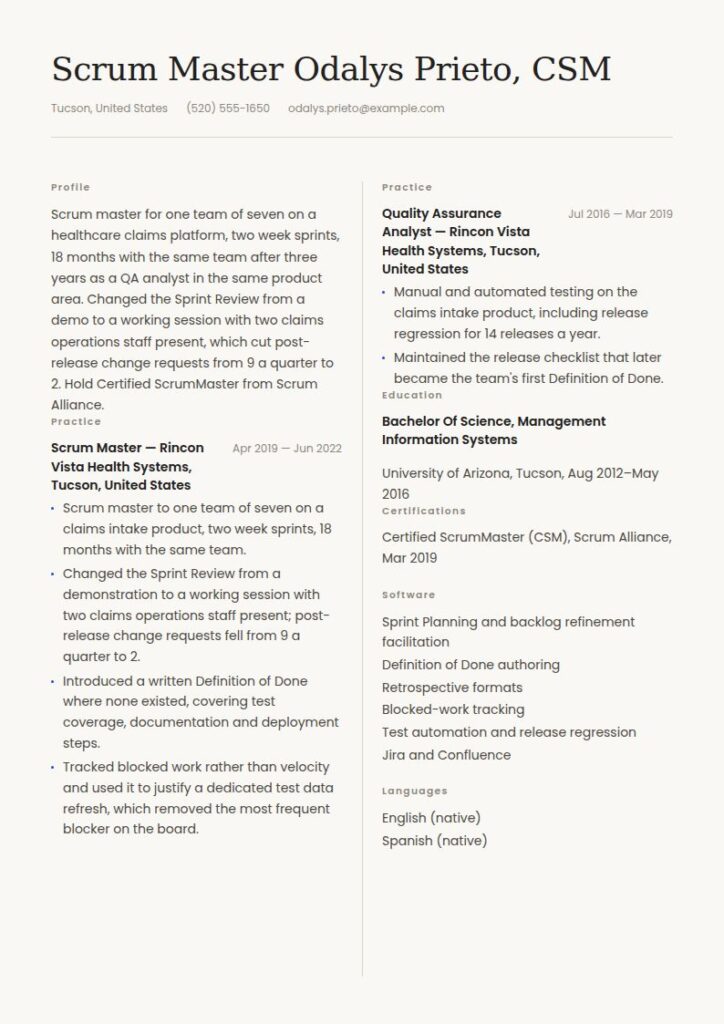
Scrum master for one team of seven on a healthcare claims platform, two week sprints, 18 months with the same team after three years as a QA analyst in the same product area. Changed the Sprint Review from a demo to a working session with two claims operations staff present, which cut post-release change requests from 9 a quarter to 2. Hold Certified ScrumMaster from Scrum Alliance.
Work Experience
04/2019 - 06/2022, Scrum Master, Rincon Vista Health Systems, Tucson, United States
- Scrum master to one team of seven on a claims intake product, two week sprints, 18 months with the same team.
- Changed the Sprint Review from a demonstration to a working session with two claims operations staff present; post-release change requests fell from 9 a quarter to 2.
- Introduced a written Definition of Done where none existed, covering test coverage, documentation and deployment steps.
- Tracked blocked work rather than velocity and used it to justify a dedicated test data refresh, which removed the most frequent blocker on the board.
07/2016 - 03/2019, Quality Assurance Analyst, Rincon Vista Health Systems, Tucson, United States
- Manual and automated testing on the claims intake product, including release regression for 14 releases a year.
- Maintained the release checklist that later became the team's first Definition of Done.
Education
08/2012 - 05/2016, Bachelor of Science, Management Information Systems, University of Arizona, Tucson, United States
Coursework in systems analysis, databases and organizational behavior.
Skills
Sprint Planning and backlog refinement facilitation, 75
Definition of Done authoring, 75
Retrospective formats, 70
Blocked-work tracking, 75
Test automation and release regression, 80
Jira and Confluence, 85
Languages
English, native
Spanish, native
Certificates
03/2019, Certified ScrumMaster (CSM), Scrum Alliance
Renewed every two years with Scrum Education Units.
Summary
A scrum master resume is a one to two page document that evidences the accountabilities, events and artifacts the 2020 Scrum Guide actually names, rather than listing ceremonies run. This guide gives you three adaptable versions, the certifications with their named bodies and renewal rules, and current Bureau of Labor Statistics pay and outlook for the occupation the role is published under.
Scrum Master resume examples by experience level
In short, a scrum master resume is a one to two page document that shows what changed on your teams, measured against the framework the job is named after.
That framework, in fact, is a document, not a philosophy. Specifically, the Scrum Guide by Ken Schwaber and Jeff Sutherland, in its November 2020 revision at scrumguides.org, defines three accountabilities, five events and three artifacts, each artifact with a commitment attached. Moreover, it says the Scrum Master is "accountable for establishing Scrum as defined in the Scrum Guide".
However, most scrum master resumes never mention any of it. They list ceremonies as though attendance were the work, and they lead with velocity, which is not an achievement metric and cannot be compared between teams. As a result, a file that walks the actual accountabilities, with evidence for each, reads as a different candidate.
Resume guide for a scrum master resume
Accordingly, this guide and the corresponding scrum master resume example will cover:
- How to write a scrum master resume, section by section
- What evidence exists for each accountability the Scrum Guide names
- Three adaptable summaries: first team, practicing and multi-team
- Why velocity does not belong in your achievements, and what replaces it
- What the job market looks like and what you can expect to earn
How to write a scrum master resume
Overall, six sections: contact header, summary, team facts, experience, skills and practices, and education with certifications. Generally, one page for your first five years, two once you have worked across several teams and coached others.
The team facts block, in particular, goes directly under the summary. It answers, above all, the four questions every hiring manager asks first: how many teams, how big, what cadence, and what you changed.
| Section | What it is answering | Where it goes |
|---|---|---|
| Summary | How many teams, what domain, and what moved | First three or four lines |
| Team facts | Team count, size, sprint length, event changes | Its own block under the summary |
| Experience | What you changed on each team and what followed | Reverse chronological, by team |
| Certifications | Which body issued it, and is the cycle current? | With education |
Write the four team facts before anything else
Four numbers place a scrum master faster than any paragraph: how many teams you serve, how many people on each, how long your sprint is, and how long you have been with that team.
They matter because the job is different at each setting. One team of six on a two week cadence is a coaching job. Four teams of nine across two products is a systems job with very little coaching in it. A reader who cannot tell which you did has to guess, and they usually guess the smaller one.
Add a fifth fact and the block is finished: the one event you changed, and what happened to flow. Not the events you ran. The one you altered on purpose, with a before and an after.
Run the finished file through the ATS resume checker before you submit. Agile roles attract high application volumes and are parsed before a person opens them.
Choosing the best resume format for a scrum master resume
Reverse chronological, then, with the employer as the spine and each team as a sub-entry. Similarly, one page for your first five years, two once you have several teams and a coaching line worth describing.
Organize by team rather than by project. After all, a scrum master's unit of work is a team over time, not a deliverable, and a reader wants to know how long you stayed with one. Six months is an assignment. For example, two years is a relationship, and the improvements you claim only become believable at that length.
Include your contact information
| ✅ Right | ❌ Wrong |
|---|---|
| Odalys Prieto, CSM | Odalys Prieto |
| Scrum Master, 4 teams, healthcare claims platform | Certified Agile Professional and Servant Leader |
| Certified ScrumMaster (Scrum Alliance), PMP (PMI) | CSM, PSM, SAFe, Agile, Scrum, Kanban |
| (520) 555-1650, [email protected], Tucson, AZ | (520) 555-1650, [email protected] |
The second line, meanwhile, gives the span and the domain in one read. The third names the issuing body for each credential, because Certified ScrumMaster and Professional Scrum Master come from different organizations with different rules, and the acronym does not say which you hold.
Make use of a summary
In short, four lines: how many teams and how big, the domain, one event or artifact change with its effect, and the credential with its body.
Scrum master for one team of seven on a healthcare claims platform, two week sprints, 18 months with the same team after three years as a QA analyst in the same product area. Changed the Sprint Review from a demo to a working session with two claims operations staff present, which cut post-release change requests from 9 a quarter to 2. Hold Certified ScrumMaster from Scrum Alliance.
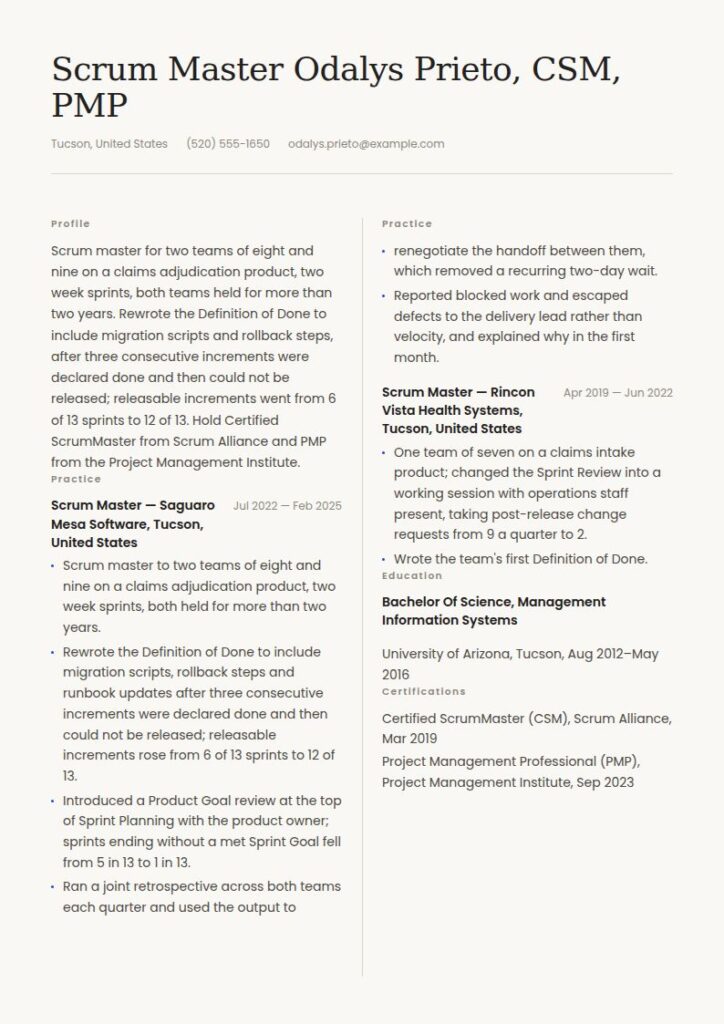
Scrum master for two teams of eight and nine on a claims adjudication product, two week sprints, both teams held for more than two years. Rewrote the Definition of Done to include migration scripts and rollback steps, after three consecutive increments were declared done and then could not be released; releasable increments went from 6 of 13 sprints to 12 of 13. Hold Certified ScrumMaster from Scrum Alliance and PMP from the Project Management Institute.
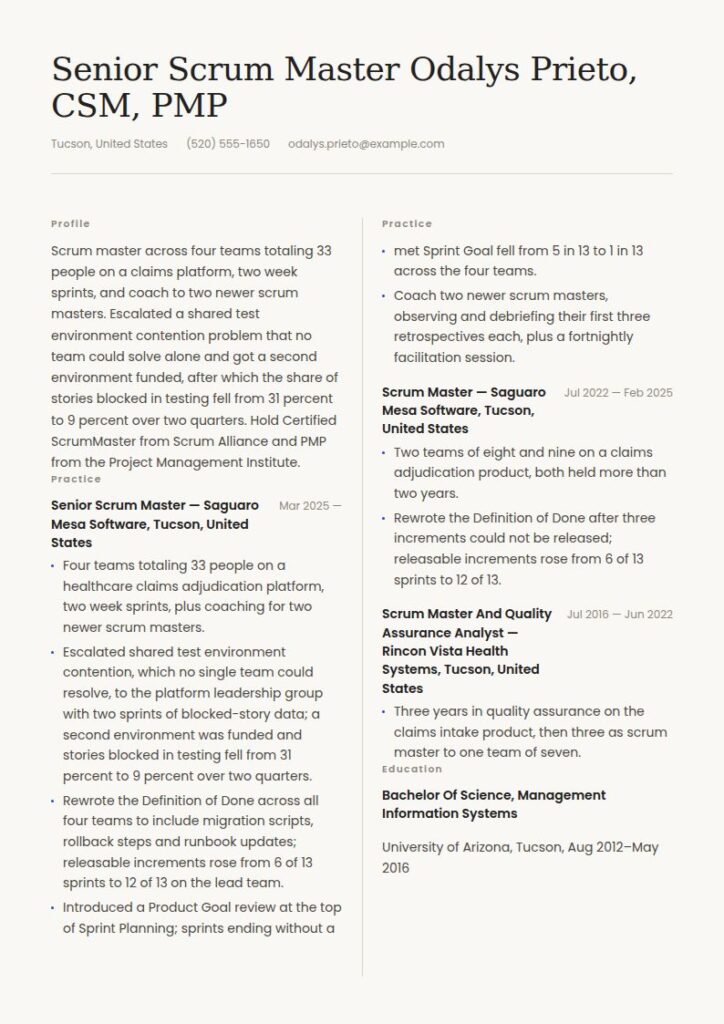
Scrum master across four teams totaling 33 people on a claims platform, two week sprints, and coach to two newer scrum masters. Escalated a shared test environment contention problem that no team could solve alone and got a second environment funded, after which the share of stories blocked in testing fell from 31 percent to 9 percent over two quarters. Hold Certified ScrumMaster from Scrum Alliance and PMP from the Project Management Institute.
Right vs wrong: the same scrum master summary, twice
| ✅ Right | ❌ Wrong |
|---|---|
| Scrum master for two teams of eight and nine, two week sprints, both held over two years. | Experienced scrum master with a passion for agile transformation. |
| Rewrote the Definition of Done to include migration scripts and rollback steps. | Facilitated all scrum ceremonies and removed impediments. |
| Releasable increments went from 6 of 13 sprints to 12 of 13. | Increased team velocity by 40 percent. |
For instance, the right column names a change to a specific artifact and an outcome tied to the Scrum Guide's own definition of done. The wrong column, on the other hand, ends in velocity, which is the point covered next.
Outline your scrum master experience
Then, employer and dates as the spine, each team as a labeled entry: size, cadence, domain, how long you were with it, and three to four bullets. Every bullet names an event, an artifact or an accountability, and carries a before and an after.
| Instead of | Use |
|---|---|
| Facilitated all scrum ceremonies for the team | Ran two week sprints with a team of nine for 26 months, including Sprint Planning, Daily Scrum, Review and Retrospective |
| Removed impediments for the development team | Escalated shared test environment contention to the platform group and got a second environment funded |
| Increased team velocity by 40 percent | Releasable increments rose from 6 of 13 sprints to 12 of 13 after the Definition of Done was rewritten |
| Coached the team on agile best practices | Coached two new scrum masters through their first six sprints, including their first three retrospectives each |
| Worked with the product owner on the backlog | Introduced a Product Goal review at the top of every Sprint Planning; the share of sprints ending without a met Sprint Goal fell from 5 in 13 to 1 in 13 |
| Improved team communication and collaboration | Changed the Sprint Review from a demo to a working session with two operations staff present; post-release change requests fell from 9 a quarter to 2 |
Senior Scrum Master, Saguaro Mesa Software, Tucson, AZ, March 2025 to Present
Four teams totaling 33 people on a healthcare claims adjudication platform, two week sprints, and coach to two newer scrum masters.
Escalated shared test environment contention, which no single team could resolve, to the platform leadership group with two sprints of blocked-story data. A second environment was funded; stories blocked in testing fell from 31 percent to 9 percent over the following two quarters.
Rewrote the Definition of Done across all four teams to include migration scripts, rollback steps and updated runbooks, after three increments were declared done and then could not be released. Releasable increments rose from 6 of 13 sprints to 12 of 13 on the lead team.
Introduced a Product Goal review at the top of Sprint Planning with the product owners. Sprints ending without a met Sprint Goal fell from 5 in 13 to 1 in 13 across the four teams.
Coach two newer scrum masters, observing and debriefing their first three retrospectives each, plus a fortnightly facilitation session.
Stayed with the lead team for 26 months, which is why the figures above cover the same people.
Evidence for each accountability the Scrum Guide actually names
Above all, the Scrum Guide is the source the job title comes from. Moreover, Ken Schwaber and Jeff Sutherland published the current revision in November 2020 at scrumguides.org, and it names exactly three accountabilities, five events and three artifacts. Therefore, walking them is the fastest way to find what your resume should say.
The three accountabilities. Developers, the Product Owner, and the Scrum Master. The Guide states that the Scrum Master is "accountable for establishing Scrum as defined in the Scrum Guide" and for the team's effectiveness. Your resume evidences that in three lines: what you established that was not there before, how you served the Product Owner, and what you did for the Developers. "Rewrote the Definition of Done", "introduced a Product Goal review at Sprint Planning" and "escalated a blocker no team could fix alone" are one of each.
The five events. The Sprint, Sprint Planning, the Daily Scrum, the Sprint Review, and the Sprint Retrospective. Do not list them; a reader assumes you run them. Name the one you changed. Turning the Sprint Review from a demonstration into a working session with real users in the room has a measurable consequence. Running it every fortnight is attendance.
Scrum artifacts and what to leave off
The three artifacts and their commitments. The Product Backlog with the Product Goal, the Sprint Backlog with the Sprint Goal, and the Increment with the Definition of Done. This is the richest evidence on the page and almost nobody uses it. Each commitment either exists and is honored or does not. Could the team recite the Product Goal? Was the Sprint Goal met, and how often? Was the Increment releasable at the end of the Sprint, or done in name?
| Scrum Guide element | What your resume can evidence |
|---|---|
| Scrum Master accountability | One practice you established that was absent before, with what it changed |
| Product Owner service | A backlog or Product Goal practice you introduced, and its effect on Sprint Goals met |
| Developers service | An impediment you removed or escalated, with the blocked work before and after |
| An event you changed | Which event, what you changed, and the flow consequence |
| Definition of Done | What you added to it, and the change in releasable increments |
| Sprint Goal | How often it was met, before and after |
Team facts (current assignment)
Teams: 4, totaling 33 people, on one claims adjudication platform. Longest tenure with one team: 26 months.
Cadence: two week sprints, shared Sprint Review, separate retrospectives.
Event changed: Sprint Review, from demonstration to working session with two claims operations staff present. Post-release change requests fell from 9 a quarter to 2.
Definition of Done: rewritten to include migration scripts, rollback steps and runbook updates. Releasable increments 6 of 13 sprints to 12 of 13.
Impediment escalated: shared test environment contention, taken to platform leadership with two sprints of blocked-story data. Second environment funded; blocked stories 31 percent to 9 percent.
Coaching: two newer scrum masters, first three retrospectives each observed and debriefed.
One thing to leave off. Velocity is a planning input for one team, not a performance measure, and it is not comparable between teams because story points are calibrated locally. A resume claiming velocity rose 40 percent tells a reader either that the team re-estimated or that the writer does not know what the number is for. Use releasable increments, met Sprint Goals, blocked work or escaped defects instead.
Build a snapshot of your key scrum master skills
In addition, twelve to sixteen entries in four groups: the framework, facilitation, the engineering practices you work next to, and tooling. Keep the framework group in the Scrum Guide's own vocabulary, because that is what signals you have read it.
Scrum framework: Definition of Done, Sprint Goal and Product Goal, backlog refinement, Sprint Review as working session, retrospective formats, Scrum of Scrums
Facilitation: conflict surfacing, silent brainstorming, dot voting, timeboxing, difficult retrospective repair, working agreements
Flow and measurement: cycle time, work in progress limits, blocked-work analysis, escaped defect tracking, cumulative flow diagrams
Engineering adjacency: continuous integration practice, test automation coverage conversations, release and rollback planning, environment management
Tooling: Jira and Jira Align, Confluence, Miro, Azure DevOps, GitHub, Slack workflow automation
List your education and certifications
Degree, then certifications with the issuing body, the year, and the state of your renewal cycle. On this title the issuing body matters unusually much, because several similar credentials come from different organizations with different rules.
Scrum Alliance issues the Certified ScrumMaster credential, which is renewed every two years and evidenced with Scrum Education Units (Scrum Alliance, retrieved 16 September 2026). The Project Management Institute issues the Project Management Professional credential, whose renewal requires 60 professional development units in each three-year cycle, and whose eligibility is a bachelor's degree with three years of project management experience, an associate's degree with four years, or a high school diploma with five, plus 35 hours of training in every case (PMI, retrieved 16 September 2026).
Consequently, write the cycle state next to the credential. "Certified ScrumMaster, Scrum Alliance, earned 2019, renewed 2025" and "Certified ScrumMaster, Scrum Alliance, 2019" look identical to a scanner and very different to a hiring manager.
Bachelor of Science, Management Information Systems, University of Arizona, Tucson, AZ, 2016
Certifications:
Certified ScrumMaster (CSM), Scrum Alliance, earned 2019, renewed 2025, current cycle
Project Management Professional (PMP), Project Management Institute, earned 2023, current cycle
Prior role: Quality Assurance Analyst, claims platform, 2016 to 2019
Choose the right layout and design
In particular, single column, 11 point body type, employer as the heading and each team as a bold sub-line. Also, use no photograph, no radar chart of agile competencies, no maturity model graphic. Let the before and after numbers do the work.
Give the four team facts before anything else. Name the one event you changed and what it did to flow. Say what you added to the Definition of Done. Give Sprint Goal attainment as a count of sprints. Name the impediment you escalated that was not yours to fix. List certifications with the issuing body and the renewal state.
Do not claim a velocity increase as an achievement. Do not list the five events as though running them were the accomplishment. Do not call yourself a servant leader without an example underneath it. Do not stack acronyms from four certifying bodies in one line. Do not claim a transformation you observed rather than ran.
Scrum master job market and outlook
The Bureau of Labor Statistics, however, publishes no Occupational Outlook Handbook profile under the title scrum master. Instead, the nearest published occupation is project management specialists, which covers delivery roles across every sector.
| Measure | Value |
|---|---|
| Published occupation | Project management specialists |
| Jobs, 2025 | 1,094,300 |
| Projected change, 2025-35 | 7 percent, +73,200 |
| Projected annual openings | About 76,500 |
| Typical entry-level education | Bachelor's degree |
| Median annual wage, May 2025 | $102,320, or $49.19 per hour |
| Management ceiling, May 2025 | Computer and information systems managers, $175,140 |
Source: U.S. Bureau of Labor Statistics, Occupational Outlook Handbook, 2025-35 projections and May 2025 wage data, published 27 August 2026.
A broad published occupation, and a narrow one above it
Project management specialists held 1,094,300 jobs in 2025, with a projected 7 percent growth and about 76,500 openings a year through 2035 (BLS Occupational Outlook Handbook, 2025-35 projections).
The occupation is far broader than software delivery. Professional, scientific and technical services accounted for 28 percent of its 2025 employment, construction for 22 percent and manufacturing for 7 percent (BLS, 2025). Sector medians in May 2025 ran from $120,700 in finance and insurance down to $98,730 in construction (BLS, May 2025).
Above it sits computer and information systems managers, with a median annual wage of $175,140 in May 2025, 685,800 jobs and projected 16 percent growth through 2035 (BLS, May 2025 and 2025-35 projections). A resume that demonstrates change across several teams argues toward that band. One that lists ceremonies does not, and no certification closes the distance.
What salary you can expect as a scrum master
There is no Handbook median published under this job title, because the Bureau of Labor Statistics does not maintain an occupational profile for it. Thus, the published occupation to quote is project management specialists, with a median annual wage of $102,320 as of May 2025, or $49.19 an hour. The lowest 10 percent earned less than $61,580 and the highest 10 percent more than $167,970 (BLS, May 2025).
Sector matters inside that figure. For example, May 2025 medians ran to $120,700 in finance and insurance, $108,260 in professional, scientific and technical services, $102,640 in manufacturing, $98,890 in administrative and support services and $98,730 in construction (BLS, May 2025). A software scrum master, therefore, is competing near the upper end, not at the midpoint.
What moves an individual offer is scope and evidence rather than certification count. Certified ScrumMaster is renewed every two years through Scrum Alliance and is now common enough that it sets a floor rather than a ceiling. The candidates who price above the median can say how many teams, for how long, what they changed in the framework, and what moved as a result. When you negotiate, quote the occupation and the cycle: the BLS May 2025 median for project management specialists is $102,320, the finance and insurance median is $120,700, and computer and information systems managers sit at $175,140.
Key takeaways for a scrum master resume
- To begin with, give four team facts: how many teams, how big, what cadence, how long.
- Similarly, evidence each accountability the Scrum Guide names, one line each.
- Likewise, name the one event you changed, not the five you attend.
- Also say what you added to the Definition of Done and what it did to releasable increments.
- Report Sprint Goal attainment as a count of sprints, before and after.
- Leave velocity off, because it is a planning input, not a result.
- Finally, list certifications with the issuing body and the renewal cycle.
Build your scrum master resume in 15 minutes with our AI resume builder.
Related information technology resume examples
- IT project manager resume
- Technical project manager resume
- Engineering manager resume
- QA tester resume
- Software tester resume
- Automation tester resume
- Software engineer resume
- Systems analyst resume
- DevOps engineer resume
- Full stack developer resume
- Java developer resume
- IT manager resume
Pair it with a matching scrum master cover letter.
Scrum master resume questions, answered
Why should I not put velocity on my scrum master resume?
Story points are calibrated inside one team and mean nothing outside it, so a velocity figure is not comparable and a rise in it can be produced by re-estimating. Use releasable increments, Sprint Goals met, blocked work or escaped defects instead, all of which survive the comparison.
How long should a scrum master resume be?
One page for your first five years. Two once you have worked across several teams, coached other scrum masters, or changed practice at a level above a single team. The team facts block earns its place at either length.
Which certification matters most?
The one whose issuing body you can name, with a current renewal cycle. Scrum Alliance issues the Certified ScrumMaster and renews it every two years using Scrum Education Units (Scrum Alliance, retrieved 16 September 2026). The Project Management Institute issues the PMP with 60 professional development units per three-year cycle (PMI, retrieved 16 September 2026). Credentials set a floor; nothing above it comes from stacking more of them.
What do I write if my organization does not really do Scrum?
Write what happened, in the Guide's vocabulary, and say where the practice diverged. "Two week sprints with a shared Sprint Review across four teams; no separate Product Owner, so backlog decisions sat with a business analyst and I ran a weekly refinement session to compensate" is honest, specific and more interesting than textbook description.
How do I move from scrum master to a broader delivery role?
Show change above the level of one team: an impediment escalated and funded, a Definition of Done adopted across several teams, or scrum masters you coached. That is what separates the project management specialist band, with a median annual wage of $102,320 in May 2025, from the computer and information systems manager band at $175,140 (BLS, May 2025).
Do I need a technical background to be a scrum master?
Not formally, but you need enough to follow the Developers' conversation about why an increment is not releasable. A previous role in quality assurance, support, business analysis or development is worth naming on the page, and it is what makes a Definition of Done rewrite credible rather than administrative.