QA Automation Engineer Yevgenia Sokolova
QA Automation Engineer
[email protected] | (813) 555-1852 | Tampa, United States
Profile
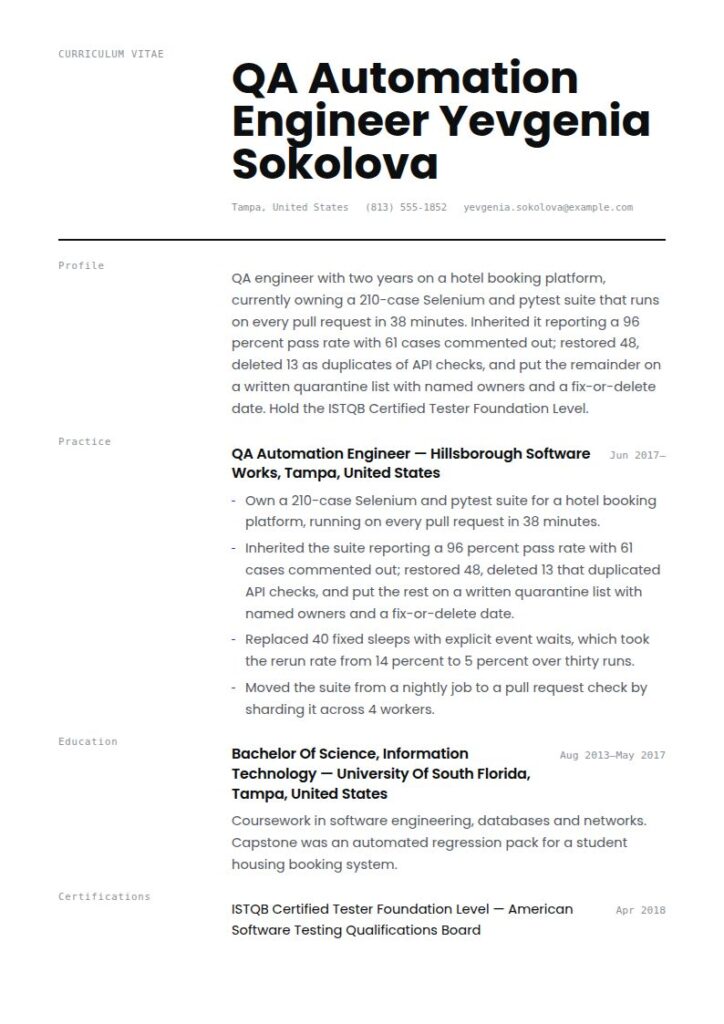
QA engineer with two years on a hotel booking platform, currently owning a 210-case Selenium and pytest suite that runs on every pull request in 38 minutes. Inherited it reporting a 96 percent pass rate with 61 cases commented out; restored 48, deleted 13 as duplicates of API checks, and put the remainder on a written quarantine list with named owners and a fix-or-delete date. Hold the ISTQB Certified Tester Foundation Level.
Work Experience
06/2017 - Present, QA Automation Engineer, Hillsborough Software Works, Tampa, United States
- Own a 210-case Selenium and pytest suite for a hotel booking platform, running on every pull request in 38 minutes.
- Inherited the suite reporting a 96 percent pass rate with 61 cases commented out; restored 48, deleted 13 that duplicated API checks, and put the rest on a written quarantine list with named owners and a fix-or-delete date.
- Replaced 40 fixed sleeps with explicit event waits, which took the rerun rate from 14 percent to 5 percent over thirty runs.
- Moved the suite from a nightly job to a pull request check by sharding it across 4 workers.
Education
08/2013 - 05/2017, Bachelor of Science, Information Technology, University of South Florida, Tampa, United States
Coursework in software engineering, databases and networks. Capstone was an automated regression pack for a student housing booking system.
Skills
Selenium WebDriver, 70
pytest and fixtures, 70
Python, 70
SQL for result verification, 65
Git and pull request review, 70
Jenkins and CI test jobs, 60
Defect triage and reporting, 75
Test data setup, 65
Languages
English, native
Russian, native
Spanish, intermediate
Certificates
04/2018, ISTQB Certified Tester Foundation Level, American Software Testing Qualifications Board, ASTQB-CTFL-522904
Foundation Level v4.0 scheme. ISTQB certificates below Expert Level do not expire.
Summary
An automation tester resume is a one to two page document describing the test suite you own by its numbers: case count, wall-clock runtime, flake rate, quarantine list and what it gates. This guide gives you three adaptable versions, the suite block almost no applicant writes, what ISTQB publishes about its automation credential, and the wage gap that decides how your file is read.
Automation Tester resume examples by experience level
An automation tester resume is a one to two page document describing the suite you own by its numbers: how many cases it holds, how long it takes to run, how often it fails for reasons that have nothing to do with the code, what you took out of it, and what it blocks when it goes red.
Most resumes for this job give one number, and it is the wrong one. "Automated 400 test cases" and "achieved 95 percent automation coverage" are both unfalsifiable, and both reward the behavior a good automation engineer spends a career undoing: adding cases nobody reads the results of. A suite that takes ninety minutes and fails one run in ten for no reason is worse than no suite, because people start ignoring it and then start merging past it.
Resume guide for an automation tester resume
In short, this guide and the corresponding automation tester resume example will cover:
- First, how to write an automation tester resume, section by section
- Then the five numbers that describe a suite, and why the quarantine list is the honest one
- Also, three adaptable summaries: first automation role, working engineer and lead
- What ISTQB publishes about its automation credential and whether it expires
- Finally, why the same Handbook profile pays two very different medians, and which one your resume asks for
How to write an automation tester resume
To start, plan six sections: contact header with a title line, summary, a suite block, experience, skills, and education with certifications. Keep one page for your first four years, then two once you own the pipeline the suite runs in.
| Section | What it is answering | Where it goes |
|---|---|---|
| Title line | Test author, or owner of the automation platform? | Directly under your name |
| Summary | How many cases, how long, how flaky, gating what? | Three or four lines |
| Suite block | Can this person be trusted with the gate on the release pipeline? | Its own block |
| Experience | What did the suite catch, and what did you take out of it? | Reverse chronological, with numbers |
| Skills | Which frameworks did you operate, not just read about? | Grouped, kept short |
| Certifications | Foundation Level, and anything beyond it | With education |
Open your pipeline and write down five numbers before you draft anything
Go to the last thirty runs of your main suite and find five things: the case count, the wall-clock runtime and the parallelism behind it, how many runs needed a rerun that then passed with no code change, how many cases are quarantined, and what the suite blocks when it is red.
Nobody produces those from memory, which is why they work. Every applicant writes "developed automated test scripts". One who writes "4,180 cases, 22 minutes on 40 containers, 0.4 percent rerun rate, 11 quarantined, blocks the release candidate" has described a system rather than a task.
Run the finished file through the ATS resume checker before you submit. Testing postings draw heavy volume, and software parses them into a structured record before a person opens them.
Choosing the best resume format for an automation tester resume
Reverse chronological. In other words, one page for your first four years, two once you have owned a suite through a rewrite, run the pipeline it executes in, or led a team. Employers judge this job on what a suite looked like when you arrived and when you left, so removing the timeline removes the evidence.
Include your contact information
| ✅ Right | ❌ Wrong |
|---|---|
| Yevgenia Sokolova | Yevgenia Sokolova |
| Test Automation Engineer, Playwright and pytest, CI-gating suites | Detail-oriented QA professional passionate about quality |
| ISTQB Certified Tester Foundation Level, ASTQB #ASTQB-CTFL-522904 | ISTQB Certified |
| (813) 555-1852, [email protected], Tampa, FL | (813) 555-1852, [email protected] |
Also, put the certificate number on the page. After all, a recruiter can verify it in ten seconds, and it separates your file from the many that list the acronym without holding it.
Make use of a summary
Next, write four lines: what you automate, the suite by its numbers, what it gates, and one thing you took out.
QA engineer with two years on a hotel booking platform, currently owning a 210-case Selenium and pytest suite that runs on every pull request in 38 minutes. Inherited it reporting a 96 percent pass rate with 61 cases commented out; restored 48, deleted 13 as duplicates of API checks, and put the remainder on a written quarantine list with named owners and a fix-or-delete date. Hold the ISTQB Certified Tester Foundation Level.
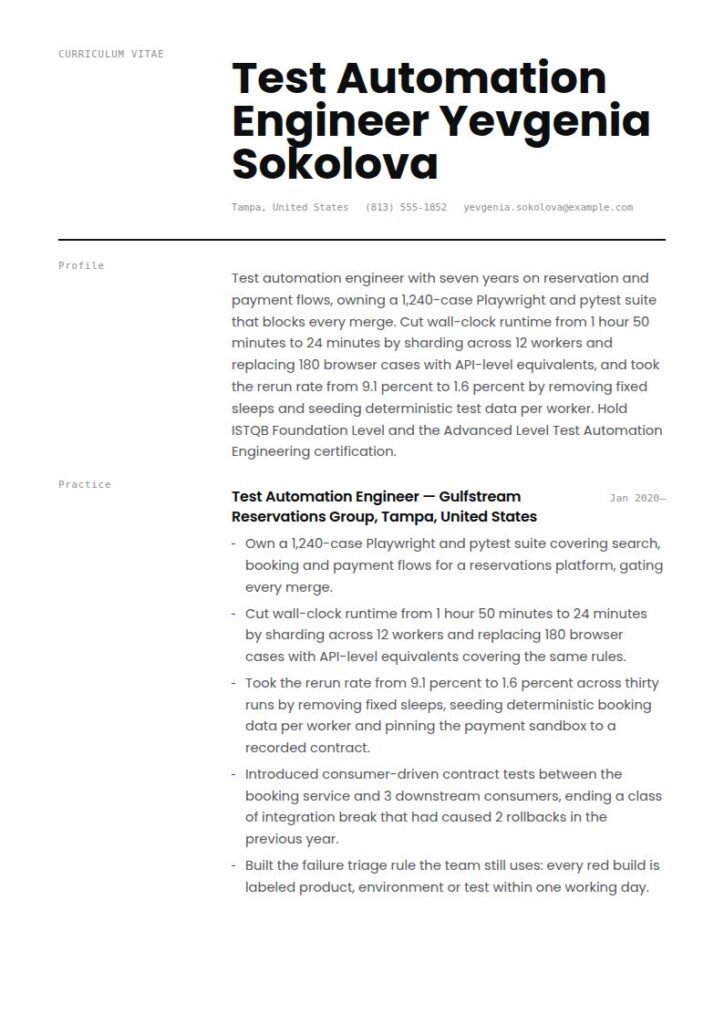
Test automation engineer with seven years on reservation and payment flows, owning a 1,240-case Playwright and pytest suite that blocks every merge. Cut wall-clock runtime from 1 hour 50 minutes to 24 minutes by sharding across 12 workers and replacing 180 browser cases with API-level equivalents, and took the rerun rate from 9.1 percent to 1.6 percent by removing fixed sleeps and seeding deterministic test data per worker. Hold ISTQB Foundation Level and the Advanced Level Test Automation Engineering certification.
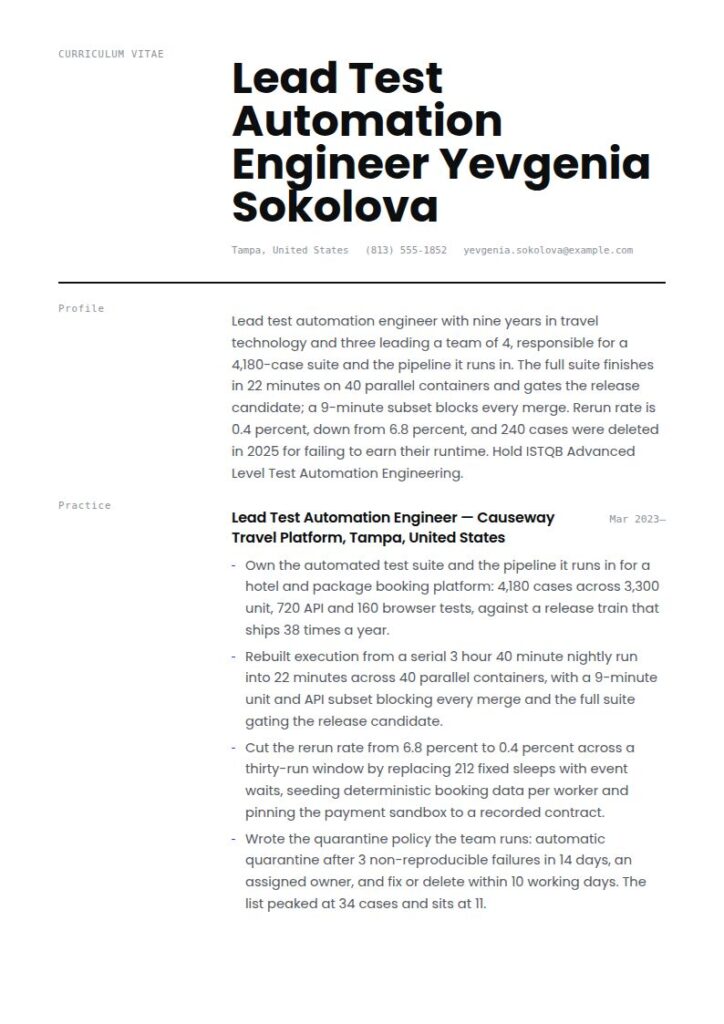
Lead test automation engineer with nine years in travel technology and three leading a team of 4, responsible for a 4,180-case suite and the pipeline it runs in. The full suite finishes in 22 minutes on 40 parallel containers and gates the release candidate; a 9-minute subset blocks every merge. Rerun rate is 0.4 percent, down from 6.8 percent, and 240 cases were deleted in 2025 for failing to earn their runtime. Hold ISTQB Advanced Level Test Automation Engineering.
Right vs wrong: the same automation tester summary, twice
| ✅ Right | ❌ Wrong |
|---|---|
| Own a 1,240-case Playwright and pytest suite that blocks every merge. | Experienced in automation testing using a variety of modern frameworks. |
| Cut wall-clock runtime from 1 hour 50 minutes to 24 minutes across 12 workers. | Improved test execution efficiency and reduced testing time significantly. |
| Took the rerun rate from 9.1 percent to 1.6 percent by removing fixed sleeps and seeding data per worker. | Achieved 95 percent automation coverage and high test reliability. |
Outline your automation testing experience
Employer, product, dates, then one line describing the system under test: what it does, how often it releases, what your suite blocks. Additionally, in experience, write three to five bullets each, every one naming a framework, a layer or a pipeline stage and carrying a number.
| Instead of | Use |
|---|---|
| Developed and maintained automated test scripts | Own 4,180 cases across unit, API and browser layers, gating a release train that ships 38 times a year |
| Reduced test execution time | Took the full suite from 3 hours 40 minutes serial to 22 minutes on 40 parallel containers |
| Improved test reliability | Cut the rerun rate from 6.8 percent to 0.4 percent by replacing fixed sleeps with event waits and seeding data per worker |
Lead Test Automation Engineer, Causeway Travel Platform, Tampa, FL, March 2023 to Present
Own the automated test suite and the pipeline it runs in for a hotel and package booking platform: 4,180 cases across 3,300 unit, 720 API and 160 browser tests, against a release train that ships 38 times a year.
Rebuilt suite execution from a serial 3 hour 40 minute nightly run into 22 minutes across 40 parallel containers, with a 9-minute unit and API subset that blocks every merge and the full suite gating the release candidate.
Cut the rerun rate, meaning runs that passed on a second attempt with no code change, from 6.8 percent to 0.4 percent across the same thirty-run window, by replacing fixed sleeps with event waits, seeding deterministic booking data per worker and pinning the payment sandbox to a recorded contract.
Wrote the quarantine policy the team now runs: a case failing non-reproducibly three times in 14 days is quarantined automatically, assigned an owner, and fixed or deleted within 10 working days. The list peaked at 34 and sits at 11. Deleted 240 cases in 2025 that had not failed in 18 months and duplicated API-level coverage, removing 19 minutes of runtime and no defect detection.
Your suite's numbers: runtime, flake rate and what you quarantined
In practice, this is the section almost nobody writes, and it is the whole difference between an automation resume and a list of framework names.
Moreover, the issuing body agrees, which is worth citing. Specifically, ISTQB publishes the Certified Tester Advanced Level Test Automation Engineering syllabus, version 2.0, released 3 May 2024, and two of its eight chapters are "Test Automation Reporting and Metrics" and "Verifying the Test Automation Solution", with a third on continuous improvement (ISTQB, CTAL-TAE syllabus v2.0). In other words, the credential assumes the automation is itself a system that you have to measure and verify. Even so, very few candidates write resumes for the job that way.
The automation tester suite in numbers
For example, five numbers describe a suite, and a reader can test every one of them in an interview.
| The number | Why the reader wants it | Example |
|---|---|---|
| Case count, split by layer | A suite that is 90 percent browser tests is a different animal from one that is 80 percent unit tests | 4,180 cases: 3,300 unit, 720 API, 160 browser |
| Wall-clock runtime, and the parallelism behind it | Runtime is the constraint that decides whether anyone waits for the result | 22 minutes on 40 containers, from 3 hours 40 minutes serial |
| Rerun or flake rate, over a stated window | The number that says whether the suite is believed | 0.4 percent of runs over thirty, down from 6.8 percent |
| Quarantine count, and the policy behind it | The honest number, and the one nobody volunteers | 11 quarantined, auto-quarantine after 3 non-reproducible failures in 14 days |
| What it gates | Separates a suite that informs from a suite that stops things | 9-minute subset blocks every merge, full suite blocks the release candidate |
Quarantined and deleted tests
Take the quarantine number seriously, because it makes the rest credible. Any suite can report a 99 percent pass rate if the failing cases were commented out, skipped or marked expected-failure, and that is the most common thing found when someone new takes over a suite. As a result, a quarantine count, a policy with a deadline and an owner per case tells a reader you know where the bodies are and wrote the rule for digging them up.
Then give the number almost nobody gives: what you deleted. Cutting a suite is a stronger claim than growing one, because it means you read failure history and traded runtime against detection deliberately. "Deleted 240 cases that had not failed in 18 months and duplicated API coverage, removing 19 minutes of runtime and no defect detection" is the opposite of the coverage-percentage claim on every other file in the folder.
Suite owned (current role)
Size and shape: 4,180 automated cases, 3,300 unit, 720 API and contract, 160 end-to-end browser. Playwright with TypeScript for browser, pytest for API and unit, Pact for consumer contracts.
Execution: 22 minutes wall clock on 40 parallel containers in GitHub Actions, from a serial 3 hour 40 minute nightly run. A 9-minute unit and API subset blocks every merge; the full suite gates the release candidate.
Reliability: rerun rate 0.4 percent across the last thirty runs, down from 6.8 percent. Fixed by replacing 212 fixed sleeps with event waits, seeding deterministic booking data per worker and pinning the payment sandbox to a recorded contract.
Quarantine: 11 cases, from a peak of 34. Policy is automatic quarantine after 3 non-reproducible failures in 14 days, an assigned owner, and fix or delete within 10 working days.
Outcomes: mean time to diagnose a red build 7 minutes, from 41. Five defects escaped to production across 38 releases in 2025 that the suite was scoped to catch, each with a case added.
Build a snapshot of your key automation tester skills
Later, in skills, list twelve to sixteen entries in four groups, frameworks first. Then list tools you have debugged a flaky test in, not ones whose documentation you have read.
Automation frameworks: Playwright with TypeScript, Selenium WebDriver, pytest and fixtures, Cypress, REST Assured, Pact consumer-driven contracts
Languages and code: Python, TypeScript and JavaScript, SQL for result verification, Git and pull request review
Pipeline and infrastructure: GitHub Actions, Docker Compose test environments, parallel sharding and test distribution, artifact and trace capture, Kubernetes ephemeral environments
Practice: Test data management and deterministic seeding, flaky test triage and quarantine policy, API and contract testing, risk-based scope calls
List your education and certifications
Degree, then certifications with the awarding body and the certificate number, then the pipeline work that is not certified but is provable.
Meanwhile, a bachelor's degree is the typical entry-level education for software quality assurance analysts and testers, and the Handbook lists no related work experience and no on-the-job training as typical for entry into the occupation (BLS Occupational Outlook Handbook, retrieved 17 September 2026). Plenty of automation engineers arrive from support, manual testing or development instead, and that route is worth writing as experience rather than apologizing for.
What ISTQB publishes about its automation credential, and whether it expires
ISTQB structures its scheme in Core Foundation, Core Advanced, Specialist and Expert levels. The entry credential is the Certified Tester Foundation Level, version 4.0, examined in 40 questions over 60 minutes with a pass mark of 26 of 40 points and 25 percent additional time for candidates whose first language is not the exam language (ISTQB, retrieved 17 September 2026).
The automation credential is the Certified Tester Advanced Level Test Automation Engineering, version 2.0, released 3 May 2024. Its syllabus states that the ISTQB Foundation Level certificate must be obtained before taking the exam, so the two lines belong on the page together and in that order (ISTQB, CTAL-TAE syllabus v2.0).
On renewal, ASTQB, the American Software Testing Qualifications Board and the ISTQB member board in the United States, states that ISTQB certification does not expire for any certificate below the Expert Level, so those certificates are valid indefinitely; the Test Management certifications that do expire run seven years and can be renewed (ASTQB, retrieved 17 September 2026). Date the line anyway. A reader wants to know when you sat it, not whether it lapsed.
Bachelor of Science, Information Technology, University of South Florida, Tampa, FL, 2017
ISTQB Certified Tester Foundation Level, American Software Testing Qualifications Board, #ASTQB-CTFL-522904, 2018
ISTQB Certified Tester Advanced Level Test Automation Engineering, American Software Testing Qualifications Board, #ASTQB-CTAL-TAE-14733, 2024
Choose the right layout and design
Lastly, use a single column, 11 point body type, plain headings, no photograph, no skill percentage bars. Applicant systems parse the file into a structured record before a person opens it, and two columns and text boxes are where that breaks.
Give the case count split by layer. Give wall-clock runtime with the parallelism that produced it. State the rerun or flake rate with the window you measured it over. Name the quarantine count and the policy behind it. Say what the suite blocks. Say what you deleted and what it cost in detection.
Do not lead with an automation coverage percentage; it is unfalsifiable and it rewards the wrong behavior. Do not list a framework you have not debugged a failure in. Do not claim you built a pipeline the platform team runs. Do not write "reduced testing time" without the before, the after and the machine count. Do not describe an inherited suite as one you designed.
Automation tester job market and outlook
The Bureau of Labor Statistics publishes no Occupational Outlook Handbook profile under the title automation tester, or under SDET, or under test automation engineer, so no employment count or ten-year projection carries that name.
The Handbook counts this work inside software quality assurance analysts and testers, published together with software developers in a single large profile.
| Measure | Value |
|---|---|
| Software developers, QA analysts and testers, jobs 2025 | 1,905,400 |
| Projected change, 2025-35 | 10 percent, much faster than average, +185,400 |
| Projected annual openings | About 106,100 |
| Typical entry-level education | Bachelor's degree |
| Median annual wage, QA analysts and testers, May 2025 | $104,300 |
| Median annual wage, software developers, May 2025 | $135,980 |
Source: U.S. Bureau of Labor Statistics, Occupational Outlook Handbook, May 2025 wage data as well as 2025 to 2035 projections, published 27 August 2026.
One Handbook profile, two medians, $31,680 apart
Software quality assurance analysts and testers earned a median of $104,300 in May 2025. Software developers, counted in the same Handbook profile, earned $135,980. The gap between the two sub-titles is $31,680, and the profile projects 10 percent growth and about 106,100 openings a year through 2035 (BLS Occupational Outlook Handbook, May 2025 wages and 2025 to 2035 projections, published 27 August 2026).
So the suite block is not a flourish. It is the argument for which side of a $31,680 gap your file belongs on, made with numbers a reader can check rather than a title you gave yourself.
Next, where the jobs sit, for quality assurance analysts and testers:
| Industry | Share of employment | Median annual wage (May 2025) |
|---|---|---|
| Computer systems design and related services | 30% | $99,960 |
| Finance and insurance | 13% | $104,260 |
| Manufacturing | 9% | $129,930 |
| Software publishers | 9% | $101,070 |
| Administrative and support services | 6% | $102,660 |
Source: U.S. Bureau of Labor Statistics, Occupational Outlook Handbook, May 2025.
What salary you can expect as an automation tester
BLS publishes no median wage against the title automation tester, since the Handbook classifies by occupation rather than by job title, and a number invented for a title BLS does not recognize is worth nothing in a negotiation.
Therefore, the published figures to negotiate against are these. First, software quality assurance analysts and testers earned a median of $104,300 in May 2025, with the lowest 10 percent under $61,440 and the highest 10 percent over $167,010. By contrast, software developers earned $135,980, with the lowest 10 percent under $82,460 and the highest over $214,670 (BLS, May 2025).
That top decile matters more than the median for anyone asking how to stop being paid as a tester. A testing role that reaches $167,010 is not running more manual passes than one at $104,300. Instead, it owns infrastructure: the runners, the environments, the data, the gate.
Three things move an offer inside that range: whether you own the pipeline or write cases inside someone else's, whether your suite blocks a release or merely reports on one, and whether you can name what you deleted, which is the clearest evidence that you manage the suite as a cost as well as an asset.
Key takeaways for an automation tester resume
- To sum up, describe the suite by its numbers: case count by layer, runtime, parallelism, flake rate.
- Name the quarantine count and the policy, because it is the number nobody volunteers.
- Say what you deleted and what it cost in detection.
- Then state what the suite blocks: a merge, a release candidate, or nothing.
- Finally, drop the automation coverage percentage; nobody can check it and it rewards case padding.
- List ISTQB Foundation Level with its certificate number, then the automation credential.
- Keep it single column and parseable; software reads the file before a person sees it.
Build your automation tester resume in 15 minutes with our AI resume builder.
Related information technology resume examples
- QA tester resume
- Software tester resume
- Software developer resume
- Software engineer resume
- Python developer resume
- Java developer resume
- DevOps engineer resume
- Full stack developer resume
- Entry level software engineer resume
- Scrum master resume
- Systems analyst resume
- IT specialist resume
Pair it with a matching automation tester cover letter.
Automation tester resume questions, answered
How long should an automation tester resume be?
One page for your first four years. Two once you have owned a suite through a rewrite, run the pipeline it executes in, or led a team. Never three, and never a page of framework logos.
Should I put an automation coverage percentage on my resume?
No. Nobody can verify it, the denominator is whatever you choose, and it rewards adding shallow cases. Replace it with runtime, flake rate, quarantine count and what the suite blocks, all of which are checkable.
Is ISTQB certification worth it for automation work?
It is worth listing and it is not what gets you hired. ISTQB publishes the Certified Tester Advanced Level Test Automation Engineering credential, version 2.0 released 3 May 2024, and its syllabus requires the Foundation Level certificate first (ISTQB). ASTQB, the ISTQB member board in the United States, states that ISTQB certificates below Expert Level do not expire (ASTQB, retrieved 17 September 2026). Give the body and the number, then spend the page on the suite.
How do I show automation experience if my team's suite is a mess?
Write what it was and what you changed. A suite you found at a 9 percent rerun rate and took to 2 percent is a better story than one that was already healthy when you arrived. Inheriting commented-out tests, restoring the ones that mattered and deleting the rest is real work, and describing it accurately is not something a candidate can fake.
Do I need to know how to code?
For automation roles, yes, and the resume should show it in the terms a developer resume would: languages, review, the pipeline, what you refactored. That is also the argument for the higher end of the published range, since software developers earned a median of $135,980 in May 2025 against $104,300 for quality assurance analysts and testers (BLS, May 2025).