Associate Systems Analyst Bernard Achterberg
Associate Systems Analyst
[email protected] | (937) 555-1656 | Dayton, United States
Profile
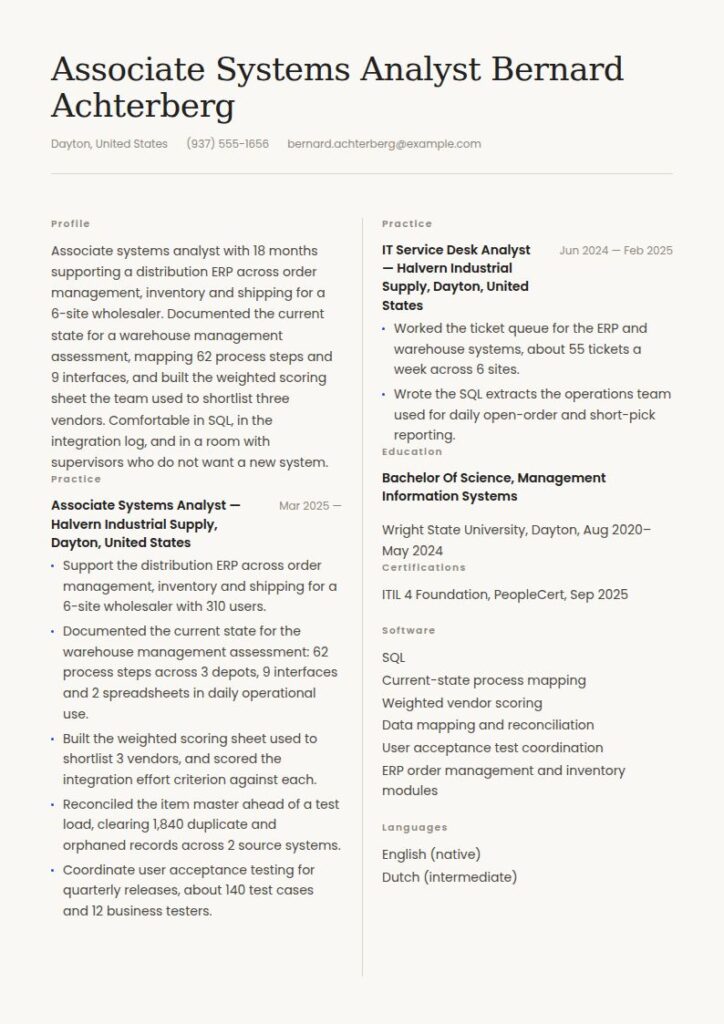
Associate systems analyst with 18 months supporting a distribution ERP across order management, inventory and shipping for a 6-site wholesaler. Documented the current state for a warehouse management assessment, mapping 62 process steps and 9 interfaces, and built the weighted scoring sheet the team used to shortlist three vendors. Comfortable in SQL, in the integration log, and in a room with supervisors who do not want a new system.
Work Experience
03/2025 - Present, Associate Systems Analyst, Halvern Industrial Supply, Dayton, United States
- Support the distribution ERP across order management, inventory and shipping for a 6-site wholesaler with 310 users.
- Documented the current state for the warehouse management assessment: 62 process steps across 3 depots, 9 interfaces and 2 spreadsheets in daily operational use.
- Built the weighted scoring sheet used to shortlist 3 vendors, and scored the integration effort criterion against each.
- Reconciled the item master ahead of a test load, clearing 1,840 duplicate and orphaned records across 2 source systems.
- Coordinate user acceptance testing for quarterly releases, about 140 test cases and 12 business testers.
06/2024 - 02/2025, IT Service Desk Analyst, Halvern Industrial Supply, Dayton, United States
- Worked the ticket queue for the ERP and warehouse systems, about 55 tickets a week across 6 sites.
- Wrote the SQL extracts the operations team used for daily open-order and short-pick reporting.
Education
08/2020 - 05/2024, Bachelor of Science, Management Information Systems, Wright State University, Dayton, United States
Capstone project: a current-state and target-state process model for a regional distributor's returns process.
Skills
SQL, 70
Current-state process mapping, 75
Weighted vendor scoring, 60
Data mapping and reconciliation, 65
User acceptance test coordination, 70
ERP order management and inventory modules, 65
Languages
English, native
Dutch, intermediate
Certificates
09/2025, ITIL 4 Foundation, PeopleCert
Service management foundation, taken to support change and release work on the ERP.
Summary
A systems analyst resume is a one to two page document showing how you decided between building, buying and configuring a system, what evidence you weighed, and what happened at cutover. This guide gives you three adaptable versions, a fit-gap block almost nobody writes, and current Bureau of Labor Statistics pay and outlook for computer systems analysts, the occupation the title maps onto.
Systems Analyst resume examples by experience level
In short, a systems analyst resume is a one to two page document that shows how you decided what an organization should do with a system: keep it and configure it, replace it with a package, or build something that does not exist yet.
That decision is the job. In other words, everything else a systems analyst does, the process walkthroughs and the vendor calls and the data mapping, exists to make that one call defensible. The resume that gets read twice names a call, shows the evidence underneath it, and says whether the organization took it.
However, most systems analyst resumes never get there. Instead, they describe activity: gathered requirements, liaised with stakeholders, supported the ERP. None of that tells a reader whether you have been in the room when money was committed to a direction that could not be reversed.
Resume guide for a systems analyst resume
In addition, this guide and the corresponding systems analyst resume example will cover:
- First, how to write a systems analyst resume, section by section
- Next, the fit-gap block that shows build, buy or configure
- In addition, three adaptable summaries: associate, practicing analyst and lead
- How to size an integration surface so a reader can check it
- Finally, what the job market looks like and what you can expect to earn
How to write a systems analyst resume
Overall, six sections: contact header, summary, systems and platforms, analysis experience, a fit-gap or decision block, and education with certifications. As a rule, one page under five years, two once you have led an evaluation and a cutover.
The order matters because a systems analyst is hired against a specific program, one that is either about to start or already in trouble. In practice, the reader's first question is whether you have done that shape of work before.
| Section | What it is answering | Where it goes |
|---|---|---|
| Summary | For example, what kind of system decisions has this person made? | Top of page, four lines |
| Systems and platforms | Similarly, have they touched what we run, or something like it? | Directly under the summary |
| Analysis experience | Did they decide, or attend? | Reverse chronological, numbers in every bullet |
| Fit-gap and decision block | Above all, can they be trusted with a build, buy or configure call? | Its own block, after the most recent role |
| Education and certifications | Do they clear the screen? | Last, short |
Write the recommendation, then write what happened to it
The strongest single line on a systems analyst resume is a recommendation with an outcome attached.
"Recommended configuring the existing warehouse management system rather than replacing it; the steering group accepted, and the project closed at 14 percent under the approved budget" is a complete claim. It says what you assessed, what you concluded, who decided, and what came of it.
The version most people write is "involved in the warehouse management system project". Same work, no claim.
Write the line when the recommendation was rejected, too: "Recommended a package; the board chose to extend the in-house system, and I wrote and costed the extension plan." Being overruled is normal, and carrying on well afterward is the harder skill.
Run the finished file through the ATS resume checker before you send it. Analyst roles are often posted by staffing firms whose systems parse the document before anyone opens it.
Choosing the best resume format for a systems analyst resume
Reverse chronological. In general, one page through your first five years, two once you have carried an evaluation from current state to cutover.
Skip the functional format. A systems analyst is read for continuity: which industry, which platform families, how long on one program, whether you were there at go-live or left during the build. By contrast, a format that hides the timeline usually means the timeline is short.
Include your contact information
| ✅ Right | ❌ Wrong |
|---|---|
| Bernard Achterberg | Bernard Achterberg |
| Systems Analyst, ERP and Integration | IT professional seeking new opportunities |
| ERP fit-gap, vendor evaluation, cutover planning | Analytical thinker with strong communication skills |
| (937) 555-1656, [email protected], Dayton, OH | (937) 555-1656, [email protected] |
In practice, three words under your name is enough, and they should name the domain you want to be hired into next rather than the one your current title uses. "Systems Analyst, ERP and Integration" and "Systems Analyst, Clinical Systems" go to different piles.
Make use of a summary
In short, four lines: what kind of systems, how long, the biggest decision you have been responsible for, and the outcome with a number.
Associate systems analyst with 18 months supporting a distribution ERP across order management, inventory and shipping for a 6-site wholesaler. Documented the current state for a warehouse management assessment, mapping 62 process steps and 9 interfaces, and built the weighted scoring sheet the team used to shortlist three vendors. Comfortable in SQL, in the integration log, and in a room with supervisors who do not want a new system.
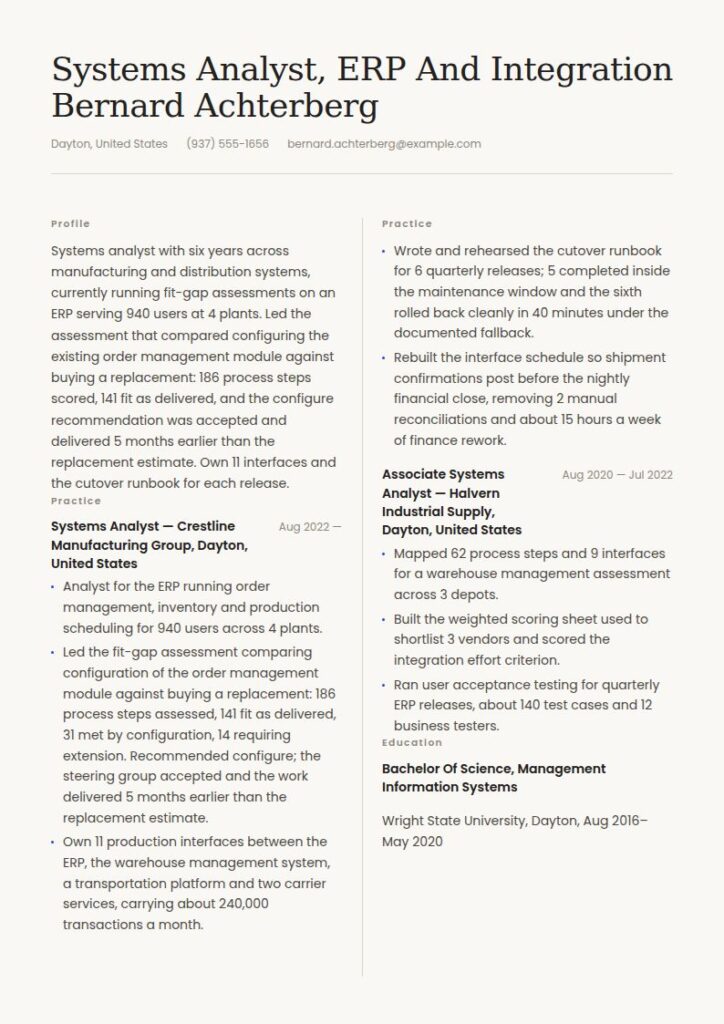
Systems analyst with six years across manufacturing and distribution systems, currently running fit-gap assessments on an ERP serving 940 users at 4 plants. Led the assessment that compared configuring the existing order management module against buying a replacement: 186 process steps scored, 141 fit as delivered, and the configure recommendation was accepted and delivered 5 months earlier than the replacement estimate. Own 11 interfaces and the cutover runbook for each release.
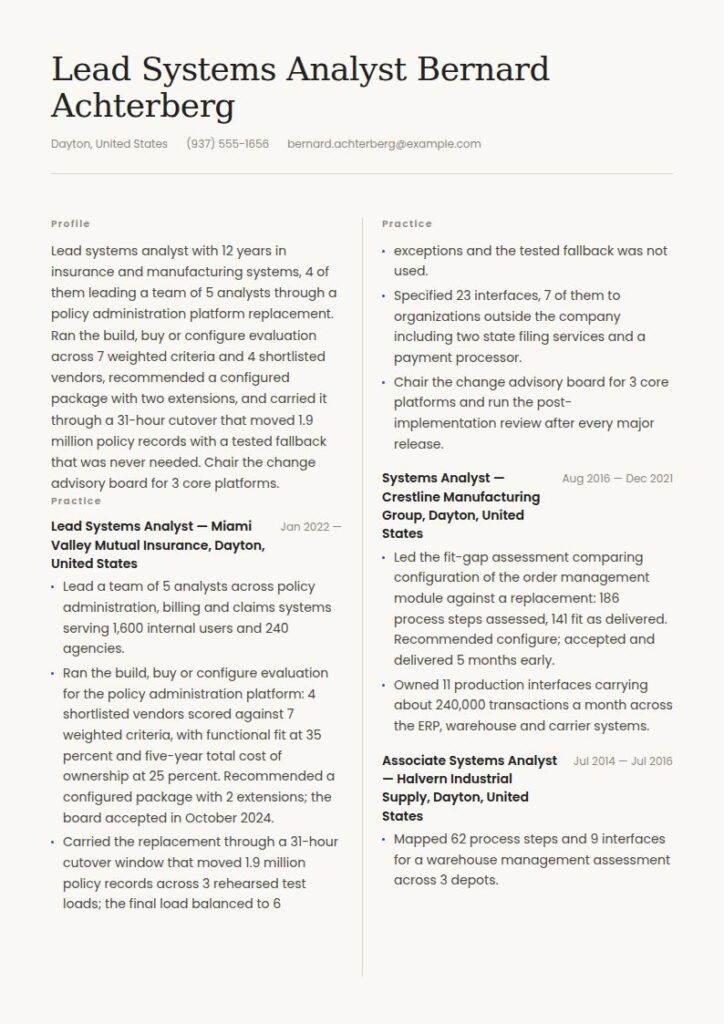
Lead systems analyst with 12 years in insurance and manufacturing systems, 4 of them leading a team of 5 analysts through a policy administration platform replacement. Ran the build, buy or configure evaluation across 7 weighted criteria and 4 shortlisted vendors, recommended a configured package with two extensions, and carried it through a 31-hour cutover that moved 1.9 million policy records with a tested fallback that was never needed. Chair the change advisory board for 3 core platforms.
Right vs wrong: the same systems analyst summary, twice
| ✅ Right | ❌ Wrong |
|---|---|
| Systems analyst with six years across manufacturing and distribution systems. | Results-driven IT professional with a proven track record. |
| Led the assessment comparing configuring order management against buying a replacement: 186 process steps scored, 141 fit as delivered. | Experienced in gathering requirements and liaising with stakeholders. |
| Configure recommendation accepted; delivered 5 months earlier than the replacement estimate. | Successfully contributed to several major system implementations. |
Above all, the right column names a decision, its evidence and its consequence. On the other hand, the left column could belong to anyone who sat in the same meetings, and most of the people in those meetings were not deciding anything.
Outline your systems analyst experience
To begin with, employer, industry, platform, user population and dates. Then four bullets, each carrying a system, a volume and a result.
| Instead of | Use |
|---|---|
| Gathered requirements from business stakeholders | Ran current-state workshops across 3 plants and mapped 186 process steps for the order management assessment |
| Supported the ERP system | Owned 11 interfaces between the ERP, the warehouse management system and two carrier platforms, about 240,000 transactions a month |
| Assisted with system selection | Built the 7-criterion weighted scoring model, scored 4 shortlisted vendors and wrote the recommendation the steering group approved |
| Involved in the data migration | Reconciled 1.9 million policy records across 3 test loads; final load balanced to 6 exceptions, all resolved before cutover |
| Worked on the go-live | Wrote and rehearsed a 31-hour cutover runbook with a tested fallback; go-live completed 4 hours inside the window |
Systems Analyst, Crestline Manufacturing Group, Dayton, OH, August 2022 to Present
Analyst for the ERP running order management, inventory and production scheduling for 940 users across 4 plants.
Led the fit-gap assessment comparing configuration of the existing order management module against buying a replacement: 186 process steps assessed, 141 fit as delivered, 31 met by configuration, 14 requiring extension. Recommended configure; accepted by the steering group and delivered 5 months earlier than the replacement estimate.
Own 11 production interfaces between the ERP, the warehouse management system, a transportation platform and two carrier services, carrying about 240,000 transactions a month.
Wrote and rehearsed the cutover runbook for 6 quarterly releases; 5 completed inside the maintenance window and the sixth was rolled back cleanly in 40 minutes under the documented fallback.
The fit-gap call: build, buy or configure, and the evidence behind it
However, this is the block that separates a systems analyst from a very organized note-taker, and it is missing from almost every resume in the pile.
Ultimately, every serious systems analyst assignment ends in one of three answers. Configure what we already own. Alternatively, buy something and fit ourselves to it. Build what does not exist. The organization is committing years of cost partly on your assessment, so a resume that shows you have made that call, with the working visible, is worth more than a page of tools.
In particular, six things make the block credible, and a reader can test every one in the interview.
| The element | What the reader is checking | Example line |
|---|---|---|
| Current state, sized | Whether you assessed the real thing or the diagram of it | 186 process steps across 4 plants, 11 interfaces, 3 shadow spreadsheets found in use |
| Target state | Whether there was a defined destination or just dissatisfaction | Single order entry path, carrier rating at order capture, financial close by day 3 |
| The shortlist and the criteria | Whether the comparison was structured or a preference | 4 vendors scored against 7 weighted criteria, functional fit weighted 35 percent |
| The answer and who took it | Whether you recommended or only reported | Recommended configure over replace; steering group accepted in October |
| The integration surface | Whether you understand what it costs to connect things | 11 interfaces, 2 rebuilt, 240,000 transactions a month, 1.9 million records migrated |
| Cutover and fallback | Whether you have been there at the sharp end | 31-hour window, 3 rehearsed loads, fallback tested and not needed |
Decision record: order management, 2024 to 2025
Current state: 186 process steps across 4 plants and 2 distribution centers, 11 production interfaces, 3 spreadsheets in daily operational use that no system owned.
Target state: one order entry path for all channels, carrier rating at the point of order capture, and a financial close completed by working day 3.
Assessment: 141 of 186 steps fit the existing package as delivered, 31 were met by configuration, 14 required extension. Two of the 14 were dropped after the process was changed instead.
Shortlist and criteria: 4 vendors scored against 7 weighted criteria, with functional fit at 35 percent, total cost of ownership over 5 years at 25 percent, integration effort at 15 percent, and the remainder across implementation risk, support model and roadmap.
Recommendation: configure and extend rather than replace. Accepted by the steering group in October 2024.
Delivery: 11 interfaces reviewed, 2 rebuilt, about 240,000 transactions a month. Cutover ran in a 31-hour window across a weekend with a rehearsed fallback that was not used. Delivered 5 months earlier than the replacement option had been estimated at.
Keep the systems analyst decision block honest
Two things keep a block like this honest, and a reader will probe both.
First, say what you owned and what you contributed. "Built the scoring model" and "scored the integration criterion in someone else's model" are different claims, and the second is not weak. Instead, it is specific, and specificity survives the interview.
Second, never present the recommendation as a decision you made alone. After all, the steering group, the board or the CIO chose; your line is the recommendation and the evidence. As a result, a candidate who blurs that reads as someone who has not sat in front of a governance body.
Size the integration surface, because that is what the estimate runs on
Interfaces are where system programs overrun, and hiring managers know it. A candidate who can size an integration surface from memory has been held to an estimate.
Four numbers do it. How many production interfaces. How many you built or rebuilt rather than reused. What they carry, in transactions or records over a stated period. And how many far ends belonged to someone outside your organization, since a carrier, a bank or a state agency moves on its own schedule.
Then add the migration number: how many records moved, how many test loads, and how the final load balanced.
Build a snapshot of your key systems analyst skills
Overall, twelve to sixteen entries in four groups: analysis, data, platforms and delivery. By contrast, an ungrouped list of twenty nouns tells the reader nothing about where your weight sits.
Analysis: Fit-gap assessment, Current-state and target-state process mapping, Weighted vendor scoring, Total cost of ownership modeling, Impact analysis, Build, buy or configure evaluation
Data and integration: SQL, Data mapping and reconciliation, API and file-based interface design, Message queues, Data migration planning, Exception reporting
Platforms: ERP order management and inventory modules, Warehouse management systems, Policy administration systems, Reporting and BI layers, Test management tooling
Delivery: Cutover planning and runbooks, Fallback and rollback design, User acceptance test coordination, Change advisory board, Post-implementation review
A skills list is a menu of interview questions you are volunteering for, so drop anything you would not want to spend ten minutes on.
List your education and certifications
Degree, then certifications with the awarding body and the date. Systems analysis has no license and no protected title, which makes the named authority on each line do more work than usual.
Bachelor of Science, Management Information Systems, Wright State University, Dayton, OH, 2014
Certifications: ITIL 4 Foundation, PeopleCert (2019). TOGAF Enterprise Architecture Foundation, The Open Group (2022). Microsoft Certified: Power Platform Functional Consultant Associate, Microsoft (2024).
For reference, the Bureau of Labor Statistics lists a bachelor's degree as the typical entry-level education for computer systems analysts, with no work experience in a related occupation and no on-the-job training typically required (BLS Occupational Outlook Handbook, May 2025). In other words, the degree line is a screen, not a differentiator. Therefore, put your evidence in the decision block.
Choose the right layout and design
In general, single column, 10.5 or 11 point body type, no photograph, no skill rating bars. Even so, the fit-gap block is the one place the layout deserves special handling: give it a heading and keep the lines short.
Name the decision you recommended and whether it was taken. Size the current state with a count a reader can test. Give the weighted criteria and their weights. State the integration surface in interfaces and volume. Say who owned the decision, since that is the governance body and not you. Include the cutover window and whether the fallback was used.
Do not write "gathered requirements" as an achievement; it is the entry ticket, not the work. Do not claim a recommendation you contributed one criterion to. Do not name vendors or internal systems you have no reason to disclose. Do not use a two-column template or a headshot for a portal that parses the file first.
Systems analyst job market and outlook
Systems analysts have a published federal profile, which is not true of every information technology title, and it describes a large occupation growing faster than the average with heavy replacement demand.
| Measure | Value |
|---|---|
| Computer systems analyst jobs, 2025 | 544,400 |
| Projected change, 2025-35 | 8% (much faster than average), +42,900 |
| Projected annual openings | About 32,900 |
| Typical entry-level education | Bachelor's degree |
| Median annual wage, May 2025 | $105,850 |
Source: U.S. Bureau of Labor Statistics, Occupational Outlook Handbook, 2025-35 projections and May 2025 wage data.
Openings, not growth, are where the jobs come from
Computer systems analysts are projected to grow 8 percent from 2025 to 2035, adding 42,900 jobs from a 2025 base of 544,400. Over the same decade BLS projects about 32,900 openings a year (BLS Occupational Outlook Handbook, 2025-35 projections).
Multiply that out. Ten years of projected growth is 42,900 positions, while ten years of openings is roughly 329,000. Almost all the hiring here is replacement: people retiring, or moving into architecture, product, delivery management or a vendor.
So your competition is mostly people already in the occupation, and the sector you have worked in matters more than it would in a growth market, because most vacancies are a named seat with a named system behind it.
Where the jobs sit:
| Industry | Share of employment, 2025 | Median annual wage, May 2025 |
|---|---|---|
| Computer systems design and related services | 23% | $108,270 |
| Finance and insurance | 13% | $106,000 |
| Management of companies and enterprises | 10% | $107,980 |
| Government | 7% | $100,190 |
| Information | 7% | $107,240 |
Source: U.S. Bureau of Labor Statistics, Occupational Outlook Handbook, May 2025 wage data and 2025 employment shares.
Therefore, read that table as a set of different jobs, not a pay ladder. For example, computer systems design is project after project, short assessments and heavy vendor comparison. In contrast, finance and insurance is one platform for years under regulated change control. Meanwhile, government is procurement law and multi-year replacement cycles.
What salary you can expect as a systems analyst
For instance, the median annual wage for computer systems analysts was $105,850 a year, or $50.89 an hour, as of May 2025. The lowest 10 percent earned less than $67,340 and the highest 10 percent more than $167,710 (BLS, May 2025).
However, industry alone does not explain that spread: the five largest employing industries sit between $100,190 and $108,270 at the median (BLS, May 2025). What moves an analyst up the range is scope of decision, size of the integration surface, and whether you have been accountable at a cutover.
Similarly, the adjacent occupation worth knowing about is database administrators and architects, where BLS separates the two halves: database administrators had a median of $104,620 and database architects $139,500 as of May 2025. Moreover, the architect half is projected to grow 9 percent from 2025 to 2035 against no change for administrators (BLS, May 2025 and 2025-35 projections). That gap is the same gap this resume is trying to demonstrate, which is the difference between running a system and deciding what the system should be.
Key takeaways for a systems analyst resume
- Name a build, buy or configure call you made, and say whether it was taken.
- Size the current state with a number a reader can test, such as process steps or interfaces.
- First, give the shortlist, the criteria and the weights, not just the winner.
- Second, state the integration surface: interfaces, volume, and who owns the far end.
- Put the cutover on the page, including the window and whether the fallback was used.
- Third, separate what you owned from what you contributed to; the interview will test it.
- Finally, write the bullets in the language of the industry column you are applying into.
Build your systems analyst resume in 15 minutes with our AI resume builder.
Related information technology resume examples
- Network systems analyst resume
- Business intelligence and data analyst resume
- IT project manager resume
- Solution architect resume
- SQL developer resume
- Data engineer resume
- IT manager resume
- System administrator resume
- Power BI developer resume
- Salesforce admin resume
- Technical project manager resume
- Web analyst resume
As a next step, pair it with a matching systems analyst cover letter.
Systems analyst resume questions, answered
How long should a systems analyst resume be?
One page for your first five years, two once you have carried an evaluation through to cutover. The second page earns its place only if it holds a decision block, a second platform family or a leadership line. A third page reads as an inability to prioritize, which is an odd signal from someone whose job is weighted criteria.
What is the difference between a systems analyst and a business analyst?
In practice the systems analyst owns the technical answer and the business analyst owns the business need, though many employers use the titles interchangeably. If the posting talks about fit-gap, integration, data mapping, environments and cutover, write the systems side. Read the verbs in the posting and mirror them, because the screen is keyword-driven before it is human.
Do I need a certification to get hired as a systems analyst?
No. The Bureau of Labor Statistics lists a bachelor's degree as the typical entry-level education for computer systems analysts, with no work experience in a related occupation typically required (BLS, May 2025). Certifications help most when they name a platform the employer runs. None of them substitutes for a decision you can describe.
What do I put on a systems analyst resume with no direct experience?
Whatever piece of a system decision you have touched. A current-state map you drew, a vendor demo you scored, a data reconciliation you ran, a test cycle you coordinated. Write it with a count and an outcome. An internship where you mapped 62 process steps and built the scoring sheet is real evidence; "exposure to the software development lifecycle" is not.
How do I show results when the project has not gone live yet?
Use the intermediate facts. How much of the current state you assessed, how many options you scored, how many gaps you closed by changing a process rather than the software, how the test loads balanced. Then say plainly where the program is: "in build, go-live scheduled for the first quarter". Honesty about status reads better than a vague claim of success.
Should I list the ERP or platform by name?
Name the platform family if it is a mainstream product your target employers run, because that is a genuine keyword match. Leave out internal system names and anything that identifies a client's estate. If your employer treats the inventory as confidential, describe the systems by function and say so in one line.