Bernard Achterberg Systems Analyst, ERP and Integration Dayton, 45402, United States [email protected] · (937) 555-1656
11 September 2026
Ms. Renata Kohl Director of Business Applications Stillwater Beverage Group Springboro, United States
Application for Senior Systems Analyst, Stillwater Beverage Group
Dear Ms. Kohl,
I am applying for the Senior Systems Analyst post supporting the order-to-cash program at Stillwater Beverage Group. I have spent six years on manufacturing and distribution systems, and the closest thing I have done to your program is the order management assessment I led at Crestline Manufacturing Group, which ended in a configure recommendation rather than the replacement that had been expected.
The assessment covered 186 process steps across 4 plants and 2 distribution centers, 11 production interfaces, and 3 spreadsheets running live operations without an owner. Of those 186 steps, 141 fit the package we already owned as delivered, 31 were met by configuration, and 14 needed extension. I scored 4 shortlisted vendors against 7 weighted criteria and recommended configuring and extending what we had. The steering group accepted in October 2024, and the work went live 5 months earlier than the replacement option had been estimated at, through a cutover I wrote and rehearsed.
Your posting describes an order-to-cash program that has already chosen a platform and is now sizing the integration work. That is the part I would want first. At Crestline I owned 11 interfaces carrying about 240,000 transactions a month, and I rebuilt the interface schedule so shipment confirmations posted before the nightly close, removing 2 manual reconciliations. I would expect to spend my first weeks on your interface inventory and the reconciliation points around the close, because that is where the estimate usually turns out to be wrong.
I can start with four weeks' notice, and I am in Dayton, so on-site work at your Springboro plant is straightforward. Thank you for reading.
Sincerely, Bernard Achterberg
Summary
A systems analyst cover letter names one build, buy or configure decision you were responsible for, the evidence you weighed, whether the organization took your recommendation, and what happened when the system went live. This guide gives you a full adaptable letter, the openings that work, and what to write when the program you are proudest of has not gone live yet.
Systems Analyst cover letter examples by experience level
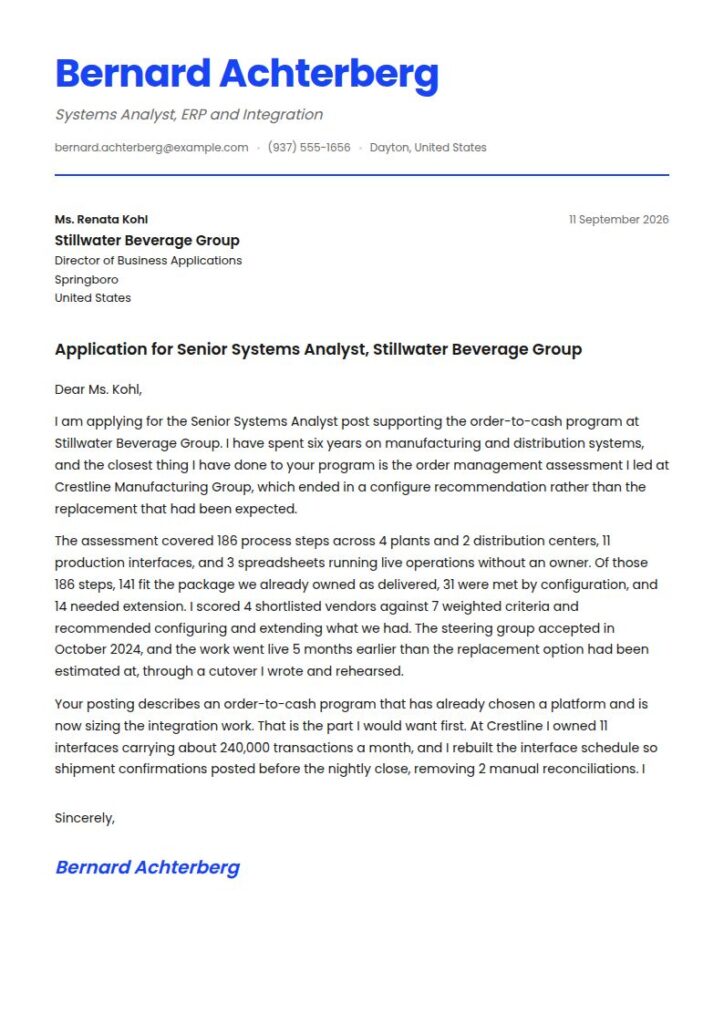
A systems analyst cover letter is a one-page letter about a single decision: what you assessed, what you recommended, who took it, and what happened when the system went live.
That narrow brief is deliberate. A systems analyst is rarely hired in the abstract: there is a program starting, or one in trouble, and the hiring manager wants to know whether you have been through the same shape of problem before.
Guide to a systems analyst cover letter
This guide and the corresponding systems analyst cover letter example will cover:
- How to structure the letter, paragraph by paragraph
- Why one decision beats a summary of your career
- What to write when the recommendation was rejected
- How to talk about a program that has not gone live yet
How to write a systems analyst cover letter
| Paragraph | Its job | Length |
|---|---|---|
| Opening | The role, the domain, and the decision you will tell them about | 2 to 3 sentences |
| Evidence | One assessment: what you sized, what you compared, what you recommended, what happened | 5 to 6 sentences |
| Fit | Something specific about their program, and the part you would take | 3 sentences |
| Close | Availability and thank you | 2 sentences |
Pick the decision that matches their program, not your best one
Most experienced analysts have three or four stories worth telling, and the instinct is to choose the largest. The better rule is to choose the one that is the same shape as the job.
If the posting is about replacing a legacy platform, tell the replacement story even if the numbers are smaller. If it is about integrating two organizations after an acquisition, tell the interface story. If it is a first hire into a team that has never run a structured evaluation, tell the story where you built the scoring model from nothing.
The reader wants to know whether you have already done the thing they are about to ask you to do.
A systems analyst cover letter example you can adapt
Dear Ms. Kohl,
I am applying for the Senior Systems Analyst post supporting the order-to-cash program at Stillwater Beverage Group. I have spent six years on manufacturing and distribution systems, and the closest thing I have done to your program is the order management assessment I led at Crestline Manufacturing Group, which ended in a configure recommendation rather than the replacement that had been expected.
The assessment covered 186 process steps across 4 plants and 2 distribution centers, 11 production interfaces, and 3 spreadsheets running live operations without an owner. Of those 186 steps, 141 fit the package we already owned as delivered, 31 were met by configuration, and 14 needed extension. I scored 4 shortlisted vendors against 7 weighted criteria and recommended configuring and extending what we had. The steering group accepted in October 2024, and the work went live 5 months earlier than the replacement option had been estimated at, through a cutover I wrote and rehearsed.
Your posting describes an order-to-cash program that has already chosen a platform and is now sizing the integration work. That is the part I would want first. At Crestline I owned 11 interfaces carrying about 240,000 transactions a month, and I rebuilt the interface schedule so shipment confirmations posted before the nightly close, removing 2 manual reconciliations. I would expect to spend my first weeks on your interface inventory and the reconciliation points around the close, because that is where the estimate usually turns out to be wrong.
I can start with four weeks' notice, and I am in Dayton, so on-site work at your Springboro plant is straightforward. Thank you for reading.
Sincerely, Bernard Achterberg
Openings that work
| Instead of | Use |
|---|---|
| I am writing to express my interest in the Systems Analyst position | I am applying for the Senior Systems Analyst post supporting the order-to-cash program |
| I have strong analytical and problem-solving skills | The closest thing I have done to your program is an order management assessment that ended in a configure recommendation |
| I have experience with ERP implementations | I have owned 11 interfaces carrying about 240,000 transactions a month |
| I am a great communicator and team player | I scored 4 vendors against 7 weighted criteria and wrote the recommendation the steering group took |
Say who made the decision
You recommended. Somebody else chose. Write it that way: "I recommended configuring rather than replacing; the steering group accepted in October." A hiring manager who has sat on a steering group recognizes an analyst who knows where their authority ends.
The version that damages you is "I decided to configure the existing platform rather than replace it". Very few analysts have that authority.
Name one decision and give the numbers underneath it. Say who took the recommendation and when. Size the integration surface in interfaces and volume. Name the part of their program you would take first. Say plainly if a program has not gone live yet.
Do not claim a decision a governance body made. Do not list every platform you have touched; the resume does that. Do not name vendors or internal systems you have no reason to disclose. Do not send a letter that works for any employer with the name swapped.
Write the rejected recommendation, too. "I recommended a package replacement on a five-year total cost basis. The board chose to extend the in-house system instead, on a capital timing argument I understood. I then wrote and costed the extension plan, and it went live in March." That shows three things at once: you can produce a recommendation, you can hear no, and you can execute the option you did not pick.
What it must not become is a complaint. The moment the letter implies the decision was wrong, the reader stops assessing your analysis and starts wondering how you talk about your employer.
When the program has not gone live yet
Half the analysts writing this letter are mid-program, and the honest version reads better than a vague claim of success. Give the status and the date.
| What you have | The sentence to write |
|---|---|
| A completed assessment, build under way | Assessed 186 process steps and 11 interfaces; the configure recommendation was accepted in October and the build is in system test |
| An evaluation in flight | Scoring 4 vendors against 7 weighted criteria now, with a recommendation due to the steering group in November |
| A migration mid-way | Three test loads complete, the last balanced to 6 exceptions against 1.9 million records, cutover in the first quarter |
Being precise about where something stands is the exact quality the job requires.
Most of these vacancies are replacements, so the sector you know matters
Computer systems analysts held 544,400 jobs in 2025, and the occupation is projected to grow 8 percent from 2025 to 2035, adding 42,900 positions. Over the same decade BLS projects about 32,900 openings a year (BLS Occupational Outlook Handbook, 2025-35 projections).
Ten years of growth accounts for 42,900 of roughly 329,000 openings. Almost everything else is replacement hiring into a seat that already exists, behind a system that already exists.
So the fit paragraph is worth as much as the evidence paragraph. You are competing against people who are already systems analysts, and the letter that names their platform family or their integration problem reads as written for them rather than for the vacancy.
Length, format and sending it
One page, four paragraphs, 300 to 400 words. PDF unless the portal insists otherwise, named for yourself and the role: bernard-achterberg-systems-analyst-cover-letter.pdf. Address a person; for a staffing firm, that is the consultant who posted it, since they decide whether the file goes forward.
Keep every number identical to your resume. Our systems analyst resume example uses the same figures, and a mismatch between the two is the kind of thing an analyst does not get forgiven for.
Key takeaways
- Build the letter on one decision, chosen to match the shape of their program.
- Give the evidence: what you sized, what you compared, what the weights were.
- Say who took the recommendation, and when.
- Write the rejected recommendation too; it shows more than an easy acceptance.
- State the integration surface in interfaces and volume, not adjectives.
- Name the part of their program you would take first.
- Keep every figure identical to your resume, and address a named person.
Write your systems analyst cover letter in 10 minutes with our AI cover letter builder.
Systems analyst cover letter questions, answered
How long should a systems analyst cover letter be?
One page, four paragraphs, 300 to 400 words. The first reader is skimming for whether you have done this exact shape of work, and length is not what convinces them.
Do I need a cover letter if I am applying through a recruiter?
Yes, and it does more work than usual. The recruiter is building a shortlist for a client they want to keep, and a letter naming a comparable program gives them something to say when they present you.
What do I write with no systems analyst experience yet?
Write the piece of a system decision you have done, from wherever you did it. A current-state map, a vendor demo you scored, a reconciliation you ran, a test cycle you coordinated. Give the count and the outcome, then say what you would want to learn first. A precise small story beats a vague large one.
Should I mention the salary I am looking for?
Only if the posting asks. One line at the end is enough, and it helps to anchor it to something public: the median annual wage for computer systems analysts was $105,850 as of May 2025, with the highest 10 percent above $167,710 (BLS, May 2025).
How do I write about confidential systems and vendors?
Describe systems by what they do rather than by name: the order management module, the policy administration platform, the carrier integration layer. Give the counts and volumes, which are rarely confidential, and add a line saying you have kept product and client names out.