Web Analyst, GA4 and Google Tag Manager Elise Bergstrand
Web Analyst
[email protected] | (612) 555-1740 | Minneapolis, United States
Profile
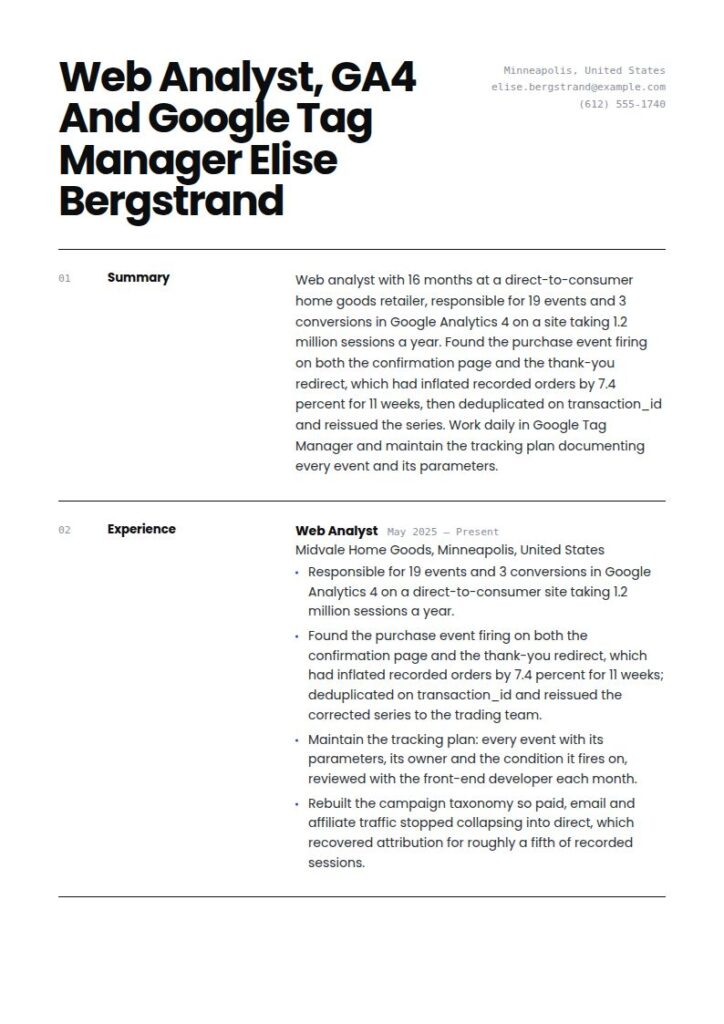
Web analyst with 16 months at a direct-to-consumer home goods retailer, responsible for 19 events and 3 conversions in Google Analytics 4 on a site taking 1.2 million sessions a year. Found the purchase event firing on both the confirmation page and the thank-you redirect, which had inflated recorded orders by 7.4 percent for 11 weeks, then deduplicated on transaction_id and reissued the series. Work daily in Google Tag Manager and maintain the tracking plan documenting every event and its parameters.
Work Experience
05/2025 - Present, Web Analyst, Midvale Home Goods, Minneapolis, United States
- Responsible for 19 events and 3 conversions in Google Analytics 4 on a direct-to-consumer site taking 1.2 million sessions a year.
- Found the purchase event firing on both the confirmation page and the thank-you redirect, which had inflated recorded orders by 7.4 percent for 11 weeks; deduplicated on transaction_id and reissued the corrected series to the trading team.
- Maintain the tracking plan: every event with its parameters, its owner and the condition it fires on, reviewed with the front-end developer each month.
- Rebuilt the campaign taxonomy so paid, email and affiliate traffic stopped collapsing into direct, which recovered attribution for roughly a fifth of recorded sessions.
08/2023 - 05/2025, Digital Marketing Coordinator, Midvale Home Goods, Minneapolis, United States
- Built the weekly trading report from Google Analytics 4 and the order system, and ran the reconciliation between the two.
- Wrote the first version of the event specification that became the site tracking plan.
Education
08/2021 - 05/2025, Bachelor of Science, Marketing, minor in Statistics, University of Minnesota, Twin Cities, Minneapolis, United States
Coursework in survey methods, experimental design and regression.
Skills
Google Analytics 4, 80
Google Tag Manager, 70
Tracking plan maintenance, 70
Event and conversion design, 65
UTM and campaign taxonomy, 80
Looker Studio, 75
SQL against a warehouse export, 55
Languages
English, native
Norwegian, intermediate
Certificates
06/2025, Google Analytics Certification, Google Skillshop
Summary
A web analyst resume is a one to two page document naming the tracking you implemented, the tool you implemented it in, and the consent boundary the numbers had to live inside. This guide gives you three adaptable versions, the implementation block almost nobody writes, and an honest account of what federal wage data does and does not publish for a title like this one.
Web Analyst resume examples by experience level
In short, a web analyst resume is a one to two page document that names the tracking you implemented, the tool you implemented it in, and the consent rules the resulting numbers had to live inside.
Every application for a web analyst post, however, carries the same sentence: analyzed website traffic and user behavior to provide actionable insights. It tells a hiring manager nothing, because reporting is the half of this job anyone can do. Somebody has to decide what a conversion event is, put it in a container, get it through review, make it fire once instead of twice, and keep it working when the consent banner changes what is allowed to fire at all.
That work, in contrast, is scarce, and almost nobody writes it down.
Resume guide for a web analyst resume
Specifically, this guide and the corresponding web analyst resume example will cover:
- How to write a web analyst resume, block by block
- Why the tracking you implemented belongs above the reporting you produced
- Three adaptable summaries: first analytics role, working analyst and lead
- How to write the consent boundary without sounding like a compliance memo
- Why there is no federal median under this title, and what to quote instead
How to write a web analyst resume
Six blocks: contact header, summary, implementation and tracking, analysis experience, skills and platforms, then education and certifications. Generally, one page for your first three years, two once you own a tracking plan other teams depend on.
In particular, implementation sits above analysis for a practical reason. After all, everyone applying can build a funnel report. The difference is whether the funnel was reading data the candidate was responsible for putting there.
| Block | What it is answering | Where it goes |
|---|---|---|
| Implementation | Which events, in which tool, shipped by whom? | Under the summary |
| Consent boundary | Do they know what the numbers are allowed to contain? | Inside the implementation block |
| Analysis experience | Which decision changed, and did anything they tested lose? | Reverse chronological |
| Skills and platforms | Which analytics tool, tag manager and consent platform? | Grouped, named by product |
Say who shipped the tag, not who asked for it
The most useful line on a web analyst resume is a boring one: whether you wrote the tag or filed a ticket for it.
Both are real jobs, hired differently. An analyst who specifies events for a development team has to write a specification an engineer can build from. An analyst who publishes their own container has to be trusted with production, since a badly scoped trigger breaks a page for every visitor at once.
So write it plainly: "author and publisher on the production Google Tag Manager container, 41 tags plus a server-side container" or "wrote the specification for 41 events, which the front-end team implemented in two sprints." Both beat "implemented tracking", and only one can be true of you.
Run the finished file through the ATS resume checker before you send it. Analytics postings screen on tool names, and "GA4" and "Google Analytics 4" do not always match the same requisition.
Choosing the best resume format for a web analyst resume
Overall: reverse chronological, single column, one page early and two once the tracking plan and the experiment record justify the space.
Resist the dashboard layout. Analysts who build reports for a living are drawn to tiles, sparklines and progress bars on their own resume; however, those are the elements that come out of a parser as one unreadable string. Instead, keep the visual craft for a portfolio link.
Include your contact information
| ✅ Right | ❌ Wrong |
|---|---|
| Elise Bergstrand | Elise Bergstrand |
| Web Analyst, GA4 and Google Tag Manager, ecommerce | Analytics professional turning data into actionable insights |
| Publisher on a production GTM container: 41 tags, 6 conversions, consent mode deployed | Skilled in Google Analytics, Excel, SQL and data visualization |
| (612) 555-1740, [email protected], Minneapolis, MN | (612) 555-1740, [email protected] |
Also, name the sector in the title line. Indeed, ecommerce, media, lead generation and subscription analytics fire different events and argue about different numbers, and a hiring manager is staffing one of them.
Make use of a summary
In short, four lines: the sector and traffic scale, the tracking you are responsible for, one implementation problem you found and fixed, and the consent setup you work inside.
Web analyst with 16 months at a direct-to-consumer home goods retailer, responsible for 19 events and 3 conversions in Google Analytics 4 on a site taking 1.2 million sessions a year. Found the purchase event firing on both the confirmation page and the thank-you redirect, which had inflated recorded orders by 7.4 percent for 11 weeks, then deduplicated on transaction_id and reissued the series. Work daily in Google Tag Manager and maintain the tracking plan documenting every event and its parameters.
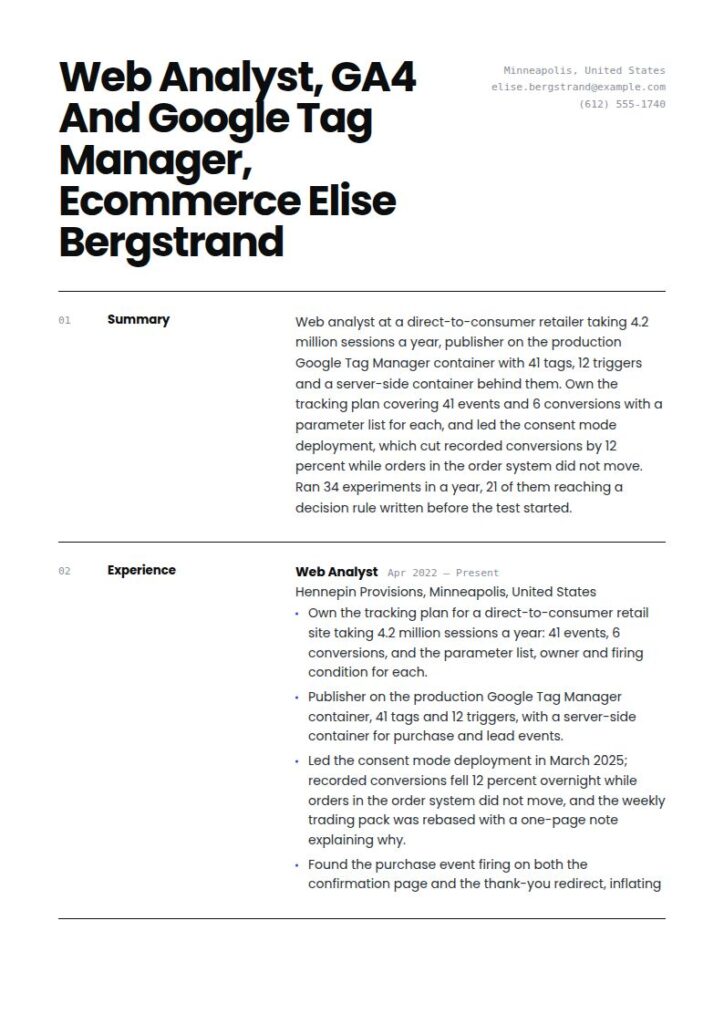
Web analyst at a direct-to-consumer retailer taking 4.2 million sessions a year, publisher on the production Google Tag Manager container with 41 tags, 12 triggers and a server-side container behind them. Own the tracking plan covering 41 events and 6 conversions with a parameter list for each, and led the consent mode deployment, which cut recorded conversions by 12 percent while orders in the order system did not move. Ran 34 experiments in a year, 21 of them reaching a decision rule written before the test started.
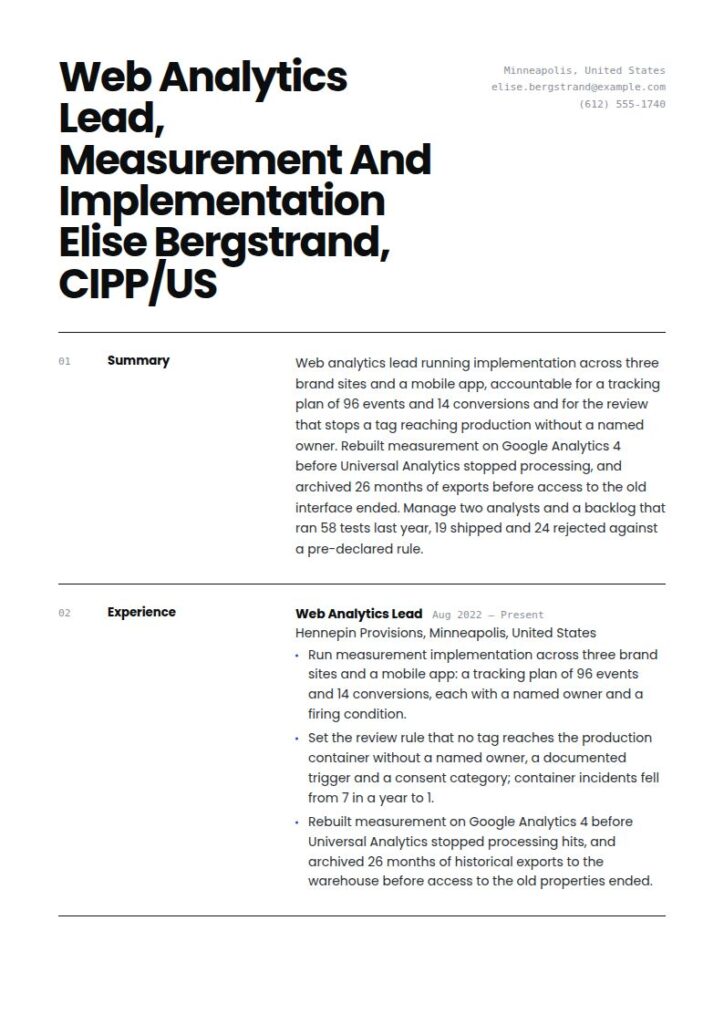
Web analytics lead running implementation across three brand sites and a mobile app, accountable for a tracking plan of 96 events and 14 conversions and for the review that stops a tag reaching production without a named owner. Rebuilt measurement on Google Analytics 4 before Universal Analytics stopped processing, and archived 26 months of exports before access to the old interface ended. Manage two analysts and a backlog that ran 58 tests last year, 19 shipped and 24 rejected against a pre-declared rule.
Right vs wrong: the same web analyst summary, twice
| ✅ Right | ❌ Wrong |
|---|---|
| Publisher on a production GTM container: 41 tags, 12 triggers, a server-side container behind them. | Experienced in Google Tag Manager and Google Analytics implementation. |
| Found a purchase event double-firing that had inflated recorded orders by 7.4 percent for 11 weeks. | Ensured data quality and accuracy across all analytics platforms. |
| Led the consent mode deployment; recorded conversions fell 12 percent while real orders did not move. | Worked closely with stakeholders to ensure GDPR compliance. |
| Ran 34 experiments; 21 reached a decision rule written before the test started. | Delivered actionable insights that drove measurable business results. |
The right column, on the other hand, is someone responsible for numbers other people spend money against. The left is someone who has opened a reporting interface.
Outline your web analytics experience
Then list employer, sector, traffic scale, analytics stack and dates. Then three to five bullets, each naming something you implemented, found or decided.
| Instead of | Use |
|---|---|
| Analyzed website traffic and user behavior | Own 41 events and 6 conversions in GA4 on a site taking 4.2 million sessions a year |
| Implemented tracking using Google Tag Manager | Publisher on the production GTM container: 41 tags, 12 triggers, plus a server-side container for purchase and lead events |
| Ensured data quality across analytics platforms | Found the purchase event firing twice on 7.4 percent of orders for 11 weeks; deduplicated on transaction_id and reissued the series |
| Supported privacy compliance efforts | Deployed consent mode and rebased the weekly trading pack, which fell 12 percent overnight while real orders held |
| Ran A/B tests to improve conversion rate | Ran 34 experiments in a year; 21 reached a pre-declared decision rule, 9 shipped and 12 were rejected, including a product page video that lost 2.1 percent on add-to-cart |
Web Analyst, Hennepin Provisions, Minneapolis, MN, April 2022 to Present
Own the tracking plan for a direct-to-consumer retail site taking 4.2 million sessions a year: 41 events, 6 conversions, and the parameter list, owner and firing condition for each.
Publisher on the production Google Tag Manager container, 41 tags and 12 triggers, with a server-side container for purchase and lead events.
Led the consent mode deployment in March 2025; recorded conversions fell 12 percent overnight while orders in the order system did not move, and the weekly trading pack was rebased with a one-page note explaining why.
Found the purchase event firing on both the confirmation page and the thank-you redirect, inflating recorded orders by 7.4 percent for 11 weeks, then deduplicated on transaction_id and reissued the series.
Ran 34 experiments last year against a shared backlog; 21 reached a decision rule written before the test started, 9 shipped and 12 were rejected.
The tracking you implemented and the consent boundary you worked inside
This is the block that separates web analysts from everyone who has opened an analytics report; moreover, it has two halves. The first is the tracking itself, written as a short inventory rather than prose.
| What to state | Why it matters to the reader |
|---|---|
| The tracking plan | Whether one exists, who wrote it, how many events it covers |
| The events and conversions | The counts, and which ones money is measured against |
| The tool and your role in it | GA4 or Adobe Analytics, and whether you author, review or publish |
| The tag manager | The container, the tag and trigger counts, and any server-side container |
| The migration | What you rebuilt, what you archived, against what deadline |
The second half is the boundary. In fact, web analytics is the one analyst role where the number a stakeholder sees depends on what a visitor agreed to, and a candidate who can explain that calmly is rare.
Implementation: Google Analytics 4 and Google Tag Manager. Author and publisher on the production container: 41 tags, 12 triggers, plus a server-side container for purchase and lead events. Tracking plan of 41 events and 6 conversions, each with a named owner, a parameter list and a firing condition, reviewed quarterly with engineering.
dataLayer: specification written with the front-end team, pushed on 14 templates, with a staging check that fails the build when a required parameter is missing.
Consent: consent platform deployed site-wide, consent mode configured with the legal team, and a documented rule for which tags may fire before consent. Recorded conversions fell 12 percent the week consent mode went live while orders in the order system were flat, and the weekly trading pack was rebased with a note explaining the difference.
Migration: rebuilt 38 events into the Google Analytics 4 model before Universal Analytics stopped processing hits on 1 July 2023, and archived 26 months of exports before access to the old properties ended the week of 1 July 2024 (Google Analytics Help).
Two things make that block work. It is falsifiable, since an interviewer can ask which tags you allow before consent and a candidate who did the work has a rule rather than an opinion. Moreover, it separates real numbers from recorded numbers, the distinction that makes an analyst trustworthy to a finance team.
Then add the experiment record underneath, and be honest in it:
Experiments: 34 run in the last 12 months against a shared backlog. 21 reached a decision rule written before the test started; 9 shipped and 12 were rejected. Losing result kept on the record: a product page video module reduced add-to-cart by 2.1 percent and was rolled back after 19 days.
After all, a candidate who reports only winners is reporting a selection, and every experienced hiring manager knows it. One named losing test with a decision rule stated in advance does more for your credibility than three more wins.
This occupation had its measurement system replaced on a published date
Google's Analytics Help documentation records that standard Universal Analytics properties stopped processing hits on 1 July 2023, and that beginning the week of 1 July 2024 users lost access to current and historical Universal Analytics data, most of them losing the interface and the API on that date (Google Analytics Help).
No other analyst occupation had its entire measurement system retired on a scheduled date. The field rebuilt its events, conversions and historical baselines inside a two-year window, and what a candidate did in that window is the most legible signal of seniority available right now.
So say what you did: how many events rebuilt, how much history archived, which figures reconciled across the two models, and what you told the people whose targets were set against numbers that no longer existed. That is a fact with a date attached rather than a self-assessment.
Build a snapshot of your key web analyst skills
Twelve to sixteen entries in four groups, named by product rather than by category.
Measurement: Google Analytics 4, Google Tag Manager including server-side containers, dataLayer specification, Event and conversion design, Cross-domain tracking, UTM and campaign taxonomy
Privacy and consent: Consent management platform administration, Consent mode configuration, Data retention settings, Server-side collection
Experimentation: Test design and sample sizing, Pre-declared decision rules, Duration rules, Holdout and rollback planning
Analysis and delivery: SQL against a warehouse export, Looker Studio, Funnel and path analysis, Attribution model comparison, Weekly trading pack writing
Also keep the privacy group even in your first role. It has the fewest competing candidates; in addition, it is what a legal or commercial stakeholder asks about in an interview.
List your education and certifications
Degree first, then platform credentials, then anything showing you understand the privacy side and not only the tooling.
Bachelor of Science, Marketing, minor in Statistics, University of Minnesota, Twin Cities, Minneapolis, MN, 2019. Coursework in survey methods, experimental design and regression.
Certifications: Google Analytics Certification, Google Skillshop (2025). Certified Information Privacy Professional, United States (CIPP/US), International Association of Privacy Professionals (2024).
Selected work: a public write-up of a measurement migration, with the event mapping, the reconciliation between old and new models, and what could not be reconciled.
The privacy credential, in particular, is the unusual one, and its value is not really the certificate. Instead, it gives you vocabulary for the conversation where a commercial stakeholder wants a number the consent settings will not produce, and handling that without overclaiming or stonewalling is a hiring reason on its own.
Choose the right layout and design
Likewise, single column, 10 or 11 point, clear headings, no photograph, and no rating bars anywhere. The implementation block wants short labeled lines rather than tool logos, and the experiment record wants four honest numbers rather than a chart.
Say whether you author, review or publish in the tag manager. Give the counts: events, conversions, tags, triggers. Name the consent platform and one rule you applied about what fires before consent. Describe one data-quality defect you found and how long it had been wrong. Keep a losing experiment on the record with its decision rule.
Do not write "actionable insights" or "data-driven decision making". Do not claim tracking a development team built from someone else's specification. Do not give a percentage change without saying whether the underlying business number moved with it. Do not give legal opinions; name the regime your legal team defined and what you did inside it. Do not list every tool you have logged into once.
Web analyst job market and outlook
There is a hole in the official data, and this page will not paper over it. The U.S. Bureau of Labor Statistics publishes no Occupational Outlook Handbook profile titled "web analyst", so no federal median exists under the title and none will be invented here. Instead, three published occupations bracket almost every posting that uses it.
| Published occupation, BLS | Median annual wage, May 2025 | Projected change, 2025-35 | Projected annual openings | Jobs, 2025 |
|---|---|---|---|---|
| Data scientists | $120,230 | 35% (much faster than average), +95,400 | About 24,800 | 275,600 |
| Web developers and digital designers | $99,520 | 5% (faster than average), +11,300 | About 13,600 | 220,100 |
| Market research analysts | $78,760 | 7%, +66,300 | About 82,000 | 952,700 |
Source: U.S. Bureau of Labor Statistics, Occupational Outlook Handbook, 2025-35 projections and May 2025 wage data.
In other words, the line the wage column draws is implementation. For example, measuring demand, customers and campaigns and reporting on them is priced like market research analysis, at a median of $78,760 as of May 2025. Putting the measurement into a production website, with containers, a dataLayer and a server-side collection path, sits next to web development and digital design at $99,520. Similarly, modeling and predicting from the resulting behavioral data is priced as data science, at $120,230 (BLS, May 2025).
A web analyst usually does parts of all three, although most web analyst resumes describe only the first. That is the most expensive editing decision in this occupation, and it costs nothing to fix when the implementation work is genuinely yours: move it above the reporting and describe it in terms an engineer would recognize.
Data science is the fastest-growing of the three at 35 percent between 2025 and 2035, and also the one where a web analyst competes hardest against formal modeling backgrounds (BLS, 2025-35 projections). Therefore, implementation depth is the more reachable move, and the one with fewer competing candidates.
What salary you can expect as a web analyst
The title has no wage series of its own in the federal data, which is why every single number you see quoted for it comes from a salary aggregator rather than a statistical agency. What follows instead is a range anchored on the published occupations a posting will actually match.
If the posting is measurement, reporting, campaign performance and audience insight, the reference is market research analysts: median $78,760 as of May 2025, lowest 10 percent under $43,390 and highest 10 percent above $155,480, with industry medians of $102,670 in information, $99,850 in management of companies and enterprises, $94,330 in finance and insurance and $77,820 in management consulting (BLS, May 2025).
Where the posting expects you to build and publish the tracking yourself, the reference is web developers and digital designers: median $99,520 as of May 2025, an occupation projected to grow 5 percent through 2035 with about 13,600 openings a year (BLS, May 2025 and 2025-35 projections).
If the posting expects modeling, propensity scoring or forecasting from behavioral data, it is priced as data science: median $120,230 as of May 2025, lowest 10 percent under $67,240 and highest 10 percent above $199,130, with industry medians of $142,240 in publishing, broadcasting and content providers and $132,380 in computer systems design (BLS, May 2025).
Two things follow. Industry moves pay more than tool choice does, since the same occupation pays $102,670 in information and $77,820 in consulting. Finally, quote the published occupation your work matches with its cycle attached, because "the BLS May 2025 median for web developers and digital designers is $99,520" is a sentence a compensation partner can check.
Key takeaways for a web analyst resume
- Above all, put the tracking you implemented above the reporting you produced.
- Say whether you author, review or publish in the tag manager.
- Specifically, give the counts: events, conversions, tags, triggers, sessions.
- Name the consent setup and one rule about what fires before consent.
- Describe one data-quality defect you found and how long it had been wrong.
- Finally, keep one losing experiment on the record with its pre-declared decision rule.
- Move implementation above reporting, because that is the line the pay data draws.
Build your web analyst resume in 15 minutes with our AI resume builder.
Related information technology resume examples
- Data analyst resume
- Data scientist resume
- Web developer resume
- Front-end developer resume
- Full stack developer resume
- Power BI developer resume
- Tableau developer resume
- Data engineer resume
- SQL developer resume
- Systems analyst resume
- Computer science resume
- IT resume
Pair it with a matching web analyst cover letter.
Web analyst resume questions, answered
How long should a web analyst resume be?
One page for your first three years. Two once you own a tracking plan other teams depend on, have led a measurement migration, or have an experiment record worth listing. The implementation block usually justifies the second page.
What do I put on a web analyst resume if I have never implemented tracking myself?
Say what you did do, precisely. Writing an event specification a development team built from is real implementation work. Then close the gap: a personal site with a tag manager container, a tracking plan, a consent banner and three events you can talk through is a weekend of work, and it changes what you can claim.
Why does this page not give a single web analyst salary figure?
Because no current federal one exists under that title. There is no Occupational Outlook Handbook profile for a web analyst, so this page gives the occupations that bracket the work: data scientists at $120,230, web developers and digital designers at $99,520 and market research analysts at $78,760, all May 2025 medians (BLS, May 2025).
Should I still mention Universal Analytics on my resume?
Only as migration work, never as a current skill. Standard Universal Analytics properties stopped processing hits on 1 July 2023 and access ended the week of 1 July 2024 (Google Analytics Help), so listing it as a tool you use reads as a resume nobody has updated in three years. Listing what you rebuilt and archived reads as the opposite.
How do I write about consent without sounding like a lawyer?
Describe what you did, not what the law says. Name the consent platform, say which regime your legal team told you the property operates under, state one rule about what may fire before consent, and give the effect on the reported numbers. That is an analyst's account of the work, and it is checkable.
Do certifications help a web analyst get hired?
A platform certification is quick to verify and worth listing once. The one that moves a file is a privacy credential, because it signals you can hold the conversation where a stakeholder wants a number the consent configuration will not produce. Beyond two or three, certificates add nothing a tracking plan would not say better.