SQL Developer, T-SQL and SQL Server 2019 Tomas Ojeda
Report Developer
[email protected] | (210) 555-1734 | San Antonio, United States
Profile
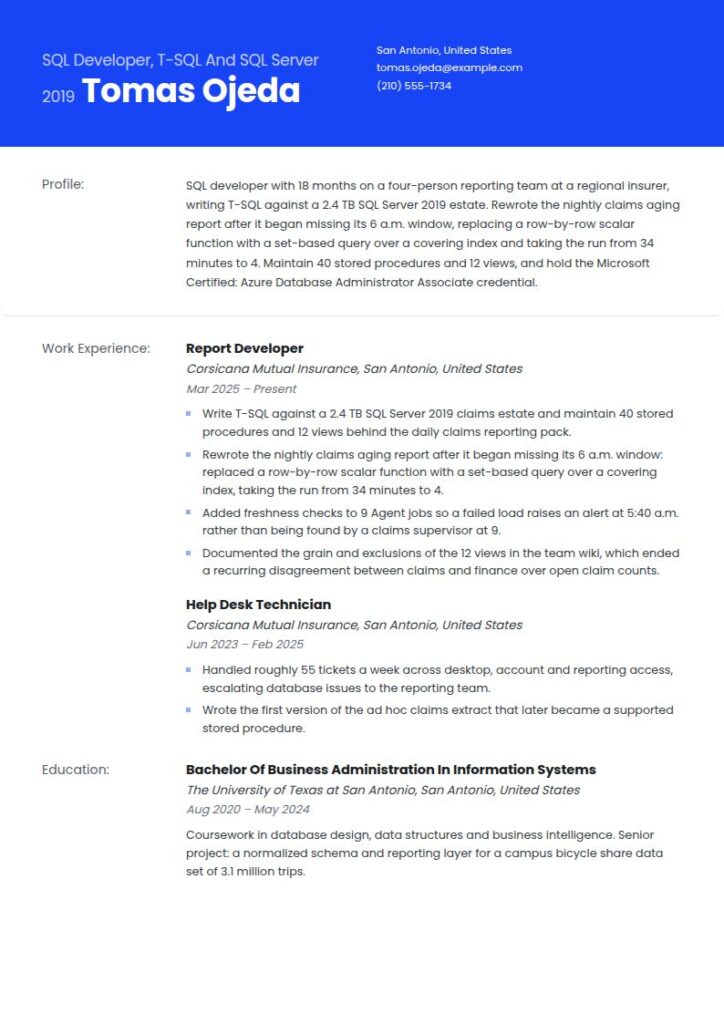
SQL developer with 18 months on a four-person reporting team at a regional insurer, writing T-SQL against a 2.4 TB SQL Server 2019 estate. Rewrote the nightly claims aging report after it began missing its 6 a.m. window, replacing a row-by-row scalar function with a set-based query over a covering index and taking the run from 34 minutes to 4. Maintain 40 stored procedures and 12 views, and hold the Microsoft Certified: Azure Database Administrator Associate credential.
Work Experience
03/2025 - Present, Report Developer, Corsicana Mutual Insurance, San Antonio, United States
- Write T-SQL against a 2.4 TB SQL Server 2019 claims estate and maintain 40 stored procedures and 12 views behind the daily claims reporting pack.
- Rewrote the nightly claims aging report after it began missing its 6 a.m. window: replaced a row-by-row scalar function with a set-based query over a covering index, taking the run from 34 minutes to 4.
- Added freshness checks to 9 Agent jobs so a failed load raises an alert at 5:40 a.m. rather than being found by a claims supervisor at 9.
- Documented the grain and exclusions of the 12 views in the team wiki, which ended a recurring disagreement between claims and finance over open claim counts.
06/2023 - 02/2025, Help Desk Technician, Corsicana Mutual Insurance, San Antonio, United States
- Handled roughly 55 tickets a week across desktop, account and reporting access, escalating database issues to the reporting team.
- Wrote the first version of the ad hoc claims extract that later became a supported stored procedure.
Education
08/2020 - 05/2024, Bachelor of Business Administration, Information Systems, The University of Texas at San Antonio, San Antonio, United States
Coursework in database design, data structures and business intelligence. Senior project: a normalized schema and reporting layer for a campus bicycle share data set of 3.1 million trips.
Skills
T-SQL (SQL Server 2019), 75
Stored procedures and views, 70
Execution plan reading, 60
Index design, 60
SSRS and Agent job scheduling, 65
Git for database objects, 60
Languages
English, native
Spanish, native
Certificates
11/2025, Microsoft Certified: Azure Database Administrator Associate, Microsoft, DP-300
Covers data platform resources, securing the environment, monitoring and optimizing database resources, automation, and high availability and disaster recovery. Renewed every 12 months by a free online assessment on Microsoft Learn.
Summary
A SQL developer resume is a one to two page document naming the dialect you write, the stored procedure estate you maintain, and one query you made faster with the plan and the timings attached. This guide gives you three adaptable versions, the before-and-after block almost nobody writes, and an honest account of what federal wage data publishes for this title.
SQL Developer resume examples by experience level
A SQL developer resume is a one to two page document that names the dialect you write, the stored procedure and view estate you are responsible for, and at least one query you rewrote, with the execution plan and the timings on the page.
Nearly every resume in this stack says the same four things: strong SQL skills, query optimization, stored procedures, performance tuning. None is checkable. A hiring manager who has read forty of these cannot tell a person who rewrote a correlated subquery into a windowed lookup from a person who added WITH (NOLOCK) until the error went away.
One worked example fixes that. Take a single query and write what it did before, what the plan showed, what you changed and what it did after. In fact, that paragraph is the only part of a SQL resume that cannot be produced by someone who has not done the work.
Resume guide for a SQL developer resume
Specifically, this guide and the corresponding SQL developer resume example will cover:
- First of all, how to write a SQL developer resume, block by block
- Then, why the dialect belongs in the title line, not buried in a skills list
- Also, three adaptable summaries: first SQL role, working developer and lead
- Finally, how to write one query optimization an interviewer can probe
- Which published occupations the federal wage data actually puts this work in
How to write a SQL developer resume
Six blocks: contact header, summary, the estate you own, development experience, skills and platforms, then education and certifications. Generally, one page for your first three years, two once you own a schema other teams write against.
The estate block sits under the summary because it is the quickest way to say how big the thing you look after is. "Wrote complex SQL queries" describes a Tuesday. "214 stored procedures and 61 views behind the operations reporting layer, on SQL Server 2019" describes a job.
| Block | What it is answering | Where it goes |
|---|---|---|
| Dialect and platform | T-SQL, PL/SQL, PostgreSQL or MySQL, and which version | Title line and skills block |
| The estate | How many objects, how much data, how many consumers | Under the summary |
| Development experience | What did they build, and what got faster or safer? | Reverse chronological |
| The worked optimization | Can this person read a plan, or do they guess? | Its own block, with numbers |
Write the dialect into your title line, because it is a different labor market
T-SQL, PL/SQL, PostgreSQL and MySQL are not interchangeable on a resume. They differ in procedural language, in isolation behavior, in how the optimizer is hinted, and in what a recruiter searches for. A T-SQL developer applying to an Oracle shop is a retraining decision, and the hiring manager wants that in the first line rather than the second interview.
So write "SQL Developer, T-SQL and SQL Server 2019" in the title line. The same rule applies inside your bullets: "optimized queries" is dialect-free and therefore keyword-free, while "replaced a scalar user-defined function with an inline table-valued function in T-SQL" is specific and searchable.
Run the finished file through the ATS resume checker before you send it. Database postings parse on exact strings, and "MS SQL" and "SQL Server" do not always match the same requisition.
Choosing the best resume format for a SQL developer resume
Overall: reverse chronological, single column, one page early and two once the estate and the optimization record justify the space.
Keep code out of the layout. However, a resume with a formatted query block in it parses badly and takes space a second employer should be using. Write the before-and-after as prose and bring the SQL to the interview.
Include your contact information
| ✅ Right | ❌ Wrong |
|---|---|
| Tomas Ojeda | Tomas Ojeda |
| SQL Developer, T-SQL and SQL Server 2019 | Experienced database professional with strong SQL skills |
| 214 stored procedures and 61 views behind an operations reporting layer | Expert in query optimization and performance tuning |
| (210) 555-1734, [email protected], San Antonio, TX | (210) 555-1734, [email protected] |
Above all, put a version number in the first block. After all, SQL Server 2016, 2019 and 2022 differ in things a developer uses daily, and a hiring manager upgrading an estate reads for exactly that.
Make use of a summary
In short, four lines: the dialect and platform, the size of what you maintain, one optimization with its timings, and the upgrade you have been through.
SQL developer with 18 months on a four-person reporting team at a regional insurer, writing T-SQL against a 2.4 TB SQL Server 2019 estate. Rewrote the nightly claims aging report after it began missing its 6 a.m. window, replacing a row-by-row scalar function with a set-based query over a covering index and taking the run from 34 minutes to 4. Maintain 40 stored procedures and 12 views, and hold the Microsoft Certified: Azure Database Administrator Associate credential.
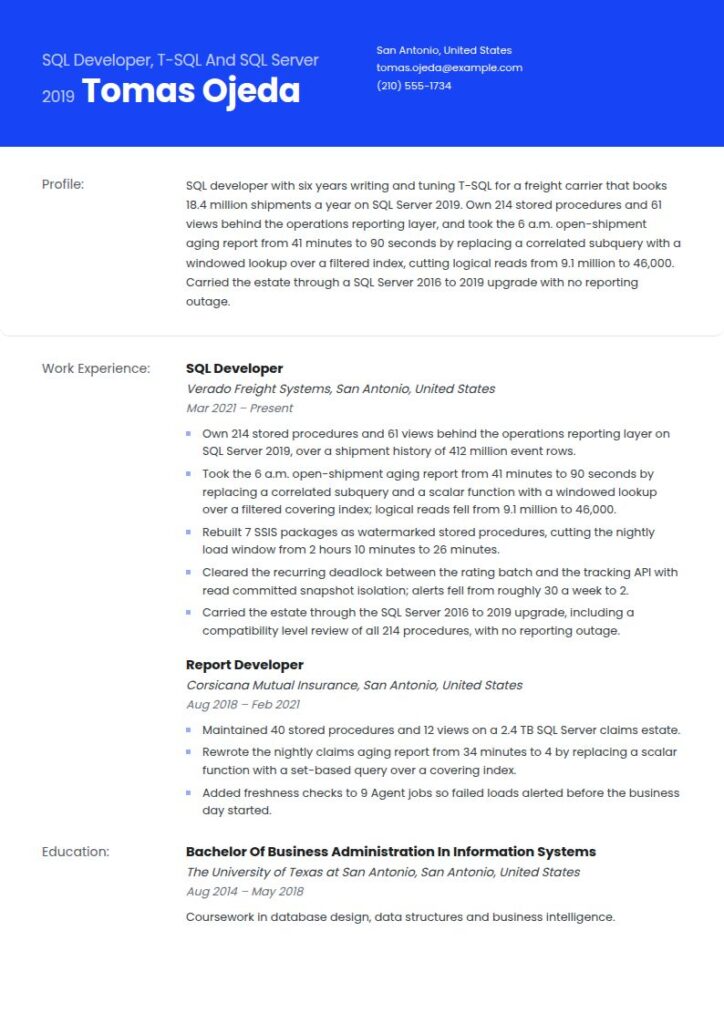
SQL developer with six years writing and tuning T-SQL for a freight carrier that books 18.4 million shipments a year on SQL Server 2019. Own 214 stored procedures and 61 views behind the operations reporting layer, and took the 6 a.m. open-shipment aging report from 41 minutes to 90 seconds by replacing a correlated subquery with a windowed lookup over a filtered index, cutting logical reads from 9.1 million to 46,000. Carried the estate through a SQL Server 2016 to 2019 upgrade with no reporting outage.
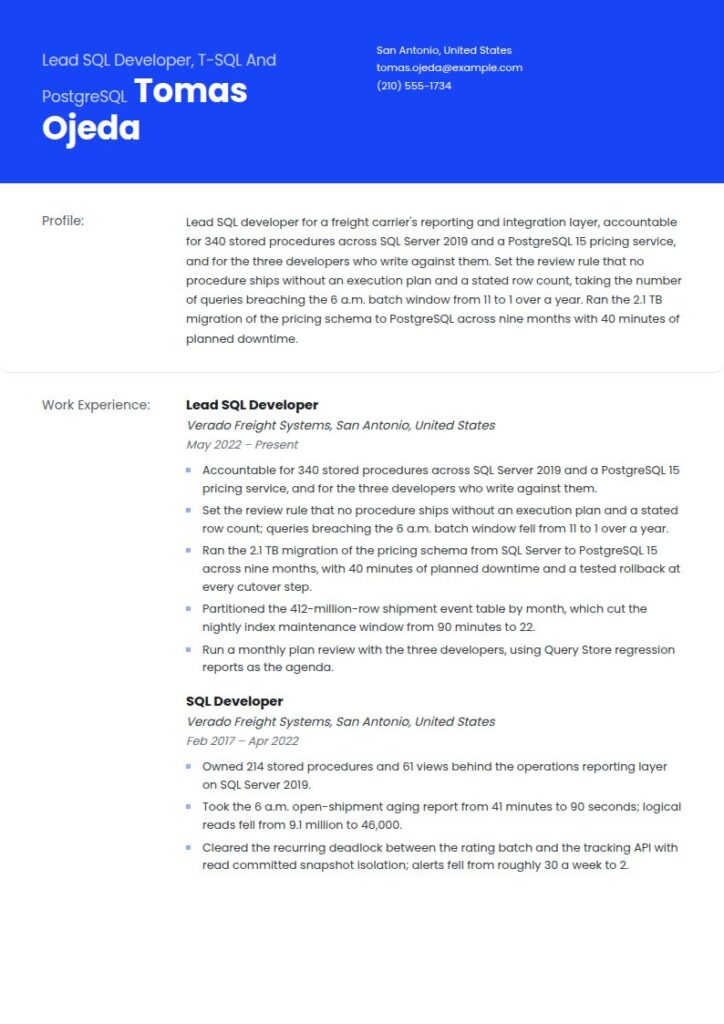
Lead SQL developer for a freight carrier's reporting and integration layer, accountable for 340 stored procedures across SQL Server 2019 and a PostgreSQL 15 pricing service, and for the three developers who write against them. Set the review rule that no procedure ships without an execution plan and a stated row count, taking the number of queries breaching the 6 a.m. batch window from 11 to 1 over a year. Ran the 2.1 TB migration of the pricing schema to PostgreSQL across nine months with 40 minutes of planned downtime.
Right vs wrong: the same SQL developer summary, twice
| ✅ Right | ❌ Wrong |
|---|---|
| Writes T-SQL against a SQL Server 2019 estate booking 18.4 million shipments a year. | Experienced SQL developer with a strong background in relational databases. |
| Owns 214 stored procedures and 61 views behind the operations reporting layer. | Skilled in writing complex stored procedures, views and functions. |
| Took the 6 a.m. aging report from 41 minutes to 90 seconds; logical reads fell from 9.1 million to 46,000. | Performed query optimization and performance tuning to improve efficiency. |
| Carried the estate through a SQL Server 2016 to 2019 upgrade with no reporting outage. | Participated in database upgrade and migration projects. |
The right column can be interviewed. Every line, in fact, invites a follow-up the candidate can answer, which is the whole point of putting it there.
Outline your SQL development experience
Employer, what the database is for, its size, the platform and version, then the dates. Then list three to five bullets, each naming an object you changed and what moved.
| Instead of | Use |
|---|---|
| Wrote complex SQL queries and stored procedures | Own 214 stored procedures and 61 views behind the operations reporting layer on SQL Server 2019 |
| Performed query optimization and performance tuning | Took the 6 a.m. open-shipment aging report from 41 minutes to 90 seconds after a plan review showed a 412-million-row scan |
| Resolved database performance issues | Cleared the deadlock between the rating batch and the tracking API with read committed snapshot isolation; alerts fell from 30 a week to 2 |
SQL Developer, Verado Freight Systems, San Antonio, TX, March 2021 to Present
Own 214 stored procedures and 61 views behind the operations reporting layer on SQL Server 2019, over a shipment history of 412 million event rows.
Took the 6 a.m. open-shipment aging report from 41 minutes to 90 seconds by replacing a correlated subquery and a scalar function with a windowed lookup over a filtered covering index; logical reads fell from 9.1 million to 46,000.
Rebuilt 7 SSIS packages as watermarked stored procedures, cutting the nightly load window from 2 hours 10 minutes to 26 minutes.
Cleared the recurring deadlock between the rating batch and the tracking API with read committed snapshot isolation; alerts fell from roughly 30 a week to 2.
Carried the estate through the SQL Server 2016 to 2019 upgrade, including a compatibility level review of all 214 procedures, with no reporting outage.
One query, before and after, with the dialect and the plan named
This is the block almost nobody writes, and it is the one that answers the interview question before it is asked.
Pick a single query. Not a project, not a quarter of tuning work: one query you can still describe in detail. Then write eight facts about it.
| What to state | Why the reader needs it |
|---|---|
| The dialect and version | T-SQL on SQL Server 2019 and PL/SQL on Oracle 19c are different skills |
| What the query is for | A report missing its 6 a.m. cutoff is a business problem, not a hobby |
| The row counts involved | 400 million rows and 400,000 rows are different problems |
| What the plan showed | The line that proves you read one |
| What you changed | Index, join order, predicate, or a set-based replacement for a cursor |
| Runtime before and after | With the window it was measured over, not one lucky run |
| A second measure | Logical reads or CPU time, since runtime alone moves with load |
| What the business noticed | The reason anyone paid for the work |
Optimization: 6 a.m. open-shipment aging report, T-SQL on SQL Server 2019
Before: the report joined 18.4 million shipments to a 412-million-row event table, then called a scalar user-defined function once per shipment to find the latest event. The actual plan showed a clustered index scan of the event table and a nested loops join, with the function invoked row by row. Median runtime over 30 consecutive mornings was 41 minutes, with 9.1 million logical reads, and it missed the 6 a.m. dispatch cutoff on 14 of those 30 days.
After: replaced the scalar function with a windowed ROW_NUMBER lookup, added a filtered covering index on shipment_id and event_time including status_code for the trailing 90 days, and rewrote a non-sargable predicate that wrapped event_time in a date conversion. The plan became an index seek with a merge join. Median runtime over the next 30 mornings was 90 seconds, with 46,000 logical reads, and the report has not missed the cutoff since.
Effect: dispatchers stopped maintaining the parallel spreadsheet they had built to cover late mornings, and the operations stand-up moved back to 6:15 a.m.
What makes the SQL example credible
Three things make that block work. It is falsifiable, since an interviewer can ask what the filtered index cost on insert. It names a plan operator, the fastest proof that you read plans rather than guess. Finally, it ends on something outside the database team.
Around the one worked example, give the wider set in four lines rather than a second essay:
- The estate. How many procedures, views, functions and jobs you are responsible for, on what platform and version, over how much data.
- The reporting load. How many downstream consumers read your objects, how many people use them, and what the cutoff time is.
- Concurrency and locking. The blocking or deadlock problem you diagnosed, the change that fixed it, and how the alert count moved.
- The migration or upgrade. Which version or engine to which, how much data, how long it took, and how much downtime the business took.
If you have no professional optimization yet, write one at the scale you have. A class project or a personal data set works, as long as you state the row counts, what the plan showed and both timings.
The title straddles two occupations moving in opposite directions
The Bureau of Labor Statistics publishes no Occupational Outlook Handbook profile titled "SQL developer", and the two published occupations the work sits between are moving apart. Database administrators and architects are projected to grow 4 percent between 2025 and 2035, with the architect half growing 9 percent and the administrator half showing no change at all, while computer programmers decline 7 percent over the same decade, a loss of 8,100 jobs (BLS Occupational Outlook Handbook, 2025-35 projections).
Openings are thin on both sides: about 7,300 a year for database administrators and architects and about 4,400 for computer programmers (BLS, 2025-35 projections). They reward opposite resumes. A page that reads as query writing on request reads as the declining half; a page that reads as owning a schema and the performance of what other teams depend on reads as the growing half.
Build a snapshot of your key SQL developer skills
Similarly, twelve to sixteen entries in four groups, named by product and version, not by category.
Dialects and engines: T-SQL (SQL Server 2016, 2019 and 2022), PostgreSQL 15 with PL/pgSQL, MySQL 8 (working)
Development: Stored procedures and inline table-valued functions, Indexed views, Window functions and common table expressions, Set-based rewrites of cursor logic, Source control for database objects in Git
Performance: Execution plan reading, Filtered and covering index design, Statistics and cardinality estimation, Query Store and Extended Events, Isolation levels and deadlock analysis, Partitioning of large history tables
Data movement and platform: SSIS, SSRS, Azure SQL Database, Point-in-time recovery testing, Agent job scheduling and failure alerting
Two rules. Write the version, because the version is the screen. And keep a performance group even in your first role, since it separates a SQL developer from anyone who has written a SELECT.
List your education and certifications
Degree first, then the vendor certification matching your engine, then anything showing you have worked on the operations side of a database rather than only the query side.
Bachelor of Business Administration, Information Systems, The University of Texas at San Antonio, San Antonio, TX, 2018. Coursework in database design, data structures and business intelligence.
Certifications: Microsoft Certified: Azure Database Administrator Associate, Microsoft, exam DP-300 (2023). Microsoft role-based certifications are renewed every 12 months by passing a free online assessment on Microsoft Learn, and this one is current.
Skills measured by DP-300: planning and implementing data platform resources; implementing a secure environment; monitoring, configuring and optimizing database resources; automating tasks; planning and configuring high availability and disaster recovery.
DP-300 earns its place because its published skill areas lean toward security, monitoring, automation and recovery, the operational half of database work a query-only resume never evidences. Listing it and then showing one recovery or automation line in your experience is a coherent pair; listing it with nothing behind it is not.
Choose the right layout and design
Likewise, single column, 10 or 11 point, clear headings, no photograph, no skill rating bars. The optimization block wants a little structure, so give it short labeled lines rather than a code fence.
Name the dialect and the version in the title line. State the estate you maintain in objects and in data volume. Write one query optimization with the plan, both timings and a second measure such as logical reads. Say what changed for someone outside the database team. Name the migration or upgrade you have been through and the downtime it took.
Do not write "complex SQL queries" or "performance tuning" as a claim on its own, since every competing file has them. Do not paste formatted SQL into the resume. Do not quote a speed improvement as a percentage without the two timings behind it. Do not list eight engines you have opened once. Do not claim ownership of a schema you only queried.
SQL developer job market and outlook
One fact belongs at the top, because it changes how every number under it should be read. The U.S. Bureau of Labor Statistics publishes no Occupational Outlook Handbook profile titled "SQL developer"; therefore, this page will not manufacture one. Instead, the work is distributed across published occupations, and two of them bracket almost every posting that uses the title.
| Published occupation, BLS | Median annual wage, May 2025 | Projected change, 2025-35 | Projected annual openings | Jobs, 2025 |
|---|---|---|---|---|
| Database administrators and architects | $126,760 | 4% (as fast as average), +6,500 | About 7,300 | 144,500 |
| Database architects | $139,500 | 9% | Included above | 69,500 |
| Database administrators | $104,620 | 0% (little or no change) | Included above | 75,000 |
| Computer programmers | $100,390 | -7% (decline), -8,100 | About 4,400 | 110,800 |
Source: U.S. Bureau of Labor Statistics, Occupational Outlook Handbook, 2025-35 projections as well as May 2025 wage data.
Read the change column before the wage column. For instance, database architects are projected to grow 9 percent between 2025 and 2035, database administrators show no change, and computer programmers decline 7 percent (BLS, 2025-35 projections). One title, three trajectories.
In other words, the distinction the data draws is design against execution. For example, work that specifies a model, decides a grain and owns what the database guarantees is projected as architecture. On the other hand, work that produces requested queries from someone else's design is projected as programming. Most SQL developers do some of both, and most resumes describe only the second.
What salary you can expect as a SQL developer
No Handbook profile carries this job title, so there is no single official median to quote and any page offering one has invented it or lifted it from a salary aggregator. Therefore, the honest answer is a range anchored to the published occupations your posting matches.
If the role is schema design, modeling, partitioning and the performance contract of the database, the reference is database architects: median $139,500 as of May 2025, lowest 10 percent under $86,240 and highest 10 percent above $204,000, with industry medians of $152,560 in infrastructure providers and data processing and $148,680 in computer systems design (BLS, May 2025).
Where the role is maintaining an existing estate, tuning it and keeping it available, the reference is database administrators: median $104,620 as of May 2025, lowest 10 percent under $60,230 and highest 10 percent above $163,320, with industry medians of $124,270 in management of companies and enterprises and $124,130 in computer systems design (BLS, May 2025).
If the role is writing requested procedures and reports against a design someone else owns, the reference is computer programmers: median $100,390 as of May 2025, lowest 10 percent under $57,710 and highest 10 percent above $160,460, with industry medians of $111,710 in software publishers and $107,620 in finance and insurance (BLS, May 2025).
Two things follow. The spread between the architect median and the programmer median is wider than anything a negotiation produces, so the work you can evidence matters more than the sentence you say on the call. Also, quote the published occupation you match with its cycle attached, because "the BLS May 2025 median for database architects is $139,500" is a claim a compensation partner can verify in a minute.
Key takeaways for a SQL developer resume
- Above all, put the dialect and the version in the title line; they decide which shortlist you land on.
- In addition, state the estate: objects, data volume, platform, and who reads from it.
- Write one query before and after, with the plan, both timings and a second measure.
- Moreover, end the optimization on what someone outside the database team noticed.
- Give the concurrency story, since blocking and deadlocks are what page people.
- Finally, name the migration or upgrade you survived and the downtime it really took.
- Decide whether your page reads as design or as execution, because the data prices them differently.
Build your SQL developer resume in 15 minutes with our AI resume builder.
Related information technology resume examples
- Data engineer resume
- Data analyst resume
- Data scientist resume
- Power BI developer resume
- Tableau developer resume
- AWS data engineer resume
- Programmer resume
- Software developer resume
- Java developer resume
- Python developer resume
- Systems analyst resume
- IT resume
Pair it with a matching SQL developer cover letter.
SQL developer resume questions, answered
How long should a SQL developer resume be?
One page for your first three years. Two once you own a schema other teams write against, have led an upgrade, or have more than one optimization worth describing in detail. The estate block and the worked query usually justify the second page.
Which SQL dialect should I put on the page?
The one you write daily, named with its version, in the title line. If you work across two, name both and say which is primary. Do not list four engines to widen your net; a hiring manager reads that as one engine and three afternoons.
Why does this page not give a single SQL developer salary figure?
Because the federal statistical system publishes none under that title. There is no Occupational Outlook Handbook profile for a SQL developer, so this page gives the occupations that bracket the work instead: database architects at $139,500, database administrators at $104,620 and computer programmers at $100,390, all May 2025 medians (BLS, May 2025).
What do I put on a SQL developer resume with no professional experience?
One query, done properly. Take a public data set large enough to be slow, write a query that is genuinely inefficient, capture the plan, fix it, and record both runtimes and the read counts. A candidate who can talk through one plan they have read is ahead of one who lists six certifications and no timings.
Do certifications help a SQL developer get hired?
One that matches your engine helps, particularly a vendor credential covering the operational side such as Microsoft's DP-300, which measures security, monitoring, automation and high availability alongside optimization (Microsoft Learn). Beyond that they stop adding much, and the space is better spent on the estate and the optimization block.