Tomas Ojeda SQL Developer, T-SQL and SQL Server 2019 San Antonio, 78212, United States [email protected] · (210) 555-1734
11 September 2026
Mr. Curtis Dunwoody Data Services Quarry Lake Health Plan San Antonio, United States
Application for SQL Developer, Quarry Lake Health Plan
Dear Mr. Dunwoody,
I am applying for the SQL Developer post at Quarry Lake Health Plan. I write T-SQL against SQL Server 2019 at a freight carrier, where I own 214 stored procedures and 61 views behind an operations reporting layer built on 412 million shipment event rows, and I have run one engine migration to PostgreSQL 15.
The work I would most want to bring is a single query. Our 6 a.m. open-shipment aging report was taking a median 41 minutes and missing the dispatch cutoff on 14 mornings out of 30. The plan showed a clustered index scan of the event table and a scalar function being called once per shipment. I replaced the function with a windowed lookup, added a filtered covering index on the trailing 90 days, and rewrote a predicate that had been wrapping the event timestamp in a date conversion. Median runtime went to 90 seconds and logical reads from 9.1 million to 46,000, and the dispatchers stopped keeping the spreadsheet they had built to cover late mornings.
Your posting mentions a claims reporting pack that has outgrown its nightly window, which is the problem I spent my first two years on at a regional insurer. I would expect to start by reading the plans for whatever runs closest to its cutoff rather than proposing an architecture, and I would want to put a freshness check on every scheduled load early, since a late report that nobody is told about is the expensive version.
I hold the Microsoft Certified: Azure Database Administrator Associate credential, exam DP-300, and it is current. I can give four weeks' notice. Thank you for reading.
Sincerely, Tomas Ojeda
Summary
A SQL developer cover letter names the dialect and version you write, gives one query you rewrote with the plan and both timings, and says what someone outside the database team noticed afterwards. This guide gives you a full adaptable letter, the openings that work, and what to write when the posting will not say which engine the team actually runs in production.
SQL Developer cover letter examples by experience level
A SQL developer cover letter is a one-page letter that names the dialect and version you write, describes one query you made faster with the numbers attached, and says what changed for the people who were waiting on it.
It works because almost nobody does it. The rest of the folder is letters about being detail-oriented and results-driven, and a hiring manager who tunes queries for a living recognizes a real optimization in two sentences.
Guide to a SQL developer cover letter
This guide and the corresponding SQL developer cover letter example will cover:
- How to structure the letter, paragraph by paragraph
- Why the dialect and version belong in the first line
- How to compress one query optimization into four sentences
- What to write when the posting will not say which engine it runs
- The openings that survive a reader who tunes queries for a living
How to write a SQL developer cover letter
| Paragraph | Its job | Length |
|---|---|---|
| Opening | The post, the dialect and version, and the size of what you maintain | 2 to 3 sentences |
| Evidence | One query: before, what the plan showed, what you changed, after | 4 to 5 sentences |
| Fit | Something specific about their stack or their problem, and what you would take on | 3 to 4 sentences |
| Close | The certification, availability, thank you | 2 sentences |
Put the dialect and the version in the first sentence
A hiring manager filling a SQL role has an engine, a version and usually a problem. The first question in their head is whether you already work in that engine, because the answer changes how long you take to become useful.
So open with it: "I write T-SQL against a SQL Server 2019 estate of 214 stored procedures and 61 views." That answers the engine, version and scale questions before the reader has decided whether to keep going.
If your engine does not match theirs, say so in the same sentence and add what transfers. Plan reading, index design, isolation levels and set-based thinking move across engines; the procedural language and the tooling do not.
A SQL developer cover letter example you can adapt
Dear Mr. Dunwoody,
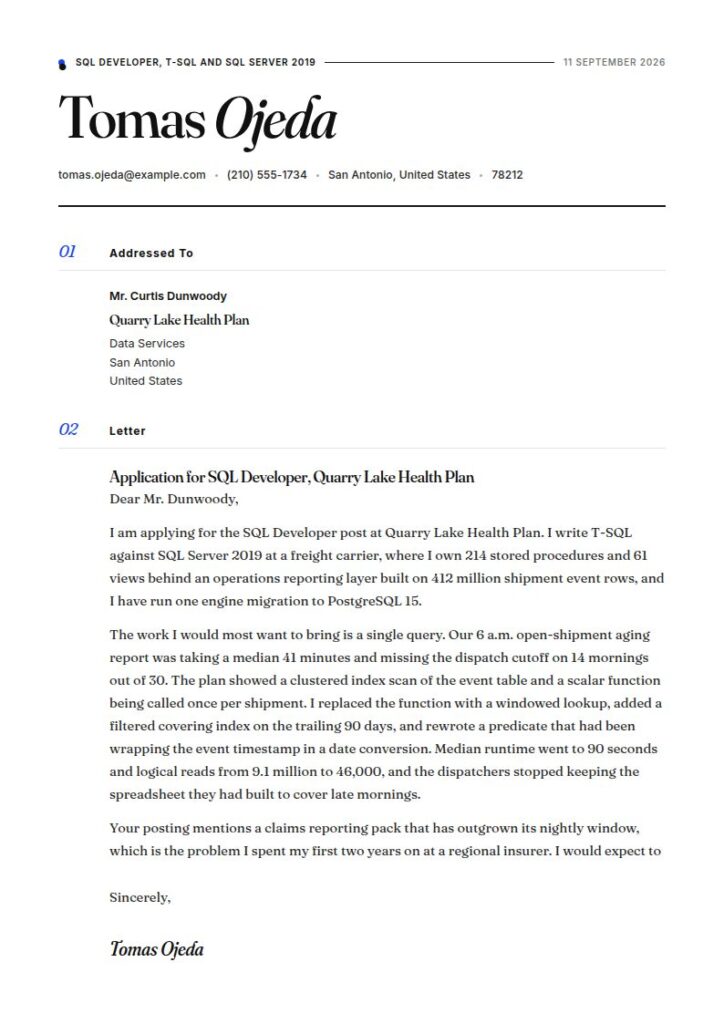
I am applying for the SQL Developer post at Quarry Lake Health Plan. I write T-SQL against SQL Server 2019 at a freight carrier, where I own 214 stored procedures and 61 views behind an operations reporting layer built on 412 million shipment event rows, and I have run one engine migration to PostgreSQL 15.
The work I would most want to bring is a single query. Our 6 a.m. open-shipment aging report was taking a median 41 minutes and missing the dispatch cutoff on 14 mornings out of 30. The plan showed a clustered index scan of the event table and a scalar function being called once per shipment. I replaced the function with a windowed lookup, added a filtered covering index on the trailing 90 days, and rewrote a predicate that had been wrapping the event timestamp in a date conversion. Median runtime went to 90 seconds and logical reads from 9.1 million to 46,000, and the dispatchers stopped keeping the spreadsheet they had built to cover late mornings.
Your posting mentions a claims reporting pack that has outgrown its nightly window, which is the problem I spent my first two years on at a regional insurer. I would expect to start by reading the plans for whatever runs closest to its cutoff rather than proposing an architecture, and I would want to put a freshness check on every scheduled load early, since a late report that nobody is told about is the expensive version.
I hold the Microsoft Certified: Azure Database Administrator Associate credential, exam DP-300, and it is current. I can give four weeks' notice. Thank you for reading.
Sincerely, Tomas Ojeda
Openings that work
| Instead of | Use |
|---|---|
| I am writing to express my interest in the SQL Developer position | I write T-SQL against SQL Server 2019 and own 214 stored procedures behind an operations reporting layer |
| I have strong SQL skills and experience with query optimization | Our 6 a.m. aging report went from 41 minutes to 90 seconds after a plan review showed a 412-million-row scan |
| I am a detail-oriented problem solver with a passion for data | I have run one engine migration, 2.1 TB from SQL Server to PostgreSQL 15, with 40 minutes of planned downtime |
One query, in four sentences
The evidence paragraph is the whole letter, and it has a fixed shape: what the query is for and how slow it was, what the plan showed, what you changed, and what it does now.
| Sentence | What belongs in it |
|---|---|
| The problem | The report or job, the row counts, the runtime, what it was late for |
| The diagnosis | The plan operator you saw: a scan, a nested loops join, a row-by-row call |
| The change | The index, the rewrite or the set-based replacement, named precisely |
| The result | Both timings, a second measure such as logical reads, and what stopped being a problem |
The second sentence separates letters. Anyone can write that a query got faster; naming what the plan showed is a claim only someone who opened it can make, and it is the sentence an interviewer comes back to.
When the posting will not say which engine it runs
Plenty of postings say "SQL" and nothing more, or list four engines because a recruiter copied a stack page. Write for that honestly.
Name your primary dialect and version, then say plainly what transfers: plan reading, index design, isolation levels, set-based rewriting. Give your one optimization anyway, since the reasoning is engine-independent even when the syntax is not. Ask, in the letter, which engine and version the estate runs on; it reads as a person who knows the question matters. If you have genuinely worked in two engines, say which is primary and how recently you used the other.
Do not list every engine you have installed at home. Do not claim an engine you have not shipped work in; the first technical screen asks about isolation defaults or procedural syntax and the gap shows immediately. Do not write "expert in query optimization" anywhere. Do not send a letter with no numbers in it.
Two published occupations, moving in opposite directions
The Bureau of Labor Statistics publishes no Occupational Outlook Handbook profile titled "SQL developer", so the market has to be read through the occupations that do exist. Database administrators and architects are projected to grow 4 percent between 2025 and 2035, and inside that the architect half grows 9 percent while the administrator half shows no change. Computer programmers decline 7 percent over the same decade (BLS Occupational Outlook Handbook, 2025-35 projections).
The medians follow the same split: database architects at $139,500, database administrators at $104,620 and computer programmers at $100,390, all May 2025 (BLS, May 2025).
Design work is the growing, better-paid half, so if you have ever chosen a grain, a partition scheme or an index strategy rather than being handed one, that belongs in the letter and not only on the resume.
Length, format and sending it
One page, four paragraphs, 250 to 400 words. PDF unless the portal says otherwise, named for yourself and the post: tomas-ojeda-sql-developer-cover-letter.pdf.
Address a person. Engineering managers and data leads are usually findable, and a named recipient on a letter that already contains real numbers reads as someone who does their homework.
Keep the figures identical to your resume. Our SQL developer resume example uses the same estate, query and timings as this letter, which is what a reader comparing the two should find.
Key takeaways
- Name the dialect and the version in the first sentence.
- Say how big the estate is: objects, data volume, who reads it.
- Give one query in four sentences: problem, plan, change, result.
- Include the plan operator you saw; it is the sentence that cannot be faked.
- End the evidence on what someone outside the database team noticed.
- If the engine does not match, say what transfers and what does not.
- Address a named person and keep the numbers identical to your resume.
Write your SQL developer cover letter in 10 minutes with our AI cover letter builder.
SQL developer cover letter questions, answered
How long should a SQL developer cover letter be?
One page, four paragraphs, 250 to 400 words. The evidence paragraph can be the longest, because it is the only part carrying something the resume does not already give in a more scannable form.
Should I include actual SQL in the letter?
No. Formatted code is hard to read on a phone, parses badly in a portal, and invites an argument about style before anyone has decided to interview you. Describe the change in words, name the operator or the index type, and bring the query itself.
What do I write if I have never optimized anything at work?
Write an optimization you did anywhere: a slow query over a public data set, a report you rebuilt in a previous job, a class project where you captured the plan before and after. State the row counts and both timings and label the context honestly. The reasoning is what is being read.
Does the cover letter still matter for a database role?
It matters where the posting is vague, where your engine does not match, or where you are moving from analysis or support into development. In those three cases the letter is the only place you can explain a mismatch before a filter removes you for it.
How do I write to a company whose stack I do not know?
Read what is public: engineering posts, job ads for adjacent roles, the technologies named on their careers page. One accurate sentence about what they appear to run beats a paragraph of admiration, and if you cannot tell, asking which engine and version they run is a reasonable question to put in the letter.