Full Stack Developer Soraya Haddad
Associate Full Stack Developer
[email protected] | (512) 555-1010 | Austin, United States
Profile
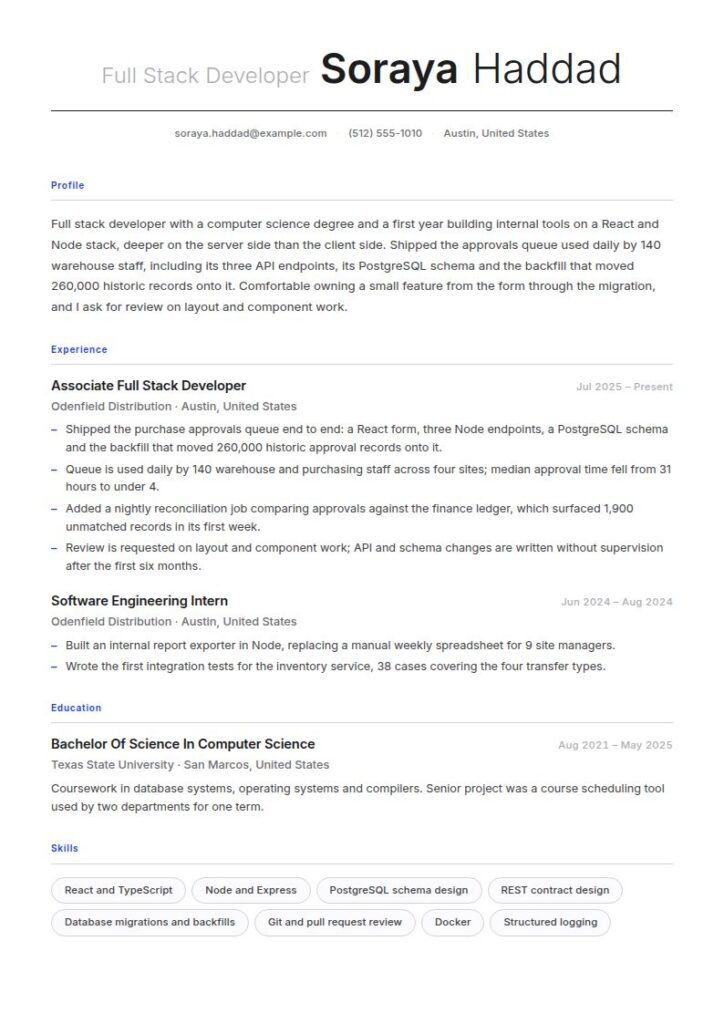
Full stack developer with a computer science degree and a first year building internal tools on a React and Node stack, deeper on the server side than the client side. Shipped the approvals queue used daily by 140 warehouse staff, including its three API endpoints, its PostgreSQL schema and the backfill that moved 260,000 historic records onto it. Comfortable owning a small feature from the form through the migration, and I ask for review on layout and component work.
Work Experience
07/2025 - Present, Associate Full Stack Developer, Odenfield Distribution, Austin, United States
- Shipped the purchase approvals queue end to end: a React form, three Node endpoints, a PostgreSQL schema and the backfill that moved 260,000 historic approval records onto it.
- Queue is used daily by 140 warehouse and purchasing staff across four sites; median approval time fell from 31 hours to under 4.
- Added a nightly reconciliation job comparing approvals against the finance ledger, which surfaced 1,900 unmatched records in its first week.
- Review is requested on layout and component work; API and schema changes are written without supervision after the first six months.
06/2024 - 08/2024, Software Engineering Intern, Odenfield Distribution, Austin, United States
- Built an internal report exporter in Node, replacing a manual weekly spreadsheet for 9 site managers.
- Wrote the first integration tests for the inventory service, 38 cases covering the four transfer types.
Education
08/2021 - 05/2025, Bachelor of Science, Computer Science, Texas State University, San Marcos, United States
Coursework in database systems, operating systems and compilers. Senior project was a course scheduling tool used by two departments for one term.
Skills
React and TypeScript, 60
Node and Express, 70
PostgreSQL schema design, 65
REST contract design, 60
Database migrations and backfills, 60
Git and pull request review, 70
Docker, 55
Structured logging, 55
Languages
English, native
Arabic, native
Certificates
03/2026, AWS Certified Cloud Practitioner, Amazon Web Services
Foundational certification taken during the first year in role.
Summary
A full stack developer resume is a one to two page document that follows one feature from the interface through the API contract and the data model to the deploy, and says plainly which half of the stack is the deep half. This guide gives you three adaptable versions, the end to end trace most applicants cannot fill in, and current Bureau of Labor Statistics pay for the published occupations the title sits between.
Full Stack Developer resume examples by experience level
In short, a full stack developer resume is a one to two page document that follows a single feature from the click that starts it to the migration that shipped with it, and tells the reader which half of that path you are genuinely deep in.
However, the second half of that sentence is the part applicants fight. The title invites a claim of symmetry: front end and back end, equally strong, nothing out of reach. Almost nobody is symmetric, and engineers reading these files know it, so a claim of symmetry makes them discount the whole page. Naming a deep half and then proving the other half is serviceable reads as a file written by someone who has shipped.
Resume guide for a full stack developer resume
Specifically, this guide and the corresponding full stack developer resume example will cover:
- How to write a full stack developer resume, section by section
- How to trace one feature end to end so a reader can follow it
- Why declaring a deep half makes you more hireable, not less
- Three adaptable summaries: first role, practicing developer and lead
- Which published occupations the title sits between, and what they pay
How to write a full stack developer resume
Overall, six blocks: contact header, summary, one traced feature, experience, skills grouped by layer, and education with certifications. The traced feature is the block that persuades, so it goes directly under the summary and everything below it is corroboration.
| Section | The question it answers | Where it goes |
|---|---|---|
| Summary | What do you build, and which half are you deep in? | Top, four lines |
| Traced feature | Can you actually hold a whole path in your head? | Directly under the summary |
| Experience | Did anyone else rely on the things you shipped? | Reverse chronological, numbers in every bullet |
| Skills by layer | Where does your depth sit, in your own words? | Grouped, never one long list |
| Education and certifications | Is there anything here worth verifying? | Bottom, short |
Write the stack in the order the request travels
Most full stack resumes list technologies alphabetically or in the order the candidate learned them. Write them instead in the order a request moves: browser, edge, API, service, data store, queue, job runner, deploy.
That ordering shows where your knowledge thins out, and shows it before an interviewer has to find out by asking. A reader who can see the thinning is far more likely to route you to a role that fits than to reject you for it.
It also stops the commonest empty line on these resumes, which is a cloud provider named with no service under it. "AWS" is not a skill. "S3, SQS and one Lambda behind API Gateway, deployed with Terraform someone else wrote" is a skill, and it is honest about the edges.
Run the finished file through the ATS resume checker before you send it. Engineering pipelines parse to structured fields first, and a two-column layout is where that parsing breaks.
Choosing the best resume format for a full stack developer resume
Reverse chronological, single column. Generally, one page for your first five years, two once you have shipped work that other teams built on.
Skills-based formats are particularly damaging for this title. The hiring question is whether you have carried a feature all the way through a real system, and a format that separates the technologies from the jobs you used them in removes the only evidence of that. After all, a reader who cannot tell which employer the Postgres came from assumes it came from a tutorial.
Include your contact information
| ✅ Right | ❌ Wrong |
|---|---|
| Soraya Haddad | Soraya Haddad |
| Full Stack Developer, deep on the API and data layer | Passionate full stack engineer and problem solver |
| React and TypeScript front end, Node and PostgreSQL behind it | JavaScript, HTML, CSS, React, Node, Express, MongoDB, SQL, Git, Agile |
| (512) 555-1010, [email protected], Austin, TX | (512) 555-1010, [email protected] |
The second line does real work. In contrast, a reader who learns in four seconds that you are an API and data person with a working front end can place you against an open role. However, ten technologies in a row leave them guessing.
Make use of a summary
In short, four lines: what you build, which half is deep, one feature with a number on it, and the scale it ran at.
Full stack developer with a computer science degree and a first year building internal tools on a React and Node stack, deeper on the server side than the client side. Shipped the approvals queue used daily by 140 warehouse staff, including its three API endpoints, its PostgreSQL schema and the backfill that moved 260,000 historic records onto it. Comfortable owning a small feature from the form through the migration, and I ask for review on layout and component work.
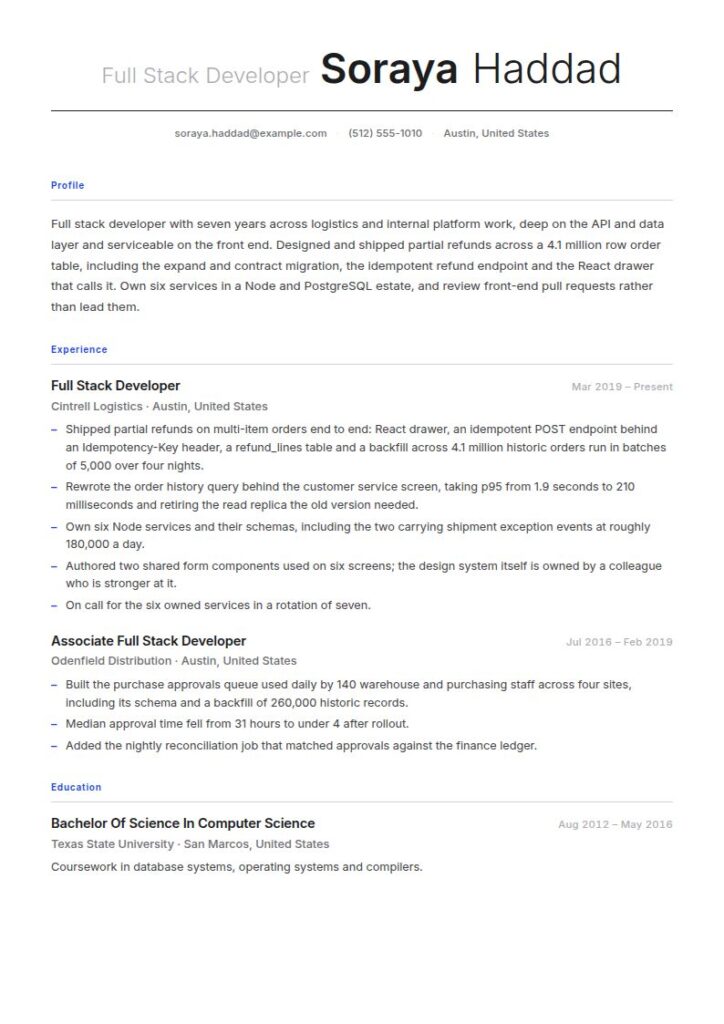
Full stack developer with seven years across logistics and internal platform work, deep on the API and data layer and serviceable on the front end. Designed and shipped partial refunds across a 4.1 million row order table, including the expand and contract migration, the idempotent refund endpoint and the React drawer that calls it. Own six services in a Node and PostgreSQL estate, and review front-end pull requests rather than lead them.
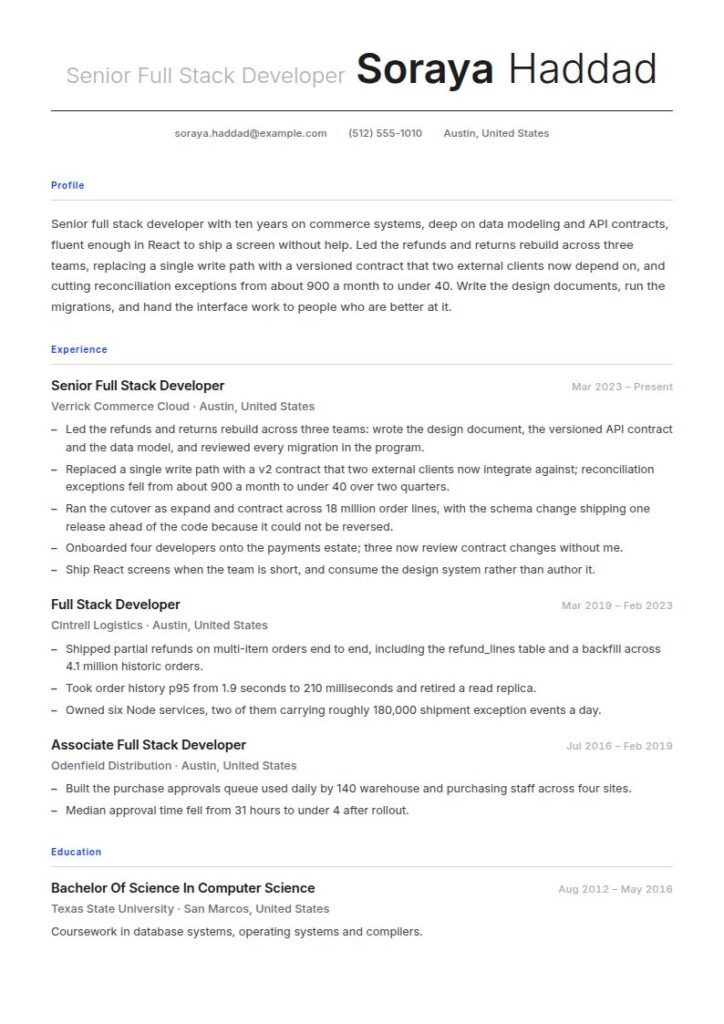
Senior full stack developer with ten years on commerce systems, deep on data modeling and API contracts, fluent enough in React to ship a screen without help. Led the refunds and returns rebuild across three teams, replacing a single write path with a versioned contract that two external clients now depend on, and cutting reconciliation exceptions from about 900 a month to under 40. Write the design documents, run the migrations, and hand the interface work to people who are better at it.
Right vs wrong: the same full stack developer summary, twice
| ✅ Right | ❌ Wrong |
|---|---|
| Full stack developer, deep on the API and data layer and serviceable on the front end. | Full stack developer equally comfortable across the entire technology stack. |
| Shipped partial refunds across a 4.1 million row order table, migration included. | Built and maintained various features for web applications. |
| Own six services in a Node and PostgreSQL estate and review front-end pull requests. | Experienced with React, Node, Express, PostgreSQL, MongoDB, Docker and AWS. |
For example, a recruiter can route the left column to a team. The right column has to be interviewed before anyone knows what it is, and that interview is the expensive step a resume exists to shorten.
Outline your experience
Then list company, title, dates, and the stack in one clause. Then three to five bullets, each naming a component and carrying a number.
| Instead of | Use |
|---|---|
| Developed full stack features using React and Node | Shipped partial refunds end to end: React drawer, idempotent POST endpoint, refund_lines table and its backfill of 4.1 million rows |
| Worked with databases to improve performance | Replaced a correlated subquery in the order history view with a lateral join, taking the p95 from 1.9 seconds to 210 milliseconds |
| Collaborated with front end and back end teams | Wrote the OpenAPI change for the refunds contract and had it reviewed by the payments team that owned the endpoint |
| Deployed applications to the cloud | Shipped behind a flag at 5 percent for six days, then to all traffic; the migration went out one release ahead because it was not reversible |
| Wrote unit tests | Added 41 tests around the refund total calculation, including the four rounding cases that had caused the previous incident |
Full Stack Developer, Cintrell Logistics, Austin, TX, March 2019 to February 2023. React and TypeScript front end, Node and PostgreSQL services, deployed on ECS.
Shipped partial refunds on multi-item orders end to end, from the React drawer through an idempotent refund endpoint to a new refund_lines table and the backfill that populated it across 4.1 million historic orders.
Rewrote the order history query behind the customer service screen, taking p95 from 1.9 seconds to 210 milliseconds and removing the read replica the old version had needed.
Owned six Node services and their schemas, including the two that carried shipment exception events at roughly 180,000 a day.
Reviewed front-end pull requests for the team and authored two shared form components, but the design system itself was owned by a colleague who was stronger at it.
That last bullet is the one applicants delete. Leave it in, because it is what makes the other four believable.
Trace one feature end to end, then name your deep half
Above all, pick one feature you shipped and write its whole path in five short lines. In fact, this is the block that separates a full stack developer from a developer who worked next to one.
Feature: partial refunds on multi-item orders, Cintrell Logistics, shipped November 2022.
Interface: a refund drawer inside the order detail screen, React and TypeScript, with a confirmation step showing the recalculated tax before submit and an optimistic row update that rolls back on a non-2xx response.
API contract: POST /v2/orders/{id}/refunds, taking line identifiers and amounts, requiring an Idempotency-Key header. The endpoint lives in the payments service, which the payments team owns; I wrote the OpenAPI change and they reviewed and merged it.
Data model: a refund_lines table keyed to order_lines, with a partial unique index preventing a second refund against the same line. Shipped as expand and contract: add the nullable column, backfill 4.1 million rows in batches of 5,000 over four nights, then set not null in a later release.
Deploy: released behind a flag at 5 percent of orders for six days, then to all traffic. The migration shipped one release ahead of the code because it could not be rolled back; the flag was the rollback.
Moreover, every one of those lines is checkable in conversation. For instance, a candidate who did not do the work cannot produce the idempotency header, name who owned the endpoint, or explain why the migration went out a release early.
Then add the depth declaration, which is two short paragraphs and one piece of evidence.
Deep half: the API and data layer. I design the schema, write the migrations, own the contract and take the pager for six services.
Serviceable half: the front end. I ship screens in React and TypeScript against a design system I consume rather than author, my two shared form components are used on six screens, and the last front-end bug I fixed was a stale closure in a debounced search field that was firing against the previous query string. Front-end architecture decisions go to someone else.
The shallow side, on the other hand, needs a checkable fact, not a reassurance. "Comfortable with React" is a reassurance. Instead, a named bug with its cause, a component you authored and where others use it, and an admission of which decisions you do not make are facts, testable in ninety seconds.
Which half you name changes which jobs you are sent
Recruiters route full stack applications into whichever requisition is open. A resume that declares nothing gets routed on keywords, which sends you to the role matching your longest list rather than your depth.
Declaring the deep half moves you out of that lottery. It costs you the requisitions you would have failed at the technical round anyway, and it wins the ones where the hiring manager was quietly looking for exactly what you are. If you genuinely are balanced, which happens most often on small product teams where nobody specializes, say that and evidence both sides inside the same feature trace. What fails is saying nothing.
Build a snapshot of your key skills
Group by layer in request order, then, with twelve to eighteen entries in total.
Interface: React, TypeScript, component library consumption, form state and validation, Playwright end to end tests
API and services: Node and Express, REST contract design, OpenAPI, idempotency and retry semantics, background job design, event consumers
Data: PostgreSQL schema design, indexing and query plans, expand and contract migrations, backfill strategy, Redis caching
Delivery: Docker, ECS, GitHub Actions, feature flags, structured logging and tracing, on-call for owned services
Deliberately not claimed: front-end architecture, design system authorship, Kubernetes cluster administration
The last line is unusual and it works. Also, a short exclusion list tells a reader that you wrote the rest of the page with the same care.
List your education and certifications
Degree, then any certification with its year and issuing body, then nothing else. In particular, this is the shortest block on the page and it should stay that way.
Bachelor of Science, Computer Science, Texas State University, San Marcos, TX, 2016
Certifications: AWS Certified Developer, Associate, Amazon Web Services (2023, valid through 2026). PostgreSQL Associate Certification, EDB (2024).
Coursework, kept only while it is the newest thing on the page: database systems, operating systems, compilers.
If you came in through a bootcamp or taught yourself, write the program and its length plainly and give the space to the feature trace instead.
Choose the right layout and design
Likewise, single column, 11 or 12 point, plain headings, no photograph, no skill bars. Export to PDF unless the portal asks for a document file.
Skill bars are worth a specific mention because they are common on developer resumes and they hurt. After all, a bar saying React is at 80 percent tells a reader nothing measurable and invites the question of what the missing 20 percent is. The depth declaration above, instead, does that job with words that survive a follow-up question.
Trace one feature from interface to deploy, in five lines. Name who owned the API contract you called or changed. Say which migration shipped and how it was made safe. Declare your deep half and back the shallow half with one checkable fact. Group skills by layer in request order. Put a number in every experience bullet.
Do not claim symmetry across the stack; almost nobody has it and experienced readers discount the whole page for it. Do not list a cloud provider with no named service under it. Do not put skill rating bars on an engineering resume. Do not describe a feature without saying whether it reached production. Do not hide the design system you consume behind language that implies you built it.
Full stack developer job market and outlook
The U.S. Bureau of Labor Statistics publishes no current Occupational Outlook Handbook profile under the title full stack developer, so no federal employment or wage figure exists for it. BLS counts the work inside two published occupations instead, and this page uses both.
| Measure | Software developers, QA analysts and testers | Web developers and digital designers |
|---|---|---|
| Jobs, 2025 | 1,905,400 | 220,100 |
| Projected change, 2025-35 | 10% (much faster than average), +185,400 | 5%, +11,300 |
| Projected annual openings | About 106,100 | About 13,600 |
| Median annual wage, May 2025 | $134,040 combined; software developers $135,980 | $99,520 combined; web developers $92,650 |
| Typical entry-level education | Bachelor's degree | Bachelor's degree |
Source: U.S. Bureau of Labor Statistics, Occupational Outlook Handbook, 2025-35 projections and May 2025 wage data.
In fact, the two occupations an employer can file a full stack job under differ by about nine to one in size and by $43,330 in median pay. The way someone wrote the requisition decided which one an employer thinks it is hiring for, before you applied.
The gap between the two occupations is larger than most title changes
Software developers had a median annual wage of $135,980 in May 2025, against $92,650 for web developers, a difference of $43,330 (BLS Occupational Outlook Handbook, May 2025). The wider group of software developers, quality assurance analysts and testers ran from under $82,460 at the tenth percentile to over $214,670 at the ninetieth, a spread of $132,210 (BLS, May 2025).
Both occupations contain people who would describe themselves as full stack developers. The same React and Node skills sit on both sides of a $43,330 line.
What moves a file from the lower side to the upper side is rarely the front-end work, because that is the half both occupations share. It is evidence of the systems half: the data model you designed, the contract other teams consume, the migration you made safe, the service you carry a pager for. That is the argument for making the deep half explicit rather than leaving it to a keyword match.
Where software developer pay sits by industry:
| Industry | Median annual wage (May 2025) |
|---|---|
| Software publishers | $164,550 |
| Manufacturing | $136,330 |
| Management of companies and enterprises | $135,680 |
| Finance and insurance | $135,460 |
| Computer systems design and related services | $132,050 |
Source: U.S. Bureau of Labor Statistics, Occupational Outlook Handbook, May 2025.
What salary you can expect as a full stack developer
No BLS median exists for this job title, because the Handbook carries no entry under it. Therefore, treat the two published occupations above as the band an employer draws your offer from, and the distance between them as what your resume argues about.
Specifically, the upper anchor is software developers at $135,980, with quality assurance analysts and testers at $104,300 and the combined group at $134,040 (BLS, May 2025). Similarly, the lower anchor is web developers at $92,650, with web and digital interface designers at $104,000 and that combined group at $99,520 (BLS, May 2025).
Furthermore, industry is the largest published lever inside the upper band. For instance, software publishers paid a median of $164,550 against $132,050 in computer systems design and related services (BLS, May 2025). For web developers, meanwhile, the same pattern is sharper in percentage terms: $119,940 in information against $84,450 in educational services (BLS, May 2025).
In both tables the best paying industries are the ones where the software is the product rather than a support function. Consequently, evidence that you have shipped and operated something customers pay for is what reads as a fit there, and the traced feature is where that evidence goes: a customer-facing path, a production release, a rollback plan, and a number that survived real traffic.
Key takeaways for a full stack developer resume
- First of all, trace one feature from interface to deploy in five lines; it is the block that proves the title.
- Name who owned the API contract, because that single fact cannot be faked.
- Also show the migration and how you made it safe, not just the table you added.
- Declare your deep half, then give the shallow half one checkable fact.
- Group skills in the order a request travels, so the thinning is visible and honest.
- Finally, put a number in every experience bullet, tied to a named component.
- Keep it single column and free of rating bars, because the first reader is a parser.
Build your full stack developer resume in 15 minutes with our AI resume builder.
Related information technology resume examples
- Software developer resume
- Front-end developer resume
- Web developer resume
- Software engineer resume
- Senior software engineer resume
- Entry-level software engineer resume
- Java developer resume
- Python developer resume
- SQL developer resume
- DevOps engineer resume
- QA tester resume
- Solution architect resume
Pair it with a matching full stack developer cover letter.
Full stack developer resume questions, answered
How long should a full stack developer resume be?
One page for your first five years, two once you have shipped work other teams built on. At three pages the cause is almost always an undifferentiated technology list, not too much experience.
Is it bad to say I am stronger on one half of the stack?
No, and the opposite claim is what costs you. Depth on both halves at once is rare, so a claim of symmetry gets discounted across the whole page. Naming the deep half and evidencing the other as serviceable reads as accuracy, which is the trait the rest of the page is asking to be believed on.
What do I put on a full stack developer resume with no professional experience?
The same trace, taken from the largest thing you have built: the interface, the endpoint and its shape, the schema and any migration run against existing data, and how it was deployed. Add whether anyone other than you used it, how many, and over what window. A project with eleven real users and a rollback story beats five finished tutorials.
Should I list every framework I have touched?
No. List what you could be interviewed on this week, grouped by layer, and let the rest go. A reader who finds one framework you cannot discuss will re-read every other line as a possible exaggeration, which is a high price for one keyword.
How do I show back-end depth without exposing internal detail?
Describe shape and scale rather than names and secrets. Row counts, request volumes, percentile latencies, index structure, contract semantics such as idempotency and versioning, and migration size are all safe. Customer names, internal hostnames, revenue figures and security controls are not, and a reader who sees them assumes the next employer will see theirs.
Does the BLS publish pay for full stack developers?
Not under that title. The Occupational Outlook Handbook carries no profile for full stack developers, so any single figure attached to the title comes from somewhere other than federal wage data. The published occupations bracketing the work are software developers at $135,980 and web developers at $92,650 (BLS, May 2025).