Salesforce Administrator Tobias Lindqvist
Salesforce Administrator (sole admin)
[email protected] | (503) 555-1816 | Portland, United States
Profile
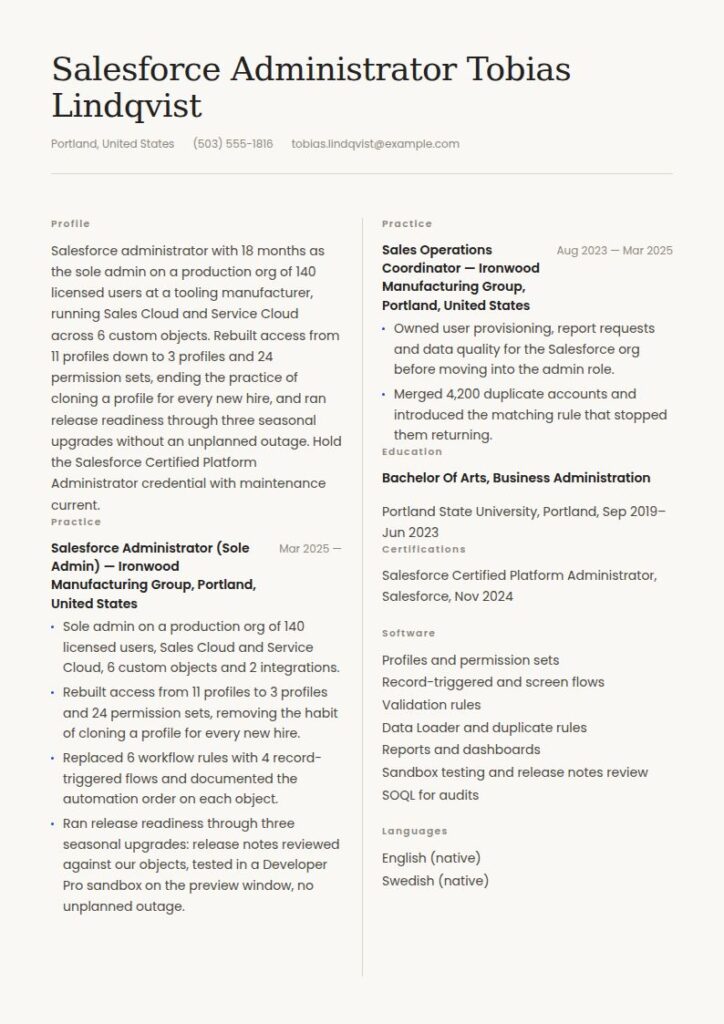
Salesforce administrator with 18 months as the sole admin on a production org of 140 licensed users at a tooling manufacturer, running Sales Cloud and Service Cloud across 6 custom objects. Rebuilt access from 11 profiles down to 3 profiles and 24 permission sets, ending the practice of cloning a profile for every new hire, and ran release readiness through three seasonal upgrades without an unplanned outage. Hold the Salesforce Certified Platform Administrator credential with maintenance current.
Work Experience
03/2025 - Present, Salesforce Administrator (sole admin), Ironwood Manufacturing Group, Portland, United States
- Sole admin on a production org of 140 licensed users, Sales Cloud and Service Cloud, 6 custom objects and 2 integrations.
- Rebuilt access from 11 profiles to 3 profiles and 24 permission sets, removing the habit of cloning a profile for every new hire.
- Replaced 6 workflow rules with 4 record-triggered flows and documented the automation order on each object.
- Ran release readiness through three seasonal upgrades: release notes reviewed against our objects, tested in a Developer Pro sandbox on the preview window, no unplanned outage.
08/2023 - 03/2025, Sales Operations Coordinator, Ironwood Manufacturing Group, Portland, United States
- Owned user provisioning, report requests and data quality for the Salesforce org before moving into the admin role.
- Merged 4,200 duplicate accounts and introduced the matching rule that stopped them returning.
Education
09/2019 - 06/2023, Bachelor of Arts, Business Administration, Portland State University, Portland, United States
Coursework in information systems and operations management.
Skills
Profiles and permission sets, 75
Record-triggered and screen flows, 65
Validation rules, 70
Data Loader and duplicate rules, 75
Reports and dashboards, 80
Sandbox testing and release notes review, 65
SOQL for audits, 55
Languages
English, native
Swedish, native
Certificates
11/2024, Salesforce Certified Platform Administrator, Salesforce
Annual Trailhead maintenance badge current.
Summary
A Salesforce admin resume is a one to two page document describing the org you run by its measurable shape, users, objects, automations and integrations, and what you do about the three seasonal releases Salesforce ships every year. This guide gives you three adaptable versions, the org profile block almost nobody writes, the credential ladder and its annual maintenance rule, and current Bureau of Labor Statistics pay for the published occupation this work sits in.
Salesforce Admin resume examples by experience level
A Salesforce admin resume is a one to two page document that describes the org you run by its measurable shape, and shows what you do about the fact that the platform underneath it changes three times a year whether you are ready or not.
Those two things are what the job actually is. Almost every resume for this title instead lists features: reports and dashboards, flows, validation rules, user management, data loader. After all, that list is identical on every file in the stack, because it is the product's own feature menu. It tells a reader nothing about whether you could be handed their org on a Monday.
Resume guide for a Salesforce admin resume
In short, this guide and the corresponding Salesforce admin resume example will cover:
- How to write a Salesforce admin resume, section by section
- How to describe an org so a stranger can picture its size and its mess
- Three adaptable summaries: first admin role, working admin and lead admin
- What Salesforce publishes about its release cycle, sandboxes and credential maintenance
- What the market pays when the Handbook publishes no profile under this title
How to write a Salesforce admin resume
First, plan six sections: contact header with a title line, summary, an org profile block, experience, platform skills, and education with credentials. Keep one page for your first three or four years, then two once you have run a production org through a platform migration or a merger.
That is because the order follows what the reader is deciding. They are not asking whether you can build a flow. They are asking whether you have run an org of roughly their size and complexity, and whether it stayed standing.
| Section | What it is answering | Where it goes |
|---|---|---|
| Title line | Sole admin, one of several, or the person who owns the platform? | Directly under your name |
| Summary | How big is the org, how complex, and what did you change about it? | Three or four lines |
| Org profile | Can this person be handed our org without a six month ramp? | Its own block |
| Experience | What did you retire, consolidate or prevent, and what changed? | Reverse chronological, with numbers |
| Skills | Declarative depth, and where the boundary with development sits | Grouped |
| Credentials | Which credentials, and are the maintenance badges current? | With education |
Write down the eight numbers that describe your org before you write a line
Open Setup and collect eight figures: licensed users, custom objects, record count on the largest object, active flows, profiles, permission sets, managed packages installed, and integrations writing into the org.
Those eight numbers are a portrait. An org with 140 users, 6 custom objects and 3 flows is a different job from one with 2,600 users, 38 custom objects, 61 million records and 14 integrations, even though both resumes would otherwise say "administered Salesforce". Nobody can produce the list from memory, which is precisely why it works on a page.
Run the finished file through the ATS resume checker before you submit. Salesforce postings draw very heavy volume and are parsed into a structured record first.
Choosing the best resume format for a Salesforce admin resume
For format, generally use reverse chronological, single column, with the org profile block high on the page. However, move to two pages only once you have run a production org through a merger, a platform migration or a Lightning transition.
The functional format is a common mistake here, because many admins arrive from sales operations, support or accounting and want to lead with skills rather than an unrelated job history. It backfires: the reader is checking how long you held an org, since the second year in one org teaches more than the first year in three. Keep the timeline and use the title line to explain the transition.
Include your contact information
| ✅ Right | ❌ Wrong |
|---|---|
| Tobias Lindqvist | Tobias Lindqvist |
| Salesforce Admin, 2,600 users, 38 custom objects, 61 million records | Certified Salesforce Professional |
| Salesforce Certified Platform Administrator II, maintenance current | Salesforce certified, multiple certs |
| (503) 555-1816, [email protected], Portland, OR | (503) 555-1816, [email protected] |
For example, the right column sizes the org in one line and states that the credential is maintained. Also, Salesforce credentials require annual maintenance, so "certified" with no maintenance note invites the reader to wonder.
Make use of a summary
Next, write three or four lines: the size and shape of the org, one thing you removed or consolidated, and the credential.
Salesforce administrator with 18 months as the sole admin on a production org of 140 licensed users at a tooling manufacturer, running Sales Cloud and Service Cloud across 6 custom objects. Rebuilt access from 11 profiles down to 3 profiles and 24 permission sets, ending the practice of cloning a profile for every new hire, and ran release readiness through three seasonal upgrades without an unplanned outage. Hold the Salesforce Certified Platform Administrator credential with maintenance current.
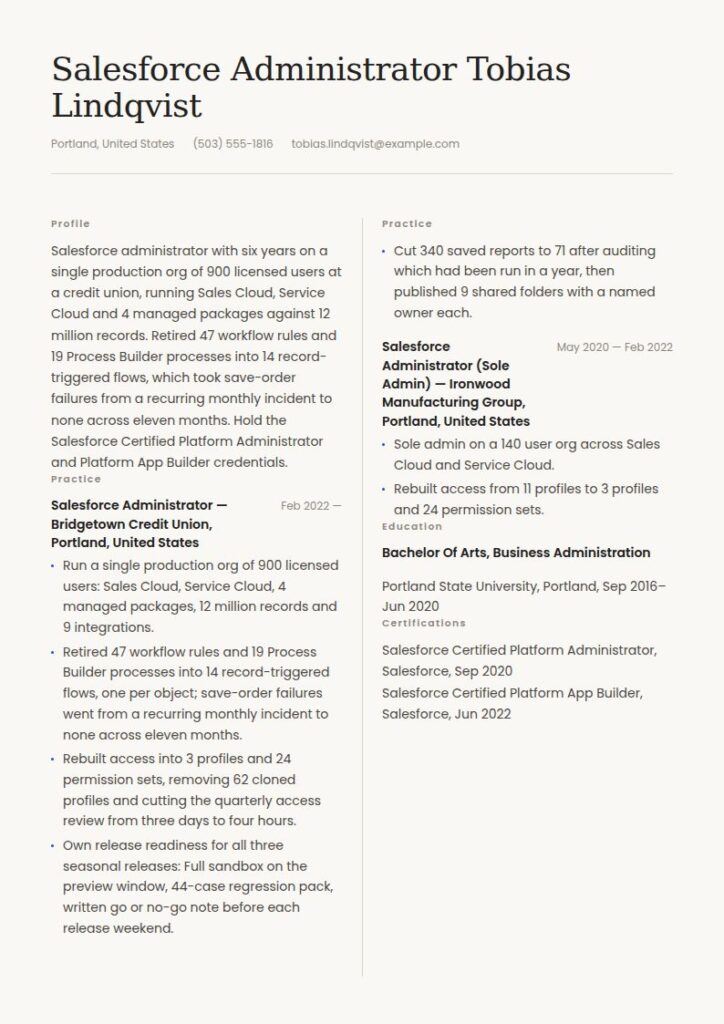
Salesforce administrator with six years on a single production org of 900 licensed users at a credit union, running Sales Cloud, Service Cloud and 4 managed packages against 12 million records. Retired 47 workflow rules and 19 Process Builder processes into 14 record-triggered flows, which took save-order failures from a recurring monthly incident to none across eleven months. Hold the Salesforce Certified Platform Administrator and Platform App Builder credentials.
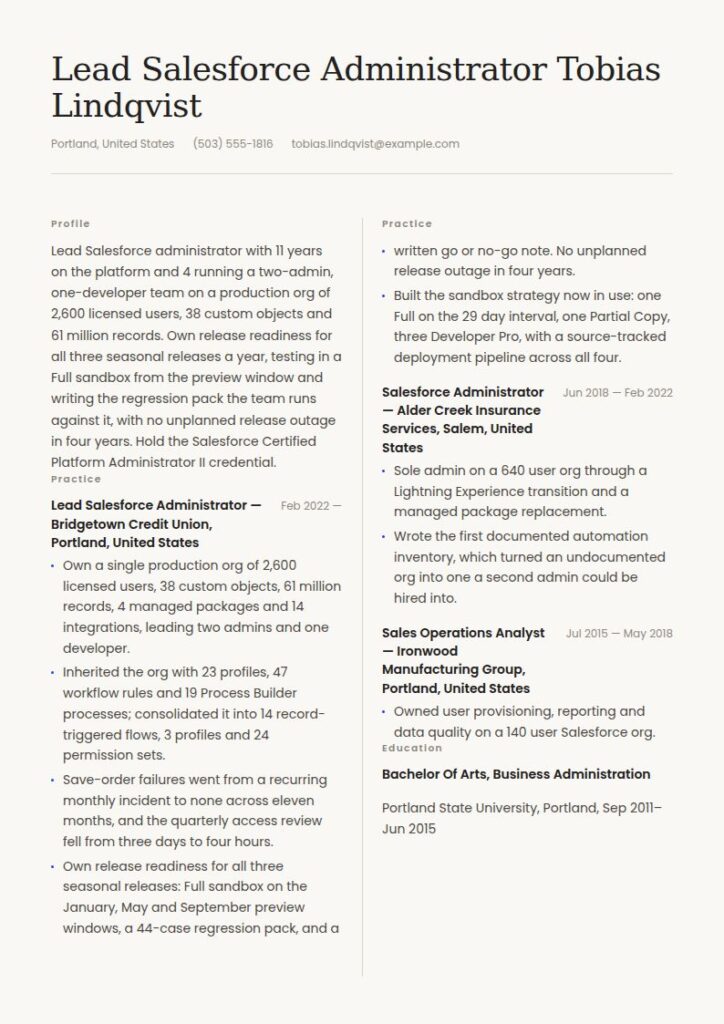
Lead Salesforce administrator with 11 years on the platform and 4 running a two-admin, one-developer team on a production org of 2,600 licensed users, 38 custom objects and 61 million records. Own release readiness for all three seasonal releases a year, testing in a Full sandbox from the preview window and writing the regression pack the team runs against it, with no unplanned release outage in four years. Hold the Salesforce Certified Platform Administrator II credential.
Right vs wrong: the same Salesforce admin summary, twice
| ✅ Right | ❌ Wrong |
|---|---|
| Sole admin on a production org of 900 licensed users, 4 managed packages and 12 million records. | Administered Salesforce for a large financial services organization. |
| Retired 47 workflow rules and 19 Process Builder processes into 14 record-triggered flows. | Built automation to streamline business processes and improve efficiency. |
| Own release readiness for all three seasonal releases, with no unplanned outage in four years. | Stayed current with new Salesforce features and releases. |
As a result, the right column describes an org a reader can picture and a job they can imagine handing over. By contrast, the wrong column is the feature menu, and every other file in the stack has it.
Outline your Salesforce admin experience
Employer, sector, dates, then the org shape before any bullet. Then write three to five bullets under each role, each naming something you built, retired or prevented, with a number on it.
| Instead of | Use |
|---|---|
| Managed users, profiles and permissions | Rebuilt access from 11 profiles to 3 profiles and 24 permission sets, removing 62 cloned profiles |
| Built flows to automate business processes | Retired 47 workflow rules and 19 Process Builder processes into 14 record-triggered flows, one per object |
| Created reports and dashboards for management | Cut 340 saved reports to 71 by publishing 9 shared folders with owners, after auditing which had been run in a year |
| Performed data cleanup and deduplication | Merged 41,000 duplicate accounts against a matching rule, then made the rule blocking so the problem stopped returning |
| Stayed current with Salesforce releases | Run the Full sandbox preview each January, May and September and a 44-case regression pack before every release weekend |
Lead Salesforce Administrator, Bridgetown Credit Union, Portland, OR, February 2022 to Present
Own a single production org of 2,600 licensed users, 38 custom objects, 61 million records, 4 managed packages and 14 integrations, with a two-admin and one-developer team reporting in.
Retired 47 workflow rules and 19 Process Builder processes into 14 record-triggered flows, one per object, which took save-order failures from a recurring monthly incident to none across eleven months.
Rebuilt access from 11 profiles to 3 profiles and 24 permission sets, removing 62 cloned profiles created for individual hires and cutting the quarterly access review from three days to four hours.
Own release readiness for all three seasonal releases: Full sandbox on the preview window, a 44-case regression pack, and a written go or no-go note to the business before each release weekend. No unplanned release outage in four years.
Cut 340 saved reports to 71 by auditing which had been run in a year, then published 9 shared folders with a named owner each.
Your org's shape, and your record through three releases a year
This is the section almost nobody writes, and it is the one that tells a hiring manager whether you have run an org like theirs.
The shape. Two admins can hold identical credentials and identical skills lists and be doing completely different jobs, because org complexity is not a skill, it is a condition. Eight numbers describe it: licensed users, custom objects, records on the largest object, active flows, profiles, permission sets, managed packages, and integrations writing in. Give all eight. A reader who runs a 2,000 user org with 12 integrations will know within one line whether your experience transfers.
Add the things that make an org hard rather than big: how many business units share it, whether it is a single production org or several, whether there is a managed package you cannot modify, and whether anything writes to it that you do not control.
Your Salesforce admin release record
The release record. This is the differentiator, and it is the part of the job nobody outside it understands. Salesforce ships new features three times a year: the seasonal releases occur in Spring in February, Summer in June, and Winter in October (Salesforce Help, retrieved 17 September 2026). Your org is upgraded on a schedule you do not set, and features you rely on can change underneath you.
Salesforce also documents the window you get to prepare. Specifically, Salesforce upgrades sandbox preview instances 4 to 5 weeks ahead of the production release, in January, May and September (Salesforce Help, retrieved 17 September 2026). In practice, that window is the whole professional discipline of the role, and an admin who can describe what they do inside it is describing something an untested applicant cannot fake.
Similarly, which sandbox you test in also says something, because Salesforce's own documentation separates them sharply.
| Sandbox type | What it copies | Refresh interval | What it is for |
|---|---|---|---|
| Developer | Configuration only, 200 MB data storage | 1 day | Building and unit testing in isolation |
| Developer Pro | Configuration only, 1 GB data storage | 1 day | Development, QA, integration testing, training |
| Partial Copy | Configuration plus a sample of production data, 5 GB | 5 days | User acceptance testing, integration testing |
| Full | A replica of production, all data and metadata | 29 days | Performance testing, load testing, staging |
Source: Salesforce Help, sandbox types and licenses, retrieved 17 September 2026.
For instance, saying "tested in a sandbox" is worth nothing, because a Developer sandbox holds no data. On the other hand, saying "regression pack run in a Full sandbox on the preview window" says you tested against production volume, and it explains why your release weekends are uneventful.
Org profile, current role
Single production org, 2,600 licensed users across retail banking, lending and collections. Sales Cloud, Service Cloud, Experience Cloud community for 4,100 members.
38 custom objects, 61 million records on the largest, 14 record-triggered flows, 3 profiles, 24 permission sets, 4 managed packages, 14 integrations including the core banking platform and the loan origination system.
Sandboxes: 1 Full refreshed against the 29 day interval, 1 Partial Copy, 3 Developer Pro. Change sets and a source-tracked deployment pipeline across all four.
Release record: all three seasonal releases owned since 2022, Full sandbox tested from the January, May and September preview windows, 44-case regression pack, no unplanned release outage in four years.
If you inherited the org, say inherited and say what it looked like when you got it. "23 profiles, 61 workflow rules and no sandbox strategy" is a better opening than any adjective, because the reader has seen that org and knows what fixing it costs.
Build a snapshot of your key Salesforce admin skills
Later, in skills, list twelve to eighteen entries in four groups. Put the declarative platform first and be honest about where the boundary with development sits, because a technical screen will find it.
Platform: Record-triggered and screen flows, validation rules, approval processes, profiles and permission sets, sharing rules and role hierarchy, page layouts and record pages, custom objects and relationships
Data: Data Loader and Data Import Wizard, duplicate and matching rules, mass transfer and record ownership, field history tracking, archiving and storage management
Release and change: Sandbox strategy, change sets, source-tracked deployment, regression testing, release notes review, Optimizer and Security Health Check
Adjacent: SOQL for reporting and audits, Salesforce Flow error handling, managed package administration, integration user and named credential setup, Experience Cloud site administration
List your education and certifications
Credentials carry more weight here than a degree, but state both. Meanwhile, a bachelor's degree is the typical entry-level education for computer systems analysts, the published occupation this work sits closest to (BLS Occupational Outlook Handbook, retrieved 17 September 2026), and many large employers still filter on it.
Salesforce credentials expire unless you maintain them every year
The ladder is short and Salesforce prints the names on its own credential pages: Salesforce Certified Platform Administrator, Salesforce Certified Platform Administrator II as the advanced version, and Salesforce Certified Platform App Builder alongside it (Trailhead, retrieved 17 September 2026).
The part applicants leave off the page is maintenance. Salesforce requires one maintenance badge per year for each certification, taken on Trailhead, with deadlines tied to the Spring, Summer or Winter release. If the badge is not completed by the deadline, every certification maintained by it expires, or in some cases becomes suspended (Salesforce Help, retrieved 17 September 2026).
So write the maintenance, not just the award: "Salesforce Certified Platform Administrator, earned 2019, maintenance current through Winter '27." That one clause tells a reader you know the rule and that your credential is live, which is more than most files in the stack manage.
Bachelor of Arts, Business Administration, Portland State University, Portland, OR, 2013
Credentials:
Salesforce Certified Platform Administrator II, Salesforce, earned 2021, maintenance current
Salesforce Certified Platform Administrator, Salesforce, earned 2016, maintenance current
Salesforce Certified Platform App Builder, Salesforce, earned 2019, maintenance current
Choose the right layout and design
Finally, keep the format plain: single column, 11 point body type, plain headings, no photograph, no credential logos scattered down the margin. The credential images are widely reproduced, so a hiring manager checks the name and the maintenance line, not the badge art.
Size the org in the line under your name. Give all eight org numbers in their own block. Say which sandbox type you test in and when. Name what you retired: workflow rules, Process Builder processes, profiles, reports. Say you own release readiness and for how long. State that credential maintenance is current.
Do not list the product feature menu; every applicant has the same list. Do not say "large enterprise org" when the user count is the fact. Do not claim Apex and integration work you did not do, since the screen finds it. Do not omit maintenance dates on credentials that require them. Do not describe an inherited configuration as one you designed.
Salesforce admin job market and outlook
No Occupational Outlook Handbook profile exists under the title Salesforce admin, because the Bureau of Labor Statistics classifies occupations by the work rather than by the vendor whose software the work is done in, so no employment count or ten-year projection carries this job title.
In terms of pay, the closest published occupation is computer systems analysts, which the Handbook describes as the people who study an organization's current systems and design changes so they fit what the business needs. That is an accurate description of this job.
| Measure | Computer systems analysts |
|---|---|
| Jobs, 2025 | 544,400 |
| Projected employment, 2035 | 587,200 |
| Projected change, 2025-35 | 8 percent, +42,900 |
| Projected annual openings | About 32,900 |
| Typical entry-level education | Bachelor's degree |
| Median annual wage, May 2025 | $105,850 |
Source: U.S. Bureau of Labor Statistics, Occupational Outlook Handbook, May 2025 wage data and 2025 to 2035 projections, published 27 August 2026.
A large base and a steady rate, which is where the openings come from
Computer systems analysts are projected to grow 8 percent between 2025 and 2035, faster than the average for all occupations, adding 42,900 jobs and producing about 32,900 openings a year (BLS Occupational Outlook Handbook, 2025 to 2035 projections). Most of those openings are replacements rather than new positions, which is what a mature, very large occupation looks like.
Employment concentrates where the systems are complex: computer systems design held 23 percent at a median of $108,270, finance and insurance 13 percent at $106,000, management of companies 10 percent at $107,980, and government 7 percent at $100,190 (BLS, May 2025).
The wider computer and information technology group had a median annual wage of $109,470 in May 2025 (BLS, May 2025). Read together, those figures say something useful about targeting: finance, insurance and consulting are where large, integrated, heavily automated orgs sit, and they are also where an admin who can prove a release record is worth paying for.
What salary you can expect as a Salesforce admin
Pay for this title has no federal median attached to it, since the Handbook names no occupation after a software vendor and a figure invented for a title the government has never defined is not one to negotiate against.
Use the published occupation instead. For reference, computer systems analysts earned a median annual wage of $105,850 in May 2025, or $50.89 an hour. The lowest 10 percent earned less than $67,340 and the highest 10 percent more than $167,710 (BLS, May 2025). That spread is wide, and therefore the org profile block is what decides where in it a reader places you.
In particular, three things in that block move an offer. Scale, because a 2,600 user org with 14 integrations is not the same job as a 140 user org. Sole ownership, because being the only admin on a production org is a different level of responsibility from being one of six. And the release record, because an admin who has carried an org through twelve seasonal releases without an unplanned outage has removed a risk the employer is currently carrying.
Key takeaways for a Salesforce admin resume
- To start, size the org in one line: users, custom objects, records, integrations.
- Then give the full org profile block; complexity is a condition, not a skill.
- Also, name what you retired, not just what you built.
- In addition, say you own release readiness, and say which sandbox type you test in.
- State that credential maintenance is current, because the credentials expire without it.
- Say what you inherited and what it looked like when you got it.
- Finally, keep the timeline; two years in one org beats one year in three.
Build your Salesforce admin resume in 15 minutes with our AI resume builder.
Related information technology resume examples
- Systems analyst resume
- Business intelligence and IT resume
- IT specialist resume
- Network systems analyst resume
- IT project manager resume
- Technical project manager resume
- System administrator resume
- IT manager resume
- Data analyst resume
- SQL developer resume
- Solution architect resume
- IT help desk resume
Pair it with a matching Salesforce admin cover letter.
Salesforce admin resume questions, answered
How long should a Salesforce admin resume be?
One page for your first three or four years. Two once you have run a production org through a merger, a platform migration or a Lightning transition, because the org profile block and the release record take real space. Three pages is a portfolio nobody asked for.
How many Salesforce certifications should I list?
All the ones that are current, with the maintenance line. Salesforce requires one maintenance badge per year per certification, taken on Trailhead and tied to a release deadline, and a missed badge expires or suspends the credential (Salesforce Help, retrieved 17 September 2026). Two live credentials read better than five you cannot account for.
What do I put on a Salesforce admin resume with no admin job yet?
Build a Developer Edition org and treat it as work: a named business problem, the objects and relationships you modeled, the flows you wrote, the permission sets rather than cloned profiles, and what you did when the release notes changed something. Then add any part of a current job that was really administration, such as owning user provisioning or report requests.
Should I mention Apex and integrations if I am not a developer?
Yes, with the boundary drawn. "Read and debug Apex, escalate changes to a developer" is a useful, honest line and it is what most admin roles want. Claiming development you cannot demonstrate is the most common way these interviews end early.
How do I show release readiness if my employer has no process?
Write the one you ran anyway. Reading the release notes for your objects, opening a sandbox on the preview window, testing the flows that touch your busiest object, and sending the business a short note about what changes is a process, even if nobody named it. Describe it in one bullet with the cadence attached.