QA Analyst, System Level Testing Roswitha Ekstrom
QA Analyst
[email protected] | (513) 555-1858 | Cincinnati, United States
Profile
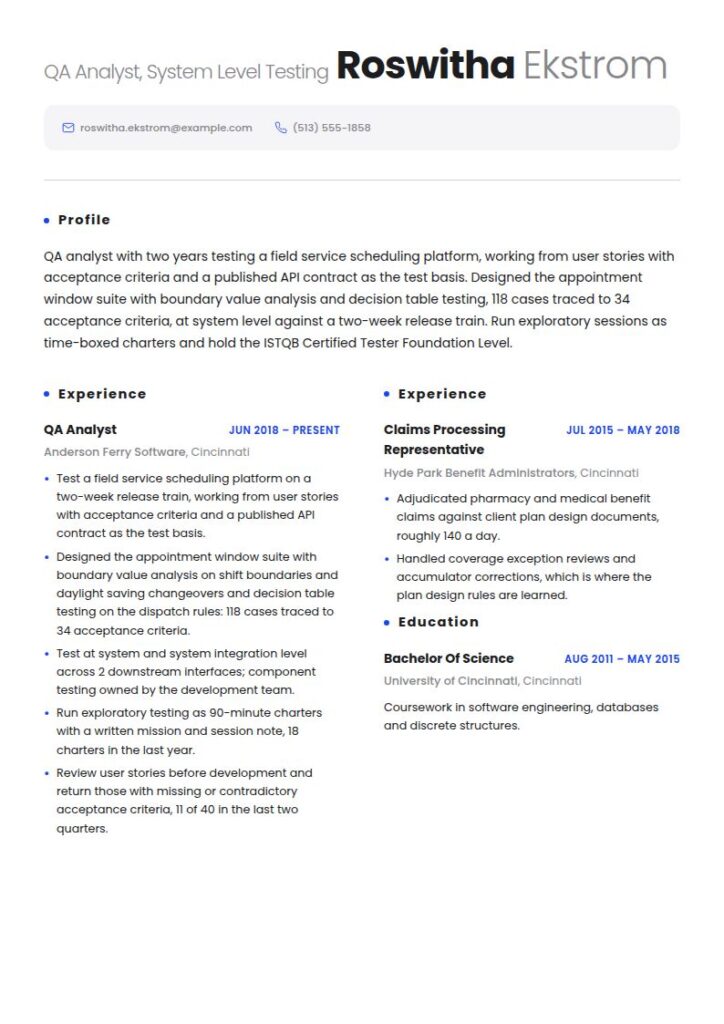
QA analyst with two years testing a field service scheduling platform, working from user stories with acceptance criteria and a published API contract as the test basis. Designed the appointment window suite with boundary value analysis and decision table testing, 118 cases traced to 34 acceptance criteria, at system level against a two-week release train. Run exploratory sessions as time-boxed charters and hold the ISTQB Certified Tester Foundation Level.
Work Experience
06/2018 - Present, QA Analyst, Anderson Ferry Software, Cincinnati, United States
- Test a field service scheduling platform on a two-week release train, working from user stories with acceptance criteria and a published API contract as the test basis.
- Designed the appointment window suite with boundary value analysis on shift boundaries and daylight saving changeovers and decision table testing on the dispatch rules: 118 cases traced to 34 acceptance criteria.
- Test at system and system integration level across 2 downstream interfaces; component testing owned by the development team.
- Run exploratory testing as 90-minute charters with a written mission and session note, 18 charters in the last year.
- Review user stories before development and return those with missing or contradictory acceptance criteria, 11 of 40 in the last two quarters.
07/2015 - 05/2018, Claims Processing Representative, Hyde Park Benefit Administrators, Cincinnati, United States
- Adjudicated pharmacy and medical benefit claims against client plan design documents, roughly 140 a day.
- Handled coverage exception reviews and accumulator corrections, which is where the plan design rules are learned.
Education
08/2011 - 05/2015, Bachelor of Science, Computer Science, University of Cincinnati, Cincinnati, United States
Coursework in software engineering, databases and discrete structures.
Skills
Boundary value analysis, 75
Decision table testing, 70
Equivalence partitioning, 75
Exploratory testing with time-boxed charters, 70
Acceptance criteria review, 65
Traceability maintenance, 65
Jira and Xray, 80
Postman and API verification, 70
SQL for result verification, 65
Languages
English, native
Swedish, intermediate
Certificates
03/2019, ISTQB Certified Tester Foundation Level, American Software Testing Qualifications Board, ASTQB-CTFL-731408
ISTQB member board in the United States.
Summary
A software tester resume is a one to two page document naming the test basis you worked from, the test design techniques you applied to it, the levels you tested at, and how you decided what not to test. This guide gives you three adaptable versions, the test basis block almost no applicant writes, the ISTQB terms that carry weight, and current Bureau of Labor Statistics pay.
Software Tester resume examples by experience level
In short, a software tester resume is a one to two page document naming the documents and behavior you derived your tests from, the techniques you derived them with, the levels you tested at, and what you decided was not worth testing.
That first item separates files. However, almost every resume for this job describes execution: cases written, cycles run, bugs raised. Very few describe derivation. After all, a tester working from an acceptance criterion and one poking at a build with no specification are doing different jobs, and only one can say what the tests do not cover.
Resume guide for a software tester resume
Specifically, this guide and the corresponding software tester resume example will cover:
- How to write a software tester resume, section by section
- The test basis block: what you tested against, and how you traced it
- Three adaptable summaries: first testing role, working tester and test lead
- The ISTQB technique names worth using, and how to attach each one to your own product
- What the job market looks like and what you can expect to earn
How to write a software tester resume
First, plan six sections: contact header with a title line, summary, a test basis and coverage block, experience, skills, and education with certifications. Keep one page for your first four years, then two once you own the entry and exit criteria on a release. Also, the test basis block goes high; it is what a testing manager reads for judgment.
| Section | What it is answering | Where it goes |
|---|---|---|
| Title line | Which levels and which domain, in eight words | Under your name |
| Summary | What you tested against, how you derived cases, what you ranked first | Three or four lines |
| Test basis and coverage | Can this person tell me what is not covered? | Its own block, high on the page |
| Experience | What did the testing find, and what did it let through? | Reverse chronological, with numbers |
| Skills and certifications | Techniques and domains, not a tool logo wall | Grouped, kept short |
Before you draft, write down what you were testing against
Open the last release you worked on and answer three questions in writing. What documents did the tests come from: acceptance criteria, a specification, an API contract, a regulatory rule, an incident report, or the observed behavior of the system being replaced? Which areas did you agree not to test, and who agreed it? What had to be true before you signed it off?
Nobody answers those from memory, which is why they work on a page, and the second is more persuasive than any coverage percentage.
Run the finished file through the ATS resume checker before you submit. Testing postings draw heavy volume, and software parses them into a structured record first.
Choosing the best resume format for a software tester resume
Reverse chronological. In other words, one page for your first four years, two once you have owned entry and exit criteria, written a risk analysis that changed a release scope, or led a team. Functional formats fail here, because a testing manager reads for domain continuity: which product, which regulatory environment, which release cadence, how long. Removing the timeline removes the only signal of whether that experience transfers.
Include your contact information
| ✅ Right | ❌ Wrong |
|---|---|
| Roswitha Ekstrom | Roswitha Ekstrom |
| Software Tester, claims adjudication, system and acceptance levels | Detail-oriented QA professional with an eye for quality |
| ISTQB Certified Tester Foundation Level, ASTQB #ASTQB-CTFL-731408 | ISTQB Certified |
| (513) 555-1858, [email protected], Cincinnati, OH | (513) 555-1858, [email protected] |
In addition, put the certificate number on the page. That is because a recruiter verifies it in ten seconds, and it separates your file from those that only list the acronym.
Make use of a summary
Four lines: the domain, the test basis, the techniques you derived cases with, and one number about coverage rather than volume.
QA analyst with two years testing a field service scheduling platform, working from user stories with acceptance criteria and a published API contract as the test basis. Designed the appointment window suite with boundary value analysis and decision table testing, 118 cases traced to 34 acceptance criteria, at system level against a two-week release train. Run exploratory sessions as time-boxed charters and hold the ISTQB Certified Tester Foundation Level.
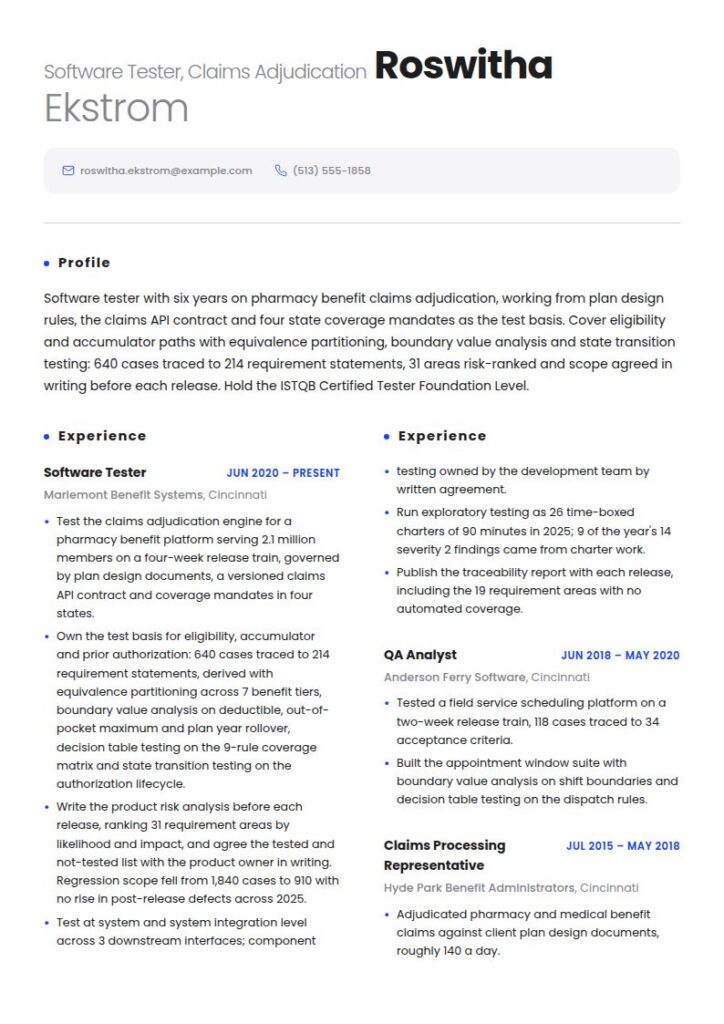
Software tester with six years on pharmacy benefit claims adjudication, working from plan design rules, the claims API contract and four state coverage mandates as the test basis. Cover eligibility and accumulator paths with equivalence partitioning, boundary value analysis and state transition testing: 640 cases traced to 214 requirement statements, 31 areas risk-ranked and scope agreed in writing before each release. Hold the ISTQB Certified Tester Foundation Level.
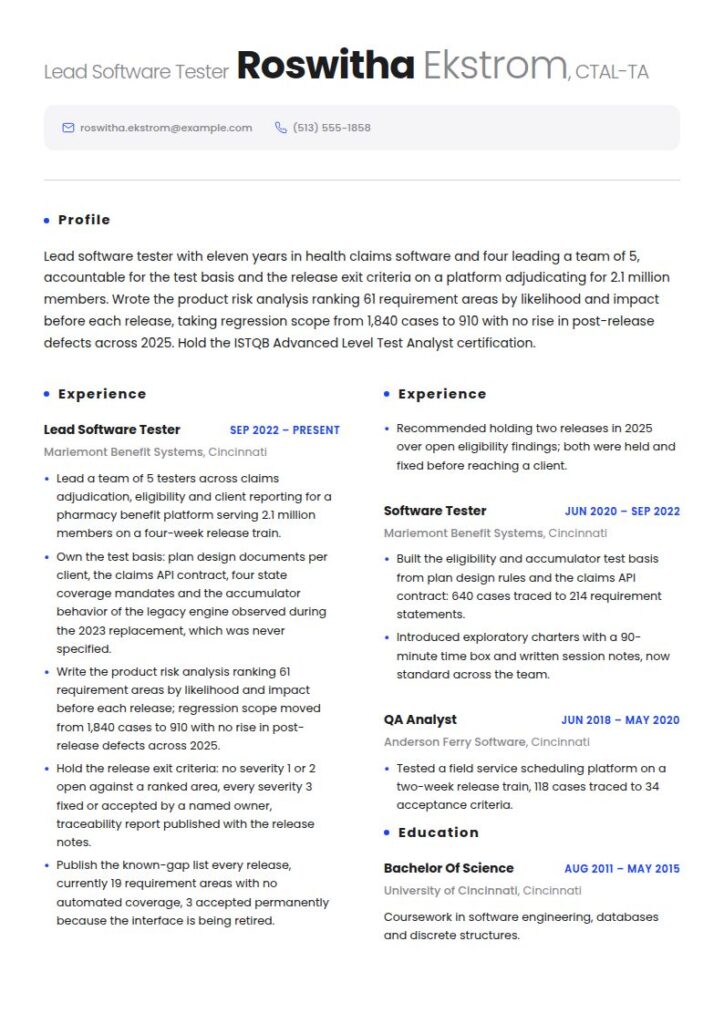
Lead software tester with eleven years in health claims software and four leading a team of 5, accountable for the test basis and the release exit criteria on a platform adjudicating for 2.1 million members. Wrote the product risk analysis ranking 61 requirement areas by likelihood and impact before each release, taking regression scope from 1,840 cases to 910 with no rise in post-release defects across 2025. Hold the ISTQB Advanced Level Test Analyst certification.
Right vs wrong: the same software tester summary, twice
| ✅ Right | ❌ Wrong |
|---|---|
| Work from plan design rules, the claims API contract and four state coverage mandates as the test basis. | Experienced in testing complex enterprise applications end to end. |
| Cover eligibility and accumulator paths with equivalence partitioning, boundary value analysis and state transition testing. | Skilled in manual and functional testing using industry best practices. |
| 640 cases traced to 214 requirement statements, with 31 areas ranked by risk before each release. | Achieved over 90% test coverage across all major product areas. |
For example, the right column survives twenty minutes of interview questions. By contrast, nobody can question the left at all, which is why it is worth nothing.
Outline your software testing experience
Employer, product, dates, then one line naming what the system does, what governs it and how often it releases. Then three to five bullets, each naming a level, a technique or a decision and carrying a number.
| Instead of | Use |
|---|---|
| Wrote and executed test cases for new features | Derived 640 cases from 214 requirement statements across plan design rules and the claims API contract |
| Ensured high test coverage | Traced every case to a requirement and published the 19 areas with no automated coverage |
| Did exploratory testing | Ran 26 charters of 90 minutes in 2025, producing 9 of the year's 14 severity 2 findings |
Software Tester, Mariemont Benefit Systems, Cincinnati, OH, June 2020 to Present
Test the claims adjudication engine for a pharmacy benefit platform serving 2.1 million members on a four-week release train, governed by plan design documents, a versioned claims API contract and coverage mandates in four states.
Own the test basis for eligibility, accumulator and prior authorization: 640 cases traced to 214 requirement statements, derived with equivalence partitioning on benefit tiers, boundary value analysis on deductible and out-of-pocket thresholds, decision table testing on the coverage rules and state transition testing on the authorization lifecycle.
Write the product risk analysis before each release, ranking 31 requirement areas by likelihood and impact and agreeing the tested and not-tested list with the product owner in writing. Scope fell from 1,840 regression cases to 910 with no rise in post-release defects across 2025.
Hold the release exit criteria, and run exploratory testing as 26 time-boxed charters of 90 minutes in 2025; 9 of the year's 14 severity 2 findings came from charter work.
The test basis you worked from, and the coverage you can defend
In practice, this is the block that does the work, and almost nobody writes it. Specifically, it replaces the paragraph most testing resumes spend on case counts and coverage percentages. A coverage percentage is not a claim, because the denominator is whatever you chose. Instead, what survives scrutiny is narrower: what I tested against, how I turned it into tests, and what my tests do not cover. Five lines build it.
One: name the test basis. The test basis is what the tests were derived from, and it is rarely one document. Write the list: user stories with acceptance criteria, a functional specification, an API contract with its version, a regulatory rule with its citation, a production incident, or the observed behavior of a legacy system being replaced. Write the last plainly when it applies, because testing a replacement against an undocumented system is a different job.
Software tester techniques in syllabus terms
Two: name the techniques, in the syllabus terms. ISTQB, the International Software Testing Qualifications Board, groups test techniques in its Certified Tester Foundation Level syllabus version 4.0 into three families: black-box, based on the specified behavior of the test object without reference to its internal structure; white-box, based on that internal structure; and experience-based, which use the knowledge and experience of testers. The black-box techniques it covers are equivalence partitioning, boundary value analysis, decision table testing and state transition testing; the white-box techniques are statement testing and branch testing; the experience-based techniques are error guessing, exploratory testing and checklist-based testing (ISTQB, CTFL syllabus v4.0, retrieved 17 September 2026).
Then tie each name to what you applied it to: "boundary value analysis on deductible and out-of-pocket thresholds, including plan year rollover" is a sentence only somebody who tested that system writes.
Test levels, risk ranking and exit criteria
Three: state the levels you tested at. The syllabus distinguishes component testing, component integration testing, system testing, system integration testing and acceptance testing (ISTQB, CTFL syllabus v4.0). Most testers work at two of the five; name yours and who covered the rest.
Four: show how you ranked risk, and what you cut. ISTQB calls the approach in which test activities are selected, prioritized and managed based on risk analysis and risk control risk-based testing, with risk level determined by risk likelihood and risk impact (ISTQB, CTFL syllabus v4.0). On a resume that is one sentence with a number: how many areas you ranked, and what left scope as a result.
Five: give the entry and exit criteria you held. ISTQB defines entry criteria as the preconditions for undertaking a given activity and exit criteria as what must be achieved to declare an activity completed (ISTQB, CTFL syllabus v4.0). Write yours as rules. A tester who can state when they refuse to start and when they sign off is describing authority, which is what separates a tester from a test executor on a pay band.
Traceability, automation and exploratory work
Then the traceability line, which is the coverage claim that holds. Similarly, the syllabus says it is important to maintain traceability between the test basis elements, the testware associated with them, test results and defects (ISTQB, CTFL syllabus v4.0). Say you held that chain, then give the number proving you were honest about it: how many requirement areas had no coverage.
Test basis: plan design documents per client, the claims API contract v4.2, four state coverage mandates, and the accumulator behavior of the legacy adjudication engine observed during the 2023 replacement, which was never specified.
Techniques applied: equivalence partitioning across 7 benefit tiers. Boundary value analysis on deductible, out-of-pocket maximum and plan year rollover. Decision table testing on the 9-rule coverage matrix. State transition testing on the prior authorization lifecycle, 6 states and 14 valid transitions. Exploratory charters on migration and reprocessing paths.
Levels: system and system integration testing across 3 downstream interfaces. Component testing owned by the development team by written agreement; acceptance testing facilitated with two client teams.
Risk ranking: 31 requirement areas ranked by likelihood and impact before each release. Regression scope moved from 1,840 cases to 910, with the deprioritized areas named in the plan and re-reviewed quarterly.
Entry criteria: build deploys clean, API contract version pinned, plan configuration loaded, release notes name the changed areas. Exit criteria: no severity 1 or 2 open against a ranked area, every severity 3 fixed or accepted by a named owner, traceability report published.
Known gaps: 19 requirement areas with no automated coverage, named in the plan, 3 accepted permanently because the interface is being retired.
One or two sentences is all the automation this page needs: what you automate, in what framework, and who owns it. Runtime, flake rate and quarantine numbers belong on an automation tester resume.
Exploratory work needs one more move. The syllabus describes exploratory testing as testing in which tests are simultaneously designed, executed and evaluated while the tester learns about the test object (ISTQB, CTFL syllabus v4.0), which is why it is invisible on most resumes: nothing is written in advance, so nothing survives. For exploratory work, instead, write it as charters, each with a mission, an area, a time box and a session note.
Build a snapshot of your key software tester skills
Later, in skills, list twelve to fourteen entries in four short groups: techniques, levels and types, domain, and systems. Techniques go first, because the block above builds on them.
Techniques: Equivalence partitioning, Boundary value analysis, Decision table testing, State transition testing, Error guessing, Exploratory testing with charters
Levels and types: System testing, System integration testing, Acceptance test facilitation, Regression scoping, Data migration testing
Test basis and planning: Requirement and acceptance criteria review, Traceability maintenance, Product risk analysis, Entry and exit criteria
Domain and systems: Claims adjudication and benefit accumulators, Jira and Xray, Postman and contract verification, SQL for result verification
List your education and certifications
Degree, then certifications with the awarding body and the certificate number, then domain training if the domain is regulated.
Meanwhile, a bachelor's degree is the typical entry-level education for software quality assurance analysts and testers, and the Handbook lists no related work experience and no on-the-job training as typical for entry (BLS Occupational Outlook Handbook, retrieved 17 September 2026). Plenty of testers arrive from support or a domain role instead. Write that route as experience: four years processing claims before testing claims software is a test basis advantage no degree supplies.
Which ISTQB line is worth writing, and how to write it
ISTQB structures its Certified Tester Foundation Level syllabus version 4.0 in six chapters: fundamentals of testing; testing throughout the software development lifecycle; static testing; test analysis and design; managing the test activities; and test tools (ISTQB, retrieved 17 September 2026). Chapters two, four and five are the material in the test basis block above, which is why those terms carry weight with a reader who holds the certificate.
Write the line with the body, the certificate number and the year, naming ASTQB, the ISTQB member board in the United States, because that is who a recruiter checks with. Then stop: using the vocabulary correctly about your own product is what carries the file.
Bachelor of Science, Computer Science, University of Cincinnati, Cincinnati, OH, 2017
ISTQB Certified Tester Foundation Level, American Software Testing Qualifications Board, #ASTQB-CTFL-731408, 2019
ISTQB Certified Tester Advanced Level Test Analyst, American Software Testing Qualifications Board, #ASTQB-CTAL-TA-21806, 2024
Choose the right layout and design
Finally, keep the format plain: single column, plain type at 11 or 12 point, clear headings, no photograph, no skill rating bars. Applicant systems parse the file into a structured record before a person opens it, and two columns and text boxes are where that breaks.
Name the documents your tests were derived from, including undocumented legacy behavior when that is the truth. Attach each technique to what you applied it to. State the levels you tested at and who covered the rest. Give the number of areas you risk-ranked and what the ranking cut. Write your entry and exit criteria as rules. Publish the areas with no coverage.
Do not lead with a coverage percentage; the denominator is unverifiable and it rewards padding. Do not make test case counts your headline number. Do not name a technique you cannot walk through on your own product. Do not claim an automation suite you did not build. Do not write "tested the full application" when the scoped list proves you were in the room.
Software tester job market and outlook
Note that the Bureau of Labor Statistics publishes no Occupational Outlook Handbook profile under the title software tester. Instead, it counts this work inside software quality assurance analysts and testers, published with software developers in one profile.
| Measure | Value |
|---|---|
| Software developers, QA analysts and testers, jobs 2025 | 1,905,400 |
| Projected change, 2025-35 | 10 percent, much faster than average, +185,400 |
| Projected annual openings | About 106,100 |
| Typical entry-level education | Bachelor's degree |
| Median annual wage, QA analysts and testers, May 2025 | $104,300 |
| Median annual wage, software developers, May 2025 | $135,980 |
Source: U.S. Bureau of Labor Statistics, Occupational Outlook Handbook, May 2025 wage data and 2025 to 2035 projections, published 27 August 2026.
One Handbook profile, two medians, $31,680 apart
Software quality assurance analysts and testers earned a median of $104,300 in May 2025. Software developers, counted inside the same Handbook profile, earned $135,980, a gap of $31,680, and the profile projects 10 percent growth and about 106,100 annual openings through 2035 (BLS Occupational Outlook Handbook, May 2025 wages and 2025 to 2035 projections, published 27 August 2026).
The Handbook describes quality assurance analysts and testers as identifying problems with applications and reporting defects. That description is why the gap exists and why the test basis block matters. A file describing reporting defects is asking to be paid for reporting defects; a file describing a derived test basis, ranked product risk and held exit criteria is describing judgment over scope, which is what the upper half of the published range buys.
Where the jobs sit hints at test basis as much as pay. For instance, computer systems design and related services holds 30 percent of quality assurance analysts and testers at a median of $99,960, finance and insurance 13 percent at $104,260 and manufacturing 9 percent at $129,930 (BLS Occupational Outlook Handbook, May 2025). As a result, the best-paying of the three is where the test basis is most often a formal specification or a regulated process.
What salary you can expect as a software tester
BLS publishes no median wage against the title software tester, because the Handbook classifies by occupation rather than job title. Negotiate against the published figures instead. Overall, software quality assurance analysts and testers earned a median of $104,300 in May 2025, with the lowest 10 percent under $61,440 and the highest 10 percent over $167,010. On the other hand, software developers earned $135,980, with the lowest 10 percent under $82,460 and the highest over $214,670 (BLS, May 2025).
Therefore, that spread, from $61,440 to $167,010 inside one occupation title, is the argument for the test basis block. Four things move an offer inside it: whether you are handed a test plan or write one, whether you can say what is not covered rather than only what is, whether the exit criteria are yours, and whether you know the domain well enough to read the rule the software is meant to implement.
Key takeaways for a software tester resume
- To start, name the test basis: the documents, contracts, rules and behavior your tests came from.
- Then attach each technique to what you applied it to, using the ISTQB syllabus terms.
- State the levels you tested at and who covered the rest.
- Also, give the number of areas you risk-ranked and what that removed from scope.
- Next, write your entry and exit criteria as rules, not intentions.
- Above all, publish your gaps; the areas with no coverage are your most credible line.
- Finally, keep automation to a sentence and leave the coverage percentage off.
Build your software tester resume in 15 minutes with our AI resume builder.
Related information technology resume examples
- QA tester resume
- Automation tester resume
- Software developer resume
- Software engineer resume
- Senior software engineer resume
- Entry level software engineer resume
- Python developer resume
- Java developer resume
- Full stack developer resume
- Front-end developer resume
- Scrum master resume
- Systems analyst resume
Pair it with a matching software tester cover letter.
Software tester resume questions, answered
How long should a software tester resume be?
One page for your first four years. Two once you have owned entry and exit criteria, written a risk analysis that changed a release scope, or led a team.
Should I put a test coverage percentage on my resume?
No. The denominator is whatever you chose, nobody can check it, and it rewards shallow cases. Replace it with the test basis you worked from, the cases traced to named requirements, and the areas you know have no coverage.
What do I write with no professional testing experience?
Write the derivation, not the volume. Take one application, build a small test basis from the documentation that exists, derive cases with two named techniques, and record what you found and what you left out. Thirty cases traced to 12 acceptance criteria with a written not-tested list demonstrates the job; a claim of 400 cases demonstrates a spreadsheet.
Is ISTQB certification worth it for a software tester?
It is worth listing and it is not what gets you hired. The value is shared vocabulary: the Certified Tester Foundation Level syllabus version 4.0 covers test levels and types, black-box, white-box and experience-based techniques, and managing test activities including risk (ISTQB, retrieved 17 September 2026). Give the body and certificate number, then spend the page on the test basis.
How do I describe exploratory testing without sounding unstructured?
Write it as charters with a stated time box. "26 charters of 90 minutes in 2025, each with a written mission and session note, producing 9 of the year's 14 severity 2 findings" reads as a discipline, because it is one. ISTQB names exploratory testing as an experience-based technique in which tests are designed, executed and evaluated at the same time while the tester learns about the test object (ISTQB, CTFL v4.0).