Obinna Achebe Solution Architect, Claims and Integration Plano, 75024, United States [email protected] · (972) 555-1828
11 September 2026
Ms. Rosalind Whitcombe Technology Architecture Bluebonnet Retail Group Dallas, United States
Application for Solution Architect, Bluebonnet Retail Group
Dear Ms. Whitcombe,
I am applying for the Solution Architect post on the order and fulfillment platform at Bluebonnet Retail Group. I cover a 41 application claims estate at Ashbrook Mutual Insurance: 118 interfaces, 2.3 million policies in force, 6 delivery teams building to the designs.
The decision I would most want to talk about is the one I am least comfortable with. In 2022 I chose a managed event streaming service over a self-hosted Kafka cluster for the claims backbone. Self-hosting was cheaper by roughly $210,000 a year and I rejected it anyway, because it needed a third and fourth platform engineer we were never going to be given, and I would rather pay a vendor than pretend a headcount case will be approved. I wrote it down with both rejected options and the consequences I was accepting, including the regional dependency, and we shipped the migration across 19 applications over 14 months with no unplanned claims outage. Reconciliation breaks went from about 340 a month to 26.
Your posting says you are consolidating three order systems after the acquisition, which is the same problem in a different industry: several sources of truth, a nightly batch holding them together, and no owner of the contract between them. That is the work I have most of, and I would start with the decision record, because the arguments you are having now will be re-litigated in eighteen months unless somebody writes down what was assumed.
I am in Plano, available on six weeks notice. Thank you for reading.
Sincerely, Obinna Achebe
Summary
A solution architect cover letter gives your scope in numbers and then spends its middle paragraph on a single architecture decision: what you chose, what you rejected and what it cost. This guide gives you a full adaptable letter, what to do when the decision was later superseded, and the openings that get an architecture file read.
Solution Architect cover letter examples by experience level
A solution architect cover letter states the size of the estate you cover, then spends its middle paragraph on a single decision you made and what it cost you.
In practice, the reader is usually a head of architecture running the same test they would run in a review board. In other words, not "has this person used these technologies", but "when they had two defensible options, how did they choose, and did they write it down". Nobody tests a letter that lists capabilities on that, because it never raises it.
Guide to a solution architect cover letter
That is why this guide and the corresponding solution architect cover letter example will cover:
- First, how to structure the letter, paragraph by paragraph
- Then, why your scope numbers belong in the first two sentences
- Finally, how to write one decision in without turning the letter into a design document
- What to say about a decision a later one replaced
- The openings that make a reader read an architecture file rather than skim it
How to write a solution architect cover letter
| Paragraph | Its job | Length |
|---|---|---|
| Opening | The post, your domain, your scope in numbers | 2 to 3 sentences |
| Decision | The choice, the option rejected, the constraint, the cost | 4 to 6 sentences |
| Fit | Something specific about their estate, and the gap you fill | 3 to 4 sentences |
| Close | Availability, notice period, thank you | 2 sentences |
Lead with the estate, not the adjective
A head of architecture sorts by level before anything else. They need to know within one sentence whether you operate over one system, one domain or one organization, because those are three different jobs sharing a title.
Give the four numbers straight away: "I cover a 41 application claims estate with 118 interfaces, 2.3 million policies in force, and 6 delivery teams building to the designs." That sorts you correctly without the reader doing work. Then resist adding "and I am passionate about scalable architecture". The numbers already said it, with evidence.
A solution architect cover letter example you can adapt
Dear Ms. Whitcombe,
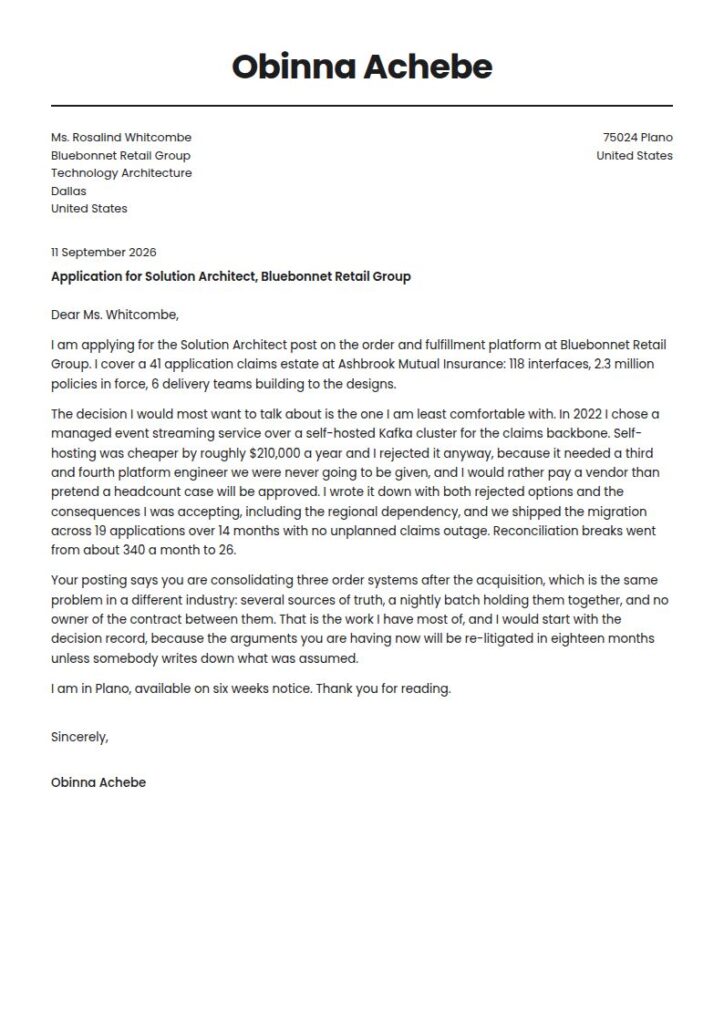
I am applying for the Solution Architect post on the order and fulfillment platform at Bluebonnet Retail Group. I cover a 41 application claims estate at Ashbrook Mutual Insurance: 118 interfaces, 2.3 million policies in force, 6 delivery teams building to the designs.
The decision I would most want to talk about is the one I am least comfortable with. In 2022 I chose a managed event streaming service over a self-hosted Kafka cluster for the claims backbone. Self-hosting was cheaper by roughly $210,000 a year and I rejected it anyway, because it needed a third and fourth platform engineer we were never going to be given, and I would rather pay a vendor than pretend a headcount case will be approved. I wrote it down with both rejected options and the consequences I was accepting, including the regional dependency, and we shipped the migration across 19 applications over 14 months with no unplanned claims outage. Reconciliation breaks went from about 340 a month to 26.
Your posting says you are consolidating three order systems after the acquisition, which is the same problem in a different industry: several sources of truth, a nightly batch holding them together, and no owner of the contract between them. That is the work I have most of, and I would start with the decision record, because the arguments you are having now will be re-litigated in eighteen months unless somebody writes down what was assumed.
I am in Plano, available on six weeks notice. Thank you for reading.
Sincerely, Obinna Achebe
Openings that work
| Instead of | Use |
|---|---|
| I am a results-driven solution architect with a passion for technology | I cover a 41 application claims estate: 118 interfaces, 2.3 million policies, 6 teams |
| I am writing to express my interest in your solution architect opening | I am applying for the Solution Architect post on your fulfillment platform |
| I have extensive experience designing scalable enterprise solutions | I ran a 14 month migration across 19 applications with no unplanned outage |
| I am skilled in cloud, microservices, APIs and transformation | I chose a managed streaming service over self-hosting on a headcount argument, and wrote down why |
In short, every replacement turns a claim about you into a fact about a system, the only kind of statement an architect can evaluate.
Writing one decision into a letter
Above all, the middle paragraph is the whole letter. Four things fit in it, in this order.
| Element | What it looks like in a sentence |
|---|---|
| The choice | In 2022 I chose a managed event streaming service for the claims backbone |
| The option rejected | Self-hosted Kafka, cheaper by roughly $210,000 a year |
| The constraint that decided it | It needed two more platform engineers we would never be given |
| The cost accepted | Vendor lock-in and a hard dependency on one region, in the record |
In particular, the third row is what makes it work. However, most architecture writing explains a choice by what was good about the option someone chose, which any vendor brochure can do. Explaining it by the constraint that ruled out the alternative is what a review board asks, and why the paragraph reads as if it came from someone in the room.
When a later decision superseded yours
Say plainly that it was superseded, and when. Name the assumption that turned out to be wrong, in one clause. Say what replaced it and whether you replaced it. Keep it to three sentences. Use a superseded decision when the role is senior, since seniority is partly the ability to describe your own errors accurately.
Do not present it as a triumph of learning, which reads as rehearsed. Do not blame the organization, the vendor or the requirements, even where the blame is fair. Do not offer more than one; a letter with two failed decisions is a letter about failure. Do not use this at all if the decision cost money or safety in a way you would not explain out loud in an interview.
Five years or more, and what that says about the letter
The closest published occupation to this title, computer network architects, is one of very few whose Bureau of Labor Statistics Quick Facts table lists five years or more of work experience in a related occupation as typical entry. It held 181,800 jobs in 2025 at a median annual wage of $134,050, with about 9,600 openings projected each year through 2035, while computer systems analysts, the occupation most architects arrive from, held 544,400 jobs at a median of $105,850 and lists no related experience requirement (BLS Occupational Outlook Handbook, May 2025 wages and 2025 to 2035 projections, published 27 August 2026).
So you are writing to someone who assumes a decade behind you and wants to know what it taught you. Novelty is not the currency here; judgment is.
That is also why the decision paragraph beats a technology paragraph. Any candidate can name a platform. Only someone who has carried a design through an outage can explain why they rejected the cheaper option.
Length, format and sending it
Overall, one page, four paragraphs, 300 to 400 words. This is one of the few roles where the upper end is right, because the decision paragraph needs room to be specific. PDF unless the portal says otherwise, named for yourself and the post.
Address a person: a generic salutation on a letter this specific is the one lazy line in it. Use the same scope numbers as your resume so the two agree; our solution architect resume example is written with the figures used here.
Key takeaways
- First, open with the estate in four numbers, not an adjective about yourself.
- Then spend the middle paragraph on one decision, in full.
- Also, name the option you rejected and the constraint that ruled it out.
- State the cost you accepted, not only the benefit you expected.
- In addition, name one real thing about their estate, from their own material.
- Also, use a superseded decision only for senior roles, in three sentences.
- Finally, one page, to a named person, with the same numbers as your resume.
Write your solution architect cover letter in 10 minutes with our AI cover letter builder.
Solution architect cover letter questions, answered
How long should a solution architect cover letter be?
One page, four paragraphs, 300 to 400 words. Longer than most because the decision paragraph carries the letter and cannot be compressed without losing the constraint, the part that proves you were there.
Should I include a diagram or an architecture artifact?
No. Attachments other than the resume are rarely opened, diagrams do not survive a tracking system, and the letter's job is to make someone want the conversation where a diagram would help. Bring it to the interview.
What if I cannot name the platform or vendor?
Describe the class and the constraint, which is where the content is anyway. "A managed streaming service over a self-hosted cluster, decided on operational headcount" tells a reader everything without naming a supplier or a customer, and survives any confidentiality review.
Do I need a certification to be taken seriously?
It helps but is not a substitute. The Bureau of Labor Statistics Occupational Outlook Handbook notes that employers of computer network architects may require or prefer certification in the products they use, and Amazon Web Services publishes that its Solutions Architect Professional exam recommends two or more years of AWS design experience and is valid for three years (Amazon Web Services, retrieved 17 September 2026). Name the level and expiry in one clause, then get back to the decision.
How do I write this letter if I have never held the architect title?
Write the decision anyway. If you have chosen between two defensible options, lived with the consequence and can describe the constraint that decided it, the title is a formality the reader can supply. Give scope numbers for the piece you covered, say who built to your design, and do not apologize for the title.