Anton Kovalenko Platform Engineering Lead Denver, 80211, United States [email protected] · (720) 555-1066
11 September 2026
Ms. Ingrid Halloran Head of Platform Engineering Ute Creek Clinical Data Denver, United States
Application for Senior DevOps Engineer, Ute Creek Clinical Data
Dear Ms. Halloran,
I am applying for the Senior DevOps Engineer post on the clinical data platform at Ute Creek Clinical Data. I lead a platform team of four at Ferro Peak Logistics serving 12 product teams and about 90 engineers on AWS and Kubernetes, and I am looking for a smaller organization where the platform is still being decided rather than maintained.
What I would bring is what the platform does for the teams that use it. A team at Ferro Peak goes from a new repository to production traffic in two days with no ticket to my team, against five weeks and three tickets when I arrived, measured across the 14 services created in 2025. Nine of our twelve teams use that path; the other three are documented exceptions, one on a vendor appliance that cannot be containerized, one on a Windows estate and one that opted out and carries its own pipeline. Platform interrupt work fell from eleven hours a week to three, counted by tagging every interrupt ticket for six weeks against its recorded handling time.
Your posting says a platform engineer currently runs each production deployment. That is the arrangement I have spent two years dismantling. At Ferro Peak every product team deploys its own services and no platform engineer deploys any of them, with break-glass access held by two people, time-boxed to four hours and logged. I wrote that policy and the engineering leadership group approved it, but what made it possible was infrastructure-as-code coverage at 96 percent rather than the argument.
The first thing I would want to look at is your cloud bill and the direction it is moving, because that is usually where the trades are. I can start on four weeks' notice. Thank you for your time.
Sincerely, Anton Kovalenko
Summary
A DevOps professional cover letter describes the platform you run for other engineers, gives one number you measured yourself, and names one thing in the posting you have already fixed. This guide gives you a full adaptable letter, how to write about cloud cost and production access without leaking anything, and the openings that get a platform file read rather than skimmed.
DevOps Professional cover letter examples by experience level
A DevOps professional cover letter is a one-page letter about a platform other engineers use: what it lets them do without you, how many of them use it, and one number you measured yourself.
Platform postings attract two candidates. One has operated somebody else's platform; one has built a platform other teams chose to adopt. Both write the same tool list, and only the second can write the letter below.
Guide to a DevOps professional cover letter
This guide and the corresponding DevOps professional cover letter example will cover:
- How to structure the letter, paragraph by paragraph
- The platform paragraph and the one number that has to be in it
- How to write about cloud cost and production access without leaking anything
- What to write when you have run a pipeline but not a platform
How to write a DevOps professional cover letter
| Paragraph | Its job | Length |
|---|---|---|
| Opening | The post, what you run now, how many teams use it, what you want next | 2 to 3 sentences |
| The platform paragraph | Self-service time, adoption with a denominator, one measured number | 4 to 6 sentences |
| Their problem | One thing their posting describes that you have already fixed | 3 to 4 sentences |
| Close | What you would look at first, notice period, thank you | 2 to 3 sentences |
Open with the denominator, not with the tool list
The first sentence a platform hiring manager wants is the size of the thing you have run. Twelve product teams and about ninety engineers is a size. AWS, Kubernetes and Terraform is not.
Give the shape in one line: how many teams depend on the platform, how many engineers, and what it runs on. Then say what you want next.
The tools belong in the resume, where a parser finds them. In the letter they cost you the two sentences you needed for the number nobody else in the stack has written down.
A DevOps professional cover letter example you can adapt
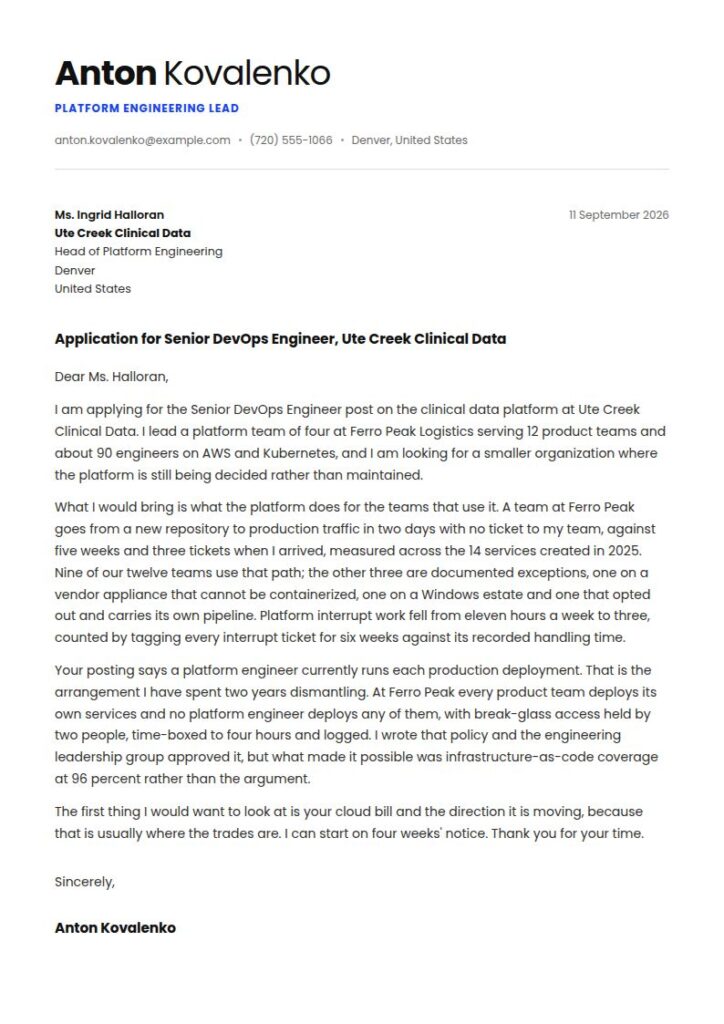
Dear Ms. Halloran,
I am applying for the Senior DevOps Engineer post on the clinical data platform at Ute Creek Clinical Data. I lead a platform team of four at Ferro Peak Logistics serving 12 product teams and about 90 engineers on AWS and Kubernetes, and I am looking for a smaller organization where the platform is still being decided rather than maintained.
What I would bring is what the platform does for the teams that use it. A team at Ferro Peak goes from a new repository to production traffic in two days with no ticket to my team, against five weeks and three tickets when I arrived, measured across the 14 services created in 2025. Nine of our twelve teams use that path; the other three are documented exceptions, one on a vendor appliance that cannot be containerized, one on a Windows estate and one that opted out and carries its own pipeline. Platform interrupt work fell from eleven hours a week to three, counted by tagging every interrupt ticket for six weeks against its recorded handling time.
Your posting says a platform engineer currently runs each production deployment. That is the arrangement I have spent two years dismantling. At Ferro Peak every product team deploys its own services and no platform engineer deploys any of them, with break-glass access held by two people, time-boxed to four hours and logged. I wrote that policy and the engineering leadership group approved it, but what made it possible was infrastructure-as-code coverage at 96 percent rather than the argument.
The first thing I would want to look at is your cloud bill and the direction it is moving, because that is usually where the trades are. I can start on four weeks' notice. Thank you for your time.
Sincerely, Anton Kovalenko
Openings that work
| Instead of | Use |
|---|---|
| I am a DevOps professional with expertise in AWS, Kubernetes and Terraform | I lead a platform team of four serving 12 product teams and about 90 engineers on AWS and Kubernetes |
| I am passionate about automation and continuous improvement | A team goes from a new repository to production traffic in two days with no ticket to my team |
| I have helped organizations adopt DevOps best practices | Nine of our twelve teams use the golden path, and the other three are documented exceptions |
The platform paragraph: users, adoption and one number you measured
One paragraph, and it has to contain a denominator, a duration and a method.
The denominator is how many teams exist, not how many use your platform. Nine of twelve is a number; nine is a word.
The duration is the self-service path: how long a team waits for the thing they ask for most often, with nobody from your team involved. Say how many real cases the figure covers.
The method is how you know. Most platform numbers in most letters were estimated on the way to writing them, and a reader who has run one can tell. "Counted by tagging every interrupt ticket for six weeks against its recorded handling time" is a sentence no exaggeration produces.
Writing about cost and permissions without leaking anything
Two subjects on this page can be sensitive, and both are worth keeping.
Cloud cost is usually confidential in absolute value rather than in shape. If the absolute is sensitive, give the proportion and direction: cut the monthly bill by about a quarter across two quarters while workload volume grew 22 percent. Then give the trade, because the trade shows judgment: batch on interruptible capacity in exchange for longer overnight windows, multi-zone capacity kept for the ledger on purpose.
Production access is a security topic, so describe the design rather than the details. Every team deploys its own services, platform engineers deploy none, break-glass is held by two people and time-boxed. That tells a reader what they need and an attacker nothing.
Open with how many teams depend on what you run. Give adoption with its denominator. Time the self-service path end to end. Say how you measured the number you quote. Name a problem their posting describes that you have fixed. Say what you would look at first.
Do not open with a tool list. Do not give a percentage with no population behind it. Do not describe cost savings without the trade that paid for them. Do not name accounts, credential holders or security tooling versions. Do not claim you built a platform you inherited; say what you changed.
No published wage attaches to this job title
The U.S. Bureau of Labor Statistics publishes no Occupational Outlook Handbook profile under the title "DevOps professional", so the salary figures circulating for it come from advertisements and self-reported surveys rather than a federal wage survey.
The published occupations the work is filed under carry median annual wages of $99,130 for network and computer systems administrators, $135,980 for software developers and $175,140 for computer and information systems managers, all May 2025 (BLS Occupational Outlook Handbook). The administrators are projected to decline 4 percent from 2025 to 2035, while the software developers group grows 10 percent and adds 185,400 jobs.
That is why the letter is written about a platform with adopters rather than systems maintained: the words decide which picture the reader has before any number is discussed.
Length, format and sending it
One page, four paragraphs, 300 to 400 words. PDF unless the portal says otherwise, named for yourself and the post: anton-kovalenko-devops-professional-cover-letter.pdf.
Address a person. Platform leads are usually findable on a company's engineering pages, and a letter to the person who owns the platform reads differently from one sent to a committee.
Keep every number identical to the resume. Our DevOps professional resume example uses the same figures as the letter above, and a reader who checks one against the other should find them the same.
Key takeaways
- Open with the size of what you run: teams, engineers, and what it runs on.
- Give adoption with the denominator, and name the exceptions.
- Time the self-service path with you out of the loop.
- Quote one number and say how you measured it.
- Give cost as a proportion and a direction when the absolute is sensitive, with the trade attached.
- Describe the permission design, never the credentials or the accounts.
- Name one thing in their posting you have already fixed, and address a real person.
Write your DevOps professional cover letter in 10 minutes with our AI cover letter builder.
DevOps professional cover letter questions, answered
How long should a DevOps professional cover letter be?
One page, four paragraphs, 300 to 400 words. Platform hiring managers read these beside a resume that already carries the tool list, so the letter's job is the three or four facts the resume cannot fit.
What do I write if I have run a pipeline but not a platform?
Write the pipeline accurately and give it a population: four product teams, one release path, what a team could do afterwards that it could not before. A letter describing that honestly beats one claiming an internal developer platform nobody adopted.
Should I mention salary expectations in the letter?
Only if the posting asks. If it does, anchor to a published occupation rather than an aggregator: the BLS median annual wage for software developers was $135,980 in May 2025 and for computer and information systems managers $175,140. There is no published figure for this job title, and saying so is more credible than quoting one.
How technical should the letter be?
Specific rather than deep. Name the cloud and the orchestration layer, then spend the space on what teams can do and how you know. The rest belongs in the interview.
How do I tailor it to a smaller company?
Read the posting for the thing they are complaining about: a platform engineer running every deployment, a two-week wait for an environment, a cloud bill nobody owns. One of those is usually in the text, and naming it is the only part of this letter that cannot be reused.