Ilya Sorokin Senior Software Engineer, Platform Austin, 78704, United States [email protected] · (512) 555-1546
16 September 2026
Ms. Marisol Duarte Engineering Manager, Platform Ardent Signal Austin, United States
Application for Senior Software Engineer, Platform, Ardent Signal
Dear Ms. Duarte,
I am applying for the Senior Software Engineer role on the platform team at Ardent Signal. I have spent eleven years on backend and distributed systems, the last five on a platform team of nine serving 40 internal product teams, which is the same shape of problem your job posting describes.
The piece of work I would most want to talk about is our event pipeline. We were carrying about 400 million events a month through per-event processing and the compute bill was growing faster than the traffic. The obvious fix was a larger cluster. Instead I moved aggregation off the per-event path into batched windows, which meant giving up sub-second freshness on internal dashboards, and I wrote that trade-off up and argued it in design review before anything was built. The pipeline now carries 3.1 billion events a month with a published p99 of 480ms and a 30 day replay window, and compute spend is 34% lower than it was at a tenth of the volume.
I read your engineering blog post on moving schema validation into the producer rather than the consumer, and it matches a change we made after a bad afternoon with a malformed payload. What I would want to work on at Ardent Signal is the ingest path, both because that post suggests you are actively rethinking it and because the failure modes there are the ones I have spent the most time inside.
I am in Austin and can work hybrid or remote, and I can make time for a loop in the next two weeks. Thank you for reading.
Sincerely, Ilya Sorokin
Summary
A software engineer cover letter has exactly one reader in a technical hiring loop: the hiring manager deciding whether to spend an hour on you. This guide gives you a full adaptable letter, the opening lines that survive that reader, what counts as evidence when you cannot share code, and when the letter is worth writing at all.
Software Engineer cover letter examples by experience level
A software engineer cover letter is a one-page letter that gives the hiring manager one reason to spend an hour of their team's time on you.
That is the whole job. Your resume goes to five readers in a technical loop; the letter goes to one, the manager deciding whether to open the schedule. Everything in it is written for that decision: one technical problem explained in plain language, one reason you want this team rather than a team, and nothing else.
Guide to a software engineer cover letter
This guide and the corresponding software engineer cover letter example will cover:
- How to structure the letter, paragraph by paragraph
- Why one technical decision beats a summary of your career
- What counts as evidence when your work is private
- When a cover letter moves the needle and when it is ignored
How to write a software engineer cover letter
| Paragraph | Its job | Length |
|---|---|---|
| Opening | The role, your specialization, and why this team | 2 to 3 sentences |
| Evidence | One problem, one decision, one number, one consequence | 4 to 6 sentences |
| Fit | Something real about their product or stack, and what you would work on | 3 to 4 sentences |
| Close | Availability, logistics, thank you | 2 sentences |
Explain one decision, not one project
The common failure is a paragraph that summarizes a project: what it did, what it was built with, how long it took. That reads as a resume bullet with more words in it.
A hiring manager is scanning for judgment, so write the decision instead: what the options were, why you picked one, and what happened. "We could have sharded the table or moved the read path to a cache; we picked the cache because the read pattern was 40 to 1 and sharding would have blocked two other teams for a quarter" tells a manager more than a page of description.
One decision. Not three, and not a tour of your career.
A software engineer cover letter example you can adapt
Dear Ms. Duarte,
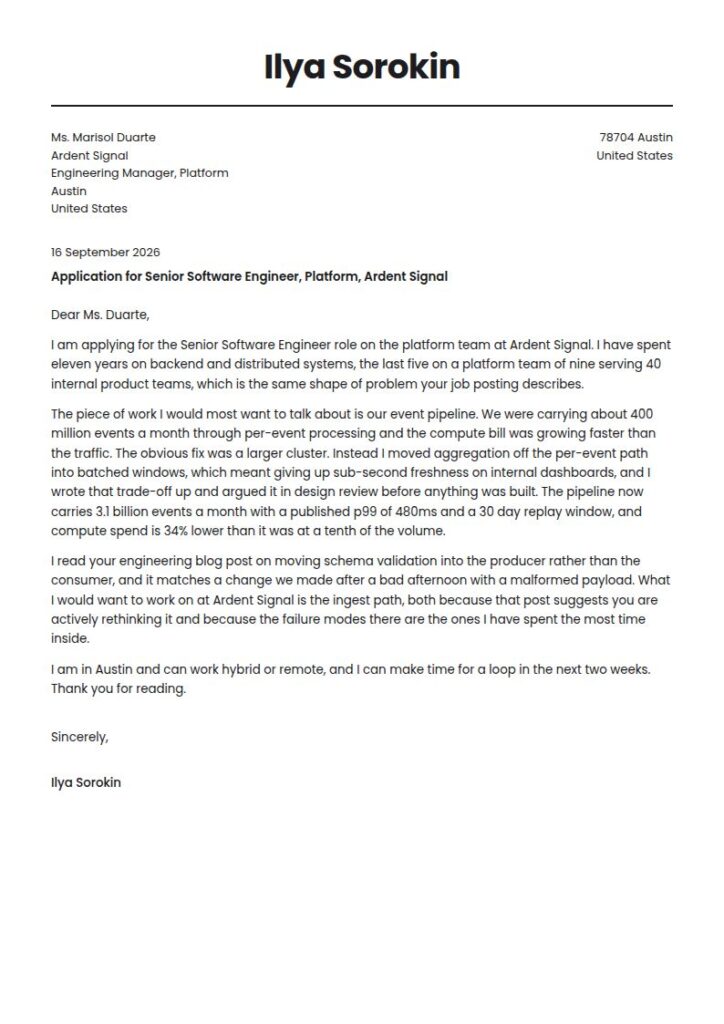
I am applying for the Senior Software Engineer role on the platform team at Ardent Signal. I have spent eleven years on backend and distributed systems, the last five on a platform team of nine serving 40 internal product teams, which is the same shape of problem your job posting describes.
The piece of work I would most want to talk about is our event pipeline. We were carrying about 400 million events a month through per-event processing and the compute bill was growing faster than the traffic. The obvious fix was a larger cluster. Instead I moved aggregation off the per-event path into batched windows, which meant giving up sub-second freshness on internal dashboards, and I wrote that trade-off up and argued it in design review before anything was built. The pipeline now carries 3.1 billion events a month with a published p99 of 480ms and a 30 day replay window, and compute spend is 34% lower than it was at a tenth of the volume.
I read your engineering blog post on moving schema validation into the producer rather than the consumer, and it matches a change we made after a bad afternoon with a malformed payload. What I would want to work on at Ardent Signal is the ingest path, both because that post suggests you are actively rethinking it and because the failure modes there are the ones I have spent the most time inside.
I am in Austin and can work hybrid or remote, and I can make time for a loop in the next two weeks. Thank you for reading.
Sincerely, Ilya Sorokin
Openings that work
| Instead of | Use |
|---|---|
| I am writing to express my interest in the Software Engineer position | I am applying for the Senior Software Engineer role on the platform team at Ardent Signal |
| I am a passionate developer with a love of clean code | I have spent eleven years on backend and distributed systems, the last five on a platform team of nine |
| I have extensive experience with a wide range of technologies | The work I would most want to talk about is an event pipeline carrying 3.1 billion events a month |
The right column gives the reader a reason to believe you looked at them specifically. A manager reading forty applications can tell a letter written for them from a letter with their company name pasted in, and the tell is always the third paragraph.
What counts as evidence in a software engineer cover letter
Most engineering work cannot be shown: the code is private and the metrics are internal. That is fine, because none of the evidence that persuades a hiring manager requires showing anything.
| Kind of evidence | What it looks like in a sentence |
|---|---|
| A trade-off you made | Chose a cache over sharding because the read pattern was 40 to 1 and sharding would have blocked two teams for a quarter |
| A number with a before and an after | p99 on the quoting path went from 1.4s to 240ms after the fan-out was batched |
| Something you wrote | Wrote the design review process the platform group still uses, which cut draft-to-approval time from 19 days to 6 |
| People | Mentored three engineers, two since promoted, and run the backend interview loop |
Describe the shape of the system rather than the business. "A pipeline carrying 3.1 billion events a month" gives away nothing your employer would object to and still tells the reader what they need.
Write for a reader who does not trust generated text
In the 2025 Stack Overflow Developer Survey, 84% of respondents said they use or plan to use AI tools in their development process, and 51% of professional developers reported using them daily. Only 3.1% said they highly trust the accuracy of the output, and 45.7% expressed some level of distrust (Stack Overflow Developer Survey, 2025).
Hiring managers here are drawn from that same population. They read a great deal of generated text and have become quick at spotting the register: balanced clauses, three-item lists, enthusiasm without specifics. The defense is not to write badly on purpose; it is to include what a generator cannot know, such as the number, the argument you lost, and the post of theirs you actually read.
When the letter is worth writing, and when it is not
Write one when a person is named in the posting, when the company is small enough that the manager reads applications, or when you are changing domain and the resume alone will not explain the move. Name the team and the problem you want to work on, and keep the same numbers as your resume.
Do not restate your resume in paragraph form; the manager has it open. Do not send a letter with no sentence in it that could only have been written to this company. Do not explain a technology to someone who builds with it daily. Do not apologize for anything you are missing. Do not skip a letter where the field is labeled optional but a human is clearly at the other end.
Length, format and sending it
One page, four paragraphs, 250 to 400 words. PDF unless the portal asks otherwise, named for yourself and the role: ilya-sorokin-senior-software-engineer-cover-letter.pdf.
Address a person. Engineering managers are usually findable from the posting, the company's team page or a conference talk. "Dear Hiring Team" on an otherwise specific letter is the one line that undoes the rest of it.
Use the same numbers as your resume so the two documents agree. Our software engineer resume example is written with the figures used here, and you can write the letter itself in about ten minutes.
Key takeaways
- The letter has one reader: the hiring manager deciding whether to open the schedule.
- Explain one decision, with the options you had and the one you chose.
- Give the number a before and an after, and keep it identical to your resume.
- Put one sentence in that could only have been written to this company.
- Describe the shape of the system, not the business, when the work is private.
- Write letters where a human reads them, and skip the portals where none does.
- One page, four paragraphs, a named person at the top.
Software engineer cover letter questions, answered
Do software engineers still need cover letters in 2026?
It depends entirely on who receives it. At a company small enough that the hiring manager reads applications, a specific letter is one of the cheapest advantages available. In a high-volume portal at a very large employer it is often never opened. Judge by whether a person is named anywhere in the posting.
How long should a software engineer cover letter be?
One page, four paragraphs, 250 to 400 words. A manager screening between meetings reads three paragraphs and stops, and anything past a page is read as a failure to prioritize.
What do I write with no professional experience yet?
Write your strongest project as though it were a job: the problem, the constraint, the decision you made, the number. Then one paragraph on why this team specifically. An internship, a research project or an open source contribution all work.
Should I mention salary expectations in the letter?
Only when the posting asks, and then give a range with a sentence saying it is flexible on level and scope. Otherwise leave it out. The letter's job is to get the loop scheduled, and a number early gives a reader an easy reason to stop.
Can I use the same letter for several applications?
The first two paragraphs carry across with light edits, because your evidence does not change. The third cannot, and it is the one the reader uses to decide whether you are serious. Short on time, write fewer letters properly rather than more quickly.