Machine Learning Engineer, Forecasting Marisol Reyna
Machine Learning Engineer
[email protected] | (619) 555-1090 | San Diego, United States
Profile
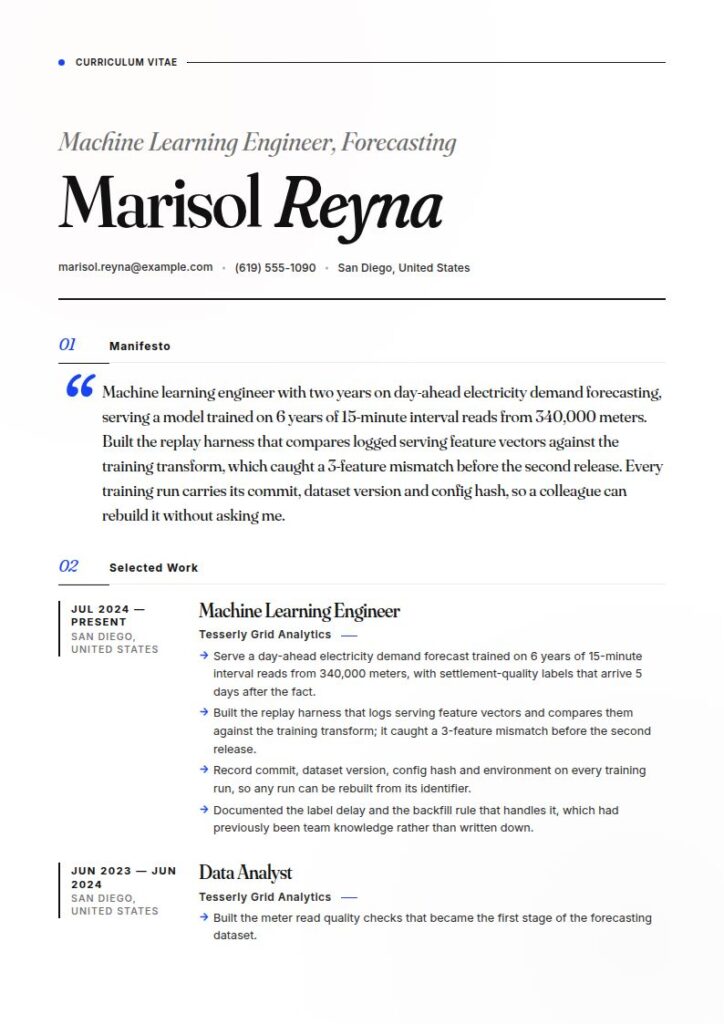
Machine learning engineer with two years on day-ahead electricity demand forecasting, serving a model trained on 6 years of 15-minute interval reads from 340,000 meters. Built the replay harness that compares logged serving feature vectors against the training transform, which caught a 3-feature mismatch before the second release. Every training run carries its commit, dataset version and config hash, so a colleague can rebuild it without asking me.
Work Experience
07/2024 - Present, Machine Learning Engineer, Tesserly Grid Analytics, San Diego, United States
- Serve a day-ahead electricity demand forecast trained on 6 years of 15-minute interval reads from 340,000 meters, with settlement-quality labels that arrive 5 days after the fact.
- Built the replay harness that logs serving feature vectors and compares them against the training transform; it caught a 3-feature mismatch before the second release.
- Record commit, dataset version, config hash and environment on every training run, so any run can be rebuilt from its identifier.
- Documented the label delay and the backfill rule that handles it, which had previously been team knowledge rather than written down.
06/2023 - 06/2024, Data Analyst, Tesserly Grid Analytics, San Diego, United States
- Built the meter read quality checks that became the first stage of the forecasting dataset.
- Reconciled interval reads against monthly billing totals and wrote the rule for which discrepancies are dropped.
Education
09/2020 - 06/2024, Bachelor of Science, Applied Mathematics, University of California San Diego, La Jolla, United States
Coursework in probability, numerical methods and statistical learning. Capstone on load forecasting under missing meter data.
Skills
Python, 85
SQL, 80
Time series forecasting, 70
Gradient-boosted trees, 70
Feature parity and replay harnesses, 75
Experiment tracking and run reproduction, 75
Dataset versioning, 70
Docker, 65
Languages
English, native
Spanish, native
Certificates
04/2025, AWS Certified Solutions Architect, Associate, Amazon Web Services
Associate level architecture certification.
Summary
A machine learning engineer resume is a one to two page document that makes an artifact nobody can open checkable by somebody who has to hire you. This guide gives you three adaptable versions, the five facts that describe the training to serving boundary, and current Bureau of Labor Statistics pay and outlook for the three published occupations this job title is actually hired against.
Machine Learning Engineer resume examples by experience level
A machine learning engineer resume is a one to two page document about an artifact nobody reading it can inspect.
That is the difficulty. After all, a model is a file of weights. The reader cannot open it, cannot rerun it, and cannot tell from your bullets whether the features it sees in production match the ones it learned from, or whether anyone could rebuild it if you left. "Built a model that improved accuracy by 12 percent" is a sentence about something invisible.
So this resume's job, then, is not to describe models. It is to describe the boundary between training and serving, and what crosses it, because that boundary is where machine learning engineering is a distinct job rather than a data science role with a different title.
Resume guide for a machine learning engineer resume
In short, this guide and the corresponding machine learning engineer resume example will cover:
- How to write a machine learning engineer resume, section by section
- The five facts that describe the training to serving boundary
- Three adaptable summaries: early, practicing and staff level
- Why reproducibility separates you from a data science file
- What the job market looks like and what you can expect to earn
How to write a machine learning engineer resume
First, plan six sections: contact header, summary, engineering experience, the training to serving boundary, skills, and education with certifications. Keep one page for your first four years, then two once you have owned a model in production through a retrain.
| Section | What it is answering | Where it goes |
|---|---|---|
| Summary | What is served, at what scale, and how it is kept honest | Top, four lines |
| Engineering experience | What you built and what you were accountable for | Reverse chronological |
| Training to serving boundary | Could anyone else rebuild and verify this? | Its own block, above skills |
| Skills | Languages, frameworks, data and platform, grouped | Compact, four groups |
| Education and certifications | Degree, and a master's if you have one | Last, or second if the degree is the gate |
Write the artifact, not the experiment
Most machine learning resumes read as a list of experiments: models tried, architectures compared, metrics improved. Experiments are cheap and a reader knows it. What is expensive is the artifact that survives: a model somebody else can retrain from your repository, on a dataset version you can name, and get the same numbers.
The test is simple. For each bullet, ask whether a new engineer could reproduce what it describes using only what is written down. If the answer is no, the bullet describes something you did rather than something you built.
Run the finished file through the ATS resume checker before you submit.
Choosing the best resume format for a machine learning engineer resume
Reverse chronological, with one exception: if you moved into the field from research, statistics or backend engineering, add a two-line block under the summary naming what you brought and what you had to learn.
Skip the projects section if you have production experience. A personal project beside a production system reads as if you could not fill the page. Keep projects only while you are early, and write them with the same discipline: dataset, version, reproduction.
Include your contact information
| ✅ Right | ❌ Wrong |
|---|---|
| Marisol Reyna | Marisol Reyna |
| Machine Learning Engineer, Forecasting and Prediction | AI/ML enthusiast and data science professional |
| M.S. Computer Science | Skilled in Python, TensorFlow, PyTorch, scikit-learn, Keras |
| (619) 555-1090, [email protected], San Diego, CA | (619) 555-1090, [email protected] |
Also, name your subfield in the title line. That is because forecasting, ranking, computer vision, speech and recommendation are different jobs with different interview loops, and the reader is trying to place you inside two seconds. A repository link belongs here only if the code in it is code you would want read.
Make use of a summary
Next, write four lines: what you serve and at what scale, one parity or reproducibility fact, and your retraining trigger.
Machine learning engineer with two years on day-ahead electricity demand forecasting, serving a model trained on 6 years of 15-minute interval reads from 340,000 meters. Built the replay harness that compares logged serving feature vectors against the training transform, which caught a 3-feature mismatch before the second release. Every training run carries its commit, dataset version and config hash, so a colleague can rebuild it without asking me.
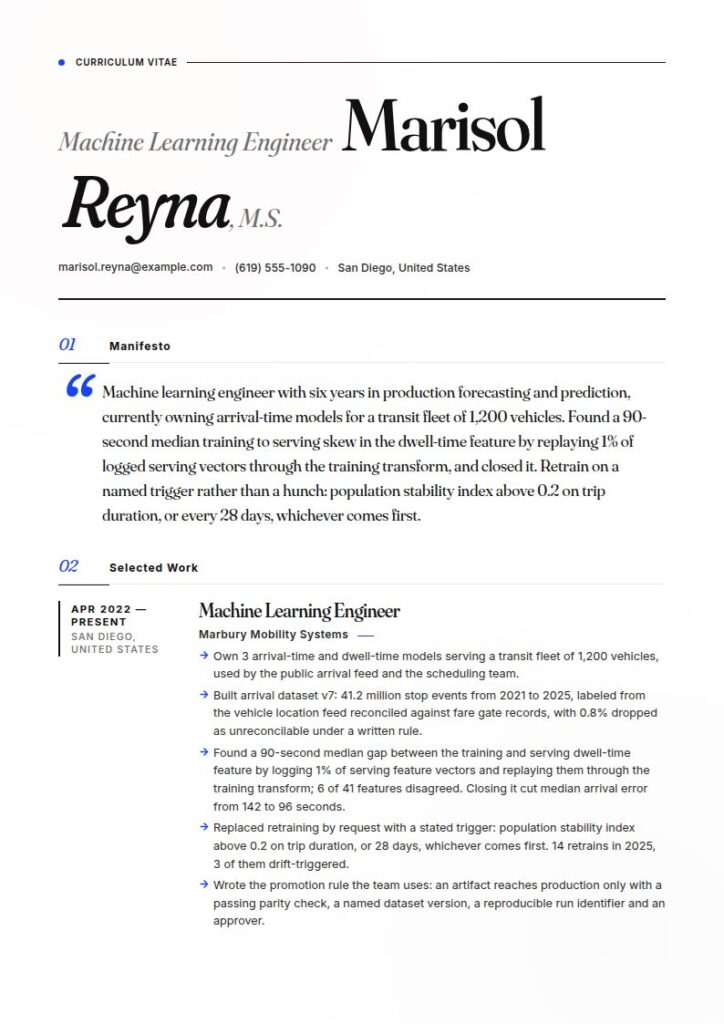
Machine learning engineer with six years in production forecasting and prediction, currently owning arrival-time models for a transit fleet of 1,200 vehicles. Found a 90-second median training to serving skew in the dwell-time feature by replaying 1% of logged serving vectors through the training transform, and closed it. Retrain on a named trigger rather than a hunch: population stability index above 0.2 on trip duration, or every 28 days, whichever comes first.
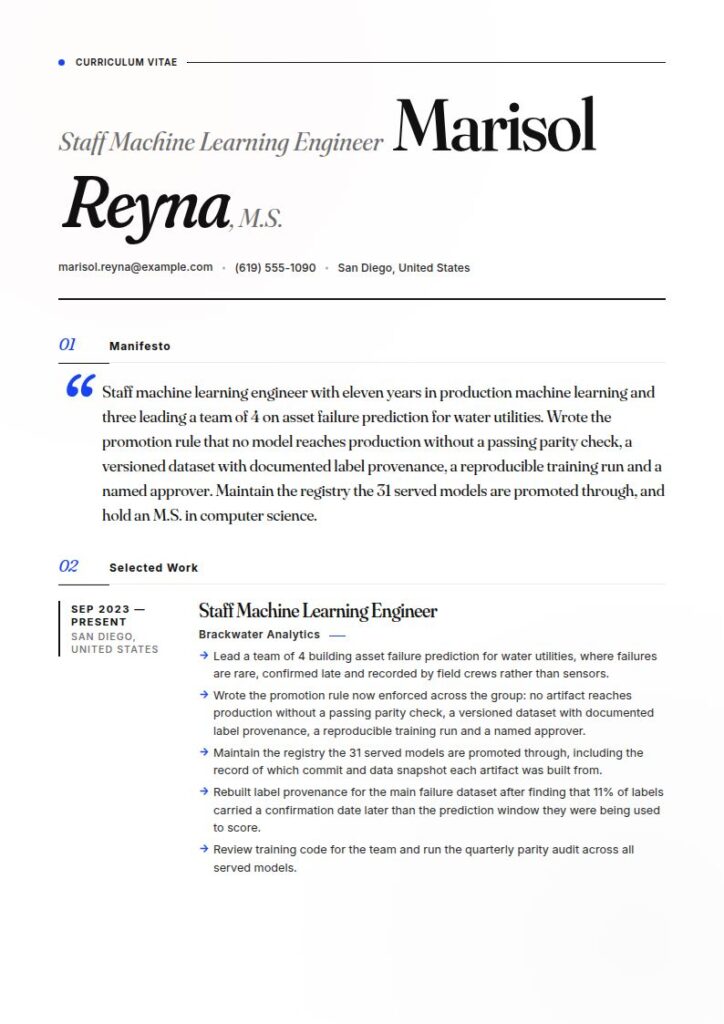
Staff machine learning engineer with eleven years in production machine learning and three leading a team of 4 on asset failure prediction for water utilities. Wrote the promotion rule that no model reaches production without a passing parity check, a versioned dataset with documented label provenance, a reproducible training run and a named approver. Maintain the registry the 31 served models are promoted through, and hold an M.S. in computer science.
Right vs wrong: the same machine learning engineer summary, twice
| ✅ Right | ❌ Wrong |
|---|---|
| Machine learning engineer with six years in production forecasting, owning arrival-time models for a fleet of 1,200 vehicles. | Machine learning engineer skilled in Python, TensorFlow, PyTorch and scikit-learn. |
| Found a 90-second median training to serving skew in the dwell-time feature and closed it. | Improved model accuracy by 12% using advanced feature engineering. |
| Retrain on a named trigger: population stability index above 0.2, or every 28 days. | Monitored model performance and retrained models as needed. |
The wrong column is not false. In fact, it is unfalsifiable, which in hiring is worse.
Outline your machine learning engineering experience
Additionally, for each job, give employer, what the models decide, the scale, and what you owned. Then four bullets, each attached to a system rather than a technique.
| Instead of | Use |
|---|---|
| Developed machine learning models using Python and TensorFlow | Own 3 arrival-time models serving a transit fleet of 1,200 vehicles, retrained on a stated drift trigger |
| Improved model accuracy by 12% | Cut median arrival error from 142 to 96 seconds on the v7 holdout, and the same on the first four weeks in production |
| Performed feature engineering and data preprocessing | Found and closed a 90-second median skew between the training and serving dwell-time feature by replaying logged serving vectors |
| Worked with large datasets | Built arrival dataset v7: 41.2 million stop events, 2021 to 2025, labels reconciled against fare gate records with 0.8% dropped |
| Deployed models to production | Every promoted artifact carries its commit, dataset version and approving engineer; promotion is blocked without all three |
Machine Learning Engineer, Marbury Mobility Systems, San Diego, CA, April 2022 to Present
Own 3 arrival-time and dwell-time models serving a transit fleet of 1,200 vehicles, used by the public arrival feed and the scheduling team.
Built arrival dataset v7: 41.2 million stop events from 2021 to 2025, labeled from the vehicle location feed reconciled against fare gate records, with 0.8% dropped as unreconcilable under a written rule.
Found a 90-second median gap between the training and serving dwell-time feature by logging 1% of serving feature vectors and replaying them through the training transform; 6 of 41 features disagreed. Closing it cut median arrival error from 142 to 96 seconds.
Replaced retraining by request with a stated trigger: population stability index above 0.2 on trip duration, or 28 days, whichever comes first. Retrains ran 14 times in 2025, 3 of them drift-triggered.
Wrote the promotion rule the team uses: an artifact reaches production only with a passing parity check, a named dataset version, a reproducible run identifier and an approver.
The training to serving boundary, and what crosses it
In other words, this is the block that makes an invisible artifact checkable, and it separates a machine learning resume from a data science one.
For example, a model in training sees a table someone assembled with all the time in the world. In production, however, it sees whatever the request carries, computed by different code, under a latency budget, sometimes missing. As a result, most of what goes wrong in production machine learning goes wrong at that seam. Five facts describe it.
One: feature parity, and the skew you found. Say how you checked, not that you did. The strong version names the mechanism, logging a sample of serving feature vectors and replaying them through the training transform, and reports what disagreed. "6 of 41 features disagreed, the worst by a 90-second median on dwell time" is a sentence only someone who ran the check can write.
Then say what caused it: training read a scheduled value from a daily table while serving read a live feed, a default fill differed, a categorical had unseen levels in production. The cause is where a reader learns whether you understand your pipeline.
Dataset versions and label provenance
Two: the dataset version, its size, and where the labels came from. Name it as a version, give the row count and date range, and say how the labels were produced. Labels are where most machine learning claims quietly fall apart, because teams often derive, delay or reconcile them from a second system. If yours were, say what you dropped and why.
Also, the practice has documentation: Gebru and colleagues proposed datasheets for datasets in Communications of the ACM, December 2021, Volume 64, Number 12, arguing that every dataset should ship with a record of its motivation, composition, collection process and recommended uses. A resume is not a datasheet, but one line of the same discipline reads as though you keep one.
Three: the retraining trigger, stated as a schedule or a threshold. "Retrained as needed" is the most common vague claim in this field and tells a reader nothing. Give a cadence with a number, a drift metric with a threshold, or both with a rule for which fires first. Then give the count: how many retrains ran in a year, and how many were triggered rather than scheduled. That last number proves the trigger exists.
Four: experiment tracking somebody else could use. The claim is not that you used a tracking tool; it is that a colleague reproduced one of your runs from its identifier without asking you a question. Say what each run records, at minimum the commit, dataset version, configuration and environment, and say that a reproduction happened and how close it came.
Five: the deployed artifact's provenance. Which commit, which data snapshot, who approved it going out. Three facts, one line. If the system blocks promotion when any is missing, say so, because a rule a system enforces is worth more than a habit. Model documentation has a published precedent too: Mitchell and colleagues proposed model cards at the ACM Conference on Fairness, Accountability, and Transparency in January 2019, short documents recording a model's intended use, training data and evaluated performance across conditions. If you wrote one, say who read it.
Parity: 1% of serving feature vectors logged and replayed nightly through the training transform. At the first run 6 of 41 features disagreed, the worst a 90-second median on dwell time, caused by training reading scheduled stop times from a daily table while serving read the live feed. Parity now blocks promotion.
Dataset: arrival dataset v7, 41.2 million stop events, 2021 to 2025, labeled from the automatic vehicle location feed reconciled against fare gate records; 0.8% dropped as unreconcilable under a written rule.
Retraining trigger: population stability index above 0.2 on trip duration, or 28 days, whichever comes first. 14 retrains in 2025, 3 of them drift-triggered.
Reproducibility: each run records commit, dataset version, config hash and environment lockfile. A colleague rebuilt the v7 champion run from its identifier alone, landing within 0.003 of the reported error.
Provenance: the deployed artifact carries commit 8f2c41d, dataset v7 and the approving engineer. Promotion is blocked if any of the three is absent.
Finally, there are two things this block deliberately does not do. First, it does not restate the model's business case, which belongs to a data science resume. And it keeps serving latency and monitoring to a clause, because those are the inference engineer's ground.
Reproducibility is the claim your competition cannot make
Read a stack of machine learning resumes and the pattern is the same: frameworks, architectures, percentage improvements. Almost none say whether anyone else could rebuild the thing described.
That is the gap to write into. A dataset version with a row count, a parity check with a number, a retraining trigger with a threshold and an artifact with an approver are four sentences no candidate can write from a course project, and most cannot write from a real job either. It also changes the interview: a reader who believes your provenance line will ask how you built it, which is a conversation you can win.
Build a snapshot of your key machine learning engineer skills
Twelve to sixteen entries in four groups, modeling first and platform last, with the boundary block carrying the evidence.
Modeling: Gradient-boosted trees, Time series forecasting, Sequence models for arrival prediction, Calibration and quantile estimation, Feature store design
Data: Python, SQL, Spark, Parquet and columnar storage, Label reconciliation across source systems, Dataset versioning
Engineering: Training pipelines, Parity and replay harnesses, Experiment tracking and run reproduction, Model registry and promotion rules, Docker, Kubernetes
Working practice: Dataset documentation, Model cards, Retraining policy design, Reviewing training code
Name frameworks once and move on. At this level, a reader generally assumes framework knowledge transfers, and a long tool list is where a resume starts to look like it is filling space.
List your education and certifications
Degree, field, institution, year. Then certifications with their issuing body, then a publication or open source contribution if either is real.
Master of Science, Computer Science, San Diego State University, San Diego, CA, 2019. Thesis on probabilistic load forecasting under missing meter data.
Bachelor of Science, Applied Mathematics, University of California San Diego, La Jolla, CA, 2017
AWS Certified Solutions Architect, Associate, Amazon Web Services
Certified Kubernetes Application Developer, Cloud Native Computing Foundation
Open source: maintainer of a small feature-parity replay library, used by 3 other teams internally.
However, put a master's near the top only when you are applying against research-shaped roles. For context, the Bureau of Labor Statistics lists a master's as the typical entry-level education for computer and information research scientists, while data scientists and software developers are both listed at bachelor's level (BLS Occupational Outlook Handbook, May 2025 data). That is the only formal education gate among the three occupations this title is hired against, so let the posting tell you where the degree belongs.
Choose the right layout and design
Lastly, use a single column, plain type at 11 or 12 point, no photograph, no skill rating bars, no charts. Give the boundary block line breaks rather than one paragraph, because readers take the five facts as a checklist.
Name the dataset version, its row count and date range. Say how the labels were produced and what you dropped. Give one parity check with the number of features that disagreed. State the retraining trigger as a schedule or a threshold, and how many retrains ran. Say that someone else reproduced one of your runs. Give the artifact's commit, data snapshot and approver.
Do not write "improved accuracy by 12%" without the dataset and holdout it was measured on. Do not say "retrained as needed". Do not list nine frameworks and no systems. Do not claim a model reached production when it reached a demonstration. Do not describe a course project in the same language as production work.
Machine learning engineer job market and outlook
Note that the Bureau of Labor Statistics publishes no Occupational Outlook Handbook profile under the title "machine learning engineer", so there is no employment count, outlook or wage for the title itself. Instead, employers hire the work against three published occupations, and the differences between them are what make the table worth reading.
| Published occupation | Jobs, 2025 | Change, 2025-35 | Annual openings | Median wage, May 2025 |
|---|---|---|---|---|
| Data scientists | 275,600 | 35%, +95,400 | ~24,800 | $120,230 |
| Computer and information research scientists | 38,600 | 22%, +8,400 | ~2,900 | $140,300 |
| Software developers, QA analysts and testers | 1,905,400 | 10%, +185,400 | ~106,100 | $134,040 |
Source: U.S. Bureau of Labor Statistics, Occupational Outlook Handbook, 2025-35 projections and May 2025 wage data.
The fastest-growing occupation here is not the smallest one
Data scientists are projected to grow 35 percent from 2025 to 2035, adding 95,400 jobs from a 2025 base of 275,600 and producing about 24,800 openings a year, on a typical entry-level bachelor's degree (BLS Occupational Outlook Handbook, 2025-35 projections and May 2025 data). Computer and information research scientists are projected to grow 22 percent over the same decade but held only 38,600 jobs in 2025 and are projected to produce about 2,900 openings a year, on a typical entry-level master's degree (BLS, 2025-35 projections).
Write for the first and the boundary block does the work, because parity, dataset versions and provenance read as competence to data science and software hiring managers alike. Write only for the second and you are competing for about 2,900 openings a year against candidates with research degrees.
What salary you can expect as a machine learning engineer
The Handbook publishes no median wage for this job title, because it carries no profile for it. What exists are the three occupations it is scored against: computer and information research scientists at a median of $140,300, software developers specifically at $135,980, and data scientists at $120,230, all May 2025 (BLS).
Industry moves the number more than the title does. Similarly, among data scientists, published May 2025 medians ran from $142,240 in publishing, broadcasting and content providers and $132,380 in computer systems design and related services, down to $129,490 in credit intermediation, $128,050 in management of companies and enterprises and $108,650 in insurance carriers (BLS). That is a spread of $33,590, wider than the $20,070 gap between the data scientist and computer and information research scientist medians.
In practice, what a resume can move is which of the three a reader files you under, and the boundary block is the instrument. For instance, a candidate who can name a dataset version, a parity result and a promotion rule reads as an engineer who ships models, which clears the widest set of postings. By contrast, a candidate whose evidence is a list of architectures reads as a researcher without a research record, the narrowest position of the three.
Key takeaways for a machine learning engineer resume
- To start, write about the artifact, not the experiment; the reader cannot open your model.
- Then give the dataset a version, a row count, a date range and a label provenance.
- Also, report one parity check with the number of features that disagreed, and the cause.
- In addition, state the retraining trigger as a schedule or a named threshold, and give the retrain count.
- Finally, claim reproducibility as someone else rebuilding a run from its identifier.
- Put commit, data snapshot and approver on the artifact, and say whether the system blocks promotion without them.
- Keep latency and monitoring to a clause; they belong to a different job title.
Build your machine learning engineer resume in 15 minutes with our AI resume builder.
Related information technology resume examples
- Data scientist resume
- AI engineer resume
- Data engineer resume
- Python developer resume
- Prompt engineer resume
- Software engineer resume
- Senior software engineer resume
- DevOps engineer resume
- AWS data engineer resume
- Solution architect resume
- Data analyst resume
- Computer science resume
Pair it with a matching machine learning engineer cover letter.
Machine learning engineer resume questions, answered
How long should a machine learning engineer resume be?
One page for your first four years. Two once you have owned a model in production through a retrain, or once the boundary block has enough real content to fill it. Two pages of experiments is still one page of evidence.
How is this different from a data scientist resume?
A data science resume argues that a model was worth building: the problem, the baseline, the metrics. A machine learning engineering resume argues that the model can be trusted and rebuilt: parity between training and serving, a versioned dataset, a stated retraining trigger, a reproducible run and a provenance line on the artifact. If you are applying for both, write both documents.
What do I put on the resume with no production experience?
One project, taken seriously. Version the dataset and say where the labels came from. Train and serve from the same transform code path, then prove parity by replaying serving inputs. Record each run's commit, data version and config, and have someone else reproduce one. That beats four projects with accuracy figures, because almost no junior candidate does it.
Do I need a master's degree?
Not for most of these jobs. BLS lists a master's as the typical entry-level education for computer and information research scientists, while data scientists and software developers are listed at bachelor's level (BLS, May 2025 data). The degree matters most for research-shaped roles, which are also the smallest group of the three, at about 2,900 projected annual openings.
Should I list every framework I have used?
No. Name the ones you have shipped with, once, and let the boundary block carry the argument. A fourteen-item tool list reads as padding where a dataset version would have read as evidence.