Marisol Reyna Machine Learning Engineer San Diego, 92103, United States [email protected] · (619) 555-1090
17 September 2026
Mr. Tobias Wrenfield Machine Learning Brackwater Analytics San Diego, United States
Application for Senior Machine Learning Engineer, Brackwater Analytics
Dear Mr. Wrenfield,
I am applying for the Senior Machine Learning Engineer post at Brackwater Analytics. I own three arrival-time and dwell-time models at Marbury Mobility Systems, serving a transit fleet of 1,200 vehicles, and what I would bring to asset failure prediction is the boundary work rather than the modeling.
The clearest thing I can tell you about is a skew I found rather than a model I built. We logged 1 percent of serving feature vectors and replayed them through the training transform; 6 of 41 features disagreed, the worst a 90-second median on dwell time, because training read scheduled stop times from a daily table while serving read the live vehicle feed. Closing that gap cut median arrival error from 142 seconds to 96 without changing the model at all. The parity check now blocks promotion.
I have spent the past two years making the work rebuildable by somebody other than me. Every training run records its commit, dataset version, configuration and environment lockfile, and a colleague reproduced the champion run from its run identifier alone, landing within 0.003 of the reported error. Retraining runs on a stated trigger rather than a request: population stability index above 0.2 on trip duration, or 28 days, whichever comes first. It fired 14 times last year, 3 of those on drift.
Your failure prediction work has a label problem I have not faced. Failures are rare, confirmed late, and recorded by field crews rather than by a sensor, which makes label provenance the first thing I would want to understand rather than the model family. I would spend the first weeks on how those labels are produced and how the datasets holding them are versioned. Thank you for your time.
Sincerely, Marisol Reyna, M.S.
Summary
A machine learning engineer cover letter is a one-page letter that gives one failure you found at the boundary between training and serving, and one fact proving your work can be rebuilt by somebody else. This guide gives you a full adaptable letter, the openings that work, and what to write when the team you are applying to already has models in production.
Machine Learning Engineer cover letter examples by experience level
A machine learning engineer cover letter is a one-page letter giving one failure you found at the boundary between training and serving, and one fact showing your work can be rebuilt without you.
It is a narrow brief, chosen against the competition. The other letters describe models, architectures and accuracy improvements. None describes a bug in a pipeline, which is the work.
Guide to a machine learning engineer cover letter
This guide and the corresponding machine learning engineer cover letter example will cover:
- How to structure the letter, paragraph by paragraph
- Why one failure beats a summary of the models you have built
- How to write reproducibility as a fact rather than a claim
- What to say to a team that already runs models in production
- The openings that work and the ones that close a file
How to write a machine learning engineer cover letter
| Paragraph | Its job | Length |
|---|---|---|
| Opening | The post, what you own now, and what you would bring | 2 to 3 sentences |
| The failure | One skew at the boundary, its cause, what closing it did | 4 to 5 sentences |
| Reproducibility | What every run records, and a reproduction that happened | 3 to 4 sentences |
| Fit | A problem in their domain you have not solved, and what you would do first | 3 sentences |
Lead with a failure you found, not a model you built
Every candidate has models. Almost none will tell you about a time the pipeline lied to them.
"We logged 1 percent of serving feature vectors and replayed them through the training transform; 6 of 41 features disagreed" is a sentence you can only write if you ran the check, which makes it the most credible thing in the letter. It is also safer than an accuracy improvement, because an accuracy number invites the question of what it was measured on and most letters cannot answer it.
A machine learning engineer cover letter example you can adapt
Dear Mr. Wrenfield,
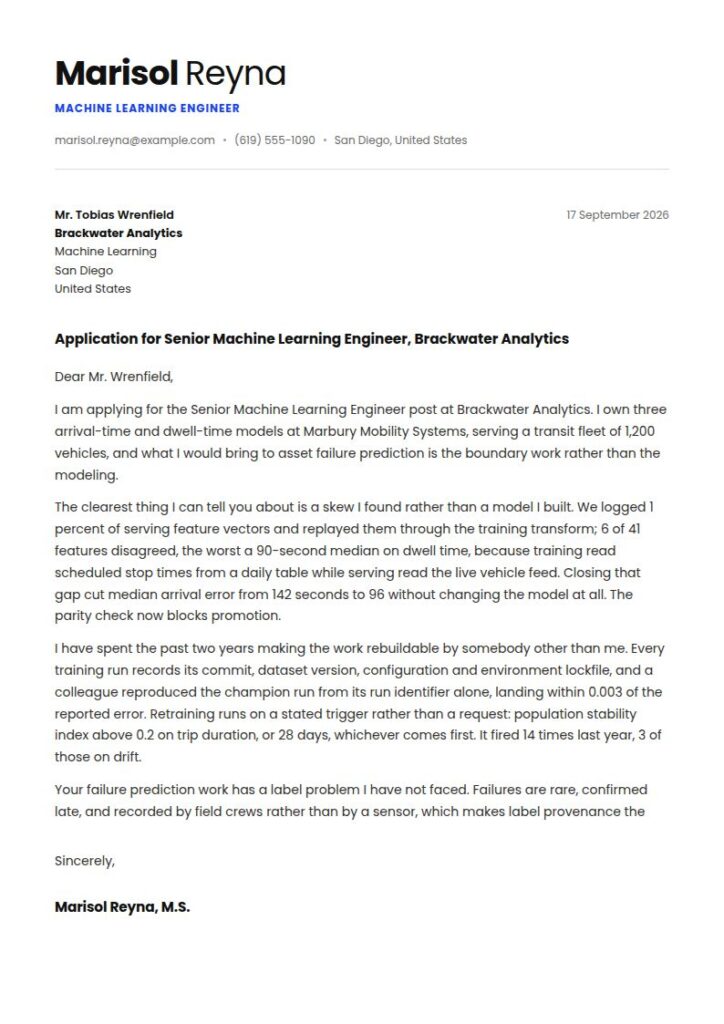
I am applying for the Senior Machine Learning Engineer post at Brackwater Analytics. I own three arrival-time and dwell-time models at Marbury Mobility Systems, serving a transit fleet of 1,200 vehicles, and what I would bring to asset failure prediction is the boundary work rather than the modeling.
The clearest thing I can tell you about is a skew I found rather than a model I built. We logged 1 percent of serving feature vectors and replayed them through the training transform; 6 of 41 features disagreed, the worst a 90-second median on dwell time, because training read scheduled stop times from a daily table while serving read the live vehicle feed. Closing that gap cut median arrival error from 142 seconds to 96 without changing the model at all. The parity check now blocks promotion.
I have spent the past two years making the work rebuildable by somebody other than me. Every training run records its commit, dataset version, configuration and environment lockfile, and a colleague reproduced the champion run from its run identifier alone, landing within 0.003 of the reported error. Retraining runs on a stated trigger rather than a request: population stability index above 0.2 on trip duration, or 28 days, whichever comes first. It fired 14 times last year, 3 of those on drift.
Your failure prediction work has a label problem I have not faced. Failures are rare, confirmed late, and recorded by field crews rather than by a sensor, which makes label provenance the first thing I would want to understand rather than the model family. I would spend the first weeks on how those labels are produced and how the datasets holding them are versioned. Thank you for your time.
Sincerely, Marisol Reyna
Openings that work
| Instead of | Use |
|---|---|
| I am a passionate machine learning engineer with expertise in deep learning | I own three arrival-time models serving a transit fleet of 1,200 vehicles |
| I have experience with Python, TensorFlow, PyTorch and scikit-learn | What I would bring is the boundary work rather than the modeling |
| I improved model accuracy by 12% using advanced techniques | Closing a training to serving skew cut median arrival error from 142 seconds to 96 without changing the model |
| I am excited to work with your data | Your labels are confirmed late and recorded by field crews, so provenance is where I would start |
Every line in the right column could be checked at interview, and two would be embarrassing if false.
Pick the failure, not the model
A letter has room for one technical story. Choose it on how hard it was to see, not on how large the model was.
Candidates in this field are usually distinguished by what they noticed: a feature computed differently in two code paths, a label that arrives three days late and leaked into training, a default fill that turned a missing sensor into a plausible reading. Each is invisible in a metric and obvious in a replay.
Write it in four beats: what looked fine, what made you check, what the check showed, what changed after. Keep the model family to a clause. Avoid two stories that read badly: the outage, which describes an incident rather than a judgment, and the competition-shaped win, where the data arrived clean and the difficulty was all in the model.
Three published occupations, one unpublished title
The Bureau of Labor Statistics publishes no Occupational Outlook Handbook profile for machine learning engineers, so the pay and outlook you can cite belong to the occupations the work is hired against.
Data scientists had a median annual wage of $120,230 in May 2025, held 275,600 jobs in 2025, and are projected to grow 35 percent through 2035 with about 24,800 openings a year. Computer and information research scientists had a median of $140,300 and are projected to grow 22 percent, but from a base of 38,600 jobs and with only about 2,900 openings a year, on a typical entry-level master's degree. Software developers had a median of $135,980 (BLS Occupational Outlook Handbook, 2025-35 projections and May 2025 wage data).
The letter decides which of those a reader files you under. An engineering story about a pipeline reads as competence to all three; a research story without a research record fits only the smallest.
Writing to a team that already runs models in production
The hardest letters to write are to teams further along than you. They do not need drift explained to them.
Name one problem in their domain you have not solved and say what you would want to understand first. Ask a real question about their practice, such as how datasets are versioned or what blocks a promotion. Give one number with the thing it was measured on attached. Say which part of the stack you have owned and which you have only used.
Do not explain their field back to them. Do not describe a model without saying what data it saw in production. Do not claim you have shipped when you have demonstrated. Do not list frameworks; the resume carries those, and a letter spending a paragraph on tooling had nothing else.
Length, format and sending it
One page, four paragraphs, 250 to 400 words. PDF unless the portal says otherwise, named for yourself and the post: marisol-reyna-ml-engineer-cover-letter.pdf. Address a named person, because a generic greeting on an otherwise specific letter reads as a template.
Use the same numbers as your resume so the two agree. Our machine learning engineer resume example uses the figures written here, and you can check the finished file with the free ATS checker.
Key takeaways
- Open with what you own now and what you would bring, in one sentence each.
- Spend the middle on one failure at the training to serving boundary.
- Give the cause of the skew, not just its size; the cause is the evidence.
- Write reproducibility as an event: someone else rebuilt a run and got the same number.
- State the retraining trigger with a threshold or a cadence, and how often it fired.
- Name a problem in their domain you have not solved, and what you would do first.
- Keep frameworks out of the letter and keep it to one page.
Build a matching machine learning engineer resume in 15 minutes.
Machine learning engineer cover letter questions, answered
How long should a machine learning engineer cover letter be?
One page, four paragraphs, 250 to 400 words. Engineering managers read these between other work, and a fifth paragraph dilutes the one technical story doing the work.
Should I include links to my GitHub or papers?
One link, in the header, and only if what is behind it is finished. A repository of half-run notebooks is worse than no link, because a reader who opens it is now assessing unfinished work. A paper link belongs in the letter only if the role is research-shaped.
What do I write with no production machine learning experience?
Write one project the way a production system is written. Give the dataset a version and say where the labels came from. Train and serve through the same transform, then prove parity by replaying serving inputs. Have someone else reproduce a run from its identifier. Then say plainly that it was a project, because a reader who catches an overclaim stops reading.
How much mathematics should the letter contain?
Almost none. A letter is read for judgment, and judgment shows in which problem you chose to describe. Save derivations for the interview and spend the letter on what you found and what you did about it.
Should I mention large language models if the role is not about them?
Only if you have shipped something with one and it is relevant to the posting. Mentioning them because they are prominent reads as padding, and it can push a reader toward filing you against a different job than the one you applied for.