AI Engineer, Retrieval and Model Serving Nadia Sarkisian
AI Engineer
[email protected] | (512) 555-1620 | Austin, United States
Profile
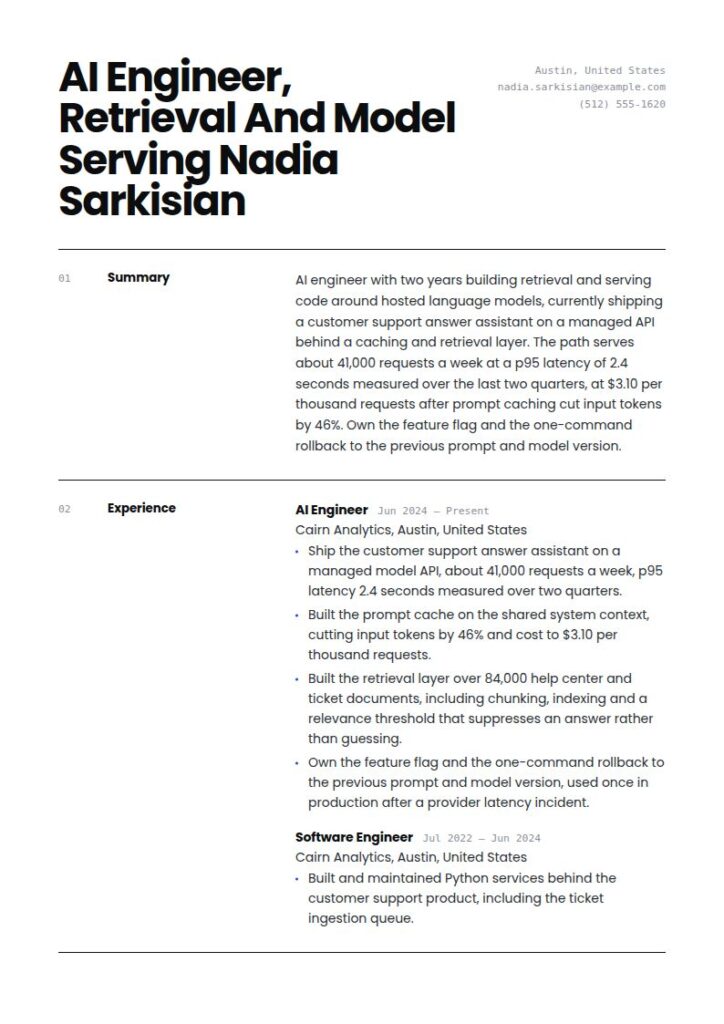
AI engineer with two years building retrieval and serving code around hosted language models, currently shipping a customer support answer assistant on a managed API behind a caching and retrieval layer. The path serves about 41,000 requests a week at a p95 latency of 2.4 seconds measured over the last two quarters, at $3.10 per thousand requests after prompt caching cut input tokens by 46%. Own the feature flag and the one-command rollback to the previous prompt and model version.
Work Experience
06/2024 - Present, AI Engineer, Cairn Analytics, Austin, United States
- Ship the customer support answer assistant on a managed model API, about 41,000 requests a week, p95 latency 2.4 seconds measured over two quarters.
- Built the prompt cache on the shared system context, cutting input tokens by 46% and cost to $3.10 per thousand requests.
- Built the retrieval layer over 84,000 help center and ticket documents, including chunking, indexing and a relevance threshold that suppresses an answer rather than guessing.
- Own the feature flag and the one-command rollback to the previous prompt and model version, used once in production after a provider latency incident.
07/2022 - 06/2024, Software Engineer, Cairn Analytics, Austin, United States
- Built and maintained Python services behind the customer support product, including the ticket ingestion queue.
- Added request tracing and per-endpoint latency dashboards later reused to instrument the model serving path.
Education
08/2018 - 05/2022, Bachelor of Science, Computer Science, The University of Texas at Austin, Austin, United States
Coursework in distributed systems, databases and machine learning.
Skills
Python and FastAPI, 85
Retrieval and hybrid search, 70
Prompt and context assembly, 75
Prompt caching and token budgeting, 75
Latency and cost instrumentation, 70
Docker and CI pipelines, 70
Languages
English, native
Armenian, native
Spanish, beginner
Certificates
09/2024, Kubernetes Administration, Cloud Native Computing Foundation
Earned while moving the answer assistant onto the shared cluster.
Summary
An AI engineer resume is a one to two page document describing the system you put around a model in production: what serves it, what sits in front of it, what it costs per request, and how you take it back out. This guide gives you three adaptable versions, the inference path block most applicants leave out, and current Bureau of Labor Statistics pay for the published occupations this title sits between.
AI Engineer resume examples by experience level
In short, an AI engineer resume is a one to two page document that describes the system you built around a model and ran in production.
However, almost every applicant for these roles writes about the model, and the model is the part you did not build. What a hiring manager is buying is the path around it: what retrieves context, what caches, what calls tools, what blocks the output you cannot ship, what it costs at a thousand requests, and what you press when it goes wrong on a Friday morning. Therefore, a resume that names a model family and stops has described a dependency, not a job.
Resume guide for an AI engineer resume
Specifically, this guide and the corresponding AI engineer resume example will cover:
- How to write an AI engineer resume, section by section
- The inference path block: model, serving, latency, cost, guardrail and rollback
- Three adaptable summaries: first production feature, owning a path, leading a platform
- How to write governance without claiming a compliance role you did not hold
- What the job market looks like and what you can expect to earn
How to write an AI engineer resume
Overall, six sections: contact header, summary, an inference path block, engineering experience, skills, and education with certifications. Generally, one page for your first three years, two once you own a production path.
The inference path block sits high because it is the only section that distinguishes this job from the three neighboring jobs that share its vocabulary. After all, a research scientist, a data scientist and an AI engineer can all write "worked with large language models" and mean completely different weeks.
| Section | What it is answering | Where it goes |
|---|---|---|
| Inference path block | What did you run in production, and what did it cost? | Its own block, under the summary |
| Engineering experience | What did you build, and what moved because of it? | Reverse chronological, with numbers |
| Skills | Which serving, orchestration and infrastructure tools? | Grouped, named by product |
| Education and certifications | Does it clear the stated degree bar? | Bottom, unless you graduated this year |
Say whether the model was hosted or self-served, and in the same line
These are two different engineering jobs and hiring teams price them differently.
A hosted model on a managed API makes you responsible for prompt and context assembly, retries, rate limits, token budgets, caching, failover between providers, and the bill. A self-served open-weight model adds accelerators, batching, quantization, memory headroom, autoscaling on an expensive node type and the cold start.
Write which one, on what: "open-weight model, 8B, self-hosted on two GPU nodes with a managed API as failover" is a sentence with nine follow-up questions in it, all of which you can answer. "Experience with LLMs" has none.
Run the finished file through the ATS resume checker before you send it, because most employers of this size parse the application into a structured record before a person opens it.
Choosing the best resume format for an AI engineer resume
Reverse chronological, then, with the inference path block between the summary and the first job. One page for your first three years, two after that.
Functional and skills-first formats, however, fail here for a specific reason. The tooling turns over in months, so a reader is not checking whether you know a framework. They are checking when you shipped, what you shipped onto, and whether it is still running. Only a dated timeline answers that.
Include your contact information
| ✅ Right | ❌ Wrong |
|---|---|
| Nadia Sarkisian | Nadia Sarkisian |
| AI Engineer, Retrieval and Model Serving | AI enthusiast passionate about the future of artificial intelligence |
| Austin, TX, open to hybrid in Austin or remote | Austin, Texas, USA |
| (512) 555-1620, [email protected], github.com/example | (512) 555-1620, [email protected] |
For this reason, put the specialty in the title line. "AI engineer" covers people who assemble retrieval pipelines, people who run inference clusters, people who wire agents to internal tools and people who write product code near a model. Those are four hires, and a manager with one seat wants one of them.
At the same time, never put a customer name, a system prompt, an API key fragment or an internal screenshot on a resume or in a portfolio repository.
Make use of a summary
In short, four lines: what you build, how long, the path you own with one latency or cost number, and the rollback.
AI engineer with two years building retrieval and serving code around hosted language models, currently shipping a customer support answer assistant on a managed API behind a caching and retrieval layer. The path serves about 41,000 requests a week at a p95 latency of 2.4 seconds measured over the last two quarters, at $3.10 per thousand requests after prompt caching cut input tokens by 46%. Own the feature flag and the one-command rollback to the previous prompt and model version.
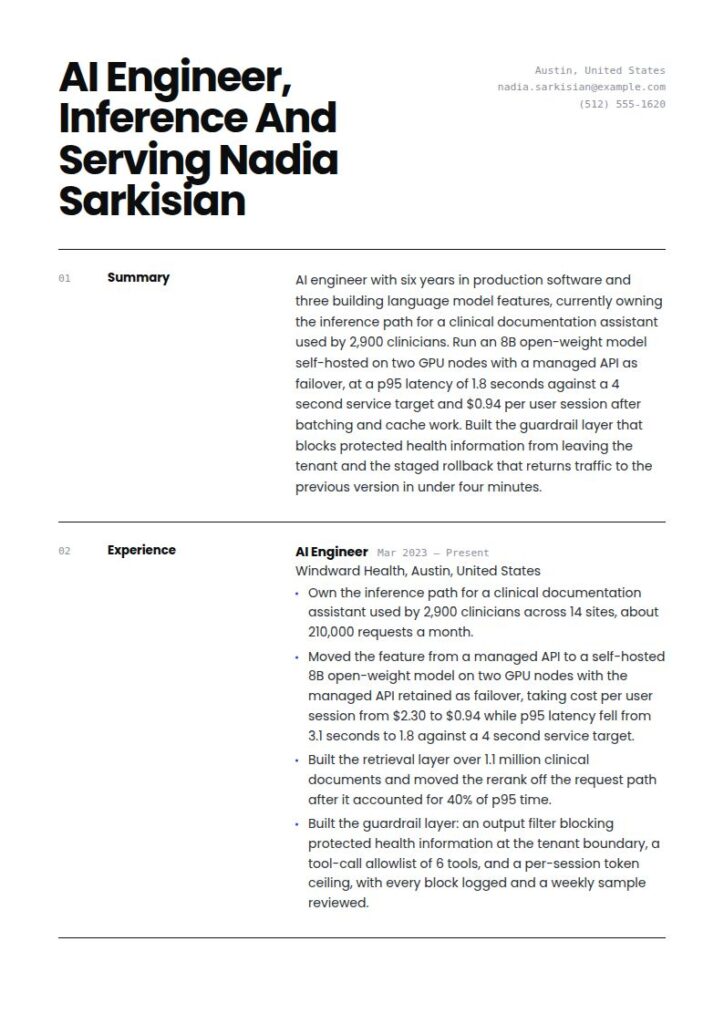
AI engineer with six years in production software and three building language model features, currently owning the inference path for a clinical documentation assistant used by 2,900 clinicians. Run an 8B open-weight model self-hosted on two GPU nodes with a managed API as failover, at a p95 latency of 1.8 seconds against a 4 second service target and $0.94 per user session after batching and cache work. Built the guardrail layer that blocks protected health information from leaving the tenant and the staged rollback that returns traffic to the previous version in under four minutes.
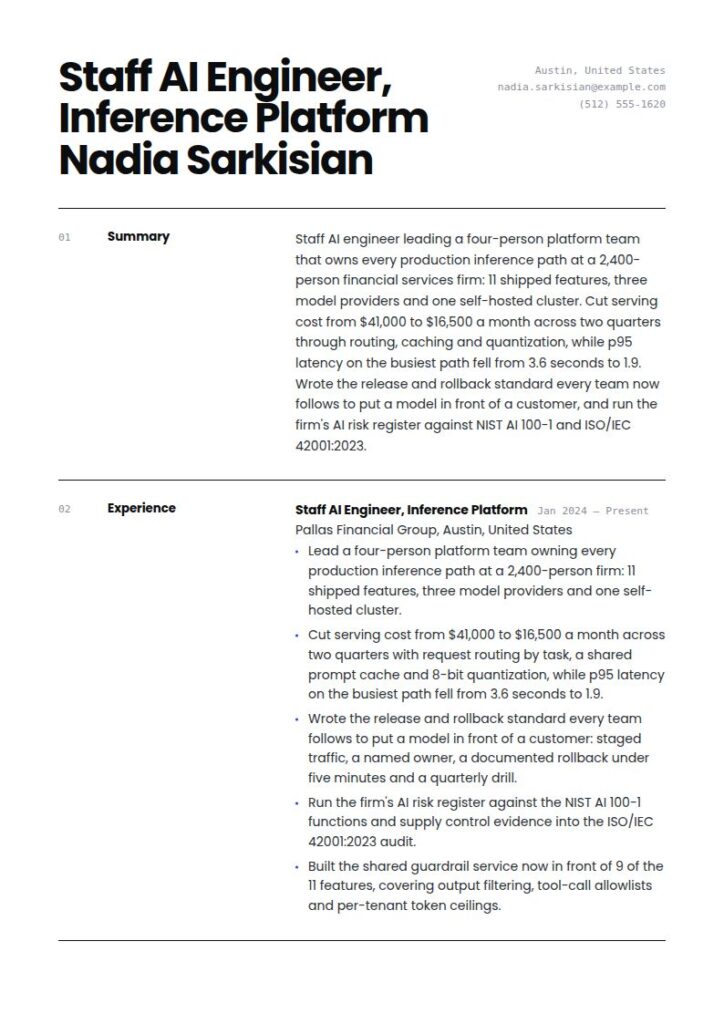
Staff AI engineer leading a four-person platform team that owns every production inference path at a 2,400-person financial services firm: 11 shipped features, three model providers and one self-hosted cluster. Cut serving cost from $41,000 to $16,500 a month across two quarters through routing, caching and quantization, while p95 latency on the busiest path fell from 3.6 seconds to 1.9. Wrote the release and rollback standard every team now follows to put a model in front of a customer, and run the firm's AI risk register against NIST AI 100-1 and ISO/IEC 42001:2023.
Right vs wrong: the same AI engineer summary, twice
| ✅ Right | ❌ Wrong |
|---|---|
| Own the inference path for a clinical documentation assistant used by 2,900 clinicians. | Worked on cutting-edge generative AI solutions for healthcare. |
| 8B open-weight model self-hosted on two GPU nodes with a managed API as failover. | Hands-on experience with state-of-the-art large language models. |
| p95 latency 1.8 seconds against a 4 second target, $0.94 per user session after batching. | Optimized performance and reduced costs significantly. |
For example, the left column can be handed a pager. The right column, on the other hand, could be someone who has run inference under load for three years or someone who has run a notebook twice, and the interview is an expensive place to find out.
Outline your engineering experience
Then list employer, title, dates, and one line saying what the system was and who used it. Then three to five bullets, each naming something you built and what it did to a number a finance team or an on-call rota would recognize.
| Instead of | Use |
|---|---|
| Built AI-powered features using LLMs | Shipped a retrieval-backed answer assistant on a managed model API, 41,000 requests a week at p95 2.4 seconds |
| Optimized model performance | Cut p95 latency from 3.6 seconds to 1.9 by moving rerank off the request path and caching the retrieval step |
| Reduced AI costs | Took serving cost from $41,000 to $16,500 a month with request routing by task, prompt caching and 8-bit quantization |
| Deployed models to production | Put the path behind a feature flag with a four minute rollback to the previous model and prompt version, exercised twice in production |
AI Engineer, Windward Health, Austin, TX, March 2023 to Present
Own the inference path for a clinical documentation assistant used by 2,900 clinicians across 14 sites, about 210,000 requests a month.
Moved the feature from a managed API to a self-hosted 8B open-weight model on two GPU nodes with the managed API retained as failover, taking cost per user session from $2.30 to $0.94 while p95 latency fell from 3.1 seconds to 1.8 against a 4 second service target.
Built the retrieval layer over 1.1 million clinical documents, and moved the rerank off the request path after it accounted for 40% of p95 time.
Built the guardrail layer: an output filter blocking protected health information at the tenant boundary, a tool-call allowlist, and a per-session token ceiling, with every block logged and a weekly sample reviewed.
Wrote the staged rollback: traffic shifts back to the previous model and prompt version in under four minutes on one command, exercised twice in production and once a quarter in drills.
The inference path you put in production
This is the block almost nobody writes; moreover, it separates you from the three adjacent job titles. Six lines, each answering a question an engineering manager asks in the first two minutes.
The model, and who runs it. Name the family and the size, and say hosted or self-served. If it is hosted, say whether a second provider was wired in. If it is self-served, name the accelerator, the node count and the serving runtime. Say what you inherited; improving an inherited system is a good claim, and pretending otherwise is easy to catch.
What sits in front of the model. Retrieval, tool calling, caching, routing, or nothing. This is where most of the engineering lives. If there is retrieval, say what the corpus is, how large, and whether there is a rerank. For tool calling, say how many tools and what they are allowed to do. If there is a cache, say what is cached and what the hit rate is.
Latency, at a percentile, over a window. Not "fast" and not a bare average. "p95 of 1.8 seconds against a 4 second service target, measured over two quarters" is defensible. Say whether it is time to first token or time to full response, because those differ by seconds in a streaming interface and readers assume the flattering one if you do not say.
Cost, per thousand requests or per user session. The single most underused number on these resumes. Give the unit, the number and what you changed it from. Cost per user session is usually the more honest unit for a product feature, because it survives someone changing the number of model calls per interaction.
The guardrail, and what it actually blocks. Name the control and the thing it prevents: an output filter for regulated data categories, a tool-call allowlist, a token ceiling, a human approval step above a threshold, a tenant boundary on retrieval. Then say what happens when it fires and whether anyone reads the log. A guardrail nobody reviews is a line of code, not a control.
Rollback and governance on the page
The rollback. What you do when the new version is worse in production: the mechanism, the time to complete it, who may trigger it, and whether it has been used for real. This sentence separates candidates who have carried a pager for one of these systems from candidates who have not.
Model and hosting: 8B open-weight instruction-tuned model, self-hosted on two GPU nodes with a managed model API retained as automatic failover. Serving runtime with continuous batching; 8-bit quantization in production.
In front of the model: two-stage retrieval over 1.1 million clinical documents, rerank run asynchronously off the request path, prompt cache on the shared system context with a 71% hit rate.
Latency: p95 1.8 seconds to full response against a 4 second service target, measured over two quarters; p50 0.9 seconds; time to first token p95 0.4 seconds.
Cost: $0.94 per user session, down from $2.30, on roughly 210,000 requests a month.
Guardrails: output filter blocking protected health information across the tenant boundary, tool-call allowlist of 6 tools, 8,000 token session ceiling. All blocks logged, weekly sample reviewed.
Rollback: one command returns traffic to the previous model and prompt version in under 4 minutes; any on-call engineer can trigger it; exercised twice in production and quarterly in drills.
Finally, write the governance line only as far as it is true. NIST released AI 100-1, the Artificial Intelligence Risk Management Framework, on 26 January 2023, with four core functions: Govern, Map, Measure and Manage, and it is voluntary rather than a regulation. For instance, ISO/IEC 42001:2023 specifies requirements for establishing, implementing, maintaining and continually improving an AI management system inside an organization. If you kept a risk register, mapped a feature against those functions, or supplied evidence into a certification audit, write that specific thing and no more.
Build a snapshot of your key skills
Twelve to eighteen entries in four labeled groups, named by product rather than category, so a reader finds their own stack in one pass.
Serving and inference: managed model APIs, self-hosted open-weight serving, continuous batching, quantization, GPU capacity planning, streaming responses, provider failover
Retrieval and orchestration: chunking and indexing strategy, vector and hybrid search, rerank, prompt and context assembly, tool calling, caching, request routing by task
Engineering: Python, TypeScript, FastAPI, Docker, Kubernetes, Terraform, CI and CD pipelines, PostgreSQL, queueing and async workers
Operations and governance: latency and cost instrumentation, tracing, canary release and rollback, output filtering, tool allowlists, AI risk register, NIST AI 100-1 functions, ISO/IEC 42001:2023
List your education and certifications
Degree, then certifications, then anything genuinely public. Bureau of Labor Statistics data is useful here as a floor rather than a rule: software developers typically enter with a bachelor's degree, and computer and information research scientists typically enter with a master's degree (BLS Occupational Outlook Handbook, May 2025 data). The research end of this work has a higher stated bar than the engineering end, which is worth knowing before you decide which postings to answer.
Certifications here are renamed often. Also list each with its issuing body and year, and check its own page for the current name first.
Bachelor of Science, Computer Science, The University of Texas at Austin, Austin, TX, 2019
Certifications: Kubernetes administration (2024). Cloud machine learning specialty certification (2023). Named by issuing body and year on the live resume.
Public work: one open-source retrieval library with 41 contributors, and a written postmortem of a production incident on a model serving path, both linked from the header.
Choose the right layout and design
Single column, 10 or 11 point body type, plain headings, no photograph, no graphics, no skill bars. PDF unless the portal says otherwise.
However, the inference path block is the one place to break the visual pattern. After all, six labeled lines read in about fifteen seconds and survive a parser; the same content buried in experience bullets does not.
Say hosted or self-served in the same sentence as the model. Give latency at a named percentile over a named window. Give cost per thousand requests or per user session, with what it was before. Name the guardrail and what it blocks. Describe the rollback, its duration and whether it has been used for real. Say what you inherited and what you built.
Do not name a model family and stop, since the model is the part you did not build. Do not give a bare average latency. Do not write "reduced costs significantly" when the unit and the number exist. Do not claim a framework makes you compliant when the framework is voluntary. Do not put a customer name, a system prompt or an internal screenshot in a portfolio repository.
AI engineer job market and outlook
The Bureau of Labor Statistics publishes no Occupational Outlook Handbook profile under the title "AI engineer" or "artificial intelligence engineer"; as a result, there is no employment count, outlook or median wage for the title itself. What exists is three published occupations the work is split across, useful precisely because they grow at different rates.
| Published occupation | Jobs, 2025 | Change, 2025-35 | Annual openings | Median wage, May 2025 |
|---|---|---|---|---|
| Computer and information research scientists | 38,600 | 22%, +8,400 | ~2,900 | $140,300 |
| Data scientists | 275,600 | 35%, +95,400 | ~24,800 | $120,230 |
| Software developers, QA analysts and testers | 1,905,400 | 10%, +185,400 | ~106,100 | $134,040 |
Source: U.S. Bureau of Labor Statistics, Occupational Outlook Handbook, 2025-35 projections and May 2025 wage data.
The scarce end is small, and it asks for a different degree
Computer and information research scientists are projected to grow 22% from 2025 to 2035, but held only 38,600 jobs in 2025 and are projected to produce about 2,900 openings a year, on a typical entry-level master's degree (BLS Occupational Outlook Handbook, 2025-35 projections and May 2025 data). Data scientists are projected to grow 35% over the same decade, adding 95,400 jobs with about 24,800 openings a year, on a bachelor's (BLS, 2025-35 projections).
Most jobs advertised as AI engineering are hired against the software developer profile, which held 1,905,400 jobs in 2025 with about 106,100 openings a year (BLS, 2025-35 projections). Write the resume as an engineer who ships, with the model work as evidence of judgment, and all three sets of hiring managers can read it. Write it as a research profile without a research degree and only the smallest of the three can.
What salary you can expect as an AI engineer
There is no published median wage for this job title, because the Handbook does not carry a profile for it. The three occupations the work is scored against are published, and they bracket the range: computer and information research scientists at a median of $140,300, software developers specifically at $135,980, and data scientists at $120,230, all May 2025 (BLS).
The spread inside each is wider than the gap between them: software developers earned less than $82,460 at the lowest 10 percent and more than $214,670 at the highest, and computer and information research scientists ran from less than $82,200 to more than $230,630, both May 2025 (BLS).
Instead, industry is the visible lever in the published data. For example, software developers in software publishers had a median of $164,550, and computer and information research scientists in software publishers a median of $211,270, against $124,870 for those in the federal government, all May 2025 (BLS).
In other words, what a resume can move is which end of a band you are read into, and the inference path block is the instrument. Cost per session, latency at a percentile and a rollback that has actually been used are how a reader tells a candidate who has run one of these systems from a candidate who built one once.
Key takeaways for an AI engineer resume
- Above all, describe the system around the model, not the model; the model is the part you did not build.
- Also say hosted or self-served in the same line as the model family and size.
- Similarly, name what sits in front: retrieval, tool calling, caching, routing, and what each one does.
- Moreover, give latency at a stated percentile over a stated window, and say which clock you mean.
- Likewise, give cost per thousand requests or per user session, with the figure it replaced.
- Finally, name the guardrail, what it blocks and who reads the log.
- Describe the rollback: the mechanism, the minutes, who can trigger it and whether it has been used.
Build your AI engineer resume in 15 minutes with our AI resume builder.
Related information technology resume examples
- Machine learning engineer resume
- Data scientist resume
- Prompt engineer resume
- Data engineer resume
- Software engineer resume
- Python developer resume
- Software developer resume
- Solution architect resume
- AWS data engineer resume
- Data analyst resume
- DevOps engineer resume
- Computer science resume
Pair it with a matching AI engineer cover letter.
AI engineer resume questions, answered
How long should an AI engineer resume be?
One page for your first three years, two once you own a production path. The inference path block earns its space at either length, because it replaces a paragraph of framework names with six lines a manager can interrogate.
What if I have never shipped a model to production?
Write what you did ship, at whatever scale it ran. A retrieval assistant used by thirty people inside your own company is a production path if it had a latency target, a cost, a guardrail and a way to turn it off, and it should be written with those four facts. A notebook that produced a nice chart is not.
Do I need a master's degree to work as an AI engineer?
Not for most of these jobs. The Bureau of Labor Statistics records a bachelor's degree as the typical entry-level education for software developers and for data scientists, and a master's degree as typical for computer and information research scientists (BLS, May 2025 data). Postings that genuinely want the research profile usually say so in the first three lines.
Should I put cost figures on a resume?
Yes, as a unit rate rather than a total, and only where you can source the number. Cost per thousand requests or per user session is the number engineering leaders are being asked for and almost never see. A monthly total is less useful, because it moves with traffic you did not control.
How do I write about AI governance without overstating it?
Name the document, the date and the specific thing you did. NIST AI 100-1 was released on 26 January 2023 and is voluntary, with four functions: Govern, Map, Measure and Manage. ISO/IEC 42001:2023 sets requirements for an AI management system. "Maintained the feature risk register and supplied control evidence into the ISO/IEC 42001 audit" is a claim. "AI governance expert" is not.