Nadia Sarkisian AI Engineer, Inference and Serving Austin, 78704, United States [email protected] · (512) 555-1620
11 September 2026
Ms. Dana Ruelas Engineering Brightwater Labs Austin, United States
Application for AI Engineer, Brightwater Labs
Dear Ms. Ruelas,
I am applying for the AI Engineer post at Brightwater Labs. I own the inference path for a clinical documentation assistant at Windward Health that serves 2,900 clinicians and about 210,000 requests a month, and your posting asks for someone who can take a feature from a managed API onto self-hosted serving without the latency getting worse. That is the move I made last year.
The path started on a managed model API at $2.30 per user session with a p95 of 3.1 seconds. I moved it to an 8B open-weight model self-hosted on two GPU nodes, kept the managed API wired in as automatic failover, and used continuous batching and 8-bit quantization to hold response quality steady. Cost per user session is now $0.94 and p95 is 1.8 seconds against a 4 second service target, measured over two quarters. The largest single win was not the hosting change: moving the rerank off the request path removed 40 percent of p95 time, and I would look for that pattern anywhere before buying more hardware.
Two things I would bring beyond that. The guardrail layer I built blocks protected health information at the tenant boundary, with a tool-call allowlist and a per-session token ceiling, and every block is logged and a sample reviewed weekly rather than written once and forgotten. The rollback is one command that returns traffic to the previous model and prompt version in under four minutes; it has been used twice in production and we drill it quarterly. I noticed Brightwater already runs two model providers, so routing and failover are familiar ground.
I would be glad to walk through the cost and latency instrumentation, which is where most of this work actually sits. I am in Austin and available for a hybrid or remote arrangement. Thank you for your time.
Sincerely, Nadia Sarkisian
Summary
An AI engineer cover letter describes one inference path you put in front of real users: what serves the model, what sits in front of it, what it costs per session, and how you take it back out. This guide gives you a full adaptable letter, the sentence that carries latency and cost, and the openings that get a strong file read to the end.
AI Engineer cover letter examples by experience level
In short, an AI engineer cover letter is a one-page letter that walks a hiring manager through one production inference path you built and what it cost to run.
The resume carries the inventory. The letter shows judgment: why you served the model the way you did, what you gave up for it, and what you would press if the new version turned out worse in front of customers.
Guide to an AI engineer cover letter
That is why this guide and the corresponding AI engineer cover letter example will cover:
- First, how to structure the letter, paragraph by paragraph
- Then, why one inference path beats a tour of everything you have touched
- Also, the sentence that carries latency and cost
- What to write when your only production system was small
- Finally, the openings that make a reader finish a strong file
How to write an AI engineer cover letter
| Paragraph | Its job | Length |
|---|---|---|
| Opening | The post, the path you own, and its size in one number | 2 to 3 sentences |
| Evidence | One serving decision: before, after, and what you traded | 4 to 6 sentences |
| Fit | The guardrail, the rollback, and one real thing about them | 3 to 4 sentences |
| Close | What you would want to talk through, availability, thank you | 2 sentences |
Pick one path and stay on it for the whole letter
The common failure in these letters is breadth. A candidate lists four features, three providers, two vector databases and an agent framework, and the reader finishes with no idea what any of it cost or whether it is still running.
One path described end to end beats four described as names. Choose the one where you made a decision you can defend, then carry it through all four paragraphs: what it serves, what you changed, what the change bought, what it cost you elsewhere, and how you undo it.
If the posting names a constraint, such as on-premises serving, a latency target or a regulated data boundary, pick the path that meets it even if it is not your most impressive one.
An AI engineer cover letter example you can adapt
Dear Ms. Ruelas,
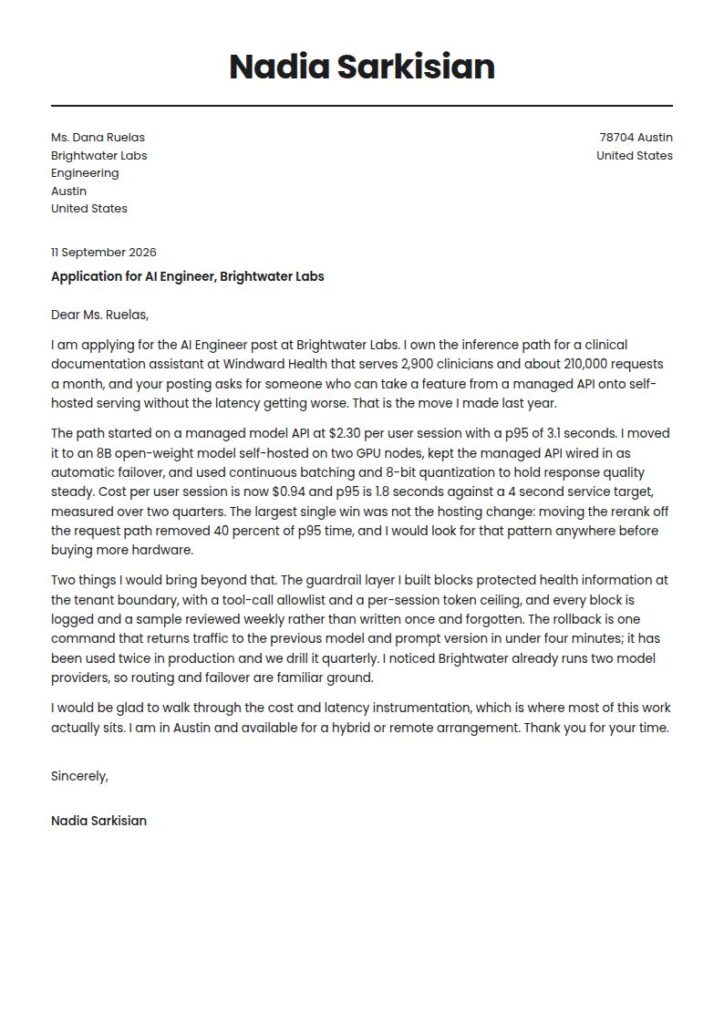
I am applying for the AI Engineer post at Brightwater Labs. I own the inference path for a clinical documentation assistant at Windward Health that serves 2,900 clinicians and about 210,000 requests a month, and your posting asks for someone who can take a feature from a managed API onto self-hosted serving without the latency getting worse. That is the move I made last year.
The path started on a managed model API at $2.30 per user session with a p95 of 3.1 seconds. I moved it to an 8B open-weight model self-hosted on two GPU nodes, kept the managed API wired in as automatic failover, and used continuous batching and 8-bit quantization to hold response quality steady. Cost per user session is now $0.94 and p95 is 1.8 seconds against a 4 second service target, measured over two quarters. The largest single win was not the hosting change: moving the rerank off the request path removed 40 percent of p95 time, and I would look for that pattern anywhere before buying more hardware.
Two things I would bring beyond that. The guardrail layer I built blocks protected health information at the tenant boundary, with a tool-call allowlist and a per-session token ceiling, and every block is logged and a sample reviewed weekly rather than written once and forgotten. The rollback is one command that returns traffic to the previous model and prompt version in under four minutes; it has been used twice in production and we drill it quarterly. I noticed Brightwater already runs two model providers, so routing and failover are familiar ground.
I would be glad to walk through the cost and latency instrumentation, which is where most of this work actually sits. I am in Austin and available for a hybrid or remote arrangement. Thank you for your time.
Sincerely, Nadia Sarkisian
Openings that work
| Instead of | Use |
|---|---|
| I am passionate about artificial intelligence and its potential | I own the inference path for a clinical documentation assistant serving 2,900 clinicians |
| I am writing to express my interest in the AI Engineer position | I am applying for the AI Engineer post, and the self-hosting move your posting describes is the one I made last year |
| I have hands-on experience with state-of-the-art LLMs | Cost per user session is $0.94, down from $2.30, at a p95 of 1.8 seconds |
| I am a fast learner who thrives in ambiguous environments | The rollback is one command, under four minutes, used twice in production |
The numbers that belong in the second paragraph
Four numbers carry almost every good letter in this field; however, most applicants include none.
| Number | What it looks like in a sentence |
|---|---|
| Scale | About 210,000 requests a month from 2,900 clinicians |
| Latency | p95 of 1.8 seconds to full response against a 4 second target |
| Cost | $0.94 per user session, down from $2.30 |
| Rollback | One command, under four minutes, used twice in production |
Therefore, give the unit and the window with every one. After all, a percentile without a window, or a cost without a unit, is a number the reader has to discount, which is the same as ignoring it.
Three published occupations, no published title
The Bureau of Labor Statistics publishes no Occupational Outlook Handbook profile under the title "AI engineer", so the pay and outlook for this work sit inside three adjacent published occupations. Software developers had a median annual wage of $135,980, computer and information research scientists $140,300 and data scientists $120,230, all May 2025 (BLS).
The volumes differ sharply. Software developers, quality assurance analysts and testers held 1,905,400 jobs in 2025 with about 106,100 openings a year, while computer and information research scientists held 38,600 jobs with about 2,900 openings a year and typically enter with a master's degree (BLS Occupational Outlook Handbook, 2025-35 projections and May 2025 data).
Most letters answering such a posting are read by people hiring against the first of those, so write like an engineer who ships and let the model work be evidence of judgment.
What to write when the system was small
Also, a path forty people use inside your own company is a production path, and you should write it as one.
Name the scale honestly, then give the same four facts a large system would get: latency, cost, guardrail, rollback. Say what you would do differently at ten times the traffic. Describe an internal tool, a hackathon project that survived, or an open-source contribution with the same structure. Name one specific thing about the employer, from their engineering blog or documentation.
Do not inflate a prototype into a platform; the follow-up question arrives in the first interview. Do not list four model providers as though breadth were the point. Do not claim a framework makes you compliant when the framework is voluntary. Do not paste a system prompt, a customer name or an internal screenshot into a letter or a public repository. Do not send a letter with no employer name in it.
Length, format and sending it
One page, four paragraphs, 250 to 400 words. PDF unless the portal says otherwise, named for yourself and the post: nadia-sarkisian-ai-engineer-cover-letter.pdf.
In addition, address a person where you can find one. Indeed, engineering leadership is usually public on a company's own site or engineering blog, and a named recipient reads as a letter written for one company.
Use the same figures as your resume so the two agree. Our AI engineer resume example is built on the numbers used here, and the free ATS checker will tell you whether the pair parses cleanly.
Key takeaways
- First, pick one inference path and carry it through the letter.
- Then say hosted or self-served, and say what the choice bought you.
- Also, give latency at a percentile, with its measurement window.
- In addition, give cost as a unit rate, with the figure it replaced.
- Above all, name the guardrail and say who reads its log.
- Describe the rollback, including whether you have used it for real.
- Finally, name one real thing about the employer, from their own pages.
Build your AI engineer resume in 15 minutes with our AI resume builder.
AI engineer cover letter questions, answered
How long should an AI engineer cover letter be?
One page, four paragraphs, 250 to 400 words. The letters read to the end are the ones that answer a technical question in the second paragraph.
Should I include code or a portfolio link?
A link, yes, if it loads and you can explain every line of it. One working demo or one readable repository beats a list. Never publish a system prompt, a customer name, an API key fragment or an internal screenshot in a repository you link from an application.
What if my experience is with hosted APIs only?
Say so plainly and write the economics, where that work is strongest: token budgets, prompt caching, rate limit handling, provider failover and cost per session. Many teams serve entirely on managed APIs and want someone who has run one at scale.
Do I need a master's degree to be taken seriously?
Usually not. The Bureau of Labor Statistics records a bachelor's degree as the typical entry-level education for software developers and for data scientists, and a master's degree as typical for computer and information research scientists (BLS, May 2025 data). Postings that genuinely want the research profile tend to say so early.
How do I mention AI governance without overclaiming?
Name the document, its date and what you personally did. NIST AI 100-1 was released on 26 January 2023 and is voluntary, with four functions: Govern, Map, Measure and Manage, and ISO/IEC 42001:2023 sets requirements for an AI management system. "Kept the feature risk register and supplied control evidence into the ISO/IEC 42001 audit" is a claim a reader can test.