Dario Ardito Systems Administrator, Linux and Windows Server Albuquerque, 87110, United States [email protected] · (505) 555-1710
11 September 2026
Ms. Alma Bledsoe Infrastructure Manager Zia Bend Logistics Albuquerque, United States
Application for Systems Administrator, Zia Bend Logistics
Dear Ms. Bledsoe,
I am applying for the Systems Administrator post at Zia Bend Logistics. I currently run a 410-server estate, 120 physical and 290 virtual, across two sites for 2,600 users, split roughly 60/40 between Windows Server and Red Hat Enterprise Linux. I hold the change window for that estate and have done for six years.
The part I would want you to check is the routine. My window is the third Saturday of the month, 22:00 to 04:00, with changes submitted by the preceding Tuesday and approved by a three-person board. Last year 214 changes went through it and three were backed out; the largest was a storage driver update that dropped two of four iSCSI paths on a hypervisor cluster, caught on the post-change path check and reverted in 35 minutes, inside the window. Vendor critical operating system patches go on within 14 days of release to 98 percent of the fleet, and the other 2 percent is a named list with a reason against each machine. Every quarter I restore a 1.4 TB production database to an isolated network as a test, most recently in 3 hours 40 minutes against a four-hour objective, because a backup nobody has restored from is a claim rather than evidence.
Your advertisement mentions consolidating three regional sites onto one hypervisor platform and retiring a Server 2016 estate. I have done the smaller version of both: 120 physical hosts onto 14 hypervisors, and an operating system refresh run as scheduled batches rather than one weekend. I would want to look at privileged access early too, since cutting standing domain administrator accounts from 23 to 4 made everything else here easier to defend.
I hold the RHCSA (exam EX200) from Red Hat and the Microsoft Windows Server Hybrid Administrator Associate certification, and I am available for a one-in-four on-call rotation and for scheduled weekend windows. Thank you for your time.
Sincerely, Dario Ardito
Summary
A system administrator cover letter names the estate you have run, the maintenance window you held, one change you backed out and one restore you actually performed. This guide gives you a full adaptable letter, what to write when nothing at your last employer was measured, and how to handle on-call and shift questions before an interviewer thinks to ask them.
System Administrator cover letter examples by experience level
A system administrator cover letter is a one-page letter that tells the person who will hand you privileged access how you have used it before.
That is the real question behind the vacancy: somebody is deciding whether to give a stranger the ability to take their business offline. Everything useful in the letter answers it. How big the estate was, what routine you held it to, what you did the time a change went wrong, and whether you have ever proved a backup by restoring from it.
Guide to a system administrator cover letter
This guide and the corresponding system administrator cover letter example will cover:
- How to structure the letter, paragraph by paragraph
- Why the size of your estate belongs in the first two sentences
- The backout and the restore, and why both belong in a letter
- What to write when your last employer measured nothing
- How to handle on-call before you are asked
How to write a system administrator cover letter
| Paragraph | Its job | Length |
|---|---|---|
| Opening | The role, the estate you run now, the operating systems | 2 to 3 sentences |
| Evidence | The window, the cadence, one backout, one restore | 4 to 6 sentences |
| Fit | Something real about their environment, and what you would take on | 3 to 4 sentences |
| Close | Certifications, on-call availability, thank you | 2 sentences |
Put the estate in the first two sentences
An infrastructure manager reading a stack of these has one calibration problem: every letter says "experienced systems administrator" and none says how much.
Open with the number. "I currently run a 410-server estate, 120 physical and 290 virtual, across two sites for 2,600 users, Windows Server and Red Hat Enterprise Linux roughly 60/40."
That sentence does the work of a paragraph. It sizes you, names your platforms, and tells the reader whether you have run a mixed shop or a single-vendor one, which is usually the first thing they need to know.
A system administrator cover letter example you can adapt
Dear Ms. Bledsoe,
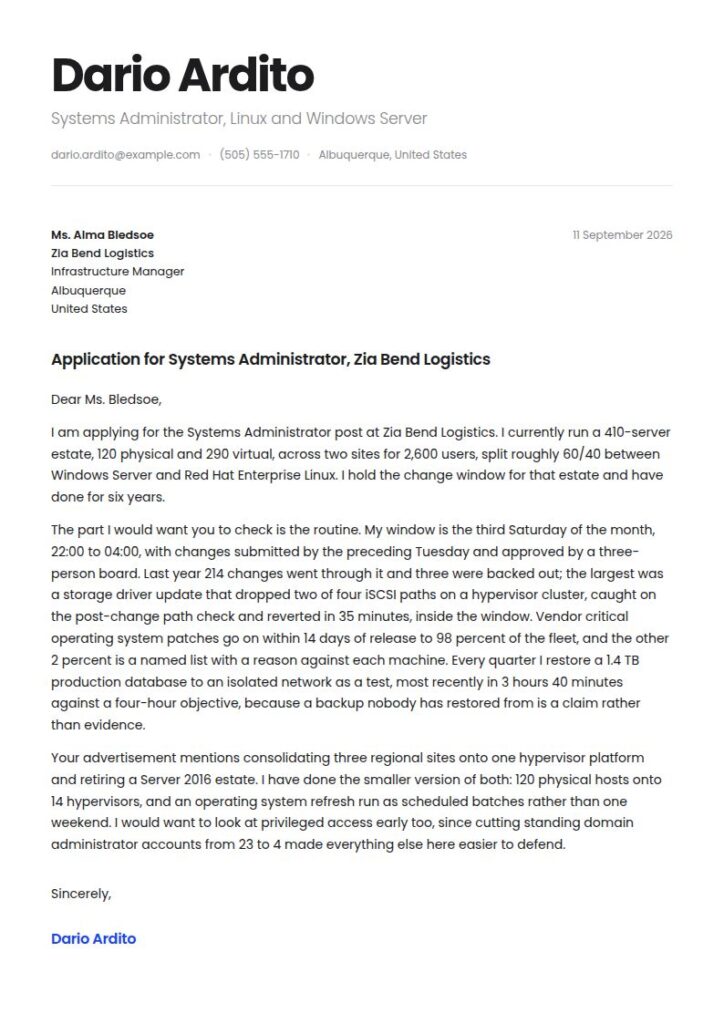
I am applying for the Systems Administrator post at Zia Bend Logistics. I currently run a 410-server estate, 120 physical and 290 virtual, across two sites for 2,600 users, split roughly 60/40 between Windows Server and Red Hat Enterprise Linux. I hold the change window for that estate and have done for six years.
The part I would want you to check is the routine. My window is the third Saturday of the month, 22:00 to 04:00, with changes submitted by the preceding Tuesday and approved by a three-person board. Last year 214 changes went through it and three were backed out; the largest was a storage driver update that dropped two of four iSCSI paths on a hypervisor cluster, caught on the post-change path check and reverted in 35 minutes, inside the window. Vendor critical operating system patches go on within 14 days of release to 98 percent of the fleet, and the other 2 percent is a named list with a reason against each machine. Every quarter I restore a 1.4 TB production database to an isolated network as a test, most recently in 3 hours 40 minutes against a four-hour objective, because a backup nobody has restored from is a claim rather than evidence.
Your advertisement mentions consolidating three regional sites onto one hypervisor platform and retiring a Server 2016 estate. I have done the smaller version of both: 120 physical hosts onto 14 hypervisors, and an operating system refresh run as scheduled batches rather than one weekend. I would want to look at privileged access early too, since cutting standing domain administrator accounts from 23 to 4 made everything else here easier to defend.
I hold the RHCSA (exam EX200) from Red Hat and the Microsoft Windows Server Hybrid Administrator Associate certification, and I am available for a one-in-four on-call rotation and for scheduled weekend windows. Thank you for your time.
Sincerely, Dario Ardito
Openings that work
| Instead of | Use |
|---|---|
| I am an experienced systems administrator with a passion for technology | I run a 410-server estate, 120 physical and 290 virtual, for 2,600 users across two sites |
| I am writing to express my interest in your Systems Administrator vacancy | I am applying for the Systems Administrator post, and I have held a monthly change window for six years |
| I have strong skills in server management and troubleshooting | Vendor critical operating system patches go on within 14 days of release to 98 percent of the fleet |
| I am familiar with backup and disaster recovery | I restore a 1.4 TB production database to an isolated network quarterly; the last test took 3 hours 40 minutes |
What counts as evidence when nothing was measured
Plenty of shops have no availability target, no change board and no reporting. You still have evidence; it is not in a dashboard.
| Kind of evidence | What it looks like in a sentence |
|---|---|
| A routine you created | Introduced a Tuesday evening window where changes had previously gone in whenever asked for |
| A number you can count | 22 servers, 340 endpoints, two sites, one person on call |
| Work you automated | Replaced a manual monthly patch run with 14 Ansible playbooks, cutting it from an evening to 40 minutes |
| A failure handled well | Reverted a driver update in 35 minutes when the post-change check failed, then reapplied it the next month |
| Access you tightened | Reduced standing domain administrator accounts from 23 to 4, with the rest time-boxed against a ticket |
On-call, windows and the shifts you are actually available for
State the on-call pattern you have worked and the one you are available for, in the closing paragraph, before anybody asks. Name the window you hold now, with the day and the hours, because a candidate who already works Saturday nights is a different proposition. Say which operating systems in the first two sentences. Read the advertisement for the project underneath it, and say whether you have run the smaller version.
Do not describe yourself as detail oriented or a strong problem solver; the letter should show that, not assert it. Do not list every product you have touched, which turns a letter into a second skills section. Do not promise unlimited availability you will resent in month three. Do not claim disaster recovery experience if what you have is a backup job that reports success.
Replacement hiring, not growth hiring
Network and computer systems administrators held 323,600 jobs in 2025, and BLS projects a 4 percent decline through 2035, a loss of 13,200 positions, alongside about 13,400 openings a year (BLS Occupational Outlook Handbook, 2025-35 projections).
Ten years of decline removes 13,200 jobs; ten years of openings is roughly 134,000. Almost every vacancy you apply to is a seat somebody has left, and the occupation's median annual wage was $99,130 as of May 2025 (BLS, May 2025).
That shapes the letter. You are being compared to people who already do this work, so specifics carry it and adjectives do nothing. It also explains why the routine matters more than the tools: when an estate is being consolidated rather than grown, the administrator with a documented cadence and a tested recovery is the one it is safe to consolidate with.
Length, format and sending it
One page, four paragraphs, 250 to 400 words. PDF unless the portal says otherwise, named for yourself and the post: dario-ardito-systems-administrator-cover-letter.pdf.
Address a person. Infrastructure managers and IT directors are usually findable, and a letter this specific losing its opening to "Dear Hiring Manager" wastes the one sentence you control completely.
Keep every number identical to your resume. Our system administrator resume example uses the same estate, window and restore figures, and a mismatch between the two documents is the kind of inconsistency this job exists to catch.
Key takeaways
- Open with the estate: servers, sites, users, operating systems.
- Name the window, with the day and the hours you hold it.
- Give the patch cadence as a rule, not a claim.
- Include one backout and how long the revert took.
- Include one restore, with its size, its duration and the objective behind it.
- Say what on-call pattern you are available for, before you are asked.
- Address a named person and keep every figure identical to your resume.
Write your system administrator cover letter in 10 minutes with our AI cover letter builder.
System administrator cover letter questions, answered
How long should a system administrator cover letter be?
One page, four paragraphs, 250 to 400 words. The evidence paragraph can run long, because the window, the cadence, the backout and the restore are the reason the letter exists.
Do I need a cover letter if the application is just a form?
Attach one wherever there is a field. The form collects a skills list from everybody. The letter is the only place you can say what your change process was, what you did when a change failed, and that you have restored from backup rather than only taken one.
What if I have never held root or had a maintenance window?
Say what you did have. Patching machines on a schedule you set yourself is a cadence; a checklist you wrote before touching a server is a change process. Describe the routine you built rather than the title you did not hold.
Should I mention on-call availability in the letter?
Yes, in the closing sentence. On-call rotation and weekend windows are the part of this job people quietly withdraw over, so saying what pattern you have worked and what you can commit to saves everybody a round of interviews. State a real pattern, such as one week in four, rather than "flexible".
How much should I write about certifications?
One line at the end. Name the certification and its exam code where the advertisement uses one, as with the RHCSA, exam EX200, from Red Hat. Certifications get a letter past the first filter; the window, the backout and the restore are what get it read twice.