Ingrid Brandvold Network Engineer, Routing, Switching and Datacenter Omaha, 68132, United States [email protected] · (402) 555-1632
11 September 2026
Ms. Marguerite Okafor Infrastructure and Networks Prairie Union Bank Omaha, United States
Application for Network Engineer, Prairie Union Bank
Dear Ms. Okafor,
I am applying for the Network Engineer post at Prairie Union Bank. I operate eBGP with two internet service providers and a multi-area OSPF core at Platte Valley Health System, and I own the routing policy rather than inheriting it: prefix filtering, local preference and communities for outbound traffic engineering, with a documented failover test twice a year. I hold CCNP Enterprise, earned June 2024 with recertification due June 2027.
The work I would point to is the clinical switching migration. Fourteen buildings moved onto a new switching platform across 22 staged change windows, each with its own rollback plan and a written back-out decision point, and we recorded no unplanned clinical downtime. The part that made it work was not the design. It was the post-change validation script I wrote, which checks BGP and OSPF neighbor state, route counts against a baseline, and reachability to a named endpoint list, so that the decision to roll back was made on evidence within ten minutes rather than on a phone call an hour later.
Your posting mentions a datacenter refresh and a move away from stretched layer 2. I built the EVPN with VXLAN overlay here and moved nine application segments onto it, which retired the last spanning tree dependency between our two datacenter rooms, so I have run the version of that project that has clinical systems on the other end of it. I would also want to bring the software train policy, because a controller and access point train mismatch caused a recurring wireless fault here that took three months to find.
I am in Omaha and can work your change windows, including overnight and weekend work. My credentials are current and dated above. Thank you for your time.
Sincerely, Ingrid Brandvold
Summary
A network engineer cover letter names the routing protocols you have actually operated and in what role, one change or migration you ran end to end with its rollback and validation, and your certification tier with the month you earned it and its recertification date. This guide gives you a full adaptable letter, the tier boundaries interviewers probe first, and the openings that get a technical file read to the end.
Network Engineer cover letter examples by experience level
A network engineer cover letter is a one-page letter that proves depth in one paragraph and honesty about your tier in another.
Network hiring managers read these letters looking for one thing: whether the candidate has operated a design or only worked inside one. That distinction decides the shortlist; however, a reader almost never sees it in a letter built out of protocol acronyms and adjectives.
Guide to a network engineer cover letter
In short, this guide and the corresponding network engineer cover letter example will cover:
- First, how to structure the letter, paragraph by paragraph
- Then, why one change window beats a list of protocols
- How to write your certification tier so the reader trusts it
- What to write when your experience is narrower than the posting
- Finally, the openings that make a reader finish a technical file
How to write a network engineer cover letter
| Paragraph | Its job | Length |
|---|---|---|
| Opening | The post, the protocols you operate, and your current tier | 2 to 3 sentences |
| Evidence | One change or migration, end to end, with the rollback | 4 to 5 sentences |
| Fit | A platform or constraint of theirs, and what you would bring | 3 to 4 sentences |
| Close | Availability, credential dates, thank you | 2 sentences |
Put the recertification date in the letter, not just the resume
Cisco's recertification page states that most Cisco certifications are active for three years from the date you earn them, with entry-level CCST certifications on a five-year cycle. Recertifying takes continuing education credits: 30 at associate level, 40 at specialist, 80 at professional and 120 at expert (Cisco, recertification policy).
So "CCNP Enterprise" on its own is ambiguous, and readers who know the policy read the ambiguity as a lapsed credential.
"CCNP Enterprise, earned June 2024, recertification due June 2027" removes the doubt in nine words and signals that you treat the credential as a cycle you are maintaining. CompTIA's Network+ is worth naming with its exam version, currently N10-009, launched on 20 June 2024 (CompTIA).
A network engineer cover letter example you can adapt
Dear Ms. Okafor,
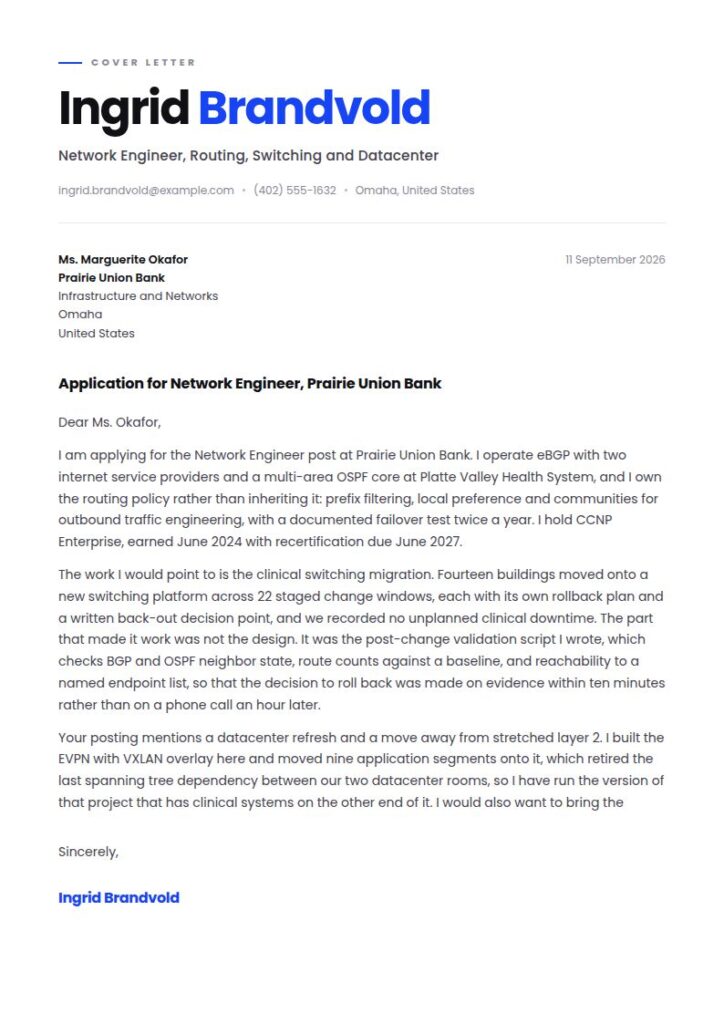
I am applying for the Network Engineer post at Prairie Union Bank. I operate eBGP with two internet service providers and a multi-area OSPF core at Platte Valley Health System, and I own the routing policy rather than inheriting it: prefix filtering, local preference and communities for outbound traffic engineering, with a documented failover test twice a year. I hold CCNP Enterprise, earned June 2024 with recertification due June 2027.
The work I would point to is the clinical switching migration. Fourteen buildings moved onto a new switching platform across 22 staged change windows, each with its own rollback plan and a written back-out decision point, and we recorded no unplanned clinical downtime. The part that made it work was not the design. It was the post-change validation script I wrote, which checks BGP and OSPF neighbor state, route counts against a baseline, and reachability to a named endpoint list, so that the decision to roll back was made on evidence within ten minutes rather than on a phone call an hour later.
Your posting mentions a datacenter refresh and a move away from stretched layer 2. I built the EVPN with VXLAN overlay here and moved nine application segments onto it, which retired the last spanning tree dependency between our two datacenter rooms, so I have run the version of that project that has clinical systems on the other end of it. I would also want to bring the software train policy, because a controller and access point train mismatch caused a recurring wireless fault here that took three months to find.
I am in Omaha and can work your change windows, including overnight and weekend work. My credentials are current and dated above. Thank you for your time.
Sincerely, Ingrid Brandvold
Openings that work
| Instead of | Use |
|---|---|
| I am passionate about networking and new technologies | I operate eBGP with two internet service providers and a multi-area OSPF core, and I own the routing policy |
| I am writing to apply for the Network Engineer position | I am applying for the Network Engineer post, and the move away from stretched layer 2 you describe is the project I have just finished |
| I am Cisco certified with strong routing and switching skills | CCNP Enterprise, earned June 2024, recertification due June 2027 |
| I have experience with network upgrades and migrations | Fourteen buildings across 22 staged change windows, each with a rollback plan, no unplanned clinical downtime |
The paragraph that shows depth
One change, described end to end, does more than a list of every protocol you have seen.
| What to include | What it looks like in a sentence |
|---|---|
| The scope | Fourteen buildings, 22 staged change windows |
| Your role | Wrote the design, ran the windows, owned the back-out decision |
| The risk control | A rollback plan per window with a written decision point |
| The validation | A script checking neighbor state, route counts and endpoint reachability |
| The outcome | No unplanned clinical downtime across the program |
Above all, name the protocol with your role attached. "Operate eBGP and own the policy" and "worked in a BGP environment" describe different candidates, and only the first survives the follow-up question.
One title, two published occupations, $34,920 apart
The Bureau of Labor Statistics publishes no Occupational Outlook Handbook profile under the title "network engineer". The two published occupations it sits between are computer network architects, with a median annual wage of $134,050 in May 2025 and a projected 8% growth from 2025 to 2035, and network and computer systems administrators, with a median of $99,130 and a projected 4% decline over the same decade (BLS Occupational Outlook Handbook, 2025-35 projections and May 2025 data).
The difference between those two medians is $34,920. BLS also records five years or more of related work experience as typical for computer network architects, and none for administrators (BLS, May 2025 data).
Your letter is an argument about which of those two descriptions fits you. Operating inside someone else's design reads as the second. Owning policy, running migrations and producing a design from a requirement reads as the first.
When your experience is narrower than the posting
Be specific about the narrower thing. A well-described OSPF design change, an 802.1X rollout or a wireless fault traced to a timer mismatch shows depth. Say which tier you hold and what you have done, and let the reader connect them. Name one platform or constraint from their posting and say what you have run that is closest to it. Offer the change window availability the job actually needs.
Do not list protocols you have only studied; the first technical question finds them. Do not describe configuration work inside an existing design as design work. Do not write a credential without its date. Do not put a hostname, a public IP range or a configuration excerpt in a letter or an attachment. Do not send a letter with no employer name in it.
Length, format and sending it
One page, four paragraphs, 250 to 400 words. PDF unless the portal says otherwise, named for yourself and the post: ingrid-brandvold-network-engineer-cover-letter.pdf.
Also, address a person where you can find one. In fact, a company's own site often lists infrastructure leadership, and a bank, hospital or service provider posting usually names a team.
Use the same protocols, dates and numbers as your resume so the two agree. Our network engineer resume example is built on the figures used here, and the free ATS checker will tell you whether the pair parses cleanly.
Key takeaways
- First, name the protocols with your role in each: operated, changed or designed.
- Then give your certification tier with the month earned and the recertification date.
- Describe one change end to end, including the rollback and the validation.
- In addition, name the overlay you run, or say plainly that you run none.
- Also, match your claimed tier to your described work; interviewers probe that seam.
- Finally, name one platform or constraint from their posting and what you have run closest to it.
- Offer the change window availability the role actually requires.
Build your network engineer resume in 15 minutes with our AI resume builder.
Network engineer cover letter questions, answered
How long should a network engineer cover letter be?
One page, four paragraphs, 250 to 400 words. A technical reader is looking for two things, a protocol you own and a change you ran, and both fit comfortably in that length.
Should I list all my certifications in the letter?
No. Name the highest current tier with the month earned and the recertification date, and leave the rest to the resume. Cisco states that most of its certifications are active for three years from the date earned (Cisco, recertification policy), so a dated line is worth more than a long undated list.
What do I write if I have never run BGP?
Write what you do run, precisely. An OSPF design change you made, an overlay you built, an 802.1X rollout or a wireless fault you traced with numbers all demonstrate depth. Precision about a narrower scope reads better than a broad list you cannot defend.
Is network engineer a separate occupation in the official data?
No. The Bureau of Labor Statistics publishes no Handbook profile under that title. The nearest published occupations are computer network architects, at a median of $134,050, and network and computer systems administrators, at $99,130, both May 2025 (BLS).
How do I write about on-call and change windows?
Say what you have carried and what you can offer. Overnight and weekend change windows are the normal shape of this work in hospitals, banks and service providers, and a candidate who states their availability plainly is answering a scheduling problem the hiring manager already has.