Lukas Brennan Senior Front-End Developer Portland, 97214, United States [email protected] · (503) 555-1018
17 September 2026
Mr. Marcus Okafor Front-End Platform Fenwold Software Portland, United States
Application for Senior Front-End Developer, Fenwold Software
Dear Mr. Okafor,
I am applying for the Senior Front-End Developer role at Fenwold Software. I own a 140-component design system at Astbury Retail Group, consumed by six product teams across 31 screens; I wrote 41 of those components myself and the contributing guide the rest are reviewed against.
The piece of work that best shows how I operate is the React 17 to 18 migration. It touched all 140 components and it took seven weeks with no production incident, which was down to the order it was done in rather than any cleverness. Before upgrading anything, I ran the existing test suite under StrictMode, which surfaced the double-invoked effects and one third-party carousel that mutated the DOM during render. Those were the only two real breakages, and both were fixed before the version bump landed. The consuming teams upgraded on their own schedule over the following month, with a compatibility shim I removed once the last one was through.
Your public checkout runs on a shared component set with a visible version number in the page source, which suggests a platform team and a real contribution model rather than six copies of the same button. That is the environment I work best in. I set the payload budget at Astbury, 180 KB gzipped for an initial route, enforced by a failing CI check owned by the platform team rather than by whichever team wants the exception, and I would want to do the same here.
My support matrix is Chrome and Edge current and current-1, Safari on iOS 16 and 17 and Firefox ESR, tested on four physical devices plus a hosted grid, and I would want to agree yours in the first week. I can start with four weeks of notice. Thank you for reading.
Sincerely, Lukas Brennan
Summary
A front-end developer cover letter says what you authored rather than consumed, names the teams that ship against it, and gives one constraint you enforced with its number and its enforcement mechanism. This guide gives you a full adaptable letter, the openings that work, and how the letter changes when the role sits on a product team rather than a platform team.
Front-End Developer cover letter examples by experience level
A front-end developer cover letter is a one-page letter making a single claim and then evidencing it: you wrote shared code other people shipped with, and you held a constraint while doing it.
Nearly every letter for this title reads the same way: enthusiastic about user experience, comfortable with React, attentive to detail. None of that can be checked, and a hiring manager reading fifty of them is looking for the two or three that can.
Guide to a front-end developer cover letter
This guide and the corresponding front-end developer cover letter example will cover:
- How to structure the letter, paragraph by paragraph
- Why authored and consumed have to be separate words
- The one constraint to name, and how to write it
- How the letter changes for a platform team and a product team
- The openings that work, and the ones that lose the reader
How to write a front-end developer cover letter
| Paragraph | Its job | Length |
|---|---|---|
| Opening | The role, the surface you own, one reuse number | 2 to 3 lines |
| Evidence | One migration or one boundary, described by what broke | 5 to 6 lines |
| Fit | What their front end looks like from outside, and what you would take on | 3 to 4 lines |
| Close | The constraint you held, availability, thank you | 2 to 3 lines |
Name the thing other people had to use
The strongest sentence available to a front-end developer is one where somebody else is the subject. Not "I built a component library", but "four product teams ship against components I wrote, and two of them have never had to ask me a question."
That sentence does three things at once. It establishes that your code survived being used by strangers, that you documented it well enough for that to work, and that you were trusted with a shared surface at all.
If you have never owned shared code, the equivalent is a constraint: a payload budget you held, a support matrix you tested against, a migration you ran. Any of the three beats a list of frameworks.
A front-end developer cover letter example you can adapt
Dear Mr. Okafor,
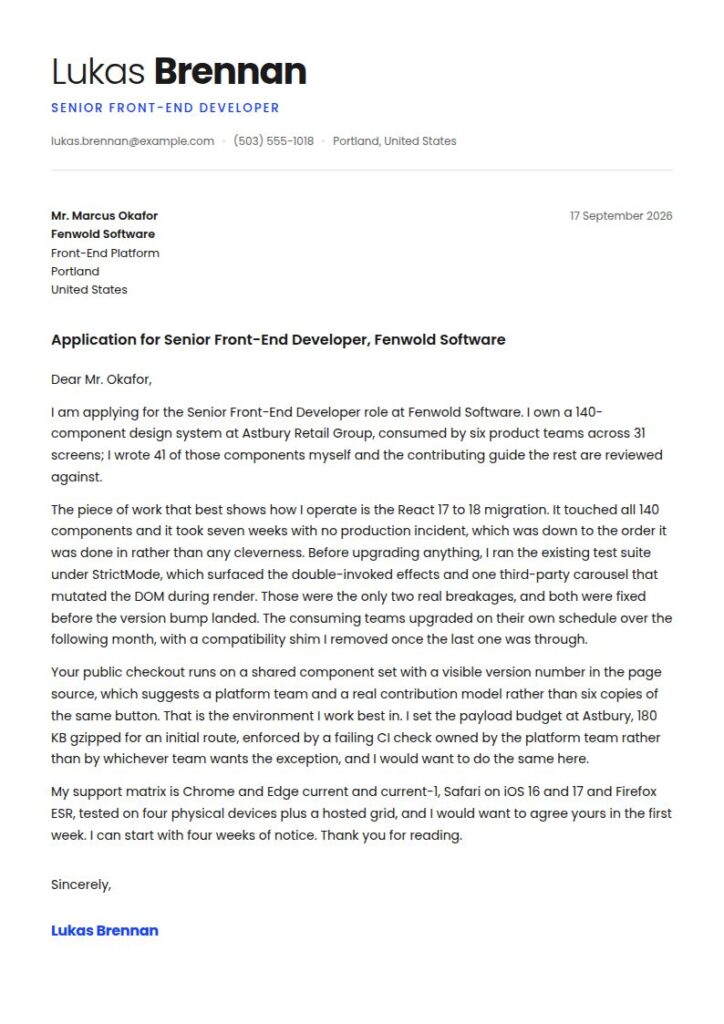
I am applying for the Senior Front-End Developer role at Fenwold Software. I own a 140-component design system at Astbury Retail Group, consumed by six product teams across 31 screens; I wrote 41 of those components myself and the contributing guide the rest are reviewed against.
The piece of work that best shows how I operate is the React 17 to 18 migration. It touched all 140 components and it took seven weeks with no production incident, which was down to the order it was done in rather than any cleverness. Before upgrading anything, I ran the existing test suite under StrictMode, which surfaced the double-invoked effects and one third-party carousel that mutated the DOM during render. Those were the only two real breakages, and both were fixed before the version bump landed. The consuming teams upgraded on their own schedule over the following month, with a compatibility shim I removed once the last one was through.
Your public checkout runs on a shared component set with a visible version number in the page source, which suggests a platform team and a real contribution model rather than six copies of the same button. That is the environment I work best in. I set the payload budget at Astbury, 180 KB gzipped for an initial route, enforced by a failing CI check owned by the platform team rather than by whichever team wants the exception, and I would want to do the same here.
My support matrix is Chrome and Edge current and current-1, Safari on iOS 16 and 17 and Firefox ESR, tested on four physical devices plus a hosted grid, and I would want to agree yours in the first week. I can start with four weeks of notice. Thank you for reading.
Sincerely, Lukas Brennan
Openings that work
| Instead of | Use |
|---|---|
| I am a front-end developer with a passion for user experience | I own a 140-component design system consumed by six product teams across 31 screens |
| I have extensive experience building responsive web applications | Four teams ship against components I wrote, and two never have to ask me a question |
| I am detail-oriented and committed to writing clean code | I set the payload budget at 180 KB gzipped, enforced by a failing CI check |
| I would love the opportunity to join your talented team | Your checkout runs on a shared component set with a version number in the page source |
Platform team or product team, and why the letter changes
Front-end roles split into two kinds of work, and one letter cannot serve both.
| The role is | The letter leads with | What to leave out |
|---|---|---|
| A platform or design system team | Authored components, reuse counts, the contribution model, the budget and who enforces it | Feature delivery counts, small next to shared-surface work |
| A product feature team | What changed for users, the state boundary you drew, the defect class a decision removed | Design system governance, which reads as wanting to rebuild their library |
| A single front-end hire at a small company | Breadth stated honestly, the migration you ran alone, what you would do first | Team-scale numbers you cannot produce, since there is no team |
Read the posting for which one it is. A description mentioning consumers, contributors or a version number is a platform role. One mentioning funnels, conversion or a product area is a feature role.
Two occupations, and the openings differ by nearly nine to one
The Bureau of Labor Statistics publishes no Occupational Outlook Handbook profile under the title front-end developer. The work is counted inside two published occupations, and they are not the same size: web developers and digital designers held 220,100 jobs in 2025 with about 13,600 openings projected a year, against 1,905,400 jobs and about 106,100 annual openings for software developers, quality assurance analysts and testers (BLS Occupational Outlook Handbook, 2025-35 projections).
The pay ladder across the two runs $92,650 for web developers, $104,000 for web and digital interface designers and $135,980 for software developers, all as of May 2025 (BLS, May 2025). The step between the first two is $11,350. The step to the third is $31,980.
A letter evidencing shared code, state architecture and an enforced constraint is legible to employers hiring in the larger and better paid occupation. One evidencing page production is legible to the smaller. That is the reason to spend your paragraphs on the component contract rather than a framework list.
Length, format and sending it
One page, four paragraphs, 300 to 400 words. PDF, named for yourself and the role: lukas-brennan-front-end-developer-cover-letter.pdf.
Address a person, and say one accurate thing about their front end that you could only know by looking: a version number in the page source, a documented component set, a public changelog. One observation of that kind cannot be reused in the next letter, which is what makes it count. Keep every number identical to your resume. Our front-end developer resume example uses the same figures.
Write authored or consumed, in those words. Give a reuse count with the teams named by number. Describe a migration by what broke and how you found it. Name the constraint you held and who enforced it. Say one thing about their front end you learned by looking. Match every figure to the resume.
Do not open with enthusiasm for user experience. Do not list frameworks in a letter; the resume has them. Do not claim to have built a design system you only used. Do not promise to rebuild their component library in the first paragraph. Do not send a letter with no company-specific sentence in it.
Key takeaways
- Lead with the shared surface you own and one reuse number.
- Use the words authored and consumed, kept separate.
- Give the migration by what broke, not by the version you moved to.
- Name one constraint with its number and its enforcement mechanism.
- Say one thing about their front end that required looking at it.
- Match the letter to the kind of team: platform or product.
- One page, four paragraphs, and the same numbers as the resume.
Write your front-end developer cover letter in 10 minutes with our AI cover letter builder.
Front-end developer cover letter questions, answered
How long should a front-end developer cover letter be?
One page, four paragraphs, 300 to 400 words. The middle paragraph carrying the migration or the boundary is the longest, and the paragraph about your qualities should not exist.
What if I have never authored a shared component?
Say consumed, and lead with a constraint instead: a payload figure you measured and moved, a support matrix you tested, a framework upgrade you ran on your own project. Any of those is checkable, which is more than most letters manage.
Should I link to work in the letter?
Name what you worked on and what your part was, in words, and let the reader ask. A letter that reads as a list of links usually has nothing to say between them, and a paragraph about what broke during a migration persuades more than anything found by clicking.
Do I need a cover letter for a front-end role at all?
Where there is a field for it, yes. The resume compresses shared-code work into bullets that look like everyone else's. A letter is the only place to say that four teams depend on your components and two of them never ask you anything.
How do I write this letter with agency experience only?
Agency work is a strength written as breadth with evidence: eleven client projects, four from an empty repository, a shared kit you contributed to, and a browser matrix that had to satisfy clients rather than an internal standard. Avoid a client list with no account of what you owned on each.