Junior Motion Designer Astrid Kowalczyk
Junior Motion Designer
[email protected] | (612) 555-1590 | Minneapolis, United States
Profile
Junior motion designer with two years in a Minneapolis studio, producing brand and social motion in After Effects 2025 and Cinema 4D 2025. Turned around roughly 45 cutdowns a month across six campaigns on a 48-hour standard turnaround, and built a 14-item lower-third and title kit that the studio's two editors now use without a designer. Comfortable working from a brand's existing motion rules, and writing down the ones that were never written down.
Work Experience
08/2024 - Present, Junior Motion Designer, Tessellate Studio, Minneapolis, United States
- Produce brand and social motion in After Effects 2025 and Cinema 4D 2025: roughly 45 cutdowns a month across six campaigns, on a 48-hour standard turnaround.
- Built a 14-item lower-third and title kit for a broadcast client; the studio's two editors now produce variants from it without a designer.
- Wrote the one-page usage guide that goes out with the kit, including timing and type rules the client had never written down.
- Storyboard and animatic work on eight campaign pitches, three of which were commissioned.
06/2023 - 08/2024, Design Intern, Tessellate Studio, Minneapolis, United States
- Prepared artwork, built simple animated variants from existing templates and maintained the studio asset library.
- Set up the naming convention the studio still uses for campaign template files.
Education
08/2019 - 05/2023, Bachelor of Fine Arts, Graphic Design, Minneapolis College of Art and Design, Minneapolis, United States
Senior project: a six-template motion kit and written usage guide for a student radio station, still in use by its producers.
Skills
Brand and campaign motion, 75
Typography in motion, 75
After Effects 2025, 85
Cinema 4D 2025, 60
Figma, 75
Template kit design, 65
Written usage guides, 70
Storyboarding and animatics, 70
Languages
English, native
Polish, native
German, beginner
Certificates
04/2024, Adobe Certified Professional, After Effects, Adobe
Summary
A motion graphics artist resume is a one to two page document that shows repeatability rather than one hero piece. It names the template kit or brand motion system you built, who used it after you, the volume you turned around in a cycle and the turnaround you held. This guide gives you three adaptable versions and current Bureau of Labor Statistics pay and outlook.
Motion Graphics Artist resume examples by experience level
In short, a motion graphics artist resume is a one to two page document that has to answer a question most applicants never address: can this person make work that keeps happening without them.
Indeed, motion graphics is rarely one hero piece. Instead, it is a series, a package, a launch, a quarter of social cutdowns, a product tour remade every time the interface changes. The people hiring know that, and therefore they are not buying an animation. In other words, they are buying throughput and a system: something built well enough that a producer, an editor or a marketer can make the next forty variants without booking you again. A resume that shows only finished pieces describes a freelancer's afternoon; one that shows a system, in contrast, describes a hire.
Resume guide for a motion graphics artist resume
Specifically, this guide and the corresponding motion graphics artist resume example will cover:
- First of all, how to write a motion graphics artist resume, section by section
- Why a template kit is worth more on the page than a beautiful one-off
- Then, three adaptable summaries: junior motion designer, motion graphics artist and motion systems lead
- Also, how to put volume, turnaround and handoff on a resume without sounding like a factory
- Finally, what the job market looks like and which industry pays this work best
How to write a motion graphics artist resume
Overall, six sections: contact header, summary, the systems block, experience, skills with named tools, and education. Generally, one page for your first few years, two once you have built systems that outlived a job. The systems block sits high because it is the part that is hard to fake and hard to find in the rest of the stack.
| Section | What it is answering | Where it goes |
|---|---|---|
| Summary | What kind of motion work, at what volume? | Under the header |
| Systems block | What did they build that other people kept using? | Directly under the summary |
| Experience | Who employed them, and what shipped? | Reverse chronological, with volume |
| Tools | Can they open our project files on Monday? | Named, with the job attached |
| Education | Where did the design fundamentals come from? | Last, unless you graduated this year |
Count the volume you actually turned around, in a named cycle
Almost nobody does this, and it is the fastest way to separate your resume from the pile.
Pick a cycle matching how your work arrived: a week, a month, a sprint, a quarter, a season. Then count what left your desk in it. "Roughly 45 social cutdowns a month across six campaigns" is a sentence a hiring manager can plan against. A portfolio cannot tell them that, because it shows the best work rather than the normal amount of it.
Pair the volume with the turnaround you held: 48 hours on standard variants, five working days on a new build. Volume without turnaround reads as backlog. Together they read as a working system.
Run the finished file through the ATS resume checker before you send it. In-house teams and agencies both push applications into a tracking system first, and a resume built as a designed graphic arrives empty.
Choosing the best resume format for a motion graphics artist resume
Reverse chronological, single column, plain type. In other words, one page early, two once the systems block has enough in it to need room.
This is the field where people most want to design their own resume; however, it is worth resisting. The portfolio carries the craft argument; the resume, on the other hand, is read by a design lead, a producer or a recruiter checking scope, volume and tools against a role.
Functional formats, meanwhile, fail for a different reason. In motion work the interesting story is progression: one-off pieces, then a series, then a kit, then a system other teams used. Reverse chronological makes that arc visible.
Include your contact information
| ✅ Right | ❌ Wrong |
|---|---|
| Astrid Kowalczyk | Astrid Kowalczyk |
| Motion Graphics Artist, Brand Systems and Product Motion | Creative motion designer and visual storyteller |
| Portfolio: astridkowalczyk.example.com | Portfolio link in my email signature |
| (612) 555-1590, [email protected], Minneapolis, MN | (612) 555-1590, [email protected] |
The title line, therefore, does the most work there. It tells a reader which of the several jobs called motion design you actually do, and those jobs are hired by different teams with different budgets. For example, broadcast packaging, brand and campaign motion, product and interface motion, social and performance work, and explainer animation all look similar in a portfolio and feel completely different in a week of work.
Make use of a summary
In short, four lines: the kind of motion work, the volume in a named cycle, one system you built that other people used, and your tools.
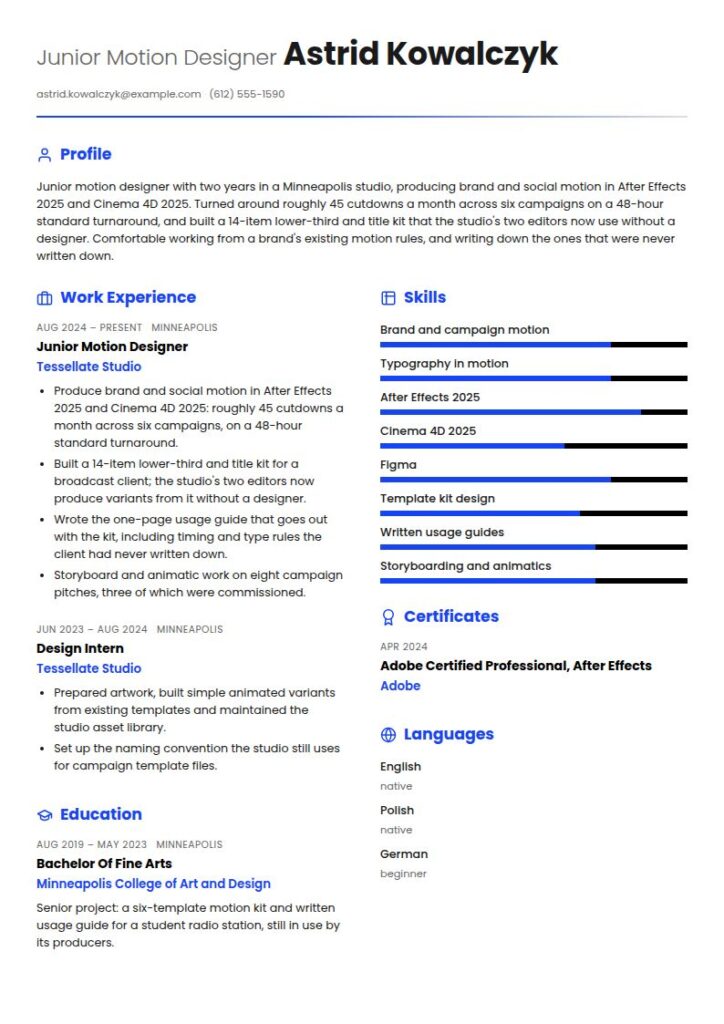
Junior motion designer with two years in a Minneapolis studio, producing brand and social motion in After Effects 2025 and Cinema 4D 2025. Turned around roughly 45 cutdowns a month across six campaigns on a 48-hour standard turnaround, and built a 14-item lower-third and title kit that the studio's two editors now use without a designer. Comfortable working from a brand's existing motion rules, and writing down the ones that were never written down.
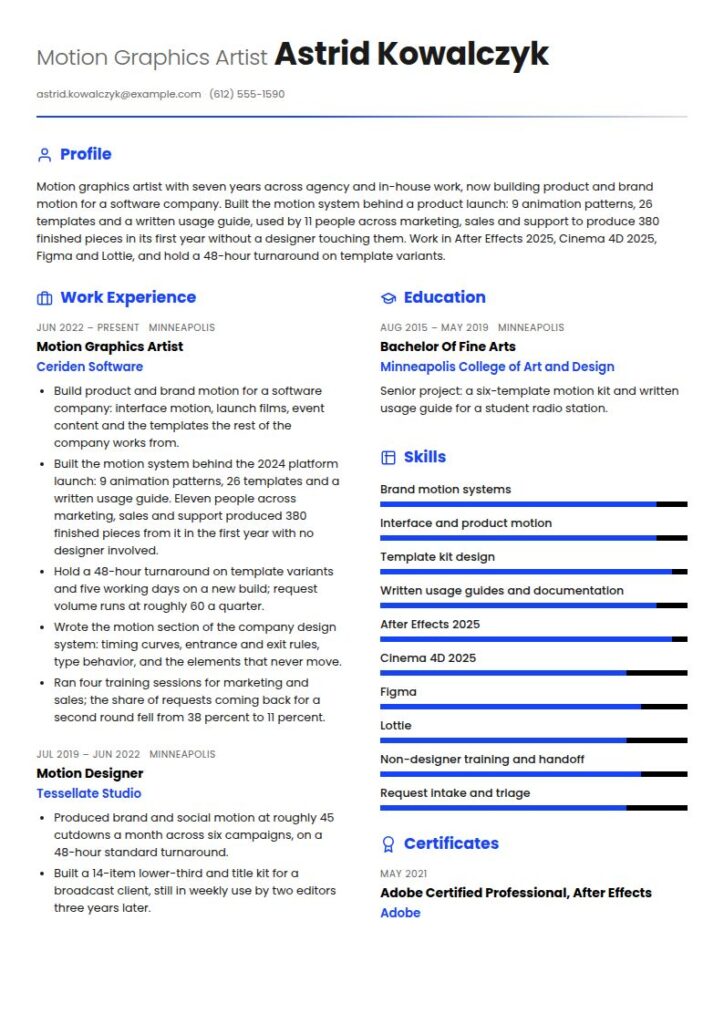
Motion graphics artist with seven years across agency and in-house work, now building product and brand motion for a software company. Built the motion system behind a product launch: 9 animation patterns, 26 templates and a written usage guide, used by 11 people across marketing, sales and support to produce 380 finished pieces in its first year without a designer touching them. Work in After Effects 2025, Cinema 4D 2025, Figma and Lottie, and hold a 48-hour turnaround on template variants.
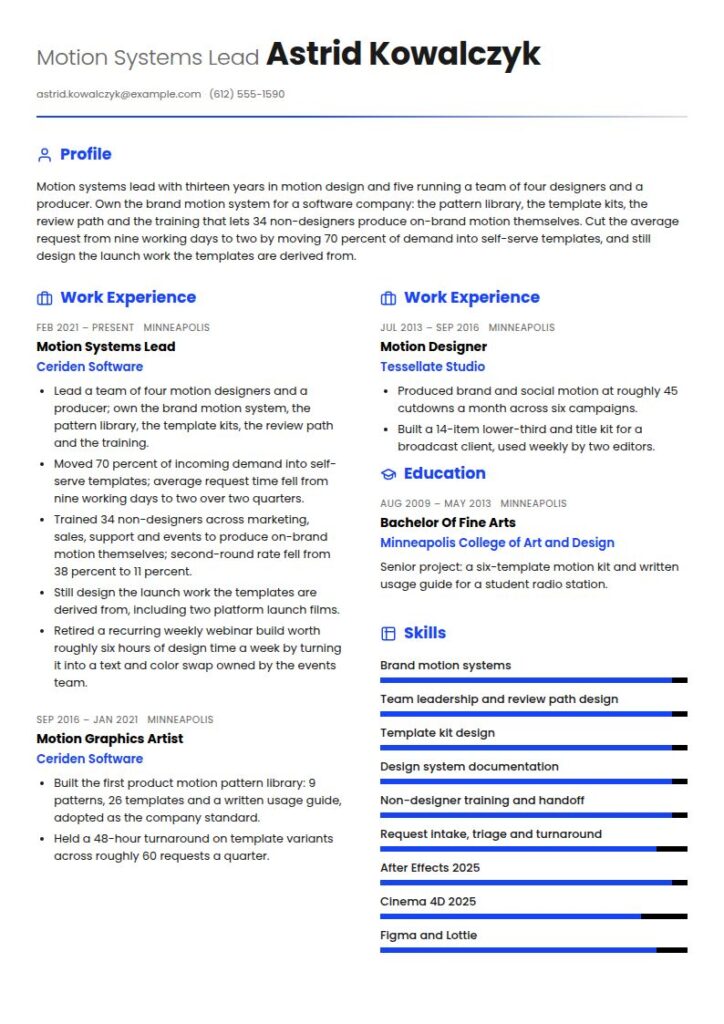
Motion systems lead with thirteen years in motion design and five running a team of four designers and a producer. Own the brand motion system for a software company: the pattern library, the template kits, the review path and the training that lets 34 non-designers produce on-brand motion themselves. Cut the average request from nine working days to two by moving 70 percent of demand into self-serve templates, and still design the launch work the templates are derived from.
Right vs wrong: the same motion graphics artist summary, twice
| ✅ Right | ❌ Wrong |
|---|---|
| Motion graphics artist with seven years across agency and in-house work. | Creative motion designer with a passion for beautiful animation. |
| Built the motion system behind a product launch: 9 animation patterns, 26 templates and a written usage guide. | Created engaging motion graphics for a variety of brands. |
| Used by 11 people across marketing, sales and support to produce 380 finished pieces in its first year. | Collaborated closely with cross-functional stakeholders. |
| Hold a 48-hour turnaround on template variants. | Consistently delivered high-quality work on time. |
The right column, in contrast, describes a capacity that a team can plan around. The left column describes a taste, which the portfolio will either confirm or not.
Outline your motion design experience
Employer, city, title, dates, then three to five bullets. Each one carries either a volume, a turnaround or a system, and ideally two of the three.
| Instead of | Use |
|---|---|
| Created motion graphics for marketing campaigns | Turned around roughly 45 social cutdowns a month across six campaigns on a 48-hour standard turnaround |
| Built animations for the product team | Built 9 interface animation patterns adopted as the product's motion standard, documented in the design system |
| Made templates for the team | Built 26 templates that 11 people across marketing, sales and support used to produce 380 finished pieces in year one |
| Worked on brand identity in motion | Wrote the brand motion guide: timing curves, entrance and exit rules, type behavior, and what never moves |
| Reduced turnaround times | Moved 70 percent of incoming requests to self-serve templates; average request time fell from nine working days to two |
| Trained team members | Ran four training sessions and wrote a one-page guide; 34 non-designers now produce their own on-brand variants |
Motion Graphics Artist, Ceriden Software, Minneapolis, MN, June 2022 to Present
Build product and brand motion for a software company: interface motion, launch films, event content and the templates the rest of the company works from.
Built the motion system behind the 2024 platform launch: 9 animation patterns, 26 templates and a written usage guide. Eleven people across marketing, sales and support produced 380 finished pieces from it in the first year with no designer involved.
Hold a 48-hour turnaround on template variants and five working days on a new build; request volume runs at roughly 60 a quarter.
Wrote the motion section of the company design system, including timing curves, entrance and exit rules, type behavior and the list of elements that never move.
Ran four training sessions for marketing and sales; the share of requests that come back for a second round fell from 38 percent to 11 percent.
Show the system, not the one-off: template kits, volume and handoff
This is the section that separates a motion graphics artist from a portfolio of nice pieces; even so, it is almost always missing. Six things carry it.
The kit or system you built, itemized. Not "created templates", but what was in it and how big it was: the number of patterns, the number of templates, the components they share, the type and color rules they inherit, and the written guide saying when to use which. A kit is countable, so count it. "9 animation patterns, 26 templates and a written usage guide" is a specification of your judgment as much as your output, because someone had to decide nine was the right number.
Who used it after you, and whether they needed you. This matters most and nobody puts it on a resume. Say how many people used the kit, which teams they were on, and what share of the output came out of it unaided. "Eleven people across marketing, sales and support produced 380 finished pieces in the first year with no designer involved" is a claim about your handoff, not your animation. A kit only its author can operate is a portfolio piece with extra steps.
Volume and turnaround for motion graphics work
The volume per cycle. Pick the cycle your work arrives in and count what leaves: cutdowns a month, episode packages a week, variants a sprint, requests a quarter. Say what the mix was, because forty variants of one build is a different job from forty new builds. Hiring managers want to know whether their queue will move if they hire you, and volume in a named cycle is the only sentence that answers that directly.
The turnaround you held, and what it was before. Turnaround is the number that makes volume believable. Give it by request type: 48 hours on a standard variant, five working days on a new build, two weeks on a launch package. If you changed it, give the before and the after with the period: "average request time fell from nine working days to two over two quarters." That is a throughput result, and throughput results are rare enough on motion resumes to be remembered.
Handoffs and what your system replaced
The handoff that let a non-designer produce a variant. Describe the mechanism, not the intention. Editable text and color fields exposed so an editor can retitle a card inside their own editing software without opening a motion project. A naming convention that says which template to reach for. A one-page guide with three examples and two rules. A short training session with a recording. Then give the evidence it worked: the second-round rate, the requests that stopped arriving, the people who now do it themselves.
What it replaced, and what stopped happening. Every good system removes work; say which work. Requests that no longer reach the design queue, a freelance line no longer needed, a recurring weekly build that became a five-minute swap, a review round that disappeared because the rules were written down. This is the part a hiring manager repeats when arguing for the hire.
Brand motion system, current employer: 9 animation patterns, 26 templates, shared timing curves and type behavior, and a written usage guide. Adopted as the company standard in the product design system.
Reach: 11 people across marketing, sales and support produced 380 finished pieces in year one with no designer involved. Second-round rate fell from 38 percent to 11 percent after training.
Volume: roughly 60 requests a quarter through the design queue, plus the self-serve output above. Mix is about 70 percent variants and 30 percent new builds.
Turnaround: 48 hours on a standard variant, five working days on a new build, two weeks on a launch package. Average request time across all types fell from nine working days to two over two quarters.
Earlier kit, agency: 14-item lower-third and title kit for a broadcast client, still in weekly use by two editors three years later.
What stopped: the recurring weekly webinar build, roughly six hours of design time a week, became a five-minute text and color swap done by the events team.
Build a snapshot of your key skills
Then, ten to fourteen entries in four groups: motion craft, tools by name, systems and handoff, and adjacent skills.
Motion craft: Brand motion systems, Interface and product motion, Typography in motion, Storyboarding and animatics, Sound and timing, Data and chart animation
Tools: After Effects 2025, Cinema 4D 2025, Figma, Lottie, Illustrator, Premiere Pro, Expressions and simple scripting in After Effects
Systems and handoff: Template kit design, Naming conventions, Written usage guides, Non-designer training, Design system documentation, Request intake and triage
Adjacent: Light 3D modeling and lookdev, Storyframe illustration, Editing short-form, Accessibility considerations for motion, including reduced-motion alternatives
Mark limited use as limited. For instance, a motion designer who writes "Cinema 4D, simple product renders only" is trusted on the rest of the list.
List your education and certifications
Degree, school, year, then training specific to the tools or to design systems work. This sits near the bottom because motion hiring runs on portfolio and on what you have built.
Bachelor of Fine Arts, Graphic Design, Minneapolis College of Art and Design, Minneapolis, MN, 2019
Training: Adobe Certified Professional, After Effects, Adobe, 2021. Design systems and documentation, professional development course, 2024.
Note: the Bureau of Labor Statistics gives a bachelor's degree as the typical entry-level education for special effects artists and animators, the occupational category that covers motion graphics work (BLS Occupational Outlook Handbook, May 2025).
Choose the right layout and design
Single column, plain type at 10 to 12 point, clear headings, no photograph, no animated anything. Save as PDF named for yourself and the role: astrid-kowalczyk-motion-graphics-artist-2026.pdf, and keep the portfolio link plain text in the header.
Itemize the kits you built: patterns, templates, guide. Say how many people used them and whether they needed you. Give volume in a named cycle and turnaround by request type. Say what stopped happening because the system existed. Name your tools with the job attached. Keep the portfolio link plain and current.
Do not describe a template kit as "various templates". Do not give volume with no cycle attached, since "hundreds of assets" means nothing. Do not claim a system nobody used. Do not design the resume itself. Do not list every tool you have opened. Do not hide the handoff work, which is the part that is hardest to hire for.
Motion graphics artist job market and outlook
In fact, motion graphics work is counted by BLS within special effects artists and animators: a small occupation with flat employment and an unusually wide pay range.
| Measure | Value |
|---|---|
| Special effects artists and animators, jobs in 2025 | 51,900 |
| Projected change, 2025-35 | 0% (little or no change), -100 |
| Projected annual openings | about 4,200 |
| Typical entry-level education | Bachelor's degree |
| Median annual wage, May 2025 | $102,030 |
Source: U.S. Bureau of Labor Statistics, Occupational Outlook Handbook, special effects artists and animators, as well as May 2025 wages and 2025-35 projections.
The same work pays $41,380 more in software than in advertising
The May 2025 median for special effects artists and animators in software publishers was $127,670. In advertising, public relations and related services it was $86,290 (BLS Occupational Outlook Handbook, May 2025). That is a gap of $41,380 a year in the same occupation.
The two industries in between were computer systems design at $103,390 and motion picture and video industries at $100,990, against an occupation-wide median of $102,030 (BLS, May 2025).
Motion graphics artists sit across all four, and the skills transfer more easily than the pay does. Software and product teams pay more not because the animation is harder but because the work is expected to be systematic: documented, reused across a surface, maintained by people who are not designers. That is exactly the work in the systems block above, and it is why itemizing your kits, your reach and your turnaround is worth more than another hero piece.
Where the work sits, and also what it pays:
| Industry | Share of employment, 2025 | Median annual wage, May 2025 |
|---|---|---|
| Self-employed workers | 63% | not separately published |
| Motion picture and video industries | 10% | $100,990 |
| Software publishers | 7% | $127,670 |
| Computer systems design and related services | 4% | $103,390 |
| Advertising, public relations and related services | 2% | $86,290 |
Source: U.S. Bureau of Labor Statistics, Occupational Outlook Handbook, May 2025.
What salary you can expect as a motion graphics artist
To begin with, the median annual wage for special effects artists and animators was $102,030 a year, or $49.06 an hour, as of May 2025. The lowest 10 percent earned less than $58,600 and the highest 10 percent more than $177,110 (BLS, May 2025).
However, industry is the largest single lever on that number. Software publishers paid a median of $127,670 in May 2025 against $86,290 in advertising and public relations (BLS, May 2025), and a motion designer who moves from an agency to an in-house product team is usually moving along that gradient rather than up a ladder. The work that makes the move possible, above all, is systems work: documented patterns, template kits, a handoff that survives you.
Moreover, the second lever is the shape of your evidence. Agencies and studios hire from portfolios; in-house product and brand teams hire from portfolios and then ask about scale, maintenance and who else can use what you made. A resume that already answers the second question makes you eligible for the better-paid version of the same job before the interview starts.
Key takeaways for a motion graphics artist resume
- Above all, show a system, not a single beautiful piece; the system is what gets hired.
- Likewise, itemize your kits: patterns, templates, shared rules, written guide.
- Say how many people used them and whether they could work without you.
- Also give volume in a named cycle, and the mix of variants to new builds.
- Give turnaround by request type, with a before and after if you improved it.
- Describe the handoff mechanism and what stopped happening because of it.
- Finally, name tools with the job attached, and keep the portfolio link plain text.
Build your motion graphics artist resume in 15 minutes with our AI resume builder.
Related information technology resume examples
- 3D animator resume
- Film and video editor resume
- Front end developer resume
- Web developer resume
- Web analyst resume
- Full stack developer resume
- Software developer resume
- Computer science resume
- Technical project manager resume
- IT project manager resume
- IT specialist resume
- IT resume
Pair it with a matching motion graphics artist cover letter.
Motion graphics artist resume questions, answered
How long should a motion graphics artist resume be?
One page for your first few years, two once the systems block genuinely needs the room. The portfolio carries the craft argument, so the resume's job is scope, volume and what you built that other people kept using.
What goes in the systems block?
Six things: the kit itemized, who used it after you, the volume per cycle, the turnaround by request type, the handoff mechanism that let a non-designer make a variant, and what stopped happening once the system existed.
Is a template kit really worth more than a hero piece?
On the resume, yes. The hero piece belongs in the portfolio, where it will be seen properly. The resume is where you answer the question the portfolio cannot: whether the work scales past you.
Which industry pays motion graphics work best?
Software publishers, by a wide margin: a May 2025 median of $127,670 for special effects artists and animators, against $103,390 in computer systems design, $100,990 in motion picture and video industries and $86,290 in advertising and public relations (BLS Occupational Outlook Handbook, May 2025).
What do I write with no professional experience?
Build a small system and document it: a six-template kit for a student organization, a social package for a nonprofit with a written usage guide, an episode package a podcast's producers now use themselves. Give it the same treatment: what was in it, who used it, how long a variant took. That beats five unconnected pieces.
Should I list every tool I have used?
No. List what you work in, with the job attached, and mark limited use as limited. After Effects, Cinema 4D, Figma and Lottie cover most of what a hiring team is scanning for; a longer list mostly invites a question you gain nothing from answering.