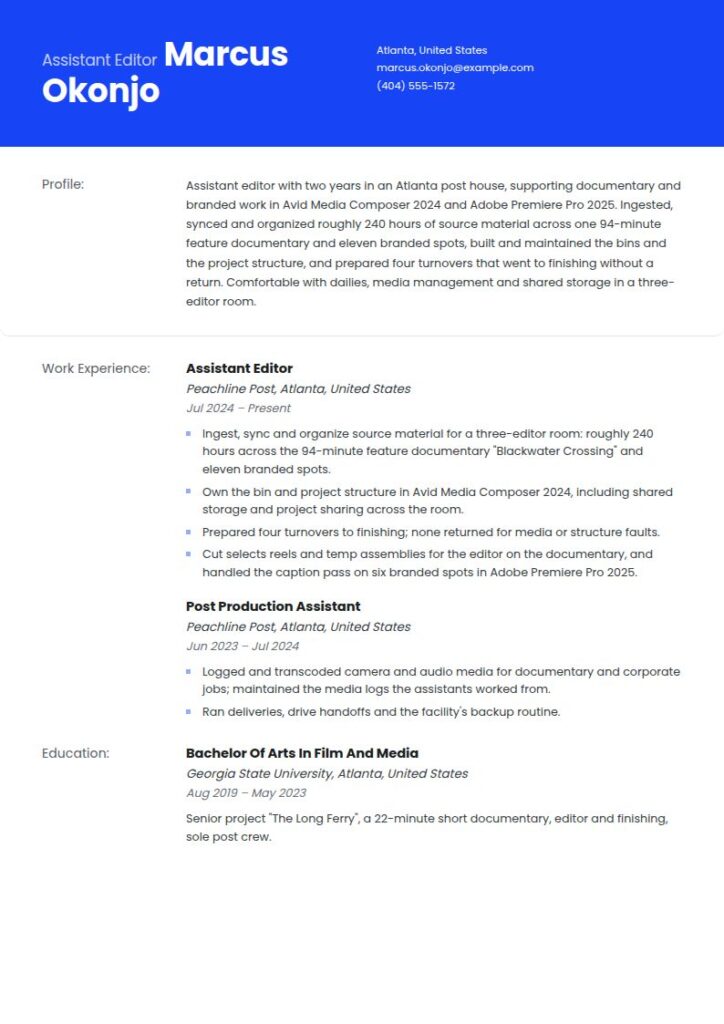
Assistant Editor Marcus Okonjo
Assistant Editor
[email protected] | (404) 555-1572 | Atlanta, United States
Profile
Assistant editor with two years in an Atlanta post house, supporting documentary and branded work in Avid Media Composer 2024 and Adobe Premiere Pro 2025. Ingested, synced and organized roughly 240 hours of source material across one 94-minute feature documentary and eleven branded spots, built and maintained the bins and the project structure, and prepared four turnovers that went to finishing without a return. Comfortable with dailies, media management and shared storage in a three-editor room.
Work Experience
07/2024 - Present, Assistant Editor, Peachline Post, Atlanta, United States
- Ingest, sync and organize source material for a three-editor room: roughly 240 hours across the 94-minute feature documentary "Blackwater Crossing" and eleven branded spots.
- Own the bin and project structure in Avid Media Composer 2024, including shared storage and project sharing across the room.
- Prepared four turnovers to finishing; none returned for media or structure faults.
- Cut selects reels and temp assemblies for the editor on the documentary, and handled the caption pass on six branded spots in Adobe Premiere Pro 2025.
06/2023 - 07/2024, Post Production Assistant, Peachline Post, Atlanta, United States
- Logged and transcoded camera and audio media for documentary and corporate jobs; maintained the media logs the assistants worked from.
- Ran deliveries, drive handoffs and the facility's backup routine.
Education
08/2019 - 05/2023, Bachelor of Arts, Film and Media, Georgia State University, Atlanta, United States
Senior project "The Long Ferry", a 22-minute short documentary, editor and finishing, sole post crew.
Skills
Ingest, sync and media management, 85
Bin and project structure, 80
Avid Media Composer 2024, 80
Adobe Premiere Pro 2025, 75
DaVinci Resolve 19, 60
Shared storage and project sharing, 75
Turnover to sound and color, 65
Captions and subtitle passes, 70
Languages
English, native
Igbo, native
Spanish, beginner
Certificates
02/2024, Avid Certified User, Media Composer, Avid Technology
Summary
A film and video editor resume is a one to two page document built out of credits, and a credit means nothing without its shape. This guide shows you how to write the format, the runtime, the post role you held, the system you cut on and who approved the cut, with three adaptable versions and current Bureau of Labor Statistics pay and outlook.
Film and Video Editor resume examples by experience level
In short, a film and video editor resume is a one to two page document made almost entirely of credits. Everything else on the page is therefore context for them.
However, the problem is that a credit on its own carries almost no information. "Editor, Six Rivers" could mean eight episodes of a documentary series cut over nine months for a showrunner, or a two-minute promo assembled from someone else's timeline in an afternoon. A post supervisor cannot tell those apart, and when they cannot tell they assume the smaller one. The fix, then, is to give every credit its shape.
Resume guide for a film and video editor resume
Specifically, this guide and the corresponding film and video editor resume example will cover:
- First of all, how to write a film and video editor resume, section by section
- Then, what a complete credit line contains, and why four of its parts are usually missing
- Also, three adaptable summaries: assistant editor, editor and lead editor
- How the post roles differ, and why naming yours correctly matters more than it sounds
- Finally, what the job market looks like and what you can expect to earn
How to write a film and video editor resume
Overall, six sections: contact header, summary, credits, experience, systems and post skills, education. One page while the credit list is short, two once it needs grouping by format. Credits sit above experience because in a field where a third of editors are self-employed, the list of productions is the career and the list of employers is only how it was paid for.
| Section | What it is answering | Where it goes |
|---|---|---|
| Credits | What has this person cut, at what length, in what seat? | Directly under the summary |
| Experience | Who employed them, in what post role, for how long? | Reverse chronological |
| Systems | Can they open our project on Monday without a week of setup? | Named systems, with the workflow |
| Education | Where did the fundamentals come from? | Last, unless you graduated this year |
Write the post role you actually held, in the industry’s own words
Post production has named seats, and the people hiring know exactly what each does. Assistant editor, offline editor, online editor and finishing editor are four different jobs, and an application that blurs them reads as inexperienced or evasive.
The Motion Picture Editors Guild, IATSE Local 700, describes itself as representing over 8,000 freelance and staff post production professionals, and lists its crafts as picture editors, assistant editors, apprentice editors, animation editors, trailer editors, sound editors, music editors, colorists, foley artists, re-recording and scoring mixers, recordists, engineers, librarians, story analysts and technical directors (Motion Picture Editors Guild, accessed 16 September 2026). That list is a useful vocabulary even if you never work a union job: it is how the work is divided and how the seats are named.
Write yours plainly. "Assistant editor on a scripted season" is a credit worth having and a bad thing to disguise as "editor".
Run the finished file through the ATS resume checker before you send it. Production companies and agencies push applications into a tracking system first, and a resume built as a graphic arrives empty.
Choosing the best resume format for a film and video editor resume
Reverse chronological, single column, plain text, with the credit list as a distinct block rather than as bullets scattered under employers.
Two-column layouts and designed templates, however, fail here for a practical reason. For example, a post supervisor is checking dates against a schedule, seats against a crew list and systems against the facility's stations. Anything that slows that check works against you, and craft is judged from work samples rather than from your typography.
Functional formats fail worse. In post, above all, continuity is the argument: which formats you moved between, how the runtimes grew, how the seat changed.
Include your contact information
| ✅ Right | ❌ Wrong |
|---|---|
| Marcus Okonjo | Marcus Okonjo |
| Film and Video Editor, Documentary and Episodic | Creative storyteller and visual craftsman |
| Avid Media Composer, Premiere Pro, DaVinci Resolve | Proficient in editing software |
| (404) 555-1572, [email protected], Atlanta, GA | (404) 555-1572, [email protected] |
Three details there do real work. The title states the seat and the formats you cut, because a documentary editor and a branded content editor are different hires. The systems line sits in the header because scheduling often turns on it. The city matters because much of post is still booked around a room, a station and a shared storage volume.
Make use of a summary
In short, four lines: the seat, the formats and runtimes behind you, the systems you cut on, and one credit with a number.
Assistant editor with two years in an Atlanta post house, supporting documentary and branded work in Avid Media Composer 2024 and Adobe Premiere Pro 2025. Ingested, synced and organized roughly 240 hours of source material across one 94-minute feature documentary and eleven branded spots, built and maintained the bins and the project structure, and prepared four turnovers that went to finishing without a return. Comfortable with dailies, media management and shared storage in a three-editor room.
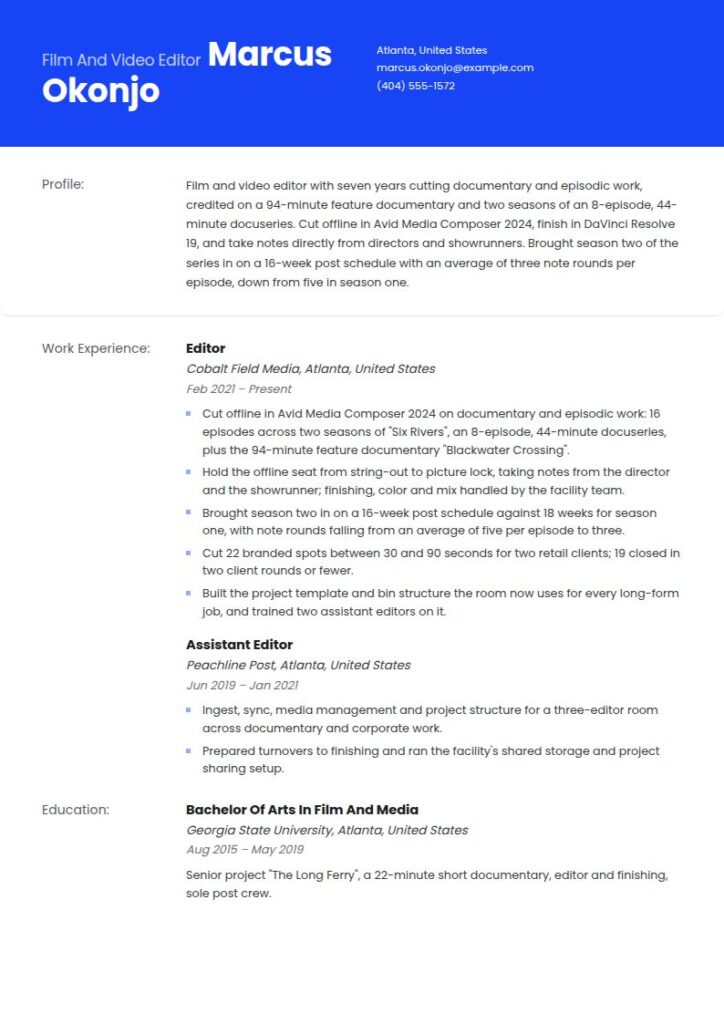
Film and video editor with seven years cutting documentary and episodic work, credited on a 94-minute feature documentary and two seasons of an 8-episode, 44-minute docuseries. Cut offline in Avid Media Composer 2024, finish in DaVinci Resolve 19, and take notes directly from directors and showrunners. Brought season two of the series in on a 16-week post schedule with an average of three note rounds per episode, down from five in season one.
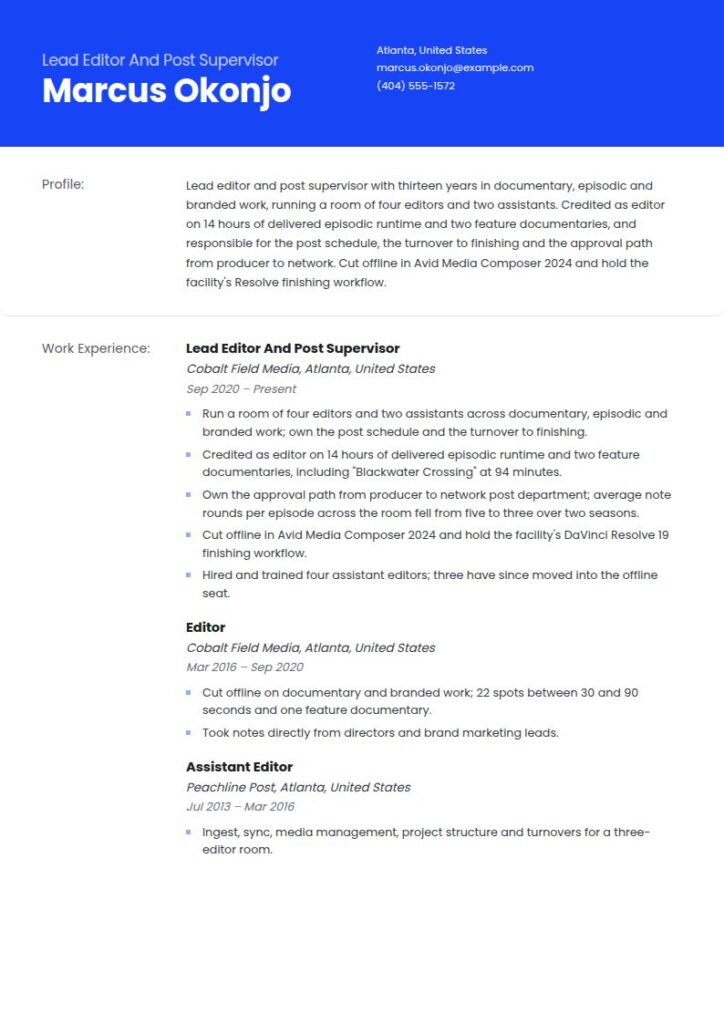
Lead editor and post supervisor with thirteen years in documentary, episodic and branded work, running a room of four editors and two assistants. Credited as editor on 14 hours of delivered episodic runtime and two feature documentaries, and responsible for the post schedule, the turnover to finishing and the approval path from producer to network. Cut offline in Avid Media Composer 2024 and hold the facility's Resolve finishing workflow.
Right vs wrong: the same film and video editor summary, twice
| ✅ Right | ❌ Wrong |
|---|---|
| Film and video editor with seven years cutting documentary and episodic work. | Creative editor with a passion for visual storytelling. |
| Credited on a 94-minute feature documentary and two seasons of an 8-episode, 44-minute docuseries. | Experience across a wide range of projects and genres. |
| Cut offline in Avid Media Composer 2024, finish in DaVinci Resolve 19. | Proficient in all major editing platforms. |
| Brought season two in on a 16-week post schedule with three note rounds per episode, down from five. | Known for delivering high-quality work under tight deadlines. |
Indeed, the right column can be checked against a crew list and a delivery date. The left column cannot, and an unverifiable claim is discounted rather than believed.
Outline your editing experience
Employer or production company, city, post role, dates and the productions you cut there, then three to five bullets. Each also names a production, a runtime and something countable.
| Instead of | Use |
|---|---|
| Edited a variety of video content | Cut 16 episodes across two seasons of a 44-minute docuseries, offline in Avid Media Composer 2024 |
| Responsible for post production | Held the offline seat; assembly, rough cut and picture lock, with finishing by the facility colorist and mixer |
| Worked closely with clients | Took notes directly from the showrunner and the network post supervisor across three note rounds per episode |
| Managed large amounts of footage | Ingested, synced and organized roughly 240 hours of source across one feature documentary |
| Delivered projects on time | Brought season two in on a 16-week post schedule, two weeks shorter than season one |
| Knowledge of editing software | Avid Media Composer 2024 for offline, DaVinci Resolve 19 for conform and grade, Premiere Pro 2025 for branded work |
Editor, Cobalt Field Media, Atlanta, GA, February 2021 to Present
Cut offline on documentary and episodic work in Avid Media Composer 2024: 16 episodes across two seasons of "Six Rivers", an 8-episode, 44-minute docuseries, plus the 94-minute feature documentary "Blackwater Crossing".
Hold the offline seat from string-out to picture lock, taking notes from the director and the showrunner; finishing, color and mix handled by the facility team.
Brought season two in on a 16-week post schedule against 18 weeks for season one, with note rounds falling from an average of five per episode to three.
Cut 22 branded spots between 30 and 90 seconds for two retail clients, with client approval in two rounds or fewer on 19 of them.
Built the project template and bin structure the room now uses for every long-form job, and trained two assistant editors on it.
The credit list: format, runtime, your post role and who signed off
In fact, this is what separates two editors with the same number of credits, and four of its six parts are missing from almost every resume in the stack.
The production and its format. Feature, episodic, documentary, branded spot, corporate, social, live event, trailer. Format is the best predictor of how you work, because each carries its own schedule shape, note culture and tolerance for change. A feature documentary is a long search for a structure that is not in a script, because there is no script. Episodic is a fixed date, a house style and a quota. Branded work is short, fast and approved by a client who is not a filmmaker. Saying which of these you have lived in tells a reader more than any adjective.
The runtime, and the source behind it. Give the delivered length and, where it is meaningful, the source behind it. "94-minute feature documentary cut from roughly 240 hours of source" describes a year of someone's life in eleven words. "16 episodes at 44 minutes" tells a post supervisor how much delivered runtime you have carried, which is the closest thing this trade has to a mileage figure, and almost nobody totals theirs.
Name your post role and editing system
Your post role. This is the part people fudge, and fudging it is the fastest way to lose a job you would otherwise get. Assistant editor covers ingest, sync, media management, bin and project structure, and turnovers. Offline editor owns the cut: assembly, string-out, rough cut, fine cut, picture lock. Online editor conforms the locked cut. Finishing is the last stage, where color, titles and the master come together. Say which seat you held on each credit, and if you held more than one, say where the boundary was.
The system you cut on, and the workflow around it. Avid Media Composer, Adobe Premiere Pro and DaVinci Resolve are the three names a post supervisor scans for, and they are not interchangeable in the way a bare skills list implies. Avid carries most long-form episodic and feature work and brings its own habits: bin discipline, media management, project sharing across a room. Premiere Pro dominates branded, corporate and social work. Resolve spans editing, color and finishing. Say which one you cut each credit in, and what you did around it: shared storage, project sharing, multicam, proxies, caption passes, turnover to sound and color.
Sign-off, review rounds and where it ran
Who approved the cut, and how many rounds it took. Every cut is signed off by somebody, and naming the level is how a reader calibrates the pressure you worked under: a director, a showrunner, an executive producer, a network or streamer post department, a brand's marketing lead, a client committee. Then give the round count if you have it. "Three note rounds per episode, down from five" says more about your judgment than a paragraph about collaboration. Nobody expects one round; everybody notices an editor whose rounds went down.
Where it ran, and whether it was released. Say plainly whether the piece was finished and seen: released, aired, streamed, screened at a festival, published on the client's channels, or delivered internally. An unreleased cut is still real work, but presenting it as though it reached an audience gets checked and remembered.
"Six Rivers", docuseries, 2 seasons, 16 episodes at 44 minutes. Offline editor, 8 episodes in season 1 and 8 in season 2. Avid Media Composer 2024, project sharing across a three-editor room. Notes from the showrunner and the network post supervisor; average 3 note rounds per episode in season 2. Delivered and streamed.
"Blackwater Crossing", feature documentary, 94 minutes, cut from roughly 240 hours of source. Offline editor from string-out to picture lock. Avid Media Composer 2024, finishing in DaVinci Resolve 19. Approved by the director and the executive producer. Screened at two regional festivals.
"The Long Ferry", short documentary, 22 minutes. Editor and finishing, sole post crew. DaVinci Resolve 19. Approved by the director in two rounds. Published on the production company's channel.
Branded spots, 22 pieces between 30 and 90 seconds for two retail clients. Editor and finishing. Adobe Premiere Pro 2025. Approved by the brand marketing lead; 19 of 22 closed in two rounds or fewer. All released.
Build a snapshot of your key skills
Generally, ten to fourteen entries in four groups: the cut itself, systems by name, post workflow, and the adjacent crafts you can cover.
The cut: Documentary structure, Scripted and episodic assembly, Interview and verite selects, Music and pacing, Trailer and promo cutting
Systems: Avid Media Composer 2024, Adobe Premiere Pro 2025, DaVinci Resolve 19, Pro Tools (rough mix only)
Post workflow: Media management and shared storage, Project sharing across a room, Multicam and proxy workflows, Turnover to sound and color, Captions and subtitle passes, Post schedule ownership
Adjacent: Color grading for short-form, Sound design and temp mix, Motion titles, On-set data wrangling
Mark limited use as limited. For instance, an editor who writes "Pro Tools (rough mix only)" is trusted on the rest of the list.
List your education and certifications
Degree, school, year, then the training specific to post. Certifications matter less than credits, but the vendor programs are recognized and answer a question a facility genuinely has.
Bachelor of Arts, Film and Media, Georgia State University, Atlanta, GA, 2019
Training: Avid Certified User, Media Composer, Avid Technology, 2020. DaVinci Resolve Certified Operator, Blackmagic Design, 2023.
Note: the Bureau of Labor Statistics gives a bachelor's degree as the typical entry-level education for film and video editors and camera operators (BLS Occupational Outlook Handbook, May 2025). In practice the credit list carries more weight than the degree, and assistant editor work is the usual route in.
Choose the right layout and design
Single column, plain type at 10 to 12 point, clear headings, no photograph. Save as PDF named for yourself and the seat: marcus-okonjo-editor-documentary-2026.pdf.
Give every credit its format, its runtime and your post role. Name the system you cut on for each credit. Say who approved the cut and, where you have it, how many rounds it took. Total your delivered runtime and put the number somewhere. Say whether each piece was released. Keep assistant editor credits as assistant editor credits.
Do not write "editor" over a credit where you were the assistant. Do not list a production with no runtime and no seat. Do not put a wall of software logos where a post supervisor expects a named system per credit. Do not claim finishing you did not do. Do not use a two-column template for a production company's application portal.
Film and video editor job market and outlook
In summary, a small occupation growing slowly, with a third of its editors self-employed and a pay range spanning nearly four to one.
| Measure | Value |
|---|---|
| Film and video editors and camera operators, jobs in 2025 | 72,000 (39,400 editors; 32,600 camera operators) |
| Projected change, 2025-35 | 3% (as fast as average), +1,900 |
| Projected annual openings | about 5,600 |
| Typical entry-level education | Bachelor's degree |
| Median annual wage, film and video editors, May 2025 | $75,420 |
Source: U.S. Bureau of Labor Statistics, Occupational Outlook Handbook, film and video editors and camera operators, as well as May 2025 wages and 2025-35 projections.
Editors and camera operators are one occupation with two very different careers
BLS reports film and video editors and camera operators together, and the split is worth knowing. Of the 72,000 jobs in 2025, 39,400 were film and video editors and 32,600 were camera operators. The May 2025 median for film and video editors was $75,420 against $74,990 for camera operators, television, video and film, with the combined occupation at $75,100 (BLS Occupational Outlook Handbook, May 2025).
The medians are close; the distributions are not. Editors ran from less than $40,280 at the tenth percentile to more than $148,550 at the ninetieth, against $38,520 to $135,180 for camera operators (BLS, May 2025).
That means two things for a resume. Do not describe yourself as working "in production" when you work in post, because the reader is filling one or the other. And do not treat the median as a ceiling: the top of this occupation earns nearly four times the bottom, and what separates them is the format and the delivered runtime on the credit list.
Where editors work, and also what it pays:
| Industry | Share of film and video editors, 2025 | Median annual wage, May 2025 |
|---|---|---|
| Self-employed workers | 35% | not separately published |
| Motion picture and video industries | 31% | $79,570 |
| Publishing and broadcasting | 11% | $78,300 |
| Professional, scientific and technical services | 8% | $63,250 |
| Religious, grantmaking and civic organizations | 3% | $72,590 |
Source: U.S. Bureau of Labor Statistics, Occupational Outlook Handbook, May 2025.
What salary you can expect as a film and video editor
To begin with, the median annual wage for film and video editors was $75,420 as of May 2025, within a combined occupation median of $75,100 a year, or $36.10 an hour. The lowest 10 percent of editors earned less than $40,280 and the highest 10 percent more than $148,550 (BLS, May 2025).
Industry explains much of that. In particular, motion picture and video industries paid a median of $79,570 in May 2025 and publishing and broadcasting $78,300, against $63,250 in professional, scientific and technical services, where much corporate and agency work sits (BLS, May 2025). After all, the credit list is what moves you between them.
With 35 percent of editors self-employed (BLS, 2025), many quote a day or week rate rather than negotiate a salary. Likewise, two things move a quote: delivered runtime in the format being asked about, and a believable answer to how long the cut will take. Both, therefore, come off a well-kept credit list.
Key takeaways for a film and video editor resume
- Accordingly, build the resume out of credits, and give every credit its format and runtime.
- Moreover, name the post role you actually held, in the industry's own words.
- Then say which system you cut that credit in, and what you did around it.
- Name who approved the cut, and give the note round count if you have it.
- Finally, total your delivered runtime; it is the closest thing to a mileage figure.
- Say whether each piece was released, aired, streamed or screened.
- Keep it single column and parseable, because a tracking system reads it first.
Build your film and video editor resume in 15 minutes with our AI resume builder.
Related information technology resume examples
- Motion graphics artist resume
- 3D animator resume
- Web developer resume
- Front end developer resume
- Web analyst resume
- Software developer resume
- QA tester resume
- Technical project manager resume
- IT project manager resume
- Computer science resume
- IT specialist resume
- IT resume
Pair it with a matching film and video editor cover letter.
Film and video editor resume questions, answered
How long should a film and video editor resume be?
One page until the credit list needs two, which usually happens once you have worked across three or more formats. Everything that is not a credit has to earn its space.
What belongs in a credit line?
Six things: the production and its format, the delivered runtime, the post role you held, the system you cut on, who approved the cut, and whether it was released. Most resumes carry the first and the last and leave the four in the middle to the reader's imagination.
Should I call myself an editor if I was the assistant editor?
No. Assistant editor is a real seat with real responsibility, and post supervisors hire for it specifically. Claiming the offline seat when you held the assistant's is a common way a promising application ends: crew lists are easy to check and the industry is small.
Do I need Avid, or is Premiere Pro enough?
It depends on the format you want. Long-form episodic and feature work is still largely cut in Avid Media Composer, branded and corporate work runs mostly on Adobe Premiere Pro, and DaVinci Resolve spans editing and finishing in both. List the one you cut each credit in rather than claiming all three equally.
How do I show experience with no professional credits?
Write what you have cut with the same discipline: the runtime, the seat, the system, who approved it and whether it was seen. Student films, a festival short, a nonprofit's annual video and unpaid documentary work all qualify. Then look for assistant editor work, which is how most editors enter the trade.
Which industry pays film and video editors best?
Motion picture and video industries, at a May 2025 median of $79,570, followed by publishing and broadcasting at $78,300. Professional, scientific and technical services, which covers much agency and corporate work, sat at $63,250 (BLS Occupational Outlook Handbook, May 2025).