Astrid Kowalczyk Motion Graphics Artist Minneapolis, 55408, United States [email protected] · (612) 555-1590
11 September 2026
Ms. Ingrid Bergland Brand Design Harbor and Vine Minneapolis, United States
Application for Motion Graphics Artist, Harbor and Vine brand team
Dear Ms. Bergland,
I am applying for the Motion Graphics Artist post on the brand team at Harbor and Vine. I build brand and product motion as systems rather than as one-off pieces, and I work in After Effects 2025, Cinema 4D 2025, Figma and Lottie.
The work closest to your posting is the motion system I built for the platform launch at my current employer: 9 animation patterns, 26 templates and a written usage guide covering timing, type behavior and the elements that never move. Eleven people across marketing, sales and support used it to produce 380 finished pieces in its first year without a designer touching them, and the share of requests coming back for a second round fell from 38 percent to 11 percent after I ran four training sessions. Alongside that I hold a 48-hour turnaround on template variants and five working days on a new build, against roughly 60 requests a quarter.
Your posting describes a brand refresh reaching packaging, retail screens and social at the same time, which is the situation template kits are actually for. I would want to start where the volume is: find the three request types that repeat most, build those first, and hand them over with a one-page guide so the campaign team is not waiting on the design queue for a text change.
My portfolio is at astridkowalczyk.example.com, including the usage guide from the system above. I am in Minneapolis and available from November. Thank you for your time.
Sincerely, Astrid Kowalczyk
Summary
A motion graphics artist cover letter is one page that shows repeatable work rather than one hero piece: the template kit or brand motion system you built, who used it after you, the volume you turned around in a cycle and the turnaround you held. This guide gives you a full adaptable letter, the openings that work, and what changes between an agency and an in-house team.
Motion Graphics Artist cover letter examples by experience level
In short, a motion graphics artist cover letter is a one-page letter that argues you can make work that keeps happening without you.
Of course, the portfolio already shows what you can make. What it cannot show is how much of it you make in a normal month, how fast, and whether anyone else was able to use what you built. In practice, those three facts are what a design lead is short of, and they are what the letter is for.
Guide to a motion graphics artist cover letter
That is why this guide and the corresponding motion graphics artist cover letter example will cover:
- First, how to structure the letter, paragraph by paragraph
- Then, why one system beats a list of pieces you are proud of
- Also, what counts as evidence: volume, turnaround, reach and handoff
- In addition, how the letter changes between an agency and an in-house team
- Finally, the openings that make a reader finish a strong file
How to write a motion graphics artist cover letter
| Paragraph | Its job | Length |
|---|---|---|
| Opening | The role, the kind of motion work you do, your tools | 2 to 3 sentences |
| Evidence | One system: what was in it, who used it, the volume, the turnaround | 4 to 5 sentences |
| Fit | Something real about their team, and the work you would take on | 3 to 4 sentences |
| Close | Portfolio link, location and availability, thank you | 2 sentences |
Lead with the system, and put a number on who used it
The letters that get answered describe a capacity rather than a taste.
Pick the most systematic thing you have built and itemize it: how many patterns, how many templates, whether there was a written guide. Then give the number almost nobody gives, which is how many people used it after you and whether they needed you there. "Eleven people across marketing, sales and support produced 380 finished pieces from it in the first year with no designer involved" is a sentence a design lead reads twice.
Finish with volume and turnaround in a named cycle. Sixty requests a quarter at a 48-hour turnaround tells them whether their queue will move if they hire you, which is the question behind the posting.
A motion graphics artist cover letter example you can adapt
Dear Ms. Bergland,
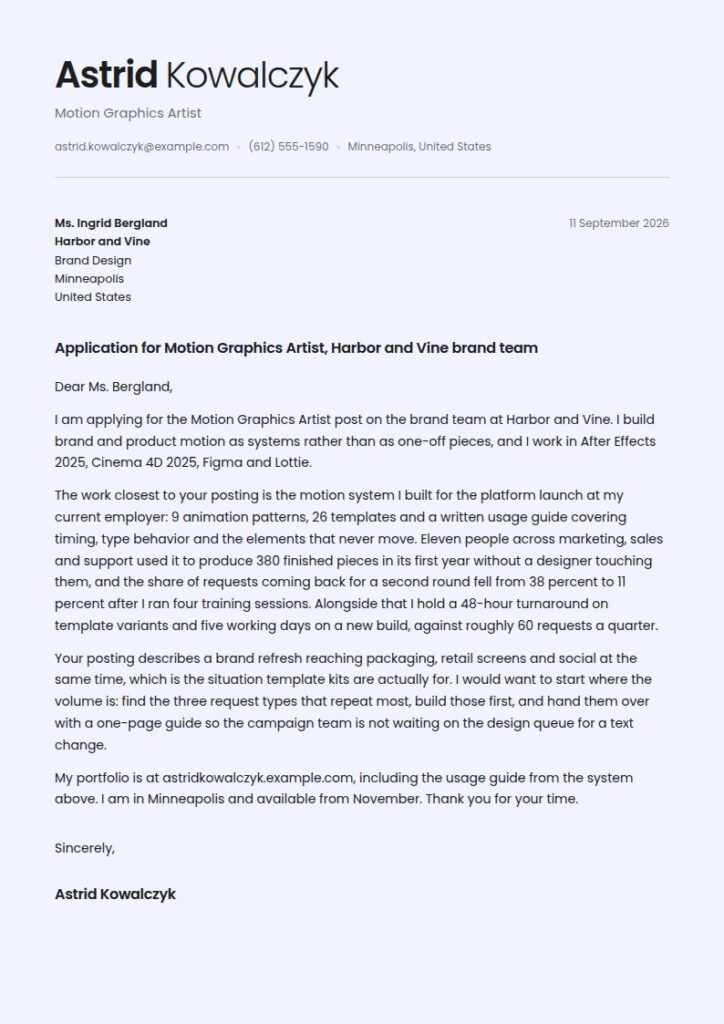
I am applying for the Motion Graphics Artist post on the brand team at Harbor and Vine. I build brand and product motion as systems rather than as one-off pieces, and I work in After Effects 2025, Cinema 4D 2025, Figma and Lottie.
The work closest to your posting is the motion system I built for the platform launch at my current employer: 9 animation patterns, 26 templates and a written usage guide covering timing, type behavior and the elements that never move. Eleven people across marketing, sales and support used it to produce 380 finished pieces in its first year without a designer touching them, and the share of requests coming back for a second round fell from 38 percent to 11 percent after I ran four training sessions. Alongside that I hold a 48-hour turnaround on template variants and five working days on a new build, against roughly 60 requests a quarter.
Your posting describes a brand refresh reaching packaging, retail screens and social at the same time, which is the situation template kits are actually for. I would want to start where the volume is: find the three request types that repeat most, build those first, and hand them over with a one-page guide so the campaign team is not waiting on the design queue for a text change.
My portfolio is at astridkowalczyk.example.com, including the usage guide from the system above. I am in Minneapolis and available from November. Thank you for your time.
Sincerely, Astrid Kowalczyk
Openings that work
| Instead of | Use |
|---|---|
| I am a passionate motion designer who loves bringing brands to life | I build brand and product motion as systems rather than one-off pieces |
| I am writing to express my interest in your motion design role | I am applying for the Motion Graphics Artist post on your brand team |
| I have created motion graphics for many well-known brands | I built a motion system of 9 patterns and 26 templates that 11 people used without a designer |
| I thrive in fast-paced environments | I hold a 48-hour turnaround on template variants against roughly 60 requests a quarter |
| I am proficient in the Adobe Creative Suite | After Effects 2025, Cinema 4D 2025, Figma and Lottie |
What counts as evidence
| Kind of evidence | What it looks like in a sentence |
|---|---|
| The kit, itemized | 9 animation patterns, 26 templates and a written usage guide |
| Reach | Used by 11 people across marketing, sales and support |
| Independence | 380 finished pieces produced in year one with no designer involved |
| Volume | Roughly 60 requests a quarter, about 70 percent variants and 30 percent new builds |
| Turnaround | 48 hours on a variant, five working days on a new build |
| Improvement | Average request time down from nine working days to two over two quarters |
| What it replaced | A recurring weekly build, roughly six hours of design time, now a five-minute swap |
In fact, you can check every line there in a conversation, which is what separates evidence from atmosphere. On the other hand, the portfolio settles craft, taste and storytelling, and repeating them in a letter suggests it will not settle them.
Agencies and in-house teams want different letters
For an agency or studio, write about range and speed: how many campaigns at once, the turnaround you hold, how you take a brand's existing rules and extend them. For an in-house team, write about maintenance: the pattern library, the documentation, the training, and who can produce without you. Name your tools with the job attached either way, and name one real thing about their work.
Do not describe a kit as "various templates". Do not give a volume with no cycle attached. Do not claim a system nobody used. Do not open with a philosophy of motion. Do not attach a large file where a portfolio link belongs.
The same work pays $41,380 more in software than in advertising
Motion graphics work is counted by BLS within special effects artists and animators. The May 2025 median in software publishers was $127,670; in advertising, public relations and related services it was $86,290 (BLS Occupational Outlook Handbook, May 2025). Computer systems design sat at $103,390 and motion picture and video industries at $100,990, against an occupation-wide median of $102,030.
The occupation held 51,900 jobs in 2025 and is projected to change by 0 percent through 2035, with about 4,200 openings a year (BLS, 2025-35 projections).
The practical reading for a letter is this. The better-paid end of this occupation is the end where motion is expected to be documented, reused and maintained by people who are not designers. A letter that describes a kit, its reach and its turnaround is applying for that end of the market, whatever the posting says.
Length, format and sending it
Overall, one page, four paragraphs, 250 to 350 words. Then send a PDF named for yourself and the role, or paste the letter into the email above the portfolio link. Keep the link in plain visible text, because people often copy it out of the message.
Also, address a person. "Dear Hiring Team" on an otherwise specific letter reads as one sent to twenty companies the same afternoon.
Use the same figures as your resume so the two agree. Our motion graphics artist resume example uses the numbers written here.
Key takeaways
- Argue that your work keeps happening without you; that is what the employer is buying.
- First, itemize one system: patterns, templates, written guide.
- Give the number of people who used it and whether they needed you.
- Then add volume in a named cycle and turnaround by request type.
- In addition, say what stopped happening once the system existed.
- Also, change the letter between an agency and an in-house team.
- Finally, address a named person, keep the portfolio link plain, and stop at one page.
Write your motion graphics artist cover letter in 10 minutes with our AI cover letter builder.
Motion graphics artist cover letter questions, answered
How long should a motion graphics artist cover letter be?
One page, four paragraphs, 250 to 350 words. The portfolio carries the craft argument, so the letter only has to carry scale, speed and handoff.
Do I need a cover letter if I have a strong portfolio?
Yes, because the portfolio answers a different question. It shows what you can make at your best; the letter says how much you make in a normal month, how quickly, and whether anyone else could use what you built.
What if I have never built a template kit?
Then say what you have made repeatable, however small: a naming convention, a reusable set of components, a guide you wrote so someone could brief you properly. Systems thinking shows up in small things first, and describing one honestly reads better than claiming a system you did not build.
Should I mention volume if my work is slow and crafted?
Yes, and frame it as the mix. "Two launch films a quarter plus roughly 20 template variants a month" tells a reader the shape of your week far better than either number alone, and it stops a careful worker from being mistaken for a slow one.
How do I write to a team I do not know?
Spend ten minutes on what they have shipped, then name one thing about it that connects to your own work. One accurate sentence about their brand or product motion is worth more than a paragraph of admiration, and it is the part of the letter that cannot be pasted into the next one.