Previous Names on Job Application Forms: What to List and Why
Previous names on job application forms: list former legal names like a maiden name, skip nicknames, and copy exact lines for marriage, divorce and more.

On this pageWhat does "previously used names" mean on a job application?
- What does "previously used names" mean on a job application?
- Why do employers ask for previous names on job application forms?
- Which names should you list, and which can you skip?
- What should you type for previous names on job application forms?
- How do background check companies use your previous names?
- What happens if you leave the previous names field blank?
- Is it legal for an employer to ask about previous names?
- FAQ
- Sources
"Previously used names" means any former legal name your records may sit under, such as a maiden name, a name before a divorce or a court-ordered name change. Employers ask so a background screener can find your school, work and court records. List every former legal name, skip nicknames, and write "None" if you have never changed your name.
When a form asks for previous names on job application pages, list every former legal name your records may be under: a maiden name, a pre-divorce name or a name before a legal change. Skip nicknames. If your name never changed, answer "None."
The field often reads "Have you used any other names?" or "Do you have previously used legal names?" It looks personal, yet the reason is plain record matching. So this guide explains what counts, what to type for each situation, and what a screener does with the answer.
You will also see when an employer may legally ask, and how to keep a former name private when it touches your identity.
Quick answers by situation
| Your situation | What to put | Example line |
|---|---|---|
| You took a spouse's last name | Your birth last name | "Maria Lopez (2010 to 2019)" |
| You divorced and went back to your birth name | Your married name | "Maria Chen (2019 to 2024)" |
| You changed your name by court order | Your full former legal name | "Jordan Patel, legal name until 2021" |
| You go by a nickname like "Bill" | Nothing, it is not a legal name | "None" |
| You transitioned and changed your legal name | Your former legal name, in this field only | "Former legal name on records before 2022" |
| Your name never changed | Nothing to list | "None" |
What does "previously used names" mean on a job application?
It means any legal name you used before your current one. That covers a maiden name, a married name you dropped after a divorce, and a name you changed by court order. Some forms also ask for aliases, which screeners define as any name variation tied to you, such as a hyphenated name.
The question comes in a few versions. You may see "Other names used," "Former legal names," "Previously used names" or "Aliases." They all ask the same thing: under which other names might your records sit?
Legal names, not nicknames
Checkr, a large screening firm, defines an alias as "any variation of a candidate's current legal name or a different name that is associated with the candidate"1. Its examples include maiden names, hyphenated names and suffixes. But a casual nickname is not a record name, because no school, court or payroll office filed anything under it.
Not the same as a preferred name
A preferred name is the one you want people to call you. A previous name is one you no longer use. If you want to share your everyday name, use the known-as name on a job application field instead.
Why do employers ask for previous names on job application forms?
Employers ask so they can verify your past. Records stay under the name you had at the time, so a degree earned under a maiden name will not match a search on your married name. Background screeners use the list to search court records, confirm schools and employers, and make sure each record belongs to you.
HR writer Suzanne Lucas, the Evil HR Lady, puts it simply: companies ask about past names because they want to verify your information and perform an adequate background check2. Her own degrees sit under her maiden name. So a school check on her married name would come back empty.
Records do not follow your new name
Courts, colleges and old employers rarely update files when you change your name. That is the core reason for the field.
Court records typically do not include all the names an individual has used throughout their lifetime.
Checkr, 2024
Names are how screeners match records
BackgroundChecks.com notes that there are no Social Security numbers on criminal records3 that could give a screener an instant match. So the screener relies on names and birth dates. Your previous names give them every key they need. That is why previous names on job application forms carry so much weight.
Check the name printed on your diploma and your old W-2s. If either shows a name you no longer use, that name belongs in the field. This one check catches most of what a screener needs.
Which names should you list, and which can you skip?
List every former legal name that appears on official records: birth surname, married surnames, and any court-ordered change. Skip nicknames, short forms of your first name, stage names you never used on payroll, and pen names. A name changed in early childhood or by adoption rarely matters, because no work or school record exists under it.
Use one test: did a school, court, employer or government office ever file something under that name? If yes, list it. If not, skip it.
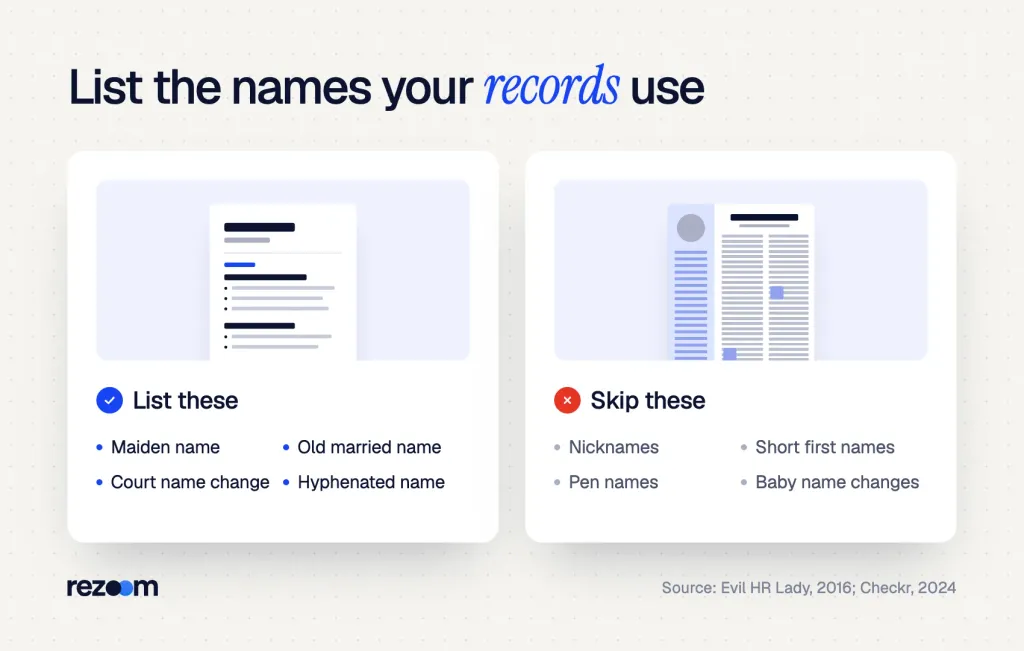
| Name | List it? | Why |
|---|---|---|
| Maiden or birth surname | Yes | Degrees and early jobs sit under it |
| Married name you dropped | Yes | Pay and license records may use it |
| Court-ordered name change | Yes | Court and tax records used the old name |
| Hyphenated or double surname | Yes, both versions | Records may show one part only |
| Nickname ("Kate" for Katherine) | No | Not a legal name |
| Pen name or blog name | No | No official records sit under it |
| Name changed as a baby or by adoption | Usually no | No school or work records exist under it |
Gray areas
Lucas calls pen names and religious names "not relevant"2 to this field. She also says a name changed in childhood or by adoption needs no mention, since you never worked or studied under it. But if you held a professional license under a former name, list it, because the licensing board's record still uses that name.
Middle names and suffixes
A spelled-out middle name is part of your current name, not a former one. See our guide to the middle name on a job application for that box. Add a suffix change, like dropping "Jr.", only if your records still show it.
Legal name on a job application: which fields need it, what "do you have previously used legal names" means, and how to list a maiden or past name.
What should you type for previous names on job application forms?
Type the full former legal name, first and last, with the years you used it if the form has room. Write one name per line or per entry. If you have none, type "None" or "N/A" rather than leaving it blank. Keep each entry factual and short, with no explanation of why the name changed.
Most forms give you a text box or a list of rows. Write the full name, not just the surname, because screeners match whole names.
Married name change
This is the most common case. List your birth surname with your first name, then the years if asked.
Previously used names: Maria Elena Lopez Years used: 1992 to 2019 Current legal name: Maria Elena Chen
Divorce or a second marriage
If you returned to your birth name, list the married name you dropped. After two marriages, list both earlier names.
Previously used names:
1. [First name] [Birth last name], [year] to [year]
2. [First name] [First married last name], [year] to [year]
A legal name change after a transition
You owe the employer a correct background check, not your life story. Lucas advises disclosing a former name if a check needs it, and using the name you go by on your resume. She also notes that recruiters, not hiring managers, often handle the screening forms.
Previously used names: Former legal name used on school and work records before 2022 (listed for the background check only)
If the form lets you, add a note that the former name is for screening only. Then ask HR who sees the field. For the resume itself, our guide on how to list materials under a former legal name shows how to handle old degrees and awards.
Free ATS score, the text the software extracts and your missing keywords. No sign-up.
How do background check companies use your previous names?
Screeners run each name you list through court, education and employment searches. Many also run an SSN trace, which reports other names tied to your Social Security number. If a record turns up under a name you listed, they can match it to you with confidence. If you left a name out, they may still find it.
Checkr says it is a "common myth that screening providers search aliases by default"1. Without aliases, a screener searches only the name you gave or your current name. So the names you list shape what the search covers.
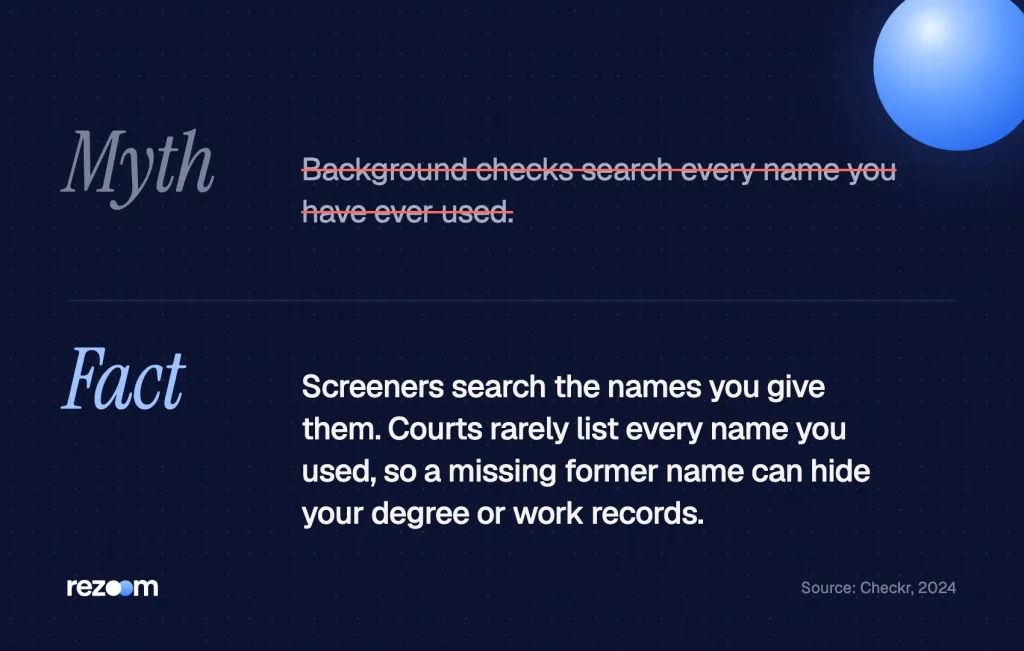
The SSN trace fills gaps
Checkr also notes that most of its criminal screening packages include an SSN trace, which reports other names associated with an individual's Social Security number1. That means an old married name can show up even if you skip the field. Then a mismatch between your form and the report needs an explanation.
Your consent comes first
A check through a screening company needs your written permission. The FTC says that you have the right to say no4, but you may not get the job. If the report hurts your chances, the employer must give you a copy first, and you can dispute errors with the screening company.
Use the same spelling of each former name on the application, the screening consent form and any license form. A dropped hyphen or a missing middle name can send a screener down the wrong record. Consistency keeps the check fast.
Make your resume match the record
Office jobs often run these checks, because the staff handle payroll, client files and records. If you apply for one, our administrative resume examples show how to list schools and employers so the dates line up with a verification. Our data entry specialist resume examples show a clean history block with titles and dates in one place.
Data entry specialist resume example
See how a data entry resume lists schools, employers and dates that a screener can verify quickly.
Your degree line can stay under your current name. If you want, add the former name in parentheses after the school, such as "(degree issued as Maria Lopez)."
What happens if you leave the previous names field blank?
If you have no former names, nothing happens, but write "None" so the form looks complete. If you do have a former name and skip it, the screener may miss your degree or past jobs, which slows the check. An SSN trace may also reveal the name, and the gap can look like an omission.
A blank box is ambiguous. The reviewer cannot tell "no former names" from "skipped the question." So type "None" or "N/A" when the answer is no.
The real cost of skipping a name
If your degree sits under a maiden name, an education check on your current name may come back "no record found." Then the employer has to stop and ask you. That delay can push your start date, or make a recruiter move to the next candidate.
Do
- List every former legal name with first and last name.
- Write "None" when your name never changed.
- Add the years you used each name when the form has room.
- Use the same spelling on the screening consent form.
Don’t
- List nicknames or short forms of your first name.
- Leave the box blank when you do have a former name.
- Explain why your name changed.
- Guess at the spelling of a name on old records.
What to say if HR asks about a name on your report
Sometimes a former name shows up that you forgot, like a short first marriage. Stay calm and confirm it in one line.
HR: "Your report shows the name Maria Gomez. You did not list it."
"Yes, that was my married name from 2012 to 2014. I forgot to add it, and I am happy to update the form today."
HR: "Any other names we should know about?"
"No. Lopez is my birth name, and Chen is my current legal name."
Is it legal for an employer to ask about previous names?
Yes, when the purpose is to find your records. EEOC-based hiring guides call it acceptable to ask whether your work records are under another name. They flag asking a woman for her maiden name or her title as a problem, because that points to marital status. After hire, Form I-9 asks for other last names used.
The EEOC warns that questions about marital status are often used to discriminate against women5. So a well-built form asks a neutral question, such as "Have you used any other names?", of every applicant.
Neutral question versus maiden name
The University of Idaho's hiring guide, based on EEOC guidance, lists as acceptable asking whether the applicant's work records are under another name6. It lists as unacceptable asking for a maiden name. If a form asks only women for a maiden name, that is a red flag worth noting.
Form I-9 after the offer
Once you accept the job, Form I-9 asks again. USCIS tells new hires to enter other legal last names used, including a maiden name7, no later than the first day of work. So keep your answer consistent from the application through day one.
May we contact your current employer? Say no without hurting your odds, say yes for past jobs, and copy word-for-word scripts for forms and recruiters.
- Gather your recordsLook at your diploma, old W-2s and any license to see which names they show.
- List each legal nameWrite first and last name for each former legal name, one per line.
- Add the yearsNote when you used each name if the form has room.
- Match the consent formCopy the same spelling onto the background check consent form.
- Answer HR fastIf a screener finds a name you missed, confirm it the same day.
Before you submit
Before you submit the application
The same form also asks for your current name, your start date and your references. See our guides to your legal name on a job application and to the question may we contact your current employer.
If you also send a letter, our administrative cover letter examples show a clean sign-off with the name you use now. Then build a resume that matches your records with the Rezoom AI resume builder.
Tailored to the job post, checked against ATS.
Frequently asked questions
What does "do you have previously used legal names" mean?
It asks whether you ever had a different legal name, such as a maiden name or a name before a court-ordered change. Employers use it to find your records during a background check. In short, list previous names on job application forms when records exist under them.
Does a nickname count as a previously used name?
No. A nickname like "Bill" or "Kate" is not a legal name, and no records sit under it. Leave it out of this field.
Should I list my maiden name on a job application?
Yes, if the form asks for previous or other names. Your degree, early jobs or licenses may sit under your maiden name, and the screener needs it to find them.
What should I write if I have no previous names?
Write "None" or "N/A." A blank box can look like you skipped the question.
Will a background check find my old name anyway?
Often, yes. Many checks include an SSN trace, which reports other names tied to your Social Security number.
Can an employer ask for my maiden name?
EEOC-based hiring guides flag a direct maiden-name question as a problem, because it points to marital status. A neutral question about other names used for your records is fine.
Sources
We opened and read each page below. The small numbers in the text point here. Pages that carry no publication date show n.d.
- Checkr2024
Court records rarely list every name a person used, screeners do not search aliases by default, and an SSN trace reports other names tied to a Social Security number
- Evil HR Lady (Suzanne Lucas)2016
Employers ask about past names to verify information and run a background check, and pen names or childhood name changes are not relevant
- BackgroundChecks.com2023
Criminal records carry no Social Security numbers, so screeners match records by name and ask about other names used officially
- Federal Trade Commission2025
Employers need your written permission for a background check, and you can dispute errors in the report
- US Equal Employment Opportunity Commissionn.d.
Pre-employment questions about marital status are often used to discriminate against women
- University of Idahon.d.
Asking whether work records are under another name is acceptable, while asking for a maiden name is not
- US Citizenship and Immigration Servicesn.d.
Form I-9 Section 1 asks for other legal last names used, including a maiden name, by the first day of work
Mohammad has spent more than ten years designing consumer products and leads product at Rezoom, deciding what gets built and what gets left out. His guides cover the whole job search, from resume sections and cover letters to interview answers and career moves.
Goodi, M. (2026, November 9). Previous Names on Job Application Forms: What to List and Why. Rezoom. https://rezoom.io/previous-names-on-job-application/