May We Contact Your Current Employer? How to Answer Yes or No
May we contact your current employer? Say no without hurting your odds, say yes for past jobs, and copy word-for-word scripts for forms and recruiters.

On this pageShould you say yes or no to "may we contact your current employer"?
- Should you say yes or no to "may we contact your current employer"?
- What happens if you say no?
- When will they contact your current employer?
- May we contact this employer for previous jobs?
- What should you write in the comments field?
- What should you say if a recruiter asks why you said no?
- How do background checks and the FCRA fit in?
- FAQ
- Sources
You can answer no when a form asks to contact your current employer. Hiring managers expect it, because a call could cost you your job. Say yes for past employers, since a no there looks like a red flag. Most employers check references late, after final interviews or a conditional offer, and a background check needs your written consent first.
When a form asks "May we contact your current employer?", you can safely answer no. Recruiters expect it, because a call could put your job at risk. But say yes for past employers, and offer your current manager after a conditional offer.
The question shows up on almost every job application. It looks like a simple checkbox, yet many people freeze on it. So this guide gives you the answer for each situation, plus word-for-word scripts.
You will also see when the call really happens, what a background check needs from you, and how to handle a recruiter who pushes back.
Quick answers by situation
| Your situation | What to do | Example line |
|---|---|---|
| Your boss does not know you are looking | Answer no | "Please contact my manager after a conditional offer." |
| Your boss knows and supports the move | Answer yes | "Yes. My manager knows I am applying." |
| A past employer, on good terms | Answer yes | "Yes. Ask for Dana Brooks, store manager." |
| A past manager left the company | Answer yes, explain later | "My manager left in 2025. HR can confirm my dates." |
| The past company closed | Answer yes, add a note | "The company closed in 2024. My former lead can speak to my work." |
| You left a past job on bad terms | Answer yes, prepare a reference | "HR can verify my dates. My former shift lead can speak to my work." |
Should you say yes or no to "may we contact your current employer"?
Say no if your employer does not know you are job hunting. Hiring managers see that answer every day and rarely hold it against you. Say yes only if your boss already knows and supports the move. Either way, offer your current manager as a reference once you have a conditional offer.
Alison Green of Ask a Manager says reasonable hiring managers understand that contacting your current manager could put your job at risk1. So the box does not test your honesty. It asks for your permission.
When yes makes sense
Answer yes if your manager already knows you are leaving. That happens when your role ends, your store closes or your boss offered to be a reference. Then a yes speeds up the check.
When no is the safer choice
Answer no in every other case. Your manager might treat you differently once they know. Some employers even let people go after they learn about a job search.
Employer: Main Street Market (current) May we contact this employer? No Reason (if asked): My employer does not know I am job searching. I am happy to share my manager's contact after a conditional offer.
What happens if you say no?
Usually nothing bad. The employer moves on to your past jobs and other references. Many companies wait until a conditional offer before they call a current employer anyway. The one cost is time: the background check may take longer, because the screener has to come back to that job later.
Employers ask about your current job mostly as a courtesy. Compliance publisher JJ Keller tells employers that delaying contact until after a conditional job offer2 should be reasonable. SHRM also advises checkers not to call a current employer without express permission10.
Contacting a current employer after being asked not to do so may be seen as unprofessional.
J.J. Keller Compliance Network, 2022
Saying no can slow the check
Screening firms honor the choice, but they still need to finish the file. The UK screener Verifile says that if you pick "do not contact," it will ask you later whether to contact your employer4 or hold off. It also warns of a delay in the check.
Some screening forms offer "contact from" instead of a flat no. Pick your planned resignation date or your offer date. Then the screener waits, and your check keeps moving.
When will they contact your current employer?
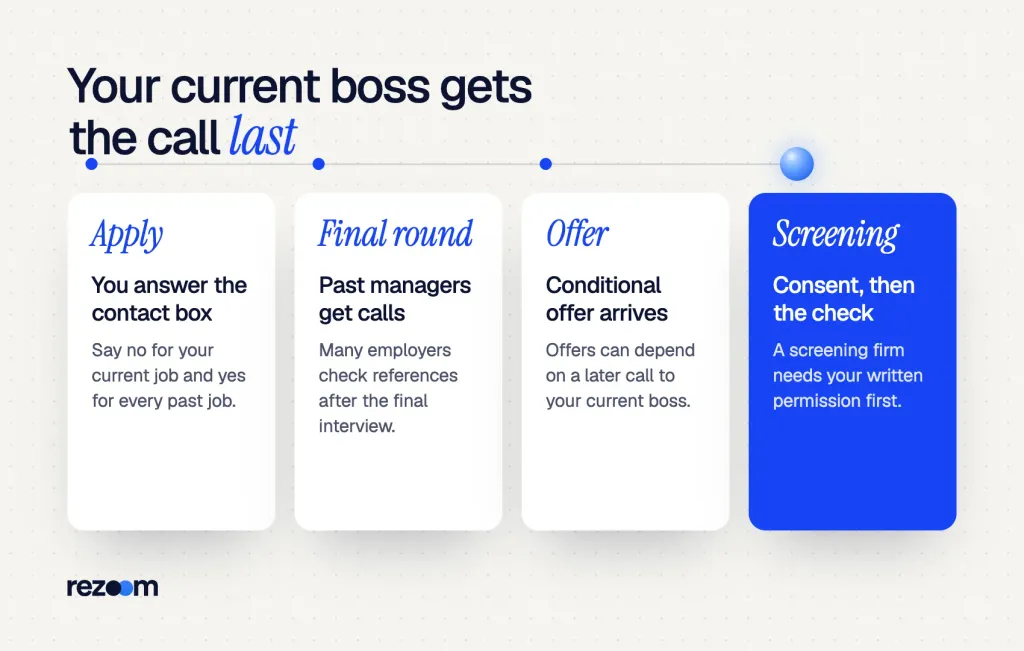
Most employers wait until the final stage. University hiring guides suggest checking references after the last interview, and some make the offer contingent on a later call to your current boss. A formal background check needs your written permission first, so you will know before it starts.
Timing depends on the employer, but the pattern is clear. Calls come late, when you are a finalist or holding an offer.
Before an offer
Indiana University's reference check guide recommends checking after the final interview for the top candidates3. It also says candidates should hear about reference checks before they start. So you will rarely get a surprise call this early.
After a conditional offer
The same guide notes that outside candidates may skip their current supervisor, and offers can be made contingent upon a later reference check3 with that person. That is the standard deal: you get the offer, then your boss gets the call.
During the background check
A 2018 survey by the National Association of Professional Background Screeners found that 95% of employers run some type of background check5. It also found that most wait until after an interview or job offer.
May we contact this employer for previous jobs?
Say yes for every past employer you can. A no on a former job reads as a red flag, because it hints that you left on bad terms. If the manager left, the company closed or the employer gives no references, still answer yes and explain it in the comments box or later.
Past jobs work the other way. Ask a Manager calls a no on former managers a "huge red flag"1. It suggests to hiring managers that you left badly, or never worked there.
Employers can call anyway
A no does not stop the call. JJ Keller tells employers they may contact previous employers without permission2. So the no only adds suspicion.
What references get asked
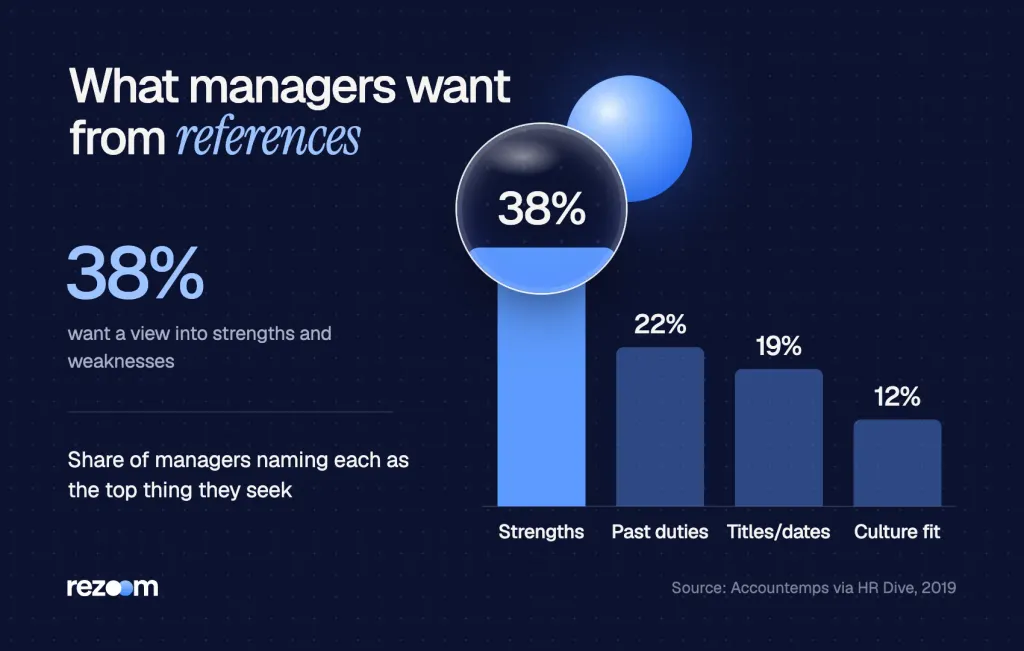
Reference calls go beyond dates. In a 2019 Accountemps survey of more than 2,800 managers, 38% wanted a view into strengths and weaknesses6. The same managers said they drop as many as 34% of candidates after reference checks.
| Past job situation | Answer | What to add |
|---|---|---|
| Left on good terms | Yes | Manager name and phone |
| Manager no longer works there | Yes | HR phone and a coworker reference |
| Company closed | Yes | Note the closure and a former lead |
| No-reference policy | Yes | "HR confirms dates and title only" |
| Left on bad terms | Yes | A different supervisor who knew your work |
What can a former employer say about you? See what HR confirms, when a bad reference is illegal, how to check your record and what to say about a firing.
Do
- Answer no for your current job if your boss does not know.
- Answer yes for every past employer you can.
- Give HR's number when a manager has left.
- Warn your references before they get a call.
Don’t
- Say no to a past job to hide a bad exit.
- Leave the box blank and hope nobody notices.
- List a friend as your "manager."
- Forget to update your boss's contact when they change jobs.
Free ATS score, the text the software extracts and your missing keywords. No sign-up.
What should you write in the comments field?
Write one short line that gives your reason and a next step. Say your employer does not know you are looking, then offer the contact after a conditional offer. For past jobs, explain closures or departed managers in a few words, and give a backup contact such as HR or a former coworker.
Many forms add a free-text box under the yes or no question. Use it, because a reason turns a plain no into a normal request.
My current employer does not know I am job searching. I will gladly share my manager's contact once I receive a conditional offer. In the meantime, my past two managers can speak to my work.
Yes, you may contact [company]. My manager, [name], left in [year]. HR can confirm my dates at [phone]. [Coworker name], my former [title], can speak to my work at [phone or email].
Keep the note short
One to three sentences is enough. Skip the story about why you are leaving. Our guide to the reason for leaving on a job application covers that box separately.
What should you say if a recruiter asks why you said no?
Stay calm and give the same reason you wrote on the form. Your employer does not know you are looking, and you will share the contact after an offer. Then offer something useful now: a past manager, a current coworker you trust, or proof of your work.
Recruiters ask this to check the answer, not to trap you. So a calm, one-line reply settles it.
"My current employer does not know I am looking yet, so I would rather keep it private for now. Once we reach a conditional offer, I will connect you with my manager. Until then, my last two managers can speak to my work."
What to say if they push back
- Offer a trusted coworker: "A senior coworker knows about my search and can talk about my work today."
- Offer proof: "I can share my last two performance reviews."
- Set a time: "I will give you my manager's contact the day I sign the offer."
- Ask about the process: "Is the call part of the background check, or a separate step?"
Recruiter: "We usually check all references before we make an offer."
"I understand. My manager does not know I am leaving, and a call now could cost me my job."
Recruiter: "Is there anyone at your current company we can speak with?"
"Yes. My shift lead knows about my search. I can also send my last review, and you can call my manager right after a conditional offer."
How to ask someone to be a reference: who to pick, when to ask, email templates and scripts, how to follow up, and what to do if someone says no.
How do background checks and the FCRA fit in?
A background check from a screening company falls under the Fair Credit Reporting Act. The employer must tell you in a stand-alone written notice and get your written permission first. You can refuse, but you may lose the offer. So you always know before a screener calls your current employer.
The FTC tells applicants that employers must get your written permission7 before they run a check through a background company. It adds that you can say no, but you may not get the job.
Your rights if something goes wrong
If the report hurts your chances, the employer must act first. The FTC says the employer must give you a copy of the report they relied on8 before it decides. Then you can dispute errors.
Verification may not involve your boss
Some checks pull data instead of calling anyone. Penn State's HR page says verifiers can see your hire date, total time with the company and job title9 through The Work Number. So your dates and titles must match your resume.
Make your resume match the record
Match the dates on your resume to your pay records, month and year. A cashier with three store jobs can look at our retail resume examples for a clean work history layout. Our retail cashier resume examples show dates, titles and register bullets in one tidy block.
Retail cashier resume example
See how a cashier lists store names, titles and dates that match a verification check.
- Pick your answerChoose no for your current job and yes for every past job.
- Add a noteWrite one line in the comments box with your reason and next step.
- Line up referencesPick two past managers and one trusted coworker, then warn them.
- Match your datesCheck your resume dates against your pay stubs or W-2s.
- Release the contactShare your manager's name after you sign the conditional offer.
Before you submit
Before you submit the application
Send each reference the job posting and two strengths to mention. Then their answers match your interviews. A warned reference also picks up the call instead of letting it ring out.
The same form also asks about your start date, pay and name. See our guides to the earliest start date on a job application, the desired salary on a job application and your legal name on a job application.
If you apply for store roles, our retail cover letter examples show how to mention a confidential search in one line. Then build a matching resume with the Rezoom AI resume builder and tailor it to each posting.
Tailored to the job post, checked against ATS.
Frequently asked questions
Should I say yes to contact my current employer?
Only if your boss knows you are job hunting and supports it. Otherwise say no, and offer the contact after a conditional offer.
Does saying no to contacting my current employer hurt my chances?
Rarely. Hiring managers expect it and usually call past employers first. It may slow the background check a little.
Will they contact my employer before an offer?
Most employers wait until after final interviews or a conditional offer. A formal background check also needs your written consent first.
Can an employer contact my current employer without permission?
A screening company needs your written consent under the FCRA. A hiring manager who calls after you said no would act unprofessionally, and many employers avoid it.
Should I say no to contacting a previous employer?
No. A no on a past job looks like a red flag. Answer yes and explain any closure or departed manager in the comments box.
What if my previous employer gives no references?
Answer yes anyway. Add a note that HR confirms dates and titles only, and list another supervisor who can speak to your work.
Sources
We opened and read each page below. The small numbers in the text point here. Pages that carry no publication date show n.d.
- Ask a Manager2015
Saying no for a current employer is understood, but saying no for former managers is a huge red flag
- J.J. Keller Compliance Network2022
Delaying contact with a current employer until after a conditional offer is reasonable, and employers may contact previous employers without permission
- Indiana University Student Affairsn.d.
References are best checked after the final interview, and outside offers can be contingent on a later call to the current supervisor
- Verifilen.d.
Choosing do not contact means the screener follows up later and the check may be delayed
- Asurint (NAPBS and HR.com survey)2018
95% of employers run some type of background check, and most wait until after an interview or offer
- HR Dive (Accountemps survey)2019
Managers drop as many as 34% of candidates after reference checks, and 38% seek strengths and weaknesses
- Federal Trade Commission (consumer advice)2025
Employers need your written permission for a background check, and you can say no but may not get the job
- Federal Trade Commission (business guidance)n.d.
Employers give a stand-alone written notice, get written permission and share the report before adverse action
- Penn State Human Resourcesn.d.
Verifiers using The Work Number see hire date, termination date, total time with the company and job title
- SHRM2019
Reference checkers should not contact a current employer without the candidate's express permission
Mohammad has spent more than ten years designing consumer products and leads product at Rezoom, deciding what gets built and what gets left out. His guides cover the whole job search, from resume sections and cover letters to interview answers and career moves.
Goodi, M. (2026, November 8). May We Contact Your Current Employer? How to Answer Yes or No. Rezoom. https://rezoom.io/may-we-contact-your-current-employer/