Suffix on a Job Application: What to Enter and What to Skip
What a suffix on a job application means: when to pick Jr., Sr., II or III, why MD or RN do not belong there, what to enter if you have none, and ID tips.

On this pageWhat is a suffix on a job application?
- What is a suffix on a job application?
- Which name suffixes go in the field?
- Do degrees like MD, PhD or RN count as a suffix on a job application?
- What should you enter if you have no suffix?
- Why should your suffix match your Social Security card and ID?
- How should a suffix look on your resume?
- What should you say if HR asks about a suffix mismatch?
- How do you finish the rest of the application?
- FAQ
- Sources
A suffix on a job application is the short tag after your last name that marks a generation, such as Jr., Sr., II, III or IV. Enter it only if it appears on your legal ID and Social Security card. Degrees and licenses like MD, PhD or RN are not suffixes, so they go in the education or license section. No suffix? Leave the field blank or pick "None."
A suffix on a job application is the generational tag after your last name: Jr., Sr., II, III or IV. Pick one only if it is part of your legal name. If you have none, leave the field blank or choose "None."
Most people skip this field. But it trips up people who share a name with a parent, and people who think "MD" or "RN" belongs there. This guide covers both, plus ID matching and resume headers.
Quick answers by situation
| Your situation | What to enter | Example |
|---|---|---|
| You share your father's full name | Jr. | Robert Lee Hayes Jr. |
| You are the father in that pair | Sr., or leave blank | Robert Lee Hayes Sr. |
| Third person with the same name | III | Daniel Ortiz III |
| You have a degree or license | Nothing in the suffix field | Add MD or RN in the license section |
| You have no suffix at all | Blank, or "None" from the dropdown | Suffix: None |
| Your ID shows a suffix you never use | Enter it as the ID shows | Marcus Reed Jr. |
What is a suffix on a job application?
It is a name field for the generational tag that follows your last name, such as Jr., Sr., II, III or IV. It tells the employer which person in a family line you are. It is part of your legal name, so it should match your ID. It is not a place for degrees, licenses or job titles.
Application forms split your name into parts. You will usually see First name, Middle name, Last name and Suffix. The suffix box is the last one, and most forms mark it optional. The same logic applies to the middle name field on the form.
What the field looks like on real forms
OPM's USA Staffing help page lists a Suffix field for values such as Jr., II and III1 after first, middle and last name. It also says you cannot edit your name there, so you must contact the agency if it is wrong.
Employers also choose how the box works. Oracle Recruiting's setup guide shows how an employer can switch the Suffix field from free text to a list of values2. So on one site you type "Jr." and on the next you pick it from a dropdown.
First name: Robert Middle name: Lee Last name: Hayes Suffix: Jr.
Put the suffix in its own box when the form has one. If you type "Hayes Jr." as your last name, a search for "Hayes" might miss you.
Which name suffixes go in the field?
Only generational suffixes go in the field: Jr. and Sr. for a son and father with the same full name, and II, III or IV for later generations or a child named after a relative. Pick the one your legal documents show. If the dropdown lacks your suffix, choose "Other" or type it in a comments box.
These are the common choices you will see in a dropdown.
| Suffix | Who uses it | Spoken as |
|---|---|---|
| Jr. | A son with his father's full name | "Junior" |
| Sr. | The father, if he chooses | "Senior" |
| II | Second in line, often named after a relative | "the second" |
| III or IV | Third or fourth with the same name | "the third" |
Sr. is often optional
Many fathers never add "Sr." to their name. If your ID does not show it, leave the field blank.
Can women have a suffix?
Yes, if it is part of their legal name. Suffixes are most common for men, but the form rule is the same for everyone. If your ID shows one, enter it, and if not, leave the box empty.
Prefix vs. suffix
A prefix, such as Mr., Ms. or a doctor title, comes before your name, and a suffix comes after it. So that title goes in the prefix box, while a generational tag goes in the suffix box.
If you are not sure you have a suffix, check your Social Security card and driver's license. If neither shows one, you do not have one for hiring purposes. Leave the field blank.
Do degrees like MD, PhD or RN count as a suffix on a job application?
No. MD, PhD, RN, CPA and Esq. are professional or academic credentials, not part of your legal name. Leave them out of the suffix field and list them in the education, license or certification section. The only time a credential belongs in a name field is when the form has a separate "credentials" or "professional suffix" box.
Some people call credentials "professional suffixes," and that causes the mix-up. Name fields feed payroll and background checks, so they need your legal name only.
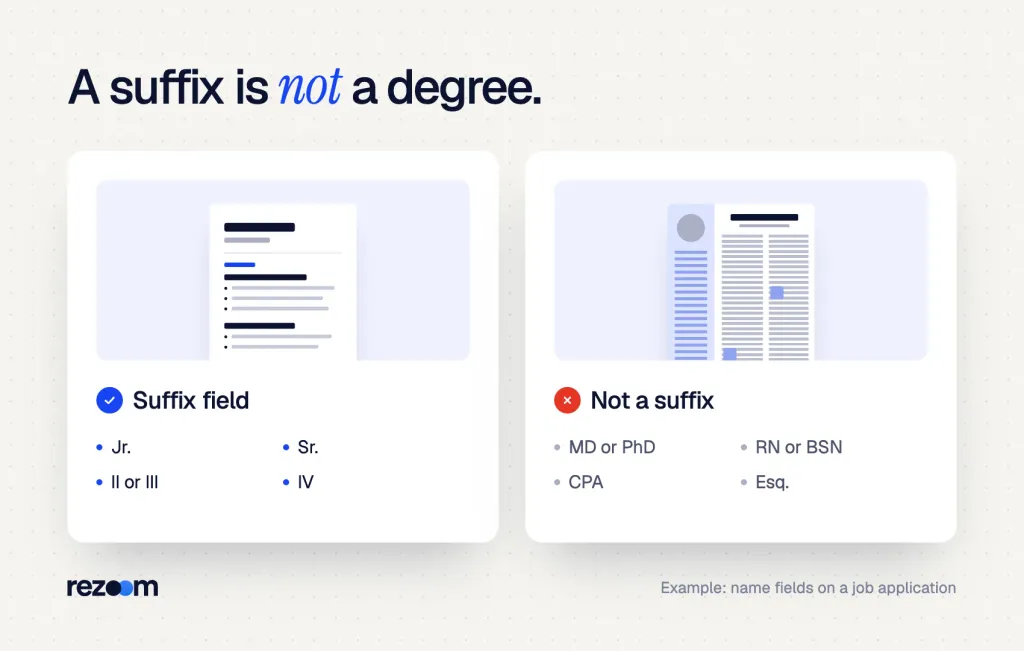
Where credentials go instead
Most applications have sections for education and licenses. Put your nursing license number, your degree and your certifications there. Then the hiring team can verify each one on its own.
On a resume, the rules relax. Nurses often list credentials after their name. Nurse.com suggests listing the highest degree first, then licensure, then certifications6, as in "Jane Smith, BSN, RN."
Do
- Enter Jr., Sr., II, III or IV if your ID shows it.
- Put degrees in the education section.
- Add license numbers in the license section.
Don’t
- Type MD, PhD or RN in the suffix box.
- Add your suffix to the last name box when a suffix box exists.
- Invent a suffix to stand out from a relative.
What should you enter if you have no suffix?
Leave the field blank if it is optional. If the form makes you pick something, choose "None," "N/A" or the blank option at the top of the list. Do not type a dash, a period or "NA" into a free-text box unless the form says to, because odd characters can land on your records.
Most people have no suffix, so an empty box raises no flag.
When the form will not let you skip
Some dropdowns force a choice. Look for "None," "Not applicable" or a blank line at the top. If the form still blocks you, use the help link or note it in a comments box.
Suffix: [None / N/A / blank top option]
Comments (if offered): I do not have a name suffix. My legal name is [First Middle Last].
Watch the autofill
Resume upload tools try to fill the name fields for you. Check them after the upload. If your resume header says "Jordan Lee, MBA," the parser may drop "MBA" into the suffix box, so clear it before you submit.
Legal name on a job application: which fields need it, what "do you have previously used legal names" means, and how to list a maiden or past name.
Free ATS score, the text the software extracts and your missing keywords. No sign-up.
Why should your suffix match your Social Security card and ID?
Your name on the application flows into payroll, tax forms and background checks. The Social Security Administration asks employers to report your name as shown on your Social Security card, and its wage file has a slot for suffixes such as Jr. and Sr. A match keeps your earnings, checks and I-9 on the same record.
Once you are hired, HR copies this name into payroll and tax records.
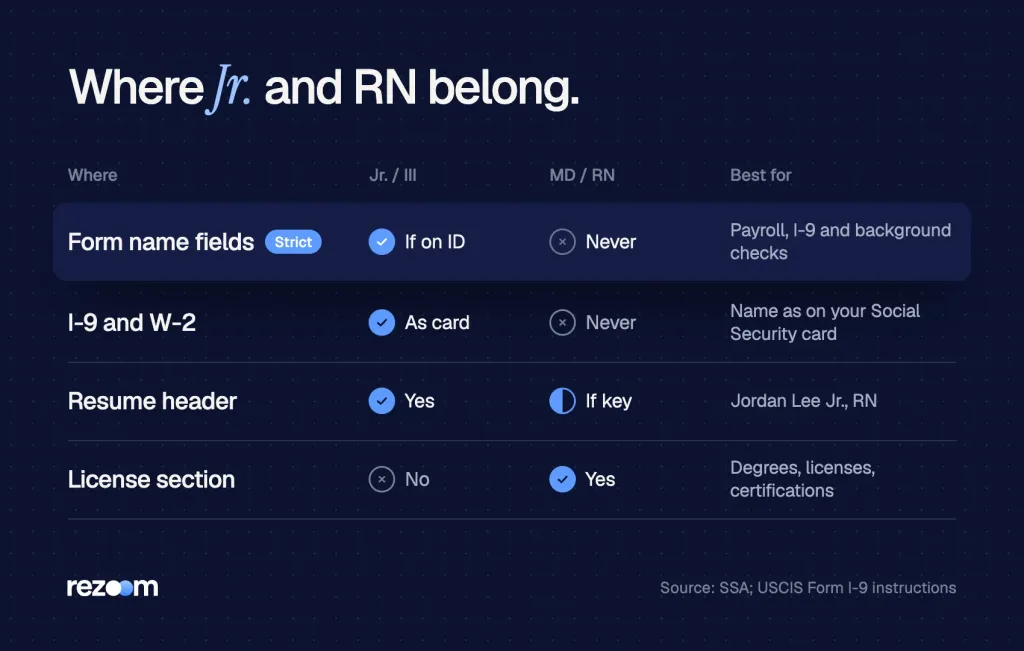
Enter the name on the Form W-2 as shown on the employee's Social Security card.
Social Security Administration
The SSA also says employers can enter a suffix, such as Jr. or Sr.3, in a set spot of the wage record. So if your card shows a suffix, your W-2 can too.
The I-9 asks for your legal name
On your first day, you fill out Form I-9. The USCIS instructions ask for your current legal name, including any hyphens or punctuation4. They also say your employer may not ask for documents to verify what you write in Section 1.
So write your name the same way on the application and the I-9. If your ID shows "Jr.," include it on both.
Background checks look for a match
Screening firms compare your name, date of birth and past addresses. If a father and son share a name and city, the suffix helps the firm pull the right records.
After a name change
If you changed your name, use the name on your current Social Security card. The SSA tells employers to change payroll only after you get an updated card3. Our guide to materials under a former legal name covers old diplomas and transcripts.
- Check your cardLook at your Social Security card. Note if it shows Jr., Sr., II, III or IV.
- Check your IDCompare it with your driver's license or passport. If they differ, ask the SSA or DMV which one to fix.
- Fill the formEnter the suffix in its own box, exactly as your card shows it.
- Keep it the sameUse the same name on the I-9, tax forms and background check consent.
How should a suffix look on your resume?
Put the suffix right after your last name in the header, such as "Marcus Reed Jr." A comma before Jr. is optional, since AP drops it and Chicago does not require it. Roman numerals never take a comma. Pick one style and use it on your resume, cover letter, LinkedIn and email signature.
Your resume header is not a legal form. But your full name with its suffix helps HR match your resume to your background check.
Comma or no comma?
Style guides have moved away from the comma. Grammar Girl notes that AP says not to use a comma before "Jr."5 and Chicago says the comma is not required. So "John Smith Jr." is the modern choice, and "John Smith, Jr." is not wrong.
| Style | Example | When to use it |
|---|---|---|
| No comma | John Smith Jr. | Default for resumes and forms |
| Comma | John Smith, Jr. | If your ID or family uses it |
| Roman numeral | John Smith III | Never add a comma |
| Suffix plus credential | John Smith Jr., RN | Resume header only, not the form |
A retail resume header with a suffix
Applying for store jobs? Our retail resume examples show clean headers and short bullets. The retail cashier resume example is a good model for a first job, with the name, city and phone on two lines.
Retail cashier resume example
An entry-level cashier resume with a clean name header, cash handling results and customer service bullets.
MARCUS REED JR.
Columbus, OH | (555) 014-2290 | marcus.reed@email.com
Handled cash and card sales with a balanced drawer each shift
Trained three new cashiers on the POS system
Suffix and preferred name together
If you go by a nickname, keep the suffix at the end. "Robert (Bobby) Hayes Jr." reads well. Our guide to a preferred name in parentheses on a resume shows more layouts.
Preferred name in parentheses on a resume: write Katherine (Kate) Ruiz. See 4 header formats, when to use quotes, and how forms treat first and last names.
What should you say if HR asks about a suffix mismatch?
Explain the mismatch in one line, name the document that is correct, and offer to fix the form. Most mix-ups are a dropped Jr. or a credential in the wrong box. If your Social Security card and ID differ, say which one you will update and when, then follow up in writing.
A mismatch is common and easy to fix, so plan a calm answer.
HR: "Your application says Robert Hayes, but your background check came back as Robert Hayes Jr."
"That is my legal name. The form had a suffix box, and I skipped it by mistake."
HR: "Can you confirm which name is on your Social Security card?"
"Yes, my card says Robert Lee Hayes Jr. I can update my profile today."
What to say if they push back
- Name the right document: "My Social Security card shows Jr."
- Own the slip: "I left the suffix box blank by mistake."
- Offer the fix: "I will update my profile and send you a note."
- Clear up credentials: "RN is my license, not part of my name."
Many systems save your name for every future application. If you only email HR, the wrong name stays in your profile. Update the profile first, then send the email.
How do you finish the rest of the application?
Once the suffix on a job application is right, check the other name fields, then your resume and cover letter. Use the same full name everywhere, keep credentials in their own sections, and tailor each document to the job ad. A clean, matching application helps HR move you to the next step faster.
The name fields take a minute. Your resume and cover letter do the rest of the work.
If the form has a preferred name box, our guide to the preferred name on a job application explains what HR sees. For store roles, our retail cover letter examples show how to sign off with your full name.
Before you hit submit
Before you submit the application
Then build a resume with the same header in the Rezoom AI resume builder and tailor it to the posting.
Tailored to the job post, checked against ATS.
Frequently asked questions
What does suffix mean on a job application?
It means a generational tag after your last name, such as Jr., Sr., II, III or IV. If you do not have one, leave it blank.
What do I put for suffix if I don't have one?
Leave the field blank. If the form forces a choice, pick "None," "N/A" or the blank top option.
Is MD or PhD a suffix on a job application?
No. Those are credentials. Put them in the education, license or certification section, not in the name fields.
Do I need a comma before Jr.?
No. AP drops the comma and Chicago does not require it. "John Smith Jr." is the modern style, but follow your ID if it uses a comma.
Should I put Jr. on my resume?
Yes, if it is part of your legal name. It helps HR match your resume to your background check and tax forms.
Can a woman have a suffix like Jr.?
Yes. Any person can have a suffix if it is part of their legal name. Enter it if your ID shows it.
Sources
We opened and read each page below. The small numbers in the text point here. Pages that carry no publication date show n.d.
- U.S. Office of Personnel Management (USA Staffing)n.d.
The USA Staffing applicant profile has a Suffix field for values such as Jr., II and III, and applicants must contact the agency to change their name
- Oraclen.d.
Oracle Recruiting lets employers change the candidate Suffix field from free text to a list of values
- Social Security Administrationn.d.
Employers should report the name as shown on the Social Security card, can enter a suffix such as Jr. or Sr., and should change payroll names only after an updated card
- U.S. Citizenship and Immigration Services2022
Form I-9 Section 1 asks for your current legal name, including any hyphens or punctuation
- Quick and Dirty Tips (Grammar Girl)2023
AP says not to use a comma before Jr., and Chicago says the comma is not required
- Nurse.comn.d.
Nurses should list credentials in order of highest degree, licensure, state designations, then national certifications
Mohammad has spent more than ten years designing consumer products and leads product at Rezoom, deciding what gets built and what gets left out. His guides cover the whole job search, from resume sections and cover letters to interview answers and career moves.
Goodi, M. (2026, November 7). Suffix on a Job Application: What to Enter and What to Skip. Rezoom. https://rezoom.io/suffix-on-job-application/